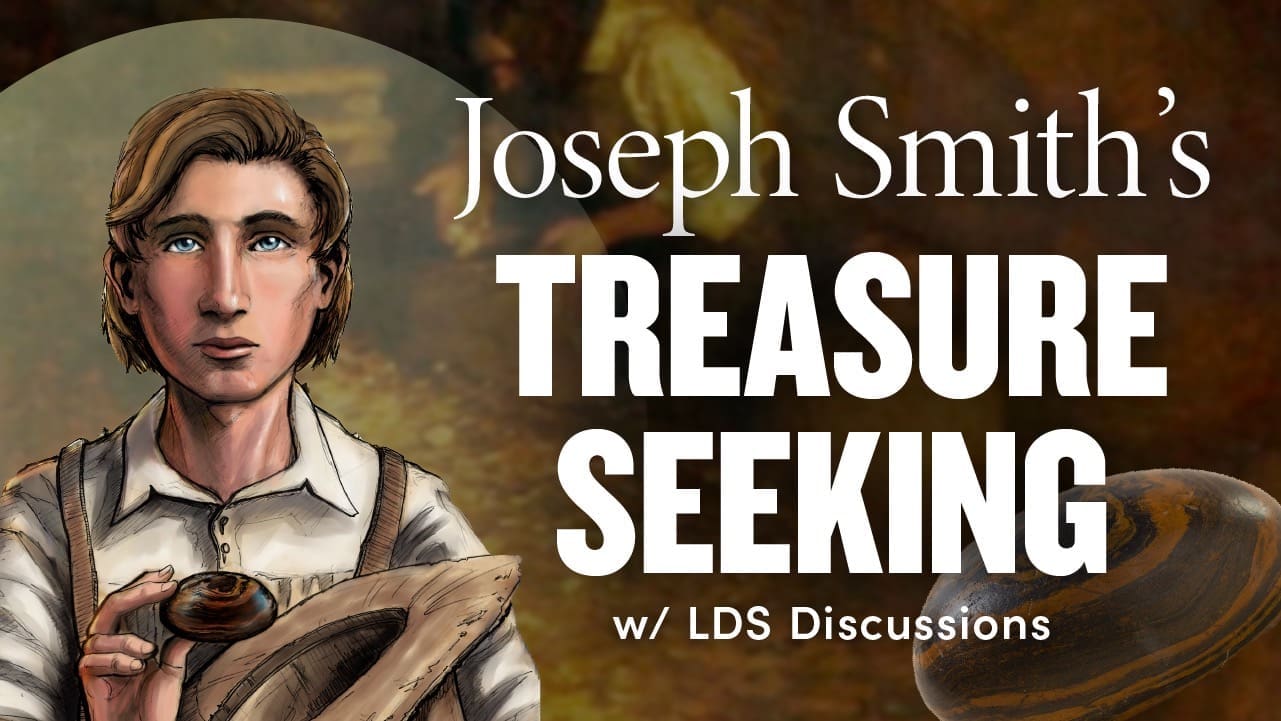
Joseph Smith and Treasure Digging w/ LDS Discussions – 01
Listen on Apple Podcasts Spotify YouTube Download MP3
About this episode
In this episode, we explore the fascinating and lesser-known history of Joseph Smith’s treasure digging, a critical aspect of his early life that raises important questions about the origins of Mormonism. While often overlooked, Joseph’s involvement in folk magic and treasure-seeking practices sheds light on his evolving role as a religious leader and how these activities may have influenced the creation of the Book of Mormon.
In the early 19th century, belief in buried treasures and folk magic was widespread in rural New York. Local farmers and villagers believed that ancient treasures were hidden in the earth and could be found through the help of seers who used magical tools like seer stones. Joseph Smith became known as one of these seers, claiming he could locate lost objects and buried treasures by peering into a stone placed inside a hat. He convinced others that his stone showed him the location of hidden riches, leading to several treasure-digging expeditions with local supporters.
Joseph’s treasure-hunting career is well-documented, with one of the most significant pieces of evidence being the 1826 court record from Bainbridge, New York. In this case, Joseph was charged as a “disorderly person” for his activities as a glass-looker—a term for someone who used a stone to seek hidden treasures. While defenders of Joseph downplay this event, the record highlights how deeply his reputation was tied to treasure digging and raises questions about how his seer abilities were viewed by those around him.
These treasure digs often ended in disappointment, with Joseph explaining that the treasure would “slip away” or disappear due to a curse or insufficient faith among the group. Despite the failures, Joseph’s persuasive charisma kept people invested in his abilities. Interestingly, this same seer stone played a central role in translating the Book of Mormon just a few years later, suggesting a continuity between his treasure-seeking and religious activities.
By the late 1820s, Joseph began shifting away from treasure digging and refocused his energies on religious claims. The transition was gradual but significant. The Book of Mormon project began around the same time his treasure expeditions faded, raising questions about how his previous experiences shaped his later religious work. Did the skills Joseph developed as a treasure seer—using a seer stone, telling elaborate stories, and explaining why hidden things couldn’t be seen—translate into his role as a prophet and scripture translator?
For many Latter-day Saints, the connection between treasure digging and early Mormonism can feel surprising, especially since the church traditionally minimized these details. However, understanding Joseph Smith’s treasure-seeking context offers valuable insights into how the early Mormon movement took shape. It paints a fuller picture of his life and the environment that inspired his later religious claims.
Far from being a fringe story, Joseph Smith’s treasure-digging activities are a key part of Mormon history that deserve careful consideration.
LDS Discussions Essay: Treasure Digging
LDS Discussions Platforms:
- LDS Discussions Website
- LDS Discussions on Anchor
- LDS Discussions on Spotify
- LDS Discussions Playlist on YouTube
Contact LDS Discussions:
- Twitter: @ldsdicussions
- Facebook: @ldsdiscussion
- Insta: @ldsdiscussions
- Email: ldsdiscussions@gmail.com
Show Notes:
Mormon Stories Related Content
- 1054-1055: Joseph Smith’s Treasure Digging – Dan Vogel
- 1074: Joseph Smith’s Involvement in Folk Magic and Treasure Digging
- 1344: Captain Kidd, Treasure Digging, Joseph Smith, and the Book of Mormon
- 1443-1447: Recovering Agency – Examining Mormon Mind Control w/ Luna Lindsey Corbden
- Mormon Stories Essays
Other
- Mormon Think
- CES Letter
- Letter for my wife
- Carah/Nuancehoe
- Gospel Topic Essays
- Early Mormonism and the magic world view book by Michael Quinn
- Richard Bushman- Rough Stone Rolling book
- Joseph Smith Foundation Project
Originally published on mormonstories.org.
Transcript
Machine-generated and lightly edited. Click any timestamp to jump the audio to that moment. The audio is authoritative; please check it before quoting.
Welcome Back and Episode Introductions
John Dehlin Hello, everyone, and welcome to another edition of Mormon Stories podcast. I'm your host, John Dehlin. It is April 12, 2022. A few of us have been off for a few days on a much needed rest and vacation, but we are super duper excited to be back in the saddle today. Helping with the audio and video engineering and production, I'm joined by the wonderful Jen Camp. Hey, Jen.
Guest Hi, everybody.
John Dehlin It's good to have you, Jen.
Guest Thank you.
John Dehlin You got some time away.
Guest It was nice.
John Dehlin So did I. Yeah, super fun. Well, it's good to have you back.
Guest Thank you.
John Dehlin And we're also joined by Gerardo. And Gerardo doesn't have his own camera today. Hey, Gerardo, how's it going?
Mike (LDS Discussions) Hey.
Gerardo Sumano Good.
Mike (LDS Discussions) How are you?
John Dehlin Did you, did you get a vacation yet or do you need to plan one?
Gerardo Sumano I need to plan one.
John Dehlin Okay. All right. Well, it's great to have you, Gerardo.
Mike (LDS Discussions) Thanks.
John Dehlin And we'll introduce our guest in just a second. I have a few quick announcements that I just want to make. I'll make it really brief. Mostly it's just shout outs to worthy causes. If some of you will notice, today I'm wearing a T shirt and the T shirt says be a menace. And that's my first shout out. There's this amazing TikTok channel and Instagram channel called Black Menaces. And it's a bunch of African American BYU students that are doing some amazing work where they just go around and interview BYU students about various topics. They're really short interviews, but they're really powerful. They've got hundreds of thousands of followers, videos with millions of views, and I just can't say enough about Black Menaces. So we want to encourage you all to support them, whether it's through Venmo or PayPal or however they're accepting donations or through buying their merch. So this is the shirt that we bought. I gave Jen a shirt. Gerardo, I've got a shirt for you. But we want to just give a shout out to Black Menaces. So check them out. Jen's going to include a link to them in the comments and in the show notes. But great job. Like Menaces. Second thing, I want to just give a shout out to really Quick is Lost and Found Club. Chelsea Homer is doing this amazing monthly community primarily for women and gender non binary individuals. Along the Wasatch front, they have a Palantine's Day. Is that right, Jen? Is that what it's called?
Guest Yep. Palantine's Day. That's coming up when I believe it's Saturday.
John Dehlin Yeah. And what is, what is Palatine's day?
Guest I think everyone's just getting together. There's going to be dancing, dress up. It's like the prom you always wish you had. I'm super excited for that.
John Dehlin Yeah. So we'll send a link, but if any of you want to, you know, looking for community, looking for friends. It's mostly for post Mormon women and gender non binary people. But every like three months or so they do one for everyone.
Guest Yeah, yeah. And jump, jump on it fast because they're, they're selling out faster and faster. So. And we, we love them and I love to support them. I love to go to their function. So I'm excited.
John Dehlin Yeah. So check them out. We'll have a link to Lost and Found Club in the show notes, but shout out to Chelsea Homer and all of her supporters. I also want to do a shout out. And Jen, I didn't warn you of this. Mindy Gledhill has a new album coming out where she's releasing a new album under a, I don't know, alter ego or a pseudonym named Madame Bandit. She did a concert last weekend that I was out of town and I missed. But I just want to give a shout out to Minnie Gledhill and Madame Bandit will include links there as well. But this is just me and Jen wanting to do some shout outs to what's praiseworthy. And these are all some very praiseworthy projects. We get no kickbacks. You know, we just want to spread the love and let you guys know about some amazing stuff. But Mindy Gledhill is doing amazing work. So shout out to Mindy Gledhill and Madam Bandit. One announcement that I have that's kind of big. You ready for this, Jen?
Guest Yes.
John Dehlin This is kind of a big announcement. For those of you who've been following our Instagram or YouTube will know that Kara Burrell has decided to move on from Mormon Stories podcast. And I don't want to kind of try and retell her story of why she's doing that, but we feel really mixed. We feel really ambivalent. On the one hand, Kara really just wants to break off and start doing her own amazing work. So she's got a Patreon up at Nuance Hobby, she's got her own Instagram page and she's got a YouTube channel up. And the, the main thing we want to do is just thank Kara for an amazing 10 months with Mormon Stories in the Open Stories Foundation. Kara, the work you did has really, there's hearts from Jen, Love You, Kara? Yeah, we, I mean, we doubled our downloads and views between 2020 and 2021. Donations did really well. We, you know, created a TikTok channel that was Kara's work. We started doing shorts on both Instagram and Facebook and also on YouTube and we just interviewed a lot of really cool people and Kara Burrell was a really important and inspiring part of all that. So we're super sad that Kara. Well, we're excited that Kara is ready to kind of spread her wings and fly and sort of do the unrestrained, full on comedic and wise and insightful nuance hoe channel and offerings. But we're just torn and sad to see her go. We feel like we're celebrating her and on. I feel like we're on super good terms. Feel like it was a definite, definite amicable decision. But please support Kara. Please support her Patreon, please support her content and we hope to be able to have her still come on and appear on Mormon Stories podcast for. From time to time. But we love you care. We thank you. Cara, we're sad to see you go. Please support her. Jen, anything you want to say to Kara or about Cara?
Guest I love Cara and if I say anything past that, I will cry. So I won't say too much, but I, I just reached out to her personally and let her know how much I love her. I'm her biggest cheerleader, so no one else gets to take that from me. So.
John Dehlin All right, beautiful. And Gerardo, anything you want to say really quickly to or about Kara?
Gerardo Sumano Well, it was great working with Kara. You know, she went on board after a while that I had been, you know, doing Mormon stories with you, John. And then things really started taking off. A lot of lots of content and tick tock channel and lots of views and it was great work that she did. And yeah, like kind of mixed feelings that she's moving on, but I mean, good for her.
John Dehlin Yeah, yeah. And she talks. We don't want to steal her thunder because one of her, I think the first video that she releases, she talks about that decision. It's like a 15 minute video. So. So best thing you can do is go to her Patreon subscribe and watch it there in her Patreon. But you can also. She also released it on her YouTube channel and you could just have her explain in her own words, listen to her in her own words explain why it was an issue of work life, balance of her own mental health and her own desires to kind of express herself creatively. But anyway, love you, Kara. Thank you so much and we'll miss you. But we hope to have you back and we support you. All right, so that is all the announcements for today. And now what I want to do is introduce to everyone Mike. And Mike is, I think Mike is trying to remember. Is this the first time we will have you unmute your mic? Is this the first time we've had you on Mormon stories mic? Or have you appeared in one way or another? Maybe you've come on as a commenter.
Introducing the LDS Discussions) Guest
Mike (LDS Discussions) I did one, one episode like a few months back where I think I was on for like three or four minutes. It was after that whole Brad Wilcox thing, and I just hopped on. I was working at home and I saw you post for. For viewers to chime inside log now. But that. That's it so far.
John Dehlin Okay, well, for those of you who don't know, Mike is the founder and creator of a really important website called LDS Discussions). Is that right, Mike?
Mike (LDS Discussions) Yep, that's right.
John Dehlin And it's found where.
Mike (LDS Discussions) So it's just LDS discussions dot com. It's a generic name. It's one of those things where I wish I had probably thought of something more unique, but, you know, really was just one of those things where I think all of us have gone through it, where you're trying to piece it together as you go, right? And so, long story short, for me, it was a very similar experience to so many others where you have that moment where you need to know. And so I went out and started looking up stuff and made those mistakes that everyone else makes, right? Like where you give the info overload to people around you. And I was asked to read some of the replies of the CES letter, so the Fair Mormon one. And then I started taking all these notes and putting them together, and it was like trying to find a way where I could organize it that it made sense to me. And then, long story short, I was introduced to some people who had been working on similar things. And one of the guys who was brilliant, his name's Kellen, wrote four of the annotated essays which he allowed me to put on the website. And then a few people did blog posts. So there's a lot of stuff. It's just been one of those projects where for me, it's like, I have a regular job, so it's a hobby. I find it fascinating. And that's kind of how it started. And I think the Saints, the Saints book was where I really started to try to put up a lot of content because I was doing the chapter by Chapter review, which I think people found helpful just because it was such a popular book for the church to push. And it was nice to be able to go through and kind of point out what I found to be problematic about it. And I learned a lot doing it. So, yeah, that was kind of the genesis of it.
John Dehlin Yeah. And if I had to just kind of add my two cents, you know, there are several sources or websites. We'll include all these in the show notes, but that are really, really valuable. The first one that came out was, was mormonthink. And that is a. That's an early attempt at addressing all of the major issues around the truth claims. And then obviously CES Letter came out. That does an amazing job. We've had Jeremy Runnels on several times. There's another one called Letter to My Wife or Letter for My Wife.
Mike (LDS Discussions) Yeah, this letter for My Wife, which
John Dehlin is really, really powerful. Trying to be maybe a little bit more soft or nuanced or sensitive in how it discusses the truth claims. And of course, on MormonStories.org there's a set of essays, these truth claims essays that Michael Brown wrote. All of those are all trying to do similar things, which is to kind of address the truth claims issues within Mormonism. And so, Mike, you know, LDS discussions is your, your attempt. Right. And Mike, if you had to summarize maybe how yours is a little bit different than the others, you probably already addressed this, but do you have like a real quick couple sentences, description of, of what, what, what made you want to do yours when these other ones existed already?
Mike (LDS Discussions) I mean, really. So mormonthink is really good, but it hasn't been updated as much, as far as I know, it hasn't been updated really in a lot of years. And then CS Letter and letter from my wife, I think are going to always be like the most effective documents to help people when they're first going through it. And for me, it was more the CES letter has a lot of replies on the website, which I didn't know about at first. So for me, it was more like trying to make sense of the critical positions and how the apologetic positions fit. Because when I first read the CES letter, I made that mistake of info dumping, which I wish I could do over because it is ineffective and it's not fair to the other person. But they had asked me to read the fair Mormon response. And so you read that and you go, oh, you know, they have a lot of reasonable points against the CES Letter. And I spent like two or three weeks going back and forth. And that's when I started finding, you know, Mormon stories, podcast Mormon expressions, podcast Mormon think. And there's so much out there. So for me, it was really just how do I make sense of it? To me, that maybe goes beyond the CES letter without trying to go too deep, to the point where, you know, because there's people that you've had on this show that can run circles around me, whether it's, you know, David Bockvoy, Dan Vogel, John Hamer, Brett Macau, all these people who were helpful to me when I was trying to figure it out. But it was more, you know, trying to make it maybe like, if the CES letter is dipping your toes in the water, maybe this is going kind of diving into the more shallow end of the pool in a way that makes sense to both answer the critical position, but also constantly going back to what the apologetics are so that people don't think you're only giving one side. And I realize people are going to say that anyways, but I'm hoping that by doing it this way, people can at least acknowledge I'm trying to constantly go back and give what the church's positions are. Whether it's the annotated essays, which are literally based off the essays, or the Saints book, which is going off the Saints book in this overview project is every page, for the most part, has a section of what does the Church say about this problem? And what do we then think the evidence says from there?
John Dehlin Yeah, we got a comment from Matthew Allen. He writes, I loved the annotated essays on the church's essays. I used them when I was reading them. I love the commentary on the first Saints book. I have asked for it on the second book.
Mike (LDS Discussions) Well, the first Saints book. The first Saints book burned me out because I was trying to do a chapter a day. And then it got further because of work and stuff. It burned me out. But again, I want to shout out Kellen, who did the the four best annotated essays. He did the Book of Mormon translation, the DNA and Book of Mormon Polygamy and Book of Abraham. And the stuff he was able to put in there for me was when I first read his annotated essays, I was encountering stuff I had never come across by looking at CES Letter or listening to some of the podcasts. So I think it's great because when you see the church's essay and then you can immediately see not only what the evidence says about the specifics, but also he was making notes about what the Footnotes say, and I think that's important because in some of these essays, in a footnote might say for the book of Abraham, there's a great one where it says something like, I sat down and penned as he translated the hieroglyphics or whatever it was by Revelation. And that same footnote also basically says, Joseph Smith was a liar. And so there's those kind of things where he was able to give a lot of insight. And so he's an amazing person and resource. So I just want to make sure I give him a shout out because he was really helpful in allowing me to put those up because I think they're so great. And a lot of people hadn't seen him up until then, so it was just super, really nice that he had done those.
John Dehlin Love it. Okay, so, yeah, LDS discussions, not only is it trying to maybe cover more comprehensive set of topics, it's trying to go a little bit deeper than CES Letter does, but it also does these amazing reviews of like, the gospel topics essays and the book Saints and others. And so. So, you know, Gerardo, as we've been trying to think about really quality content we can provide to Mormon stories, you know, Gerardo, you and I have kind of collaborated on bringing Simon Southerton on. You know, I brought John Larsen on to kind of share, you know, to kind of revive his amazing work. We've been trying to bring Sandra Tanner on as much as we can. Mike, I would say part of the reason we're bringing you on is with the idea of doing a series with you where over a period of, let's just say a year or two, we can do a comprehensive coverage of many of the most important issues that people face. And so maybe that's a good intro to the slide presentation. Gerardo, do you want to add anything really quick about LDS discussions before we jump in?
Gerardo Sumano I've been chatting with Mike for a couple years now while I was at byu, Idaho, going through my deconstruction. You know, when I had just recently found Mormon stories, I start, you know, I found Mormon Think. And then LDS discussions was huge on my deconstruction face. It was just a great resource. The annotated essays are amazing. The Saints book commentary, and, you know, all, all of his content is. Is amazing. So, I mean, I've been waiting for this moment for a while to finally have Mike on Mormon stories. Yeah. So, yeah, really happy for this.
Overview of Joseph Smith and Treasure Digging
John Dehlin All right, so with that, I think what we're going to do is we're going to launch so this. Today we're going to be covering an overview of Joseph Smith and treasure digging. It's going to be the first topic, hopefully of many.
Mike (LDS Discussions) And.
John Dehlin And so we're going to be bouncing between these slides and kind of a panel discussion. And so, Mike, where do you. And I guess it's worth mentioning that Mike isn't your real name. Is that okay to say?
Mike (LDS Discussions) Yeah, it's fine. Like I said, it's easier to do it this way. I had left one pretty generic comment on. It was actually when I was doing the Saints book. And so I was doing the chapter by chapter book and I kept getting these paid Facebook ads for their face to face event in Nauvoo. And I left an event. I just left a comment. I think it said something like, I hope the event's more honest than the book. And I shouldn't have done it. It was stupid. But I kept seeing the ad and this was back when I was really more in that angry phase and I shouldn't have done it. But a family member saw it and called everybody and so this is just. I had the second account that I was using beforehand for basically an enter contest, and I just used it and I said, you know what? Screw it, I'll do that. It's just easier because they know where I'm at, but I don't want to put it in their face. So it's just easier for me to do it this way. And hopefully people can understand that. You know, like I said, they know where I'm. It's not like I'm hiding my positions from them because they know how I feel. But at the same time, I don't need to post links to these pages I've done and have to, you know, put that in their face either, because, you know, they don't put things in my face. So, you know, it's just more of a easier way to live, I guess.
John Dehlin Yeah. And. And so, Mike, do you want to tell people your Facebook handle or do you not want to tell people that?
Mike (LDS Discussions) I don't even know what it is. But if you go, you could go to, I think, Facebook.com LDS discussion.
John Dehlin No, just the name then. Okay. LDS.
Mike (LDS Discussions) Oh, it's. It's just, it's. I have to look it up. I don't even know because I. Like I said, I just. It was a thing I used for contests. I don't even know exactly how you spell the last name. And it's. It's fine.
John Dehlin Okay. All right, well, let's go ahead and jump into. So let's Go ahead and jump into the presentation if you want, and we'll jump back and forth.
Mike (LDS Discussions) Okay. So you know, this part I just wanted to cover really quickly because if we're going to do this in the future, if people listening want to hear more topics. I had been doing the LDS discussion stuff for a while and to be honest, I hadn't put much up. And I had basically a family member come to me and say, do you really believe you can prove the truth claims are not true? And I said, I do believe that. So they asked me to put together basically something that encompassed all of it that would prove the truth claims are not true. And for the purpose of these episodes, however many we do, when I say not true, you can't prove the idea of Mormonism not true because that's not really a testable claim. I'm talking about the testable truth claims the Church makes. I believe you can prove are not true through this research. So I just want to make that clear because I know sometimes there's an argument like you can't prove the church is true or not true. I'm speaking more to truth claims because to me it's like saying you can't prove a house is good because the outside you could see the siding and all that. But I'm saying when you look at the truth claims, which to me are the building blocks, that's all. I mean, so that's what started the project. That's what kind of got it going. And I first envisioned like eight to 10 topics, kind of like you would see with the CS letter. And the crazy thing was every time I got going, it was like I would come across something else and go, I got to add that. And it just kept adding and adding and adding and eventually got to this 39 pages. There are some more I wanted to do, but I just got burned out on it. And really the intent of the whole thing, because I was asked by a family member, was to put it together in a way that made sense from start to finish. So they're not really meant to be a bunch of separate pages. And really to avoid anything that I felt like I couldn't personally defend, is using as a source. We know sometimes that critics will use sources and apologists will say this is crap because we can tell it's a third hand account from 80 years, whatever the case might be. And on the flip side, with the Church's own materials, they might use sources that I would say they're so speculative or distant that you can't use them. And so I tried really hard not to use overly speculative accounts, try to avoid the salacious ones, unless you could perfectly or at least very solidly back them up. And by doing that, I'm hoping that even if you read it and you are a believer, you might say, I don't agree with you, but at least you're not willfully dishonest. Because I really feel like I tried hard not only to avoid those issues, but to also give the apologetic on every page, to give the church's position so that somebody can understand that I'm covering what I think the evidence says, what the church's response would be, and then what I think we can make from that so we can go to the next slide on that.
John Dehlin Yeah. And I just want to say I really love that idea that. That you're working hard to be credible, to be fair, and to be sensitive to truth and not to create your own straw man. Right. Like, yeah.
Mike (LDS Discussions) And to be fair, I'm sure there are going to be areas in 39 pages where you're gonna say, like, you shouldn't have said it that way, or you're framing it wrong. And I get that because I was doing them. I'm not. I don't have a proofreader or anything, but I really tried. So, like, you know, a good example would be people will often say, Joseph Smith practiced abortions in Nauvoo. And to me, I look at that, I'm like, there is not enough evidence for me to even go down that road. So I'm not even touching it. And it's not that I'm saying 100% it didn't happen, or it did happen. I'm just saying, for me, that's just too speculative. And you could give countless examples. That's just one where people will constantly say, like, why don't you cover the apportions? I'm like, because there's not enough to go with. And the one thing I learned early on is early on, I was just accepting everything I found as like, okay, once I got to that point, when you read the CES letter and then you take that step back and you're like, you know what? If I'm going to accuse or if I'm going to point out when the church is using a source that's really not good, then I don't want to do it myself. That was really where that came down, was just trying to make sure that, like I said, if you read it as a believer, you might not agree. It might still make you uncomfortable. But at least you won't say you're intentionally using bad sources. I really tried to avoid that where I could, you know, everywhere.
John Dehlin Yeah, well, that's good. And that, that way we're not being dishonest. That way people can trust what we're saying and then they can kind of make their own decisions. And that's what Mormon stories is about. It's literally about informed consent. And so you're just trying to provide people with a narrative that's more honest. More honest than the, than the gospel topics essays that. That allows people to make informed decisions. All right, so what's next on your.
The LDS Discussions) Website and Project
Mike (LDS Discussions) Yeah, so that's the website, if anybody wants to check it out. If you haven't, you can just go to ldsdiscussions.com it's not the best designed website. At some point I need to go in and do a better job of that. But it's just, you know, it's just there, it's the overview project is at the top. That really is the. Basically the only thing I've done in the last year with the website is just getting that up there and doing the different topics.
John Dehlin Okay.
Mike (LDS Discussions) And, you know, when I was doing the project the best way I thought of this. And it might sound cheesy, but it's like I was a convert to the church. I joined in college. I took the discussions in high school. I went through high school. And I feel like when you're given the presentation on the church, you're given like a box, so a picture. You get by a puzzle at the store, they've got the picture on the front of what it looks like, and you open it up, you're putting it together, and you're having someone tell you what the history is. You're popping it together. And whenever I came across things, it made me uncomfortable. Like, polygamy always bothered me. As dumb as it sounds. My, I dated. I started dating my wife in high school. And when you go out with like groups of friends separate and like say, my, my, my now wife went with a group that had a bunch of guys and, you know, I saw, you know, they're off chat and I would get jealous. And on the flip side, same thing. And so polygamy bothered me because I'm talking, I always thought, like, how could a loving God do that? But at the same time, you just kind of push it off the side, you know, because you don't want to let that lead you on the path. So you mash those pieces together, the puzzle, because you're like you know what? I don't think this fits right. They're telling me this is where it goes. You push it down and it doesn't quite fit right. But you just keep going with it for that. You keep telling yourself, look, the puzzle makes sense once you look at it. Just put the pieces together, don't worry about it, then go to the next slide. And so for me, when I had that moment where I had to know, it's like you go up back to the table, and you just take the puzzle, you put all the pieces, you scatter them on the table, and you throw the box away. So now you still have all the pieces, but you don't have the picture that it's supposed to look like when you're done doing it. And so now you're not worried about jamming the pieces together. You're only worried about making sure they fit the way they're supposed to and go to the next one. And so this is really, for me, when I started to study it, and I'm talking about months after I started, because, of course, those first few months are always kind of rocky when you're doing it. And I would say this really took about a year to feel comfortable with. You start finding all the pieces can fit together if you just go with what the evidence tells you. Instead of saying, this is what I was taught as a convert, or this is what I was taught on Sunday, you say, here are the sources telling us what happened with these topics. They start popping together really nicely, and all of a sudden you're putting the pieces together. And it's weird because on one hand, when you're deconstructing this stuff, you're really upset and you're frustrated because you're upset that you felt like you weren't told the truth. On the other hand, there's something oddly satisfying about finding this, finding all these evidence and sources that fit together and kind of solve the puzzle. So for me, that was kind of how this overview project worked, too, because you're starting with one piece of the puzzle, and then as we go, you just keep adding on. And that's why in the overview project, which needs a better name, at some point you're popping, the next piece is going to fit and you're going to be able to call back to the previous one and say, and this is why this comes from this, or this is why these have similar problems. So that was pretty much the genesis of that. And I don't know if anyone has any comments on that before we move
John Dehlin on No, I think it's great. And I just want to make sure listeners and viewers know that this is. We want this to be a bi directional conversation. So if there are historians out there or amateur historians that want to tell us we got something wrong. Mike, I'm sure that you would invite that feedback. You'll probably edit your essays or your website web pages accordingly. And we're willing to come in future episodes and kind of make it clear. But what we hope is accomplished at the end of this is how many total episodes do you think we could possibly do together? Mike?
Mike (LDS Discussions) It depends on how much people want to go over because there's 39 topic pages. Some of the topics are split because it's just one, it's too long, and two, because they kind of like polygamy is three topics, because there's one account it talks about the genesis of it. Then there's one that talks, I think, about the proposals and kind of how Joseph Smith implemented himself. And then the third, I think, is going over the apologetics and I think some other stuff and the happiness letters in there. But it's really one topic. So I mean, it depends on how much. Basically, I would invite viewers to let you know how much they want to see, because you could do it in probably 15 to 20, or you could do it in 25 to 40, depending on how in depth you want to go. But like I said, for me, I think there's a bunch of topics you can mash together and kind of keep it a little more concise because they do work together. And you don't have to obviously cover the entire overview on every episode. So we could probably condense it down quite a bit.
John Dehlin Yeah. So what I would like to see is just this steady stream of Mormon stories, content that deals with truth claims. And if it ends up being 40 or even 50 episodes that spans a few years, that will be a self contained library of a comprehensive discussion of many or most of the major issues that deal with church truth claims. So that's the series that we envision, if, if you all like it. So please give us your feedback and we'll consider keeping this going. Is that all right?
Mike (LDS Discussions) That sounds. Yeah, it sounds good. Like I said, you know, when you. For people watching, it's like, if you feel like this is helpful, let us know, because I'm doing. You know, I was laughing one day because one day I was listening to someone talk about Anthony Miller, I think, and who he's been on here. And he actually was very helpful to me about biblical Scholarship stuff. And he always calls, he says, Joseph Smith was an eclectic aggregator, I think is the phrase he always uses. And it's because he was really good at pulling sources and then kind of aggregating them into the way he wanted it. And really, that's all I did here was, for the most part, you're just going through and looking at what other people have done, trying to find what makes sense, looking at documents. So it's not like I'm presenting anything that's going to rattle the earth here. But I feel like it's put together in a way that's a little more unique, and I feel like it's more solid with regards to, like I said, just being really careful and trying not to overstep on some of this stuff. So if people like it, we'll keep going. If they don't totally understand that, too, I love it.
John Dehlin I think that the term that Terrell Givens likes to use is that Joseph Smith was an inspired syncretist. And that's a way of.
Mike (LDS Discussions) He's doing bricolage now, I think. Right?
John Dehlin Yeah, bricolage. Yeah.
Mike (LDS Discussions) And the thing is, we'll get to that more as we go. But, you know, it's definitely a shift in from what they. You know, I took the missionary discussions 20, 24, 25 years ago, and, like, the way that they talk, it would be completely foreign to me. And if they had given me those Talks, you know, 24 years ago, I would have had a much different impression because, you know, we'll get into it more. But, yeah, those. Those changes. And you'll never hear those positions given on. On a general conference talk either. At least not now.
John Dehlin Yeah. Yeah. All right, so let's. You've got another. At least another slide about how to view.
Why Treasure Digging Matters to Church Origins
Mike (LDS Discussions) Yeah, it's just the last one. And so when I was writing this, like I said, I was writing it for someone who asked me to put it together, and the two thoughts I had here when I was doing it, I tried to mention this. If you guys read it, the different overview topics are going to constantly go back to this, which is one. When you read these issues, you got to take them in totality. You cannot divide and conquer them. And I say that because when you read the replies, like the Fair Mormon, the Jim Bennett replies to the CES letter, what you'll see a lot of times is you'll take two issues that are problematic to the church's truth claims, and they'll get two separate apologetic responses. But if you take that apologetic response and apply it to the other. It can't work. So you can't reconcile the two because you're not looking at them in totality. So a good example of that would be in the Book of Mormon. We are told at times that it was loosely translated. And that's why there's anachronisms. That's why Joseph Smith wrote his own life experience into there. That's why there's King James Bible errors at the same time. Then we're told, oh, but it's a tight translation. That's how we got chiasmus. That's how we got Hebraism. That's how we got some of the words that are unique, like deseret. Right? And so for me, you cannot take those two things unless you want to then expand the translation kind of reality field and say, well, he could. Whenever Joseph Smith wanted to, God was okay with him just jumping from reading off the stone to just riffing on his own. And I'm overgeneralizing here. We'll get into that later if people want to hear more of these topics. But to take the issues in totality is the way you have to do it because. And I'll keep calling back to them as we go, but a lot of these issues are really connected. There's patterns in some of these problems. And when you see those patterns, it becomes easier to understand where they come from, as opposed to constantly taking one issue, coming up with some apologetic and saying, okay, we're good with that. Let's go to the next. For me, it's about going, you know, overall, you can't just take one out and then pop it back in and then take another one out. So that was the first point.
John Dehlin If I can, if I can just kind of echo that, like, some examples of that would be how the, you know, when we're talking about polygamy, the Book of Mormon says, you know, if I'm going to raise a seed, I think this is in Jacob, then I will. Otherwise, polygamy is bad. And it's basically saying the purpose of polygamy is to raise righteous seed, which means bearing children. But then when they try and talk about Joseph Smith's polygamy, Brian Hales and others are always trying to say there were no offspring. Well, you can't have it both ways. The Book of Mormon is about raising a righteous seed or having children. But then Joseph Smith never had any children or never had sex with any of his polygamous spouses. Another example would be just understanding that, that, that, you know, the first The First Vision changes to the First Vision story in and of themselves. You might be able to say that each of the different versions of the First Vision fits some sort of combined narrative. But when you combine that with the fact that the Book of Mormon itself has a trinitarian view of the Godhead, and then as Joseph Smith's theology evolves, then his recounting of the First Vision story changes along with the Book of Mormon text itself changing to reflect Joseph Smith's evolving views on the Godhead. Once you kind of put all those pieces together, you see things that you can't see when you're dealing with the topics separately. Is that kind of what you're saying?
Mike (LDS Discussions) Yeah, I mean, it is. And the thing is, when you go through these topics, I'll try to point to them. I think with treasure digging, you won't see as much that, because it's kind of a little bit away from the main Mormon topics, you see. But yeah, that's the whole thing is trying to say to them, if you're going to use that apologetic here, then how do you then take that same apologetic and apply it to here? Because if you take it to both topics, it's irreconcilable, because they can't work in tight versus loose, whether skin means skin in the Book of Mormon. Or we could go about polygamy, how words are used in polygamy, and then they're said, oh, no, it didn't mean that. But it means that. Because again, I mean, I think we'll
John Dehlin get into this, but I think there are apologetics for the peep stone in the hat and the treasure digging that are problematic. Once you realize that Joseph Smith carried the peep stone and the hat into his translation of the Book of Mormon. Jen wants to jump in here. Hey, Jen.
Guest Hey. I was just gonna say as I was starting my faith crisis, that's kind of, I believe, how all of them start. Like, you find one thing, and at least for me, I found one thing, and I would be like, okay, I'll put it on the shelf or whatever. You know that phrase, put it on the shelf? And then you, you read another thing and you're like, okay, I can, I can just leave that here. You know, it'll all be worked out in heaven. You know that saying, too. And then you find another thing and then another thing and then another thing. And as you're. Then you're starting to, like, bundle them in like little groups, and then you just can't, you can't look past them anymore. Because they're just so big. And I think that that's kind of what your. Your website does kind of helps you have the bundle already there, so.
John Dehlin Yeah.
Guest Yeah.
John Dehlin Well said, Jen. Thank you. Yeah. Yeah, that's great.
Mike (LDS Discussions) Okay, and then the second part of that slide is basically. And this is the really hard part, and it was hard for me to do. And I had really stopped believing in the church before I started the deep dive into research because of, like I said, polygamy bothered me. And then going through the temple was, for me, just horrific. It still took me years to get to this point. But you have to. When you read these things, when you listen to these, you have to be willing to take that step back and. And look at these issues the same way. You would look at it as if you were talking to somebody who is explaining another religion, another politician organization to you, and then say, if someone else told me this thing with someone else besides Mormonism in it, would I immediately tell them, oh, my goodness, this is absolutely not true? Or would you say, yeah, you know what? I believe that could happen because. And we could all give stories. I mean, I had really quick story is I was talking with some believing members and this. I don't want to get into politics, but it was an issue in 2020 when Elizabeth Warren was running for president, and she, in her book had written that when she got pregnant, she got fired because she was pregnant. They fired her because at the time, the law allowed it, and they had found an interview with her that was before the book was written. And in the interview, she had said that after she had gotten pregnant, she quit so that she could spend more time with her kids. So in the earlier interview, she did not say she was fired. She said she voluntarily quit so she could spend time with her kids. And again, that part's not important because I don't want to get into politics. But I was talking with some believing members, and they were like, oh, she absolutely lied. And so I immediately thought of the first vision, and I said, yeah, if you have a story and then there's an earlier version that totally undercuts the grand importance of the second one, then that's not true. And they said, oh, yeah, absolutely. And I had posted it on Twitter and I had gotten a lot of comments that would also be reflective of how our brains function. And a lot of the replies were, she may not have told the story quite right, but the feelings behind it are good. Or I know she wasn't lying in the first one. I think that you're Just trying to make too much of it, all that stuff. And so then I said, so if you were to recreate the story and add that element in, which is then going to launch your political career, to give you more credibility, you would say that that's not true. And one of them turned around, he kind of laughed and he goes, you used to be able to get away with that, but with Google now you can't get away with that anymore. Now if I had said that's the exact same thing that Joseph Smith did with the first vision of the priesthood restoration, I would have been out on the street. And we all work that way. I'm not just picking on members of the Mormon Church, but you have to be able to look at this evidence as if it's kind of like foreign to you, if it's not to Mormon church. And then if you can't say this makes sense or I think this is still true, then you have to make that question of what does that mean and what do I do with it? But at least at first, you have to be willing to evaluate it as if it's not your predetermined beliefs. You have to let go of the rod, so to speak, and then assess it. And then if it's true, you could go right back to where you were. And if it's not true, you deserve to know that too.
John Dehlin I love it. So kind of look at it, look at things objectively like you would other religious traditions or even politics or other organizations. I love it.
Mike (LDS Discussions) Yeah.
John Dehlin And that's what we're trying to do here is to be as. Even though it's obvious we all have our own positions, we're going to do our best to be as objective as possible as we, as we analyze this and just look at the evidence.
Gerardo Sumano Gerardo, I just want to come in really quick about this point that Mike is making, because I think it's really important. And you'll find apologists usually use this kind of logic, fault logic, on their apologetic, apologetic arguments. Yesterday I was reading just this reply to a comment from the Joseph Smith foundation, and they say, well, Joseph Smith said this about how he translated the Book of Mormon with the Urim and Thummim. So if we believe that Joseph is a prophet of God because we already have a testimony of that, then we must take him at his word. And we need to, to like, recognize that he can't be lying. And that's how kind of like they defend, defend their point. And I think what Mike is saying, it's really, really Important that we evaluate our own beliefs, like, from an outsider perspective, if what we're really trying to find is the truth. Right.
John Dehlin Yeah, if we care about the truth. Yeah.
Mike (LDS Discussions) Right.
John Dehlin I love it. All right, well, I love it. And so. And I do want to apologize to everyone. We're already 41 minutes in. Normally, we're going to have very brief introductions and dive right in. We're going to try and keep these to one to two hours. But just so you all know, today we wanted to set up, we wanted to introduce Mike to you, tell you about LDS discussions, talk about a little bit of his story and what led to this project, and then kind of lay out the idea for the project. We also just want to thank. We are live streaming this. We want to thank Em Marie for her super chat. We would welcome donations to support this project. So we want to thank you for that and invite you guys all if you really value this sort of content. You know, we appreciate your support through super chats or however you want to support Mormon stories. All right, Mike. Well, should we jump into the next. The next slide, which is why we're starting with treasure digging. Should we do that?
Why Start With Treasure Digging Instead of the First Vision
Mike (LDS Discussions) Yeah. And this is just something quick because I think sometimes I've gotten a few emails over the last year and they'll say, why do you start with treasure digging and not the first vision? And I just want to point out, historically speaking, the first vision, we're told, happened in 1820, but from a historical background, if it happened, what Joseph smith details is 1824, and he never tells anyone about it until 1832 when he writes it down. Even then, no one really knows about it. So for me, treasure digging is where this starts. And the reason it starts there is because treasure digging directly impacts the gold plate story, the translation of the Book of Mormon. It's in the text of the Book of Mormon itself. And so for me, when I talked earlier about the puzzle, this is the first puzzle piece that everything else is going to start from, because without treasure digging, you cannot get to the other stuff. It also helps us to understand where Joseph Smith's worldview was before the Book of Mormon dictation begins. And it also impacts aspects of the church today that we don't think about when you're there, because it seems so normal to us, but this has implications all the way to today. So that's why I wanted to start with this topic as opposed to jumping into the first vision.
John Dehlin Yeah. And for me, I think that's where I always like to start, too, because the Fact that he didn't tell the treasure digging is happening in the 1820s and he didn't first really mention the first vision to anyone until 1832. It does beg the question as to whether or not the first vision really happened, versus it's a story he made up later. And then it makes a lot more sense. It's where the evidence is, it's where the history is. And it's much easier to draw a line from treasure digging to Book of Mormon to then the foundation of the Church and then to a first vision story to kind of retroactively justify the question of authority and divinity. It really does start for all those reasons. It really, really does start with treasure digging.
Mike (LDS Discussions) Yeah, you can't get to like, that's the whole thing. You cannot get from there to the Book of Mormon without it. And so again, it might seem somewhat boring in the sense of we're not going to be talking about the Book of Mormon today, even though we may do some. A little bit of foreshadowing, like, yeah, but for the most part, this is something that happened before the plates were. They might have been conceived during this time, but obviously he wouldn't claim to have them until after this. But you still have to do it because if you don't cover this, you can't really understand the translation at all, really. I think. I think it's really. And we'll cover all that. So I don't need to go into it now, but yeah, it's big now.
John Dehlin We even have a list of all the treasure digs that Joseph Smith was involved with. And we have treasure digging, according to Mark Elwood, going all the way back to 1820. So you could argue that Joseph Smith's treasure digging predates his first vision account. Even if you believe that a first vision happened.
Mike (LDS Discussions) Yeah, it's all right there. It's just like we were talking about earlier. It's like for me, I'm looking at what does the evidence tell you? And for me, there are people who can make the claim that something happened he experienced. I think John Hamer will say he experienced something, even if it wasn't what he wrote down or expressed in the 1838 account. But even if you have that, it's not going to be the correlated version of the first vision. So whatever we want to talk about with the first vision is not going to be as the Church narrative is. So for me, I don't think it's the first thing you want to cover because we'll get to it if we get if people want to hear more in the first vision overview, I kind of lay out why the first vision is in a lot of ways kind of retrofitting back into the history. And I can show why. And so for me, treasure digging, we have a lot of accounts like Mark's list of digs. Those have specific dates that we can actually point to. We know those happened. And so I think that's why you have to start there.
John Dehlin Yeah. Were you going to say something, Gerardo?
Gerardo Sumano Well, this idea that Mike mentioned that Joseph Smith might not have experienced the first vision, like, you know, he told it later in 1838, this idea, I've heard it from Dan Vogel as well. And, and Dan Vogel also, I mean, I respect Dan Vogel so much. You know, he, he knows the documents like, like the palm of his hand. And so. But I just wanted to mention he also believes like if something happened, would have happened around 1824 and 1825.
John Dehlin In terms of a first vision.
Gerardo Sumano In terms of a first vision, yeah, yeah. And yeah, he, he also recognizes that treasure digging started 1818. 19. 1820.
John Dehlin Yeah, yeah, yeah. And I'll just say again, this is kind of spoiler alert, but this really does frame things that the entire Book of Mormon story. You cannot understand the Book of Mormon emergence, the. Without understanding treasure digging. Because what we're going to just, we're going to talk about is this idea of buried treasure with the spirit guarding it. And that's treasure digging. It's buried treasure with the spirit guarding it. And the fact that the stone in the hat starts with the treasure digging goes into the Book of Mormon creation. And treasure digging is where Joseph Smith gets his reputation as someone with special powers. And that's what allows him to claim that he found golden plates with an angel. That would have been viewed as crazy or non credible except for the fact that he had already established a reputation as someone with special powers from his treasure digging. So this is just a preview and we're going to. Now we're going to kind of dig into it now. So let's define, Mike, let's define what treasure digging is. Should we do that?
Evidence That Joseph Smith Was a Treasure Digger
Mike (LDS Discussions) Yeah. And so we're just going to go quick because this is more. If you're watching, you've probably heard of it, but so this is from BYU studies. And so this is being written, of course, in a way that would be softer towards Joseph Smith, but just says in frontier America, seer stones or peep stones were commonly used by lost object finders. People engage in the widespread practice of lost treasure digging. And sometimes by people seeking to uncover the kind of truth they might call a private or police detective. For today, it is unclear how much of this kind of activity Joseph Smith was involved in, except for water divining and treasure digging, which are widely attested. So this is basically all I'm doing here, is I just want to make clear when we say Joseph Smith did treasure digging, this isn't. There are people who dispute it, but at this point, there's no reputable scholar I know of in the church or out of the church that would deny it happened. We have way too much evidence to say that. And so even though this is a very soft account of what treasure digging was, I just wanted to put in there because even at BYU they're saying, oh, yeah, absolutely, he was engaged in this kind of treasure digging.
John Dehlin Yeah. Maxwell Institute agrees. The Joseph Smith Papers Project agrees. And the Mormon Church's own Gospel Topics essays. They all agree. So believers who are watching and listening, there's nothing we're going to be saying here that the church fundamentally disagrees with, right? Yeah. Yeah, that's a great point. Okay, let's go to the next slide.
Mike (LDS Discussions) So the next one, this is a little bit different take on it. This is Benjamin Franklin, who we all know, and I just want to point out this is the thing about treasure digging is that it was common enough that people were aware of it. So when the church says it was a common practice, they're not lying. It was common enough that people looked at it. It's just this is what Benjamin Franklin thought. And I think this is a fair way to think of what educated people thought.
John Dehlin And by the way, this quote, as I understand it, comes from the early 1700s. This isn't even a late. It's not Even a late 1700s quote. This is what Benjamin Franklin is writing in whatever periodical he wrote for. And let's just say the 1720s or 1730s is. Is kind of where I date this quote. Yeah.
Mike (LDS Discussions) So this is a good quote.
John Dehlin And, Mike, don't rush reading of it because there's listeners that will want you to take your time to read it. Okay?
Mike (LDS Discussions) Okay. There are among us great number of honest artificers and laboring people who, fed with a vain hope of growing suddenly rich, neglect their business almost to the ruining of themselves and families, involuntarily endure absurd abundance of fatigue and a fruitless search after imaginary hidden treasure. At length a mighty hole is dug and perhaps several cartloads of earth thrown out. But alas, no keg or iron pot is found, no Seaman's chest crammed with Spanish pistols or weighty pieces of eight. Then they conclude that through some mistake in the procedure, some rash word spoke or some rule of art neglected, the guardian spirit had power to sink it deeper into the earth and convey it out of their reach. And just to be clear, when you look at that quote, every element of that is in Joseph Smith's history. So even when Benjamin Franklin says that they do this to the ruining of themselves and families, and I don't really touch on it so much in the overview, but on one of their treasure digs, they lose the farm while they're out treasure digging. And so what he's saying before Joseph Smith's time is literally every element of that is in this treasure digging. And that's why I think when we see apologists will frame this as well. It was part of the world, the milieu of the time, and it was common. It's like it was. But a lot of things today are common that really can hurt people's lives. So to say it's common does not at all mean it was good or that it was helpful to anyone, even to themselves. And I think that's important to note.
John Dehlin Yeah, we can think about today. What are some of the most common scams? Let's just say a Ponzi scheme or a pyramid scheme or other types of fraud. Let's just say, you know, counterfeiting, or
Gerardo Sumano there's a ton of cryptocurrencies. Netflix is launching tons of new shows, you know, about, about Silicon Valley schemes and just like, yeah, a lot of con women and con man or, you know.
Mike (LDS Discussions) Yeah, the thing is like, you know, we could touch on this real quick now, but you always hear presentism, right? So they'll say, you can't talk about the things that happened in the early church because we didn't live through it. So it's presentism for us to project our feelings onto it. But the difference is when you could show that Benjamin Franklin and was giving an explanation of what this was, that's not presentism. He actually was before Joseph Smith. So you, you can evaluate what they were doing based on what other people at the time were doing. And to your point, this is nothing new and it's still here today. I mean, I can tell you part of what I do for work, I am in different groups. And then in some of those groups, I've seen people get killed because they're trying to, I try to explain without doing too much. But they'll sign up for these classes. People will Give classes on how you can get rich quick by doing certain things online and they'll sign up for it. And I'm always thinking like, why are you doing this? It's so expensive. And then they do it and then they put the money in towards these projects of what you're supposed to do, whether it's day trading, cryptocurrency or some of it's making products online and they ruin themselves because they lose money they don't have. This is nothing new and it's nothing old. It's just we have to put it in proper context to understand that with treasure digging it is nothing different than a scam you would see today. And so to claim presentism I think would then say, well then you can't comment on what people might do today. Like you said, whether it's a Ponzi scheme or an MLM or something where well intentioned people are taking advantage of people who don't know better whether they mean to hurt them or whether they think they can help them, it doesn't matter. Those things still exist today. And so that's all I wanted to point out there.
John Dehlin Yep, it was a known scam, a hundred well known scam. Treasure digging was a, was a disreputable, illegal, well known scam a hundred years before Joseph Smith started practicing it. Yep.
Gerardo Sumano Oh, and so probably just like today, Ponzi schemes and pyramid schemes would be illegal at that time. Pretending to find lost objects, you know, like keeping and treasure seeking was illegal as well.
Mike (LDS Discussions) Yeah, that's the thing. So people will say the church put out some videos, they're kind of animated, they're called the now you know series. And I haven't watched in a while, but I watched it and it says basically it's trying to say this was really common in his day so we really shouldn't worry about it. And my thought is yeah, it was common, but it was so common and so well known to be a scam that it was against the law. So they don't point that out. And it's a really important context, you know, in my opinion, because if you tell someone it's common, it was common in their time, it implies that it was reputable and it was anything but. And I think that's why the Benjamin Franklin quote is so important because it really illustrates pretty much every aspect of it that we're going to be talking about today.
John Dehlin Yeah, the fact that it was illegal means that it was well known and common enough for legislatures and governors to take the time to make laws and it was harmful enough, right? It was harmful enough, pervasive enough, and well known enough to make legislatures and executive officers make laws to prohibit it.
Mike (LDS Discussions) Yep, exactly.
John Dehlin All right, let's go ahead and go to the next slide.
Mike (LDS Discussions) So the next one is just kind of starting to really kind of go through this real quick. But Joseph Smith, we know, participated in treasure digging. He used what was known by some as a peep stone. He would call it a seer stone. But I wanted to point out Oliver Cowdery also believed in kind of this magical worldview. He had a dousing rod or divining rod where these were different objects that were used. And the one thing this was in the annotated essay on our website that Kellen put together. But, you know, we look at the magic mirror in Snow White or the Paleonter in Lord of the Rings, and you think, well, those are. Those are goofy, you know, fantasy type things. But that's the same process that Joseph Smith would have claimed to have with the Seer Stone. And the one thing that was kind of funny with the Palantir and the Lord of the Rings is.
John Dehlin What is that? Explain what that is.
Mike (LDS Discussions) It's looks like a crystal ball. And in the Lord of the Rings, oh, my gosh. I think it's Pippin, one of them. He wakes up and he open, he holds it, and you could see like the eye of Sauron in it and the eyes looking at you, and you could see into the.
John Dehlin It's like a crystal ball, right?
Mike (LDS Discussions) Yeah, it's a crystal ball. And so. But in the book, it talks about how people that look at that, the more power you hold, the better you get a vision into the ball. And that's the same thing with treasure digging. This belief was the stronger your ability to be a seer, the more you could see with it, whether it's treasure, whether it's seeing further away. And so the Lord of the Rings, which obviously was written long after but. Or I think it's in the similiarian saying that wrong after. But it's the same prospect of these are fantasy, science fiction, magical ideas that were talked about in literature. And yet Joseph Smith was basically adopting these ideas. And not just him, but people in his milieu as well.
John Dehlin Yeah. So it's on the level of crystal balls, magic mirrors, Ouija boards, Jupiter talismans. And it was viewed as superstitious then, right? Yeah, yeah, absolutely.
Mike (LDS Discussions) And that's what Saul's pointing out. It's just, you know, when you look at Snow White, you'd say, oh, that's so funny that there's a magic mirror that can look back at you. Or if you watch Lord of the Rings, you're like, holy cow. That'd be amazing if there was a ball that you could see a vision of across Middle Earth or whatever. But that's what treasure digging is. And it's really hard to, like, if you're a believer in Joseph Smith, to, like, try to visualize just how what you need to do to get to that point where you can believe he had these powers, but you have to then kind of accept that those are real things. And that's just kind of the way of pointing out how much of a stretch it is to get there.
John Dehlin And I think for the show notes, Jen, we'll add Michael Quinn's book, Early Mormonism and the Magic Worldview, which is a really important book. It's a groundbreaking book that Michael Quinn, may he rest in peace, came out with in the 80s that really, really digs into this magic worldview that. That largely uneducated, you know, rural citizens had. But not only. But. But largely.
Mike (LDS Discussions) Yeah, not only. I mean, everyone could fall into it. It's just that tends to be where it was. So.
John Dehlin Yeah, absolutely. Okay, so now we've got a video that we want to set up. And this is from Hannah Stoddard. Is that right, Gerardo? Of the Joseph Smith Foundation. And it's a bit of a lengthy video, but I think it's brilliant because this, you know, for a long, long time, the Mormon Church just denied that Joseph Smith was a treasure digger. They denied that he got arrested. If you look at, you know, Hunibli's. Are we gonna have the Hugh Nibley quote later, Mike? We're Hugh Nibley. Okay. Yeah. Well, we'll get into it. But the church denied it for so long, and there's a reason that the Mormon church for over 100 years denied that Joseph Smith was a treasure digger and that he was involved in folk magic and why it's problematic. And Hannah Stoddard is going to lay out the problem. But did you want to say something, Michael? Gerardo John.
The Church's Denial of Joseph Smith's Treasure Digging
Gerardo Sumano Yeah, I wanted to just read a quote. It's not going to be on the clip that we are going to play right now, but it's a quote from the actual full video, and it's a quote by Richard Bushman. And so I just want to say, like, it's not just you claiming that the church denied this or that apologists denied it. It's not just us, like, you know, Anti Mormon crazies. But Richard Bushman, who sells his book at Destroy Book.
John Dehlin Rough stone rolling, right? Rough stone.
Gerardo Sumano Yeah, yeah, yeah.
Speaker E Correct.
Gerardo Sumano And he says the response of Mormon historians in the 1970s was to deny almost everything. They argued all the money digging stories were fabrications of Joseph Smith's and Emmys. They claimed that the sources for the stories were corrupted and therefore not to be trusted.
John Dehlin So that's a former patriarch, the church's number one expert on Joseph Smith, faithful stake president. Church historian Richard Bushman, acknowledging that for over 150 years, the Mormon Church hid or lied or deceived or denied or downplayed the treasure digging and basically kept Joseph's peep stones in their vaults, denied that they existed, and hid them from the membership. All true?
Guest Yes, Definitely was hid from me.
John Dehlin Yeah, yeah. It was hid from Jen.
Guest Well, they were. I was told that it wasn't true. Like blatantly.
John Dehlin Yeah, yeah. And what Hannah Stoddard is about to tell us is she's going to explain to us why Joseph Fielding Smith, Hugh Nibley and others were so terrified to acknowledge Joseph Smith treasure digging. Is that all right?
Mike (LDS Discussions) Yeah.
John Dehlin Should we roll it?
Mike (LDS Discussions) It's good. I think we should do it.
John Dehlin All right. This is Hannah Stoddard of the Joseph Smith Foundation Project.
Speaker E Because John Dehlin realizes that this issue alone is driving members out of the church, it's leading to the greatest apostasy since Kirtland. And this is something that actually scholars within the church have acknowledged. Daniel Peterson, who works at byu, he acknowledged that the character of Joseph Smith matters. It matters if he was a treasure digger. It matters if he was in the occult. Daniel Peterson said the character and claims of Joseph Smith are fundamental to the claims of the church he founded. Knowing this, critics of the prophet have contended for more than a century and a half that he and his family were the kind of people from whom nobody would want to buy a used car, much less receive a plan of salvation. In other words, what Daniel Peterson is saying is if Joseph Smith was a man of character, that matters. That lends credibility to the gospel that he gave. If he was not a man of character, that calls the entire restoration of the gospel into question. It calls the Book of Mormon and everything else into question. Because think about it. Would you buy a used car from a bumbling idiot who is dishonest and running around with money diggers and treasure hunters and dabbling in occultic practices? Why would you trust him to buy a used car? And if you wouldn't trust him to buy A used car. Why are you going to trust him with your plan of salvation, your plan to get back to God? It just doesn't make sense. And a lot of people, sometimes people will say, well, I heard Rough Stone Rolling is this great book. If someone's struggling with their testimony, then we're supposed to give them this book. I've heard this book will help them. Well, my question to them is then why is John Dehlin promoting Rough Stone Rolling as one of his top books when John Dehlin's top motivation is to lead people out of the church, not keep them in? It's clearly due to this magical worldview. The magical worldview is huge. It is one of the most fundamental issues at heart in this faith crisis. Again, what we're discussing is this new narrative, this idea that Joseph Smith was a boy who gazed into stones and saw treasure. That grew up to become a translator who looked in a stone and saw words. Right? Joseph Smith goes and uses this stone for occultic purposes and treasure digging. And then he says, oh, I'm a prophet of God now, so I'm gonna take that stone and go and use it for God's work. And there's no problem. And that's where the Book of Mormon came from. That doesn't sit right. Richard Bushman says it may have taken four years after Moroni appeared for Joseph to purge himself of his treasure seeking greed. So we've got Joseph Smith here with treasure seeking greed. Joseph never repudiated the stones or denied their power to find treasure. Remnants of the magical culture stayed with him to the end. Right. So here's Joseph Smith giving us the temple endowment. Here's Joseph Smith in Liberty jail. And here's Joseph Smith in Carthage jail ready to lay down his life. And here he is with all of these remnants of magical culture and occultism hanging on to him, influencing him and defining who he is as a prophet of God. This completely changes the way we see the restoration because from a rough Stone Rolling perspective, magic had served its purpose in his life. In a sense, it was a preparatory gospel. So not only is it part of his life, but it's actually supposed to have helped him be a better prophet. It prepared him for the priesthood. It was a preparatory gospel. This is the progressive narrative. And again, the question we need to ask ourselves is, where did this come from and is it true? Because if it's true, we all need to face the facts and we need to reassess our belief system.
John Dehlin Wow, there is, there is so much there. But I got to Begin by just kind of defending myself. She kind of. She kind of comes at me and claims that my goal or our goal on Mormon stories is to take people out of the church and to weaken people's faith. And I just want to address that directly. I want to thank the commenters that came on. In my defense, what I want with Mormon stories, what I've always wanted, even when I was a semi believing, active, faithful member for 10 years of Mormon stories, at least, was just informed consent. I believe that people deserve to know the truth about the church they're giving their lives to. And I just want people to be able to know what they're paying 10% of their income to, what they're giving their lives to and supporting. But if people know the truth and they decide to stay in the church, I've got no problem with it. So I take umbrage with her claim that my goal is to lead people out of the church. But other than that. Jen, what do you think of her logic?
Guest I don't know. I don't even know what this Joseph Smith foundation project. Maybe I need to look into that because she's making a good argument for, like, us, right, for people who. Who have studied and. And researched and found these truth claims that were told us to us differently or not told to us at all. And she's kind of making the point for us. So I'm a little confused.
John Dehlin I think the Joseph Smith foundation is like descendants of Joseph Smith who believe he was, you know, God's prophet. And so they're closely affiliated, I think, with. With Rodney Meldrum and the. With the Heartland theory people. But their approach kind of like. Kind of like those who deny that Joseph Smith practiced polygamy. It's sort of the same argument. If Joseph Smith practiced polygamy, then he couldn't have been a true prophet. So we've got to reinterpret the history to be that Joseph didn't practice polygamy. And it's the same thing. Her argument is, if Joseph Smith was indeed a charlatan and a treasure digger, how could he have then credibly created the Book of Mormon? That would have been too much. Too much tomfoolery. So what we have to do is reinterpret the history to make it so he didn't practice treasure digging, and that's the only way he could be a prophet.
Guest Okay, well, let's do that for her. Let's help her out with that.
John Dehlin Yeah. Yeah. All right. Gerardo and Mike, anything else you want to add to what Hannah had to say, you go first.
Gerardo Sumano Yeah, well, I think you. You did that. That probably was something that we should have mentioned before playing the clip, but basically, yeah, the Joseph Smith foundation, one of their main claims is that Joseph Smith did not practice treasure digging. But as we know, you know, the church itself today accepts and publishes on their website on the Joseph Smith Papers
Guest project
Gerardo Sumano that in fact, Joseph Smith and his family did practice and were involved in treasure digging. So I just think it's really nice that she makes the argument for us. Well, she really helps us, as, you know, people who have had issues with this information. She helps our argument and, you know, like, how could Joseph Smith be a true prophet? Or how could he use this occult practices to later translate the Book of Mormon?
John Dehlin Yeah, it's a great setup. Really quickly, before we bring you on, Mike, I'll just read another comment that makes a lot of sense. It basically, there's a viewer who wrote that this denial of Joseph Smith's treasure digging. Here it is. Scott Duke. Hey, Scott. Great. Great to hear from you. Scott writes, this reminds me of the pushback from within the reorganized LDS church when they started to come clean about their own history. For a long, long time, the RLDS church denied that Joseph Smith was a polygamist because it was just too hard to square that with him being a true prophet. And it's out of the same vein. Mike, what did you want to add really quickly to?
Mike (LDS Discussions) You know, I don't have a whole lot to add. I would just say that, like, you know, when I, when I say, said earlier that when you're talking about the Ovary project I did, the two things were to look at it like a puzzle, because if one piece has a problem and it connects to another, then you're going to have more problems. And I think she's making that case for us. Like, if he was a treasure digger and was deceiving people, that means that using that same method to translate the Book of Mormon is going to have problems. And I think that's why the church tried to downplay it. And then the second part is when I say you have to look at these things the same way you would another religion. You watch that video and you can see why. Because if you had told Hannah that Warren Jeffs was using a stone in receiving revelation in modern times, she'd say, that's absolute nonsense, because that doesn't work. And yet you then have to replace and say, well, Joseph Smith did it. What do you think? And then all of a sudden you're in that really tough spot of either having to, say, give special pleading to Joseph Smith or say, you're right, this doesn't make sense. And so that's really all we need to say, because as we get into it, we're going to make what she was asking us to kind of show. I think we're going to show that.
John Dehlin Yeah. And so thank you, Hannah Stoddard, and the Joseph Smith foundation, for helping us see the truth more clearly. All right, so let's go ahead and go to your next slide. Tell us about this slide, Mike.
Timeline of Joseph Smith's Treasure Digging Activities
Mike (LDS Discussions) So this is a picture from Miners Hill, which is one of the treasure digs. And I think Dan Vogel had said his research led them to. To go to this hill. And when I first heard about Joseph Smith doing treasure digging, my first thought in my head was, like, when you go to the beach and you got like a metal detector and you're digging these little holes for, like, coins or bottle caps, These are caves. They're not digging. When you say treasure digging, it's not a one day, couple hours thing. This is where they're going. They're digging into the sides of caves for weeks, sometimes longer than a month. And you could see how deep it is because someone went inside the hill, took a picture of them on the outside. I mean, this, this was preserved from one of the treasure digs. So this. Just keep this picture in mind as you hear this, because this, you want to downplay this into being a very small thing. It was a very big, long operation that kept people going with digging companies. So just keep this picture in mind as we go.
John Dehlin Okay. Massive digs. All right, so you've got a timeline here.
Mike (LDS Discussions) Yeah, so this timeline is pretty, pretty generic. But just to point out again that in 1820, we're told the first vision took place. Historically, I don't believe that, but I'm just putting it in there. 1822 is when Joseph Smith finds the Peep Sears stone that was dug at the Willard Chase property. Now, this is the stone that he is going to basically gain his credibility and charisma with, as Dan Vogel would say, because this is a stone that people believe in. So to go really quickly, Sally Chase was known as a treasure digger or a seer.
Gerardo Sumano Right.
Mike (LDS Discussions) And so because Sally Chase viewed this as a seer stone, it gave Joseph the charisma to effectively use it and get people to believe. It's kind of like when you get a really good endorsement, you write a book or something, a really famous author that people respect endorse it, It Gives you more credibility right off the top. And so that's why we mentioned that, because even though he may have started doing the trick, going without him earlier, this is when he's going to get his own stone that he can use. And I think that's really important kind of to this. And then 1826 is the trial.
John Dehlin Can I just. Mike, can I just reinforce a point you were just making?
Speaker E Go ahead.
John Dehlin We don't realize that part of the history that just like a magic mirror has powers or a magic crystal ball has powers. It was essential for Joseph Smith to claim that he found a magic object, because at the time it was believed that the object had power. And then you needed a special seer who could use the magic object. And that's just something that people don't realize. And so you have to ask yourself, is it a magic object? And if so, the Mormon Church has the seer stone right now.
Mike (LDS Discussions) Exactly.
John Dehlin Why aren't the prophets, seers and revelators using the magic object that they have now in their powers? I mean, heck, they have a magic object. Right. And so it's just really important piece of the puzzle that Joseph, to be able to convince people that he could find buried treasure, had to convince them, like Sally Chase, that he had found a magic object. Okay, sorry. Just had to reinforce that.
Gerardo Sumano I think actually the narrative goes that Joseph borrows Sally Chase's stone because she had, you know, that stone had certain reputation, so he had to borrow hers for a while. And then later, I think it was actually Willard Chase's who actually found while digging. And then Joseph was there, Joseph grabbed it, asked for it, put it on his hat and said, oh, this, you know, this works. And then asked to borrow it and then kind of kept it. Is that right, Mike?
Mike (LDS Discussions) I think so. I think they found it, he used it, and I think he gives it back. And then he goes back later and asks to borrow it again. I believe that's how Willard Chase tells it. And so he has it, he gives it back, and then he goes, that's going to be the stone that's used for treasure digs and the Book of Mormon translation. And basically for the rest of his time in the church, he's going to be using the same stone. And so to the earlier point, it's like you need the person who can give the charisma or at least get the credibility that they're seeing stuff, but you need that object that people believe is the vehicle to give you that power. And so to that point, for the church today, they have the rock. Right. And you would think they would use it, but no one does. It's because I think we look at it now in 2022, we're like, that's nonsensical. But in the 1820s, I don't want to go on a tangent too much, but to give a point of how believable this was to certain people. So after the church is formed, Hyrum Page has a seer stone, and he's claiming to get revelations off of the same stone or not off Joseph's stone. He's claiming to get revelations about the church off of his stone. And it's so believable that some of the witnesses to the Book of Mormon believe that Hyrum Page is receiving real revelations. And then Joseph Smith has to get a revelation from God saying that Hyrum's is from the devil. So to that point, people in this area around Joseph Smith were primed to believe that this is possible. And so all you need then is someone who can guide those people and channel that belief into their own, whether you want to call it ambitions or power or credibility. And that's what Joseph did.
John Dehlin Love it. Okay, so let's go ahead and go back to the timeline now.
Mike (LDS Discussions) Yeah. So, gentlemen. So basically, I tried to make it somewhat generic just because we don't need to go into every. We're not intending to go into every dig, but so he's doing these treasure digs for, you know, what, four or five years, whatever. The 1826 trial happens, and we'll cover that. And then after that, there's just a little bit of treasure digging. Dan Vogel had kind of cited. I think Mark also has some that are after. And then in 1827, we have the account that Joseph promises to give up treasure digging to Isaac Hale. And then after that, we're done. Except for one potential one that happens in Salem in 1836. So that was just to give a really quick timeline before we dig in.
John Dehlin So the heavy. The heavy period of treasure digging with Joseph smith is from 1820 to 1827.
Mike (LDS Discussions) Yeah.
John Dehlin With a little bit in 18, in the 1830s sprinkled in.
Gerardo Sumano Yeah. And I think there was some after the restoration of the church. Am I right, Mike?
Mike (LDS Discussions) A little bit, Marx. Because from what I saw, the bulk of it was pretty much done by 1826. There was a little bit after. And then the Salem one isn't. We don't know if it's a traditional treasure dig. It's kind of referred that way. But I know Mark has A better. Mark had a more thorough spreadsheet than what I had from Dan Vogel. So.
John Dehlin So we're showing it here on the screen.
Mike (LDS Discussions) Yeah, so he's pretty much got what we have.
John Dehlin He's got, he's got something around 1836, insane.
Mike (LDS Discussions) And that's in the slide. So we'll get to that one later.
John Dehlin Yeah. So Mark, shout out again to Mark Elwood and his amazing book. What's his book called, Gerardo?
Mike (LDS Discussions) Glass looker. Right?
John Dehlin Glass Looker, yeah. What Mark's done, Mark and his amazing partner as well. They've, they've put together 41 different treasure digs that they attribute to Joseph Smith being a part of. And we'll share a link to that as well. But shout out to Mark Elwood, check out his book. We'll include a link to that book in the, in the show notes.
Mike (LDS Discussions) All right. Yeah, we can continue after.
John Dehlin Okay, so let's, let's continue.
Mike (LDS Discussions) And so what we want to look at after the timeline is this is from Dan Vogel. So Mark's is more comprehensive than this, but it was just to show. So Dan had written a dialogue article. This was tacked at the end of it and I just put it on there because it was just a way to show that these are the treasure digs that we knew of. Mark has uncovered more or I don't know if uncovered is the right word, I'm not sure. But Mark has more of a list. So you know, this is not a one time thing. This is, you know, he did mark at 41. So there are a lot of these treasure digs. So this was not like some isolated incident. When we get to the 1826 trail. So you can find that on our overview. You can also we'll share Mark's much more comprehensive list as well. So we can go to the next one. All right, in this one, you know, we talk about how treasure digging was done. This is going to sound familiar to anyone who has been through the church, but they would be able to locate the buried treasure in the ground. And then you would direct a team that would dig where you're pointing them to. But the first thing they had to do was to basically prepare the ground so that they could do it. And we have, and this is kind of a somewhat of an aside, but this was one area where I really actually got pretty upset reading it because I had heard when I was doing some of the studying at first that Joseph Smith might have sacrificed dogs. And I'm a big dog person. So I was like, that sounds Horrible. We have three separate accounts, all independent of each other, that they sacrifice a dog. And just this one quote from Emily M. Austin where she says, for in the time of their digging money and not finding it attainable, Joe Smith told them there was a charm on the pots of money, and if some animal was killed and the blood sprinkled around the place, then they could get it. So they killed a dog and tried this method of obtaining the precious metal. But again, money was scarce in those diggings. Still, they dug and dug, but never came to the precious treasure. Alas, how vivid was the expectation when the blood of portrayed was used to take off the charm and after all, to find their mistake, that it did not speak better things than that of Abel. And now they were obliged to give up in despair. And Joseph went home again to his father's in Palmyra. And I'll just note that's a late source, but there on the overview project, there's three different sources all giving the same thing. Dan Vogel talked about it too. They have accounts of him sacrificing, I think, goats. And they said black sheep.
John Dehlin A black sheep, I believe. Jen.
Mike (LDS Discussions) Jen, you have, you know, it's just.
John Dehlin Jen, you have a sad face. Why do you have a sad face, Jen?
Guest I might go crying, actually.
John Dehlin Why?
Guest Because I have three dogs and I have goats. I live on a little urban farm.
John Dehlin Yeah.
Guest And, like, I love my animals. Like, that really disturbs me.
John Dehlin Yeah.
Guest I'm just gonna say it, like, really disturbs me.
Mike (LDS Discussions) Yeah, me too. And, you know, I realize I will not in any way say that in 18. In the 1820s, they view dogs the same way they do now. I totally, totally accept that. That being said, once you realize that there are no treasure, guardian spirits guarding these dogs, the thought that you're like slitting a dog's throat open to. To drop blood for nothing, to deceive people, that is where I'm like, okay, or sheep.
John Dehlin Right. Or a sheep. A little lamb.
Mike (LDS Discussions) Or a sheep.
Gerardo Sumano About this a little bit, though. Like, according to the. To the church's narrative, by this point, Joseph would have already seen God and Jesus. He would have already received several visitations, three in one night from the angel Moroni, giving him all night instructions from, like, an angelic, you know, like an angelic, like, celestial being.
Mike (LDS Discussions) Yep.
Gerardo Sumano He would have had been going every year to the hill Cumorah, to receive even more instructions. And then at the same time, we have him practicing all this occult and magic witchcraft kind of stuff to find treasure. Like, to me, that doesn't make Sense in my mind. Unless you make in my mind. The only way it makes sense is that the Moroni visitations, Jesus and the Father appearing are later fabrications and added into the story.
John Dehlin That's a great point. Because if he's seeing God and Jesus in 1820, seeing Moroni multiple times, being tutored by God, why in the world is he leading? And then he. But. But we also know that he admits by 1827 to his father in law, Emma's dad, Isaac Hale, that he never saw anything in the stone to begin with. And we know that they never found any treasure ever and that it was illegal. It makes no sense that God's chosen holy prophet is not only defrauding people for seven years and with illegal activity, but slitting the throat of animals knowing that, that he's really leading people on fool foolish treasure digs. That's a problem.
Guest I didn't, like, I didn't think it could, I didn't think it could get worse. It just got worse. Yeah, like it just got worse with knowing what her arter just said, like the timing of that. And in the back of my mind I also have going like if. I don't know when the. Like Jesus was the ultimate sacrifice. If he's. And you're not supposed to sacrifice animals past the atonement, like if he believed that or not. I don't know. There's a whole bunch of things are now like going through my head about timing and narrative and teachings and things like. Like that. Sorry, I'm in like a. No a mind thing going on right now.
John Dehlin That's part of why we like having you here, Jen, because you, you more recently went through your faith crisis so you can give a little bit more of a fresh reaction. We really like that.
Guest Yeah. Yeah.
John Dehlin And Mark, Mark Elwood just made a comment. We're really grateful. Aaron. Aaron is here in the chat as well as Mark. Aaron Elwood is Mark's partner and they together have done this, this amazing book, the Glass Liquor. But Mark writes, by my count, I have six treasure digs that include an animal sacrifice where Joseph was present and we're kind of beating a dead horse, no pun intended, and piling on. But we appreciate Mark and Aaron's scholarship,
Mike (LDS Discussions) you know, and I only bring it up because for me that was one of those few areas. By the time I did the overview project, I was past that angry phase. The only thing that still really gets me sometimes is polygamy. And there are a few things where you'll see but for some reason just Being a dog person, it just really frustrated me. And the only small pushback I'll make is on the Isaac Hale comment where Joseph Smith says he never saw anything. That's another area where for me, I stay away from that only because it's written in 1833. There is an affidavit from Isaac Hail's son, but you gotta remember at that point they hate him. So I don't know if Joseph would have admitted he never saw anything and then claim he did. But again, we have evidence that he said it. It's just to be clear, it's evidence that comes from a source that they do not like Joseph because he did steal their daughter and was doing practices that they obviously hated. So he might have said it, he might not have, but it's just to point that out.
John Dehlin Well, I'm just going to say, Mike, I think it's valuable to make that sort of disclaimer, but I think it's egregious what the church has done, which is to basically just say any of the hurlbut affidavits, anything in Mormonism unveiled we have to completely throw away because it's all anti Mormon freaking. Isaac Hale was Joseph's father in law, he was Emma's dad, and he was a first person witness to the Josiah stole treasure digs, and he was a first person witness to the translations of the Book of Mormon. And he was invested. And so for that reason at least, those accounts deserve to be mentioned. They do, they do, but maybe with an asterisk to say, hey, they may have been a little bit salty, but they were salty for a reason, right?
Mike (LDS Discussions) They were. And so that's the thing, like you can't blame. So I believe, and I'm going off the top of my head here, I believe the two accounts of that are Pomeroy Tucker wrote a letter that has it. And the affidavit I believe is Isaac Hail's son, Alvin or Avon or something like that. So we have two sources. One is from the son. So it's, you know, I guess you could, you could call it a first if he was there or a secondhand witness. But there are two sources. It's worth noting because of the fact that, you know, there's two sources. Even if you think they are antagonistic, you need to note it. And you know, again, the whole point of that encounter is that he is upset with Joseph Smith for taking his daughter and eloping with her. So you could have Joseph really trying to make amends. And in that he may have said that. I just. For me, that's the only reason. I'm not saying you're wrong. I'm just saying that's one area where I would just give a little bit of pushback. Just clarify that. We, you know, I don't want to run with that as absolute truth, but to your point, you also can't throw it out just because of the fact that Isaac didn't like Joseph.
Gerardo Sumano And I think it's not honestly, Joseph accepting that he couldn't see anything on his stone. It's not necessary. Like, I think everyone would agree that there was never treasure. Right. Hidden by the Spaniards and like, that would be slippery and guarded by guardian spirits that you would have to kill animals for.
Speaker E Right.
Gerardo Sumano To retrieve. So.
John Dehlin And there's also no one are disputing that this was known fraudulent and illegal activity.
Mike (LDS Discussions) Exactly.
John Dehlin Yeah.
Mike (LDS Discussions) Yeah, 100%.
Guardian Spirits, Seer Stones, and Early Ritual Practices
John Dehlin Okay, so let's. Let's move on to the guardian spirits. Because guardian spirits, in my view, become moroni.
Mike (LDS Discussions) Yeah, that's. And that's just it. So this is why, again, I talk about how these things, these are puzzle pieces that are going to connect. And so in this one, one in the folklore, one of the, I think Captain Kidd stories has basically, Captain Kidd's gonna bury this treasure, I believe, and then he slits the throat of one of the people he's with and tosses them in with the chest. And by doing this, that dead person is now going to guard this treasure. Which again, makes no sense because if I'm out with John and John's digging a hole, he puts some treasure and slits my throat and throws me in. The last thing I'm doing is helping John protect treasure. That's beside the point. But that's kind of the folklore is that these dead people are buried with the treasure to protect it and that you have to then find a way to break that enchantment. And this is going to be how the early accounts of Nephi or Moroni, depending on, you know, they kind of mix the names up in the early accounts. That's how they are presented, as Joseph Smith tells these early visitations, almost as if they're treasure guardians, as opposed to being like these angelic beings that would come down like we would later hear with like say, Peter, James and John. So this is going to connect directly into the Book of Mormon gold plates story as we go.
John Dehlin Yeah. And if I can just kind of just add 2 cents to that. What we haven't really given people the background for that are brand new to this issue is that In New England in the early 1800s, there was this fascination with pirates, with Spanish conquistadors. And like we mentioned earlier, that either these pirates or these Spanish conquistadors or even Native Americans buried super valuable treasure. And then you add to that the spirits who guarded the treasure. This is literally why these gullible, largely uneducated farmers who were poor were running around trying to find the buried treasure to try and become rich, because farming wasn't super fun. And this is why they needed a seer or someone, a magical peepstone scryer or glass looker. They needed that magic person to help them find the magic treasure and to break through the protections of the guardian spirit. And this is all just really fundamental to understanding the con, frankly. Is that right, Mike?
Mike (LDS Discussions) No, I mean, that's the whole thing. In order to believe any of this is possible, you have to believe that there were these giant gold and silver mines buried and we've never found it. So again, this is a huge prerequisite to this even being possible is that this has to happen. And because there were all these treasure lore is being told, people began to believe it and look for it again, just as you would find today. Or if people have these get rich quick schemes, thinking that you could do something quickly. It's the same basic premise and. But yeah, I mean, it just didn't. Like Gerardo said earlier, it just didn't happen. And so everything that comes from this comes from something that's not true, if that makes sense.
Gerardo Sumano Totally.
John Dehlin So Moroni becomes the spirit guarding the slippery treasure later.
Mike (LDS Discussions) Yeah. And because Dan Vogel talked about, I think with you, that those early visitation stories were in the middle of his prime treasure digging. So he might have been telling those stories to people as they're doing other treasure digs is maybe it's a way to tell stories while you're doing it. Maybe it's a way for him to test out some ideas that he's working on his head that he could use later. I don't know. That's speculative. But in the early stages of this story about the plates, when you're talking about 1823, they would have been presented as treasure guardians and not as angelic beings that were coming down to tell them about a preservation of ancient records.
Gerardo Sumano I think the earliest or some of the, like the accounts that we have of what happened in 1823 3, when Joseph starts talking about the or first mentions the plates, they don't mention, you know, that it was Moroni or Nephi or is just, you know, The. The guardian spirit or angel. Yeah. And I think it's really interesting how you can connect how Joseph is learning how to incorporate a lot of these techniques to make people believe that he could find treasure. You know, he gets the idea of the hat on the stone. We know his dad used that. We know Salad Chase used that. The idea of, you know, sacrificing animals and doing all these rituals, drawing a circle on the, you know,
Mike (LDS Discussions) on the
Gerardo Sumano soil that comes from. I think. Oh, my goodness, the name just popped right out of my head.
Guest Sorry.
Gerardo Sumano But like, we. We know who was kind of like using this technique that he can later incorporate on his own.
Mike (LDS Discussions) Pressure diggings. Yeah, because he's learning it as a young, you know, teenager or whatever from his dad, because his dad believes that. Then there's Lumen Walters, who's out there trying to think of other names. So, yeah, he's. And that's the thing, like, in a way, you kind of look at it like an apprentice. Right. So he's doing these early digs with his dad. He's learning how to do things, and then he then can take over because he finds out how to get people. And again, this is, you know, my speculation a little bit, but he's learning how to get people to believe him. And once he can almost project more power than those he's working with, people are going to go to him. Because, of course, you want to go with the person who's most likely to find it. Right.
John Dehlin Love it. Okay. All right, let's go. So we got. So we got guardian spirits as part of the formula. What's next?
Mike (LDS Discussions) And so the methods of treasure digging. This is what I meant when I said that this will sound familiar because they would go out and Joseph would put his peep slash seer stone in the hat, put his face completely in the hat, and then he would claim he could see the location from the stone in the hat. And so we have these two quotes. They're both from 1833. I know they're a little late, but it's. William Stafford said, which Joseph Jr. Could see by placing a stone of singular appearance in his hat in such a manner to exclude all light, at which time they pretended he could see things within and under the earth. And then there's Joseph Capron, who says this power he pretended to have received through the medium of a stone of peculiar quality. The stone was placed in a hat in such a manner as to exclude all light except that which emanated from the stone itself, this light of the stone he pretended enabled him to see anything he wished. And so this is just to say that when we get into the translation, you know, a couple overview topics from now, this is literally the genesis of how the Book of Mormon translation process is. And while these accounts are late and obviously you can tell from the quotes that they're not believers in him having a power, the fact that they replicate the translation method so well and they were not involved in the Book of Mormon translation tells you that Joseph Smith was doing the same thing with treasure digging that he's going to do with the Book of Mormon. That's really two quotes, I think, that summarize that really well.
John Dehlin So, so far, we've got, in both treasure digging and the Book of Mormon, we've got treasure digging. We've got a magic object stone in a hat, we've got a seer or a scryer or a glass looker, and we've got a guardian spirit guarding the treasure. That's slippery. We've got that. Those four things in both narratives. Is that what you're saying?
Gerardo Sumano Yep.
John Dehlin Okay. All right. All right, what's. So tell us why treasure digging failed.
Why the Treasure Digs Always Failed
Mike (LDS Discussions) Yeah, and so this is just a few of the reasons, because that's the whole thing. The treasure diggings always fail, so you need to have a reason why they failed. Right. And so the different reasons, at least I came across, were, one, the incantations were not said. Right. The rituals were not followed in the exact way they needed to be. The guardian spirits became too strong and overpowered the seer's ability to see it. Someone made a mistake during the digging process. It might have offended the spirits or caused them to dig deeper. And the point is, there's a lot of reasons, but it's always the fault of something that went wrong. It's never the fault of, like, it's not like Joseph Smith would say, oh, crap, you know, I mistook that for something else or any other treasure digger. It's always in something else. And again, I don't want to foreshadow too much, but this is another tactic. You see in a lot of the early revelations when they're saying, this will work if your hearts are good or if you're righteous or if you follow the word, there's always an out, you know? And so with treasure digging, the seer or the person that's running this has to always have an out that isn't pointed back at him, because it can never be the failure of the person who claims to see it. And so we have all of these different examples of where they point to something going wrong, even though we realize today that at no point is that the reason that they failed.
John Dehlin And again, where this tactic reappears in the Book of Mormon narrative is, is, you know, there's the example of Joseph Smith having to go back to the site for multiple years before he's able to get the treasure. Or there's the Martin Harris losing of the 116 pages where as soon as he, as soon as Martin Harris loses the 116 pages, Joseph is told that he has to. He loses his ability to translate for several months. Which, you know, could be that God's taking away his power because of wickedness, even though God foresaw it. Or it very well could be that Joseph needs time to recreate the pages that got lost and it's part of this long standing habit of needing some sort of out to buy time or to explain why all of a sudden the powers as they were presented are no longer working. Is that right?
Mike (LDS Discussions) Well, I think the most simplest way to look at it for me is with treasure digging. With him being a prophet and getting revelations is when he's in control, he can make it work. And the moment he doesn't have control, it doesn't work. And so with treasure digging you can control up to a certain point, but up to a certain, at a certain point you have to stop digging because you're not going to find it. And so you see that with revelations too, you can control revelations, you can control like I could prophesy that I'm going to eat at McDonald's this week and I can go to McDonald's and do it because I'm in control of that. But if I'm in jail, I can't prophesy I'm going to do it. You know what I mean? And so with 116 pages, that's a great example of where Joseph Smith loses control of the situation. And because of that he doesn't have answers because once you lose control, the magic is gone. And so then you have to find a new way to do it. And is a bit of foreshadowing. The 116 pages overview is one of my favorites because I think it's one we don't talk about enough. But yeah, to your point, it's about being in control because if you can portray that you're in control of a situation, you can make people believe and keep them believing. But with treasure digging, it always has an end because you can only dig so far.
John Dehlin I love it. Jen, Jen, you Had a comment you wanted to make.
Guest Sorry, I have so much things coming up today in this, this episode, but I just wanted to pause for a second and just acknowledge all the people that are now sitting with the thought in their mind. Like I think Anna said, this is where maybe where the, the shame started. Where it, if you're faithful enough, then, then your patriarchal blessing will come true. Or if, if this, then that it comes from treasure digging, it comes from illegal activity, it comes from this part of the LDS history. It's just kind of, it's. This is actually a big part of my faith crisis. It's actually where I started researching and, and moving. One day I'll tell my story. John keeps asking me to. One day I will, I promise. But that question, like, are you. It's not happening because you're not faithful enough is like, to just hear that it might have come from this and it's been there the whole time is just really hitting me hard right now. So.
John Dehlin Yeah, thank you, Jen. And we love it that you're bringing in the human aspect. And I'm just going to add,
Guest if
John Dehlin anyone wants to refer to Luna Lindsay Corbden's series from their book Recovering Agency, One of the 31 techniques of undue influence is called blame reversal. So if you think about, Jen, the churches, including ours, that prophesied that Jesus would come at a certain year or when Joseph Smith prophesied that they would go down to Missouri and, and, you know, Zion's camp and they would beat the Missouri militias or whatever, and then the prophecy doesn't come true. Jesus doesn't come in the year predicted or, you know, they don't. Zion's camp doesn't win against the Missouri militia. The quote, prophets always need a way to excuse that the prophecy doesn't come true. And so that technique is called blame reversal, where when Jesus doesn't come at the year specified, the prophet will say, well, it's because you, the members weren't worthy. And that's the way that they can preserve their power and their reputation.
Guest How much? That's just so sad. Like, it's just so sad that they're going to like, like, I just am feeling so much right now for like, all the people that like that blame and that shame, that, that tactic, like, hurt people. Like, it hurt people. It hurt families. It like made people think they weren't good enough. You, like, you are good enough. I just want people to know you're good enough. Your whole.
John Dehlin Yeah, yeah. But it's also, it is the one of the most insidious parts of Christianity because you're put on this treadmill of righteousness and worthiness, and you're told, if you have enough faith, if you believe enough, if you're obedient enough, then good things will happen. But then what happens when the good things don't happen? Well, then the church always needs a way to explain that away. And they'll say, well, you weren't doing it righteous. You weren't righteous enough. And I'm not saying it's intentional on the church's part. I'm not saying it was necessarily even intentional on Joseph's part, but. But that's the way it has to work. And by the way, so many people ask Jen, you know, why. You know, during this trial that we're about to talk about, the question that's going to come up is, why were so many people who were at the treasure digs willing to continue testifying that Joseph Smith did have power? Because there are all these people that went on the treasure digs with Joseph Smith. They went on multiple treasure digs with Joseph Smith and never was any treasure found. So how did Joseph get these followers to believe failed treasure dig after failed treasure dig after failed treasure dig? How did they continue believing that Joseph had special powers? When every single time they're digging, they're digging, they're digging for days, Multiple people, Sometimes up to 14 diggers, digging, digging, digging. They get to the point where there's supposed to be treasure, and then Joseph's like, oh, oh, the treasure got pulled away. How did they keep believing? And the answer is, Joseph would turn it back on the diggers and say, well, you didn't do it quite right. Then all of a sudden they feel guilt, Then all of a sudden they feel shame, Then all of a sudden they feel culpable. And then they don't ever stop to think that maybe Joseph doesn't have the power. Instead, it's like, well, I'm not good enough. I didn't do it right. I'm not worthy enough. And if I could just do it right, the next time, I will finally get the treasure. That's how it works.
Guest Yeah, I can see that's how it's worked in a lot of areas now.
John Dehlin Yeah, it's hard. It's hard. All right, Gerardo and Mike, do you guys want to add anything or should we go to the trial?
The 1826 Trial of Joseph Smith
Mike (LDS Discussions) Just one thing I wanted to add is, like, you know, one of the things about treasure digging that will be continued into Mormonism is you're offloading the requirement of this, working onto the people with it. And so with treasure digging, like you said, it might not be that you're going to blame one specific digger, but you might just say, you know what? I can't see it anymore. We must have done something wrong. It might not be super specific. I would say in Christianity, there are such varying degrees of that. So, I mean, I've been involved in churches where you just don't feel like at any point you're not good enough. It just feels like they'll tell you you will be saved just by trying to be a better person. You don't have to get there. And then when you get to Mormonism, obviously you're at the other end of the spectrum where it is shifting that blame on you. You will get these blessings if you do this. You will be able to fulfill your patriarchal blessing if you obey what we tell you. And so, yeah, I think one of the things Joseph Smith was really good at was finding ways to push the responsibility of fulfilling a promise away from him and onto someone else. And that's just really all I'd say on that before we move on.
John Dehlin All right, well, let's move on to the 1826 trial of Joseph Smith. It's a very important trial because it's what ends ultimately, it's what ends Joseph Smith's treasure digging career.
Mike (LDS Discussions) Yeah, this is ultimately going to be where he kind of hits. You know, the thing with treasure digging is you're. You're constantly kind of flying too close to the sun. And this one, I think, is where he finally realizes, yeah, this is not going to work.
John Dehlin All right, let's talk about it.
Mike (LDS Discussions) So Joseph Smith was digging for Josiah Stowell. Josiah Stowell, by some accounts, came to Joseph because Joseph had a reputation. Remember, when you look at Mark's list, he's digging for a lot of people. Word of mouth among this community is going to spread. Josiah's nephew at one point, because remember, they're digging for weeks, not just a day or two, he realizes what's going on. He files a complaint. And he says, Mr. Sto is represented as not as being not a very bright man, but he had saved considerable money for those times, and Joe Smith managed to get and spend most of it. And as John said earlier, this is fascinating because this trial gives us a glimpse into how people can continue to believe and sometimes even stronger when things fail. And so we have Josiah's nephew realizing this is absolutely my uncle is being taken advantage of. So he tries to stop it. But the person being taken advantage of still believes that it's absolutely happening. And so this is a really important trial to Johnson, not just because of what happens, but because it gives us more insight into why people do continue to believe even when they're in the middle of something that tells you that there should be some red flags going off.
John Dehlin Yeah, I think we've all had loved ones who believed in sort of superstitious or unhealthy or non science based things. And I think it's important to note that whether it's Josiah Stole's family members or others or Lucy Harris. Right. There were people surrounding a lot of these gullible, superstitious followers who were saying this is all a problem and it's important to have them as witnesses. So, yeah, how does that apply to the trial?
Mike (LDS Discussions) Okay, so go to the next slide because I think the next one has some quotes. And so we have Jonathan Thompson, who says he reported digging with the Seer in pursuit of a chest of money. This person says that he struck his spade upon probably the chest, but on account of enchantment, the trunk he settling away from under them while digging. Josiah Stole himself described a dig in which money moved down beyond their reach. And so this is showing that the people that were involved in these treasure digging hunts believe that they're a part of it. You know, he believed he struck the spade of the treasure chest that Joseph had described. And maybe he hit a rock and maybe he hit clay, but because he believed what Joseph was telling him, he envisioned himself hitting a treasure chest. And Josiah Stowell we'll get to in a few slides, but same process. And so this is why this trial to me is so damning, because it shows how Joseph Smith has the ability to get people to believe what he's seeing, that they're a part of it, you know. And so that's going to be important as we continue on as well.
John Dehlin I think that Hugh Nibley quote is really important.
Mike (LDS Discussions) Yeah. So Hugh Nibley quote at the end is important because he said if this court record is authentic, it is the most damning evidence in existence against Joseph Smith in that it would be the most devastating blow to Smith ever delivered. Which is close to what Hannah Stoddard said as well.
John Dehlin And that's what Joseph Fielding Smith, prophet, seer and revelator believed as well. He denied that Joseph Smith used the Seer stone in the hat. And again, Hugh Nibley denied that this trial ever took place. And he was paid by the church to make those apologetic arguments. Now fast forward 20 or 30 years. Because of Mormon scholarship, the church has been forced to acknowledge what they paid people to professionally deny with PhDs just a few decades previous.
Mike (LDS Discussions) Right.
John Dehlin Yeah.
Gerardo Sumano Do you want to just tell the. If it's fresh on your mind. Just a quick story of how were we able to prove that this trial document was authentic.
John Dehlin I think we should. Do we show the slide coming up.
Mike (LDS Discussions) Yeah, show the next slide. We can kind of go. We'll go through that in the next few, I think.
John Dehlin Okay. Okay.
Mike (LDS Discussions) So the next slide is a scan they found. Wes Walters, I believe, found it in the 70s. And this is one of those things, I think, where, you know, it's hard to know exactly what all of it is, but it does match up with. At the. Some of the earlier records were transcribed into a newspaper, not word for word, but they had accounts of the trial in the newspaper which were reported. This matches that. And I don't think that there are any, like, again, I'm saying reputable, which I know is a generic term. I don't think there's too many scholars who are saying that this is false. I know there are a few people that think Wes Walters wanted to defame Joseph. I don't think there are many people saying that he forged this, though.
John Dehlin Well, this is really important.
Gerardo Sumano Sorry.
John Dehlin No, go ahead.
Gerardo Sumano So I think how we went is like, from what I understand, the newspaper was printed in Utah.
Mike (LDS Discussions) Yes.
Gerardo Sumano And in Utah we had, you know, the transcript of. I mean, it was called a transcript, but it was like. Like a summary of the testimonies. So we had the record. But most apologists, including Hunibly, would say, like, well, this is not really authentic. We can't really prove, you know, that it's. It's real. But then we have this Christian pastor who goes and goes to wherever this record would have been and he finds it on the courthouse, like on. On their archives. And. And then the information there matches identically, you know, the information on the. On the transcript that we already had. And that's how they were able to prove that the court record was authentic. And to the point where Joseph Smith Papers project sponsored by the church includes the trial record and on the project.
Mike (LDS Discussions) Yeah.
John Dehlin Really quick. I think what's really important about this is prior to the 1970s, you have the. More. Again, we've already made this point. The Mormon Church is denying that Joseph Smith was a treasure digger. While they had Joseph Smith seer stone in their vault, you've got Joseph Fielding Smith ripping pages out of journals to hide the church's True history. They're paying a PhD level apologist at BYU to shoot down and deny all of these things. And it takes a Christian minister, historian, pastor to go dig up the true court records to prove that this stuff happened. And then even when Wesley Walters presents it, an army of BYU apologists in the 60s and 70s or whatever are actively denying that the record's credible. They're shooting down that this is a credible document. And it takes decades, I think, for the church to finally, at least a decade, if not more, for the church to acknowledge that this was indeed a credible trial, credible document. And then it even takes more decades for the church to publish, you know, an essay, a gospel topics essay that finally admits to the broad church membership that this, all that, all the stuff that they denied and hid and lied about ended up being true.
Mike (LDS Discussions) Yeah. Yeah, I think that's fair.
John Dehlin All right. Yeah.
Mike (LDS Discussions) So this is a picture of the record that was found. And then the next slide. You know, this is like we had talked about. This is contested by apologists and critics, but there's a docket entry in 1826 that outlines the case against Joseph Smith, and it ends with the statement of. And therefore the court finds a defendant guilty. And this is also in the Joseph Smith Paper project. So this is not just me pulling a source that's contested by the church. This is in their own Joseph Smith paper project. Constable Philip De Zang had a bill that included 10 miles travel. And as Dan Vogel points out, after Joseph Smith goes through this trial, he lives and works on the Joseph Knight Senior property. And so that's about 10 miles from where this courthouse would have been. So it's possible that this bill was his way of charging the court to take Joseph Smith to 10 miles, basically as a way, as he speculates, which makes sense that they kind of just said, you know, get out of here and don't come back for six months or a year or whatever it is, because they're not. Obviously this is. Today we look at this as a big deal because it's, you know, Joseph Smith, but again, back then, he's just a dude being charged with disorderly conduct for what probably would. We would think of today as like, you know, small time fraudulent activities. This isn't like, you know, I can't remember the guy's name who did the giant Ponzi scheme in New York, which is eluding me right now. But yeah, it's just Bernie Madoff.
John Dehlin Bernie Madoff.
Mike (LDS Discussions) Yeah, Bernie Madoff. This isn't Bernie Madoff. This is a guy that Today we look of as a big figure because of being involved in the church. But yeah, so they probably would say, we don't want to do a full trial. We think you're guilty enough to go to the trial, or we think you're guilty, but just get out of here and we're just gonna let it go. And those things all add up to pointing to that, which is to say that there is really good reason to think he was either found guilty or they found him guilty enough to where they would have proceeded had he not left.
John Dehlin Yep. So for me, the summary is treasure digging was illegal. Joseph Smith did it. He not only did it, but he was brought in front of a court of law and he was found guilty. And. And he was sort of let go after being found guilty. So he didn't actually serve long jail time or anything. But all those facts are completely indisputable. And we actually had a commenter earlier up say that we're basically lying and misrepresenting the truth and, you know, with devious motives. This is it right here. I'll just read it. And I don't mean to shame this person, but Sioni Talaluli says you guys trying to get attention and money from trying to accuse someone without evidence. Gold digger is the proper name for your podcast. Sion, we don't, you know, we wish you well. We're not going to shame you, we're not going to belittle you. But we understand, Sion, why you are saying that we're accusing people without evidence. Sion, you are a victim of the LDS Church with good intentions, misleading its membership and or hiding the truth from its membership for basically two centuries until just the past few years. And even now with the Gospel topics essays, the Mormon Church has admitted it does not want the general membership to read the Gospel topics essays. And we know for a fact in 2020, 22, 2021. What year are we in 2022 that most Mormon bishops do not even know the Gospel topics essays exist, let alone have they read them. Because even now the Mormon Church wants the essays to be out there, but they don't want anybody reading them or they're going to potentially lose their faith. So, Sion, we're not going to get mad at you or shame you for calling us deceivers. It's. You're a victim of. Of the church misleading people.
Mike (LDS Discussions) Yeah. Oh, God. Go ahead.
Gerardo Sumano I do want to know that while he says that this is without evidence, this is like this. This trial record is on the Joseph Smith Papers Project Like, I don't think you can get more official from, you know, more official than that. It's not unfair Mormon. It's not, you know, like in any third party apologist website. I, it's. I mean, the Brethren promote, they talk. We have, you know, this video where I'm Russell Ballard is saying like, I have all Joseph Myth papers project on my, on my home. I, I've read most if some of them and, and he says like we're open and, and, and this is sponsored by the church. So yeah, it's hard to say that
Mike (LDS Discussions) this is,
Gerardo Sumano this is not credible evidence.
Mike (LDS Discussions) Yeah. I would just add for myself, I don't take any money from the website. So I know that comments directed at the podcast, but so if you want to throw it at me, I don't take any money. So I don't make anything from this. And the second part is, and I tell people when they email me, it's just like, if you disagree, show me. If you want to get into the actual evidence for it, then show me where I'm wrong. And I'm happy to. I've changed a few things where people have said, you need to look at this. And I do. And I say, you know what? Yeah, that's right. And on the flip side, if you can't show your work, you can't make those accusations. Like, you have to dive in if you want to engage in this. You can't sit on the side and yell in that you don't believe it. And that's kind of what I was talking about early on. It's like, it's hard to do that, but until you can, you can't really have that conversation.
John Dehlin I love it. Okay, Mike, well, you've got about 30 minutes left before you've got to go, so let's go ahead and go to the next slide. Yep.
The 1836 Salem Treasure Revelation and Its Legacy
Mike (LDS Discussions) So the next slide is just kind of the aftermath. And we've kind of hinted at that already, but basically at this point, Joseph's flying too close to the sun. And we have in the Joseph Smith paper this quote where they basically say, Joseph Smith Sr. Is reported as saying at the 1826 trial that both he and his son were mortified that his wonderful power, which God had so miraculously given him should be used only in search of filthy lucre. He said his constant prayer to heavenly Father was to manifest his will concerning this marvelous power. He trusted that the Son of righteousness would someday illuminate the heart of the boy and enable him to see his will concerning him so effectively Saying my son needs to stop this treasure digging and use this power for something else. And we obviously know that's going to happen.
John Dehlin And what this kind of shows maybe is that Joseph Smith was fooling his own dad. Yeah, I think that's fair because this shows the dad believing that this was foolishness and that Joseph had admitted to him that it was foolishness. In other words, not spiritually credible. So, so it means that Joseph Smith's dad believed that Joseph had special powers but that he was misusing the special powers.
Gerardo Sumano Yeah, well, we know that actually when he, when he, when Joseph first mentions the plates, when he comes up with, you know, the story of the plates is during an argument that Lucy, his mom and his dad are having regarding religious issues. I think Dan Bogle says it was a pretty strong argument that they, they were pretty heated argument that they were having. And Joseph comes up with this idea of plates in the hill that written by a Native American prophet so he could help, you know, solve this family or his parents argument regarding religious issues. And he, I think how it goes, I mean, you can correct me if I'm wrong, Mike, but he, at some point, I think it's at this point where he kind of like channels what the plates say and kind of like does this thing where he, where he can read what the plates are saying to kind of end the argument with his parents. Is that correct?
Mike (LDS Discussions) I think so. I mean it's a little speculative just because of the accounts I think Lucy Max says are long after. But basically he's telling these stories at night to the family for hours on end. And I think in a way that is helping to bridge that divide. But you know, that's a little hard to say just because I think that's happening before she joins the Methodist Church. I'll have to check that for next time though.
John Dehlin All right, well let's go ahead and go on to the next slide where we talk about the 1836 Salem Treasure Revelation. I think that's a really important slide to this topic to discuss because just to give a little bit of the background. Right, like okay, yes, Joseph Smith is alleged to. Alleged. Alleged to have stopped treasure digging in the late 1820s. But it wasn't the last time that he did it. Right.
Mike (LDS Discussions) Yeah. And this is different because we don't have any record of him digging. But basically at this point the church is heavily in debt. They need to find a way to pay it. And the Joseph Smith paper basically says that this is going to become DNC111, which we'll get to in the next one. But Joseph Smith is apparently told that there's much treasure in Salem. And apparently they think that someone had been over there and then told Joseph they had heard rumors that there's this buried treasure somewhere. Hidden treasure. In 1843, 16 year old dissident James C. Brewster briefly mentions treasure hunting in relation to the trip. And ebenezer Robinson in 1889, which again is long after, links this to a search for treasure. And so this is a Joseph Smith paper, so of course it's gonna be a little softer. But I just want to lay that out there because when we get to the next slide, it's gonna be pretty clear from the Revelation itself that this is about finding treasure.
John Dehlin Why are you mentioning the Salem treasure expedition now? Mike, what is your point by bringing this up right now in the presentation?
Mike (LDS Discussions) Just following the timeline, that there was at least one more attempt to find hidden money after he had already ended it. So you know, the church will kind of say, well he never engaged in it after he got the gold plates. But even here, unless you want to downplay the fact that he's out there looking for money, it shows that he was still engaging in this idea that you could find it. But again, this also could give point to the fact that Joseph did have a magical worldview himself. So maybe he believed when the other people said there was hidden treasure that they could go out there and find it. Which again, it shows how kind of nuanced all of this can be and squishy when you're trying to figure out who is intending to do what.
John Dehlin Yeah, I think that's a really important point that this would be after the alleged first vision, after the formation of the Book of Mormon, after the formation of the Church, after the receiving of alleged receiving of the Aaronic and the Melchizedek priesthood, maybe even after the sealing powers, seeing Peter, James and John and Elijah and Jesus and God. Joseph Smith is still perpetuating this idea that he has the power to find buried treasure. And of course he never finds the buried treasure. Right.
Mike (LDS Discussions) So if you go to the next slide, I just think it's important because this is going to be DNC111. And so basically what we see here, and I'm just going to go through some of it real quick, where in the revelation it says, I have much treasure in this city for you, for the benefit of Zion and many people in the city to whom I will gather out in due time for the benefit of Zion through you. Instrumentality. Through instrumentality. Therefore it is expedient that you should form acquaintance with men in the city as you shall be led and as it shall be given you. And it shall come to pass in due time that I will give the city into your hands, that you shall power over it insomuch that they will not discover your secret parts. And its wealth pertaining to gold and silver shall be yours. Concern yourself not about debts, for I will give you power to pay them. So Joseph Smith is receiving a revelation that he's going to find this treasure, and they never do. And he also is given a revelation that the city is going to come under his power so he can get what he needs. Doesn't happen. And so again, this is a different scenario than the earlier treasure digs because of the fact that he's not going to go out there and just start walking into hills. But he must have heard, as the accounts say, that there was this treasure somewhere. And he goes out there and maybe he's using the revelation to convince people going with him that they can find it. That would be the most likely thing. But it does show that there was this treasure seeking aspect of Joseph Smith that he continues after, you know, long after the Book of Mormon. And not only that, but he's willing to put that in the voice of God, not just his own, you know, rock and hat. This is the voice of God telling him, there's gold and silver here and I'm going to help you find it. And he doesn't.
John Dehlin Something else that, that's really important, Mike, and something else that I don't think we're going to be covering this time is this treasure digging. Slippery treasure meme is also found in the Book of Mormon itself, because if you read the actual text of the Book of Mormon, prophets will write down and talk about there being treasure buried throughout the land. And I think it's even called slippery treasure and that this treasure gets removed when people try and dig for it. So this motif, this lore of superstitious folk magic, buried treasure that's slippery makes it into, quote, the, you know, inspired, you know, God's most correct book translation of an ancient record.
Mike (LDS Discussions) Yeah, we'll see that. That's on the. I think I have it on the last slide, so.
John Dehlin Okay.
Mike (LDS Discussions) Okay, we'll get to that real quick at the end.
John Dehlin I'm sorry, I'm. I'm stealing your thunder. I'm stealing your thunder a little bit. Okay.
Mike (LDS Discussions) No, you're fine. So the one thing I want to cover, and I know I've got about 18 minutes, so we have two accounts here where we can show that Joseph Smith is willing to deceive. So you can make the question of, do we believe Joseph Smith thought he had this power? And we can't answer that because we're not there, but we can show that he was willing to deceive. So Jesse Townsend had written a letter to Pomeroy Tucker. Now, remember, people do say that those are antagonistic sources, but again, when you read the account, he has had a stone into which, when placed in a hat, he pretended to look and see chests of money buried in the earth. He was also a fortune teller, and he claimed to know where the stolen good went, probably too well. And he's saying, and we have accounts where someone's cow might go missing, and then Joseph Smith can find it quickly. And the whole thing is, again, as I said earlier, when you're in control, you can make things happen. When you're in control of hiding something, you can make things happen. And that leads us to this Josiah Stowell one, which is where this is from. A 2002 Fair Mormon conference. But during the Josiah Stowell digging, he was told that the treasure chest had a feather on top of it. So at one point during the dig, they find the feather, but the money's gone, the treasure chest is gone. And the reason we know that this is outright deception is because if you put a feather in the ground, it will decompose in just a few months. So in order to find a feather without the chest in a hill that, as we saw from the picture earlier, these are giant hills that are not, like, constantly being dug up. These are formed from the glaciers. They're just not. They're untouched. And so there is no way of feathers in that ground, because it would be gone. It would be unrecognizable, be decomposed, disintegrated, if it ever was there. So to find a feather where Joseph Smith says it would be makes you have to logically say Joseph Smith likely puts the feather there. And then as he's telling the treasure party where to dig, he knows to kind of lead him that way. Then all of a sudden, they dig up the feather. And it keeps the target believing that even though you didn't find the ultimate goal, that you weren't being duped. And I think that's really important to show that Joseph Smith was willing to deceive.
Speaker E Yeah.
John Dehlin And then. And this is where, again, this early point you made about all the puzzle pieces and then seeing them in aggregate really comes into play, because we Know, Joseph Smith lied to Emma about his polygamy. He married 22 women before he ever told Emma that he was even practicing polygamy. We've got the Fanny Alger adultery thing, we've got the Kirtland bank scandal, we've got the Book of Abraham problems. So if you add to these examples that you highlight of Joseph being willing to commit overt fraud with him admitting to his father in law that he never saw any treasure to begin with, if you then add to it other accounts of him perpetrating fraud, plus all the other examples in the history, it's really clear that Joseph Smith was willing to engage in deceptive or fraudulent behavior. It's kind of, it's inarguable.
Mike (LDS Discussions) Right.
Gerardo Sumano This point that Mike makes that the feather would have been disintegrated, I think is really important because I think think apologists today will use that example of Josiah stole. And I think it's from the court case when Josiah stole is actually, you know, vouching for Joseph and saying, well, he actually can see, you know, can see treasure or, you know, because we, we digged and we found a feather. We didn't find the treasure, but we found the feather that he said we would find. Yeah, but the fact that he would have been disintegrated if he would was really there. I mean, it's a good point because I heard too many apologists saying, well, they actually found the feather that proves that Joseph actually had powers. Yep.
John Dehlin Yeah. Okay.
Mike (LDS Discussions) I think it's important. So I think now we're on to the apologetic stuff. And, and so.
Folk Magic Connections to the Modern Church
John Dehlin So. Well, you have a slide on how it impacts the modern church.
Mike (LDS Discussions) Oh, yeah. Let's do this real quick. So this is something that you got to keep in mind because when you think of the way folk magic worked and how Joseph Smith practiced it, we have elements that into the church today. So every Sunday when they get up and they give their prayer before the sacrament, if it's not said exactly right, they have to start over. And that is from folk magic because the belief is if you don't say it right exactly right, it loses its power. If you baptize someone and not every single hair is underwater, they believe that the ritual of baptism is not going to have the power that it needs. And you know, we obviously, I'm not going to get into temple stuff, but the temple has stuff like that too, where you have to do it exactly right or else we believe it doesn't hold the power that all comes out of folk magic. And so Every Sunday, when you sit down and take the sacrament, you are engaging in, at least in that. The prayer beforehand, the blessing that you're engaging in. Folk magic. And so I just want to point that out because we often hear. Oh, yeah, folk magic was before the Book of Mormon, totally isolated. It's like. No, no, it impacts us today, even if it's not obviously as heavy as it would have been then.
John Dehlin It reminds me of kind of a witch's incantation. You got to follow the steps of the witch's incantation to get the result of the spell.
Mike (LDS Discussions) As soon as you get off track, it loses all of its power. So you just keep that in mind next time you're in church and you hear that.
Gerardo Sumano This is. This is actually something that Richard Bushman, you know, the author of Rough Roller, recognizes. He says that the magic worldview informs or kind of like.
Mike (LDS Discussions) Yeah. Prepares you.
Gerardo Sumano Shows up throughout the restoration.
Mike (LDS Discussions) Yep.
Speaker E Yeah.
Apologetics and Final Thoughts on Treasure Digging
Mike (LDS Discussions) All right, so we'll go through apologetics and I'm sorry, I'm short. Changing this one a little bit, but unfortunately I got.
John Dehlin So you're. You're basically sharing what the apologetic responses might be.
Mike (LDS Discussions) Yeah. And so this is actually on the church's site in their Gospel Topics library. It's not a full essay, but I'm just going to go through it fairly quickly. But what they're saying is that Joseph smith acknowledges in 1825, that he was. He acknowledges after the church is formed, that he did work as a money digger with Josiah Stowell. And what I just want to point out is that these things only are mentioned by Joseph Smith because of the fact that they're following him. These stories are following and dogging Joseph Smith. He has to address them. So this gospel topic thing is to say, look, yeah, Joseph admitted he did it. And what they'll do is they'll say Josiah still hired him. Joseph didn't go to him. And again, we covered it earlier, but they're hiring him because he's getting his. He's doing so many digs and he's building this charisma that people believe in, and that's why they seek him out. And so it's just to point out that saying Joseph admitted to it later is only because these stories are following him wherever he goes.
John Dehlin Yeah. Sometimes apologists want to say that he was just. He was the digger. Like, I remember Rod Meldrum tried to argue that he was the digger. He wasn't the scryer or the. The seer. That's another common tactic.
Gerardo Sumano But.
John Dehlin But again, saying that he Admitted it later doesn't necessarily erase the fact that he did it. Is that what you're saying?
Mike (LDS Discussions) Exactly. Yeah, exactly. And so. Okay, well, like I said, I feel
Gerardo Sumano bad on his testimony on the trial.
Guest He.
Gerardo Sumano He admits that he was seeing. Right. Because he says that his eyes hurt.
Mike (LDS Discussions) Yeah.
Gerardo Sumano And he was trying to convince Josiah still to stop.
Mike (LDS Discussions) Yep. Yeah, that's. And that. Yeah, that's coming up, too, because that's another apologetic.
John Dehlin Okay.
Mike (LDS Discussions) And so what they talk about is how seeing and Sears are part of the culture. And we talked about that earlier. It was part of the culture, but it's part of the culture. Just as over the last. Like when I grew up, you know, my formative years or whatever were in the 90s, and Ms. Cleo was on TV all the time, you know, and she got sued for fraud. Crystal ball tellers, tarot card readers, all of these things are part of our worldview. And yet no one's going to go up on a Sunday and say, you guys shall get tarot card readings, because we know it's not real. And so, again, to say it's part of the culture does not give it any weight as to being a valid, true method of finding anything. And the church kind of very carefully skirts that in this gospel entry, because
John Dehlin when they say it was part of the culture, they're not admitting that it was illegal, disreputable, and widely known to be both superstitious folk magic and fraudulent. To say that people do it is just like saying, well, people do Ouija boards and other forms of folk magic in 2022. That doesn't make it right. And it's not a good excuse.
Mike (LDS Discussions) Yeah. And to put it to a real extreme way, it'd be like saying in the night. I'm trying to think when Al Capone was big, but say in the early 1900s, gangsters were a huge part of the culture. It doesn't make Al Capone a good person, and I fully acknowledge it's a huge exaggeration. I'm just trying to say making that point only works if it's an acceptable method, and it's just not. And we've shown earlier that, you know, people at the time knew it was wrong. So it doesn't really fix the problem. It just. They want members to think, oh, it was normal back then, so don't worry about it. And that's just not how it is.
John Dehlin Yeah, that's important. Okay, next slide.
Mike (LDS Discussions) And then to continue on, this is just talking about. We talked about earlier how they believe that there were Spanish Treasure deposits. And Josiah Stowell hired Joseph. And then they talk about how Josiah Stowell took Joseph's advice to finally give up the hunt. And I just want to point out this is the whole point I was mentioning earlier. These always have an end. Treasure diggings have an ending, because you can only dig so far before either the person runs out of money, the person runs out of patience, or you have nowhere else to go. And so to say that, well, Joseph's the one that told him to stop, it really doesn't make it better because one, he still took money for weeks, maybe over a month. And two, at some point, his nephew came in and was filing charges against him. So we don't know. It could have been his nephew came in and said, he's taking advantage of you. And Joseph said, you know what? I lost it. Anyways, you should stop. Now. We don't know. But to say that implies that Joseph had good intentions. And as we've shown with the feather story, he clearly was deceiving Josiah Stowell. So to make that comment without the context is deceptive. From that Gospel Topics entry.
John Dehlin Yeah. So to say that we should give Joseph a break because he was the one that ended the treasure digs. The scryer or the peeper always ended the treasure digs because he knew that there wasn't gonna be treasure. So to say that that means that Joseph was somehow on the side of good and truth. It's misleading. It's misleading.
Mike (LDS Discussions) That's a problem. All right, so we'll continue on. Oh, I think it's good. Okay. So then they say basically that, you know, it was uncommon for people to encounter those who claim to have stones to search for lost objects, but it was unheard of to translate an ancient record. With one, Joseph Smith got the power to translate from God, redirecting the use of the seer stone towards the work of a spiritual nature. And I just want to point out it was unheard of for treasure diggers to actually locate anything. So again, this statement gives credibility to treasure digging in order to give credibility to the Book of Mormon translation. And if the first one is untrue, then the second one isn't going to be true. And that's what Hannah Stoddard was saying. Like, that is the problem. If Joseph Smith was deceiving people in treasure digging, there is no reason to think he wasn't with the translation unless you give special pleading to Joseph Smith. And if you want to do that, then you got to figure out a way to explain that. Outside of just saying, because I feel it, because the evidence is telling you that he's using the exact same deception method. And the one thing I would say is I said this earlier. When you do a treasure dig, it has an end. It always has an end because you have to produce something tangible. You can't keep digging without giving a physical reward.
Gerardo Sumano Right.
Mike (LDS Discussions) And when you create a religion, all of a sudden you can use the same methods of treasure digging, but that reward now is something you will never get until you die. And so you could keep that treasure dig. Kind of picture the church as being like a spiritual treasure dig in Joseph Smith's time. And you're constantly being told, oh, go here, dig here, go here, dig here. And that might be donate and tithing. It might be, go on a mission. And that reward you're dangling over the head instead of it being a treasure chest in the ground, it is eternal. It is after you die. And so I would just point out that you're taking Joseph Smith converted treasure digging and found a way to use the same method. But instead of needing to present a physical reward, you can always, you never have to present it because you can always keep them digging because that rewards after you die.
Gerardo Sumano So are you saying that the Covenant Path is a lifelong treasure dig?
Mike (LDS Discussions) I mean, I think it could be. I'm like, again, I don't think Russell Nelson's thinking of it that way, but I would say that, like, for Joseph Smith to be able to convert because he realizes he can't keep doing it, he's skirting the law, he's going to get in trouble. So to be able to then say, you know what, I can't keep doing it. Treasury has an end. But as he creates the Mormon Church and starts bringing people in, they are effectively his treasure digging perspective, hiring people. And he can then keep saying, okay, keep digging here, we're going to dig here. And if you keep doing that, but again, now that the rewards eternal, you never have to produce anything outside of the only thing you have to produce is keeping them believing that you're in charge. And that's all you have to do
John Dehlin with that, that you have special powers, right?
Gerardo Sumano Yep.
Mike (LDS Discussions) That's all you need to do, is to make sure they still believe that you are the one with the authority. And then everything else will continue on until they die. And I think that's why treasure digging continues. The methods of it continue on, as we'll show in future ones.
John Dehlin I mean, that's a really profound observation. Mike and Gerardo and Jerem Writes, that's deep, and I think it's true. It's basically the really essential elements are Joseph Smith claiming to have special powers from God, getting people to believe that he has those special powers, and then getting them on a treadmill of following him and giving him money. Basically giving him money and, you know, or obedience or prestige, reputation, etc.
Mike (LDS Discussions) Exactly. And I've got four minutes. I won't get into that too much. We'll cover that more later, though, I promise, because that does tie into the future things as well.
John Dehlin Okay. Okay. So any other final. So, Mike, any other final points you want to make from the slides?
Mike (LDS Discussions) So why don't we go through them really fast? And then. So the next one is about Richard Bushman, and it actually replies to what Hannah had started with, which I thought would have been the perfect bookend. So, you know, let's do this one really quick. This is really quick. So Joseph says, he answers because these stories follow him. In 1838, he says, was Joseph Smith money digger? Yes, but it was never a very profitable job for him, as he only got $14 a month. So if you go to the next slide, this is the wages for farm laborers in Vermont in 1827. If you'll see it, they make $9 a month. So basically, Joseph Smith is getting $14 a month to be able to put his rock in a hat. And they are going to make it sound like it's not much money, but he's making over 50% more than the people in his area that are doing hard labor. And so that, again, is an apologetic that they'll use to say, well, he didn't make much of it, so you shouldn't worry about it, but he's making over 50% more than people who are doing honest work on a farm. And so I think you have to again, put that into context when people make that apologetic. He was making way more money than he would have doing doing typical farm labor at the time.
John Dehlin Yeah. And it wasn't as hard. It wasn't as difficult. Wouldn't you much rather tell people where to dig than to be doing the digging and the hoeing and the planting and the weeding yourself?
Gerardo Sumano She never did that slide, as is. Amazing, because I've heard that argument so many times from apologists saying, well, he only made $14 a month. And if we put it in today's context, oh, like, you know, that's nothing.
Mike (LDS Discussions) But, yeah.
Gerardo Sumano Seeing the wages. Yep.
Mike (LDS Discussions) And so real quick. And maybe what we'll do is we'll cover This a little more at the start of the gold plates one, if people want to hear more. But. So the Hannah Stoddard video at the beginning kind of attacks Richard Bushman's idea that money digging was a way to prepare Joseph Smith to be able to dictate the Book of Mormon. Because he God needed someone who believed in the magical worldview or else he wouldn't have been able to get someone to believe that when an angel came down, it was a real angel. And we'll save most of that for next time just because of my. My schedule kind of bumping up. But you know, the one thing I would say is that this shows us the lengths you have to go to in order to make this work. Because you would have never made this argument if he didn't wasn't a treasure digger. And this is only out of necessity. It's not. Because this is what the church wants. And the church won't even really say this unless they're pushed into it because you have to believe like again. And I realize the response will be, you can't say how God works. But if I'm laying in bed and an angel comes down and starts talking to me, whether or not I was doing treasure digging, I'm going to believe it. You know what I mean? And so this idea that you can't. That God needed basically someone who was deceiving people through treasure digging, it doesn't work and it only comes out of necessity.
John Dehlin And Mike, what we're gonna do, I'm gonna go ahead and read your slides after you take off because I think your conclusions are really valuable and really important. But Mike, I just wanna thank you. I'm really looking forward to this series. You've helped me and Jen and Gerardo understand things about treasure digging and we've been studying this stuff for a long time. So, Mike, this is really valuable today. Your website, LDS Discussions), has helped so many people. We're really glad to be able to promote it. And then I'll just say, Mike, I really hope that we can have you back to follow on the other 40 or 50 or 60 topics and listeners and viewers. We hope that you will email us or comment or support us so that Mike will feel motivated to want to come back. So please send Mike. Please email us or comment with your positive feedback and Mike will get the motivation and the incentive that he needs to continue this project. Anything else you want to say, Mike,
Mike (LDS Discussions) before I go, for anyone who's watching or listening, please email John or email me and let us know if this is too long, too short, if you feel like we're going. Because I can do these overview projects, I want to cater them to be the most helpful. The whole point of doing this was to find a way to put it in a perspective that made sense to me so it can help others. So if there's some suggestions you have on how to make this better, please do. Because like John said, we might end up doing a bunch of them. So if you have some suggestions, we can take them in because, you know, this is kind of a trial run. And then we'll try to make it better, and we'll try to make sure that we're doing it in a way that's informative to you. And if you're a believer, I hope. I know this is uncomfortable, but I hope this is being done in a way that doesn't feel quite as in your face as maybe sometimes, like reading the CES letter, sometimes can feel like you're being punched because all this information right in your face at once. And I'm hoping by doing this, you can kind of understand it in more of a gentle way and to help make sense of it. And so just please give us feedback. And thank you all so much. And thanks for all of the very nice comments, and I really do appreciate it.
John Dehlin All right, well, Mike, you go take care of your family stuff and we'll finish up. Thank you so much, Mike.
Mike (LDS Discussions) Talk to you all later. Thanks again.
John Dehlin We'll see you back. Hopefully, I'm. More stories really soon. Thanks, Mike.
Mike (LDS Discussions) Of course. Bye, guys.
John Dehlin Really, really quickly. I think it makes sense to go ahead and finish off the slides. So I'm going to go ahead and read them because Mike's already done the work. So he talked about Richard Bushman's defense that. That Joseph's money digging prepared him for, you know, as a way for him to explore his prophetic powers. I remember reading that argument first in Joseph Smith and the Beginnings of Early Mormonism, which was Richard Bushman's predecessor to Rough Stone Rolling. And I really like what, you know, what Mike gives as the response. He says Joseph Smith's. He says Richard Bushman's defense comes out of necessity, not because of the evidence. This argument would make sense if Joseph was able to locate any buried treasure to show a growing divine power. But he never located treasure and ran into legal trouble. So again, if Joseph was truly experimenting with the peep stone and the hat to practice his godly powers, then he would have at some point found something. But he didn't. And that's that's the point Mike is making. Mike goes on to write, to make this argument work, you have to believe that there is really actual literal buried treasure that is protected by guardian spirits that become slippery and sinks into the ground. If you don't believe in this, and there's absolutely no reason to believe that anyone would, then you have to believe in a trickster God that makes Joseph Smith think he could see these treasures to prepare him, which also makes absolutely no sense and would be indistinguishable from outright fraud. So again, if Joseph's talking to God, if Joseph is communicating with the divine through the Seer Stone, all God would have need to do is say, hey, Joseph, through the peep Stone, there's no treasure here. Stop looking and don't waste your time. Don't soil your reputation being involved in these illegal, fraudulent treasure digs where no treasure is found. God could have just simply communicated that to Joseph through the Seer Stone, which he didn't. And that's a really important point for Mike. So Mike gives us some conclusions that we think are worth reading. Mike writes, we have a lot of overview topics on the Book of Mormon to come, but understanding Joseph Smith's role in money and treasure digging is important because it finds its way into every aspect of the Book of Mormon, whether it's obtaining the plates, translating the text, or the actual text itself. And this is the quote that I referenced previously that Mike concludes with. This is from Helaman chapter 13. In the actual Book of Mormon itself, treasure digging makes it into the text of the Book of Mormon quote. And and behold, the time cometh that he curseth your riches and they become slippery that ye cannot hold them, and in the days of your poverty you cannot retain them. Yea, we have hid up our treasures and they have slipped away from us because of the curse of the land. Yea, in that day ye shall say, oh, that we had remembered the Lord our God in the day that he gives us our riches. And then they would not have become slippery that we should lose them. For behold, our riches are gone from us now. Jen, I don't know if this is true for you, but for me, the fact that slippery treasure makes it into the text of the Book of Mormon, to me, that kind of taints or pollutes the Book of Mormon.
Guest Yeah, there's a lot of things that the treasure digging taints. Yeah, the whole Book of Mormon, the whole story. Everything really. But Helaman. Yeah, yeah, the wording, everything. And you don't understand it till you understand it.
John Dehlin Yeah. And so what Mike's overall work does is it puts everything. It's like he said at the very beginning of today's episode, it puts all the puzz puzzle pieces together in their proper place. And by seeing all the puzzle pieces, you know, it, it all of a sudden starts to make perfect sense. I used to say for the church to be true, you have to have a million complicated, distorted, back bending, almost back breaking explanations for a million things that don't make sense. But if all of a sudden you look at all of this as well, maybe it wasn't true. And then you look at the secular, secular explanations, you have a million reasonable sense, sensible explanations that make everything make sense. It all makes sense if it's not true. You know what I mean?
Guest Yeah, I do, yeah.
John Dehlin It's hard.
Guest Yeah.
John Dehlin The final slide that we'll add that Mike writes is in order to believe the Book of Mormon is an ancient historical record, you have to believe that there is buried treasure that can slip into the ground. Furthermore, then you have to believe that people in the ancient Americas were experiencing the same treasure digging as Joseph smith in the 1820s with the same problem of treasure slipping away because the practice is written into the Book of Mormon. As Mike mentioned earlier, this is the first piece of the puzzle and everything to come will lead back to this puzzle piece, which without treasure digging, there is no story of gold plates. And without the gold plate story, there is no Book of Mormon. And again, it's all there, treasure digging. You've got the Seer, you've got the Seer, who's got special powers with the Seer stone. You've got treasure buried in the ground. You've got a guardian or an angel guarding the treasure. You've got slippery treasure that gets taken away. And you have gullible followers that believe that the Seer has special powers. And you've got these special objects with powers. And you've got the followers believing that the Seer has special powers, following him to the end and whenever the prophecies don't come true. Jen, what do we have, you know, in, in the plan of salvation?
Guest I don't know.
John Dehlin Well, you've got the followers, you've got the blame reversal.
Guest Yeah, exactly.
John Dehlin The followers believing that if the prophecy doesn't come true. What?
Guest That it's their fault.
John Dehlin It's their fault.
Guest And I think that like bringing it like full circle back to like us here now in this day, like I have written down here, like I took a couple notes, but it was exmo Candle Company earlier she. I don't know if it's who it was. Sorry, who wrote that, but they were saying that their infertility. Every time they left the infertility clinic and they weren't pregnant because of whatever was taught to them, it was their fault. It was their fault that they, they weren't faithful enough to get pregnant. They weren't, you know, faithful enough for the blessings of being a parent. And like these are things like now day, like in our day that using this same concept they are putting on, back on to the people. And to do some. That to someone who's in that space is just cruel. It's just cruel. It's just so wrong in so many ways. And I just want to tell them that I'm so sorry that that happened to you and I'm so sorry that that was put on you, that that was your fault and there was something wrong with you. There's nothing wrong with you.
John Dehlin Yeah. And that's why Gerardo made that point. That kind of the covenant path or the plan of salvation is kind of, it's, it's kind of analogous to these treasure diggers following an alleged, you know, prophet or seer. But, but whenever the treasure is not found, the happiness, the joy that we're all seeking after, we just blame ourselves and then continue bowing our head and following the seer.
Guest Yeah. And that same, like I'm getting into a whole nother subject, so I'll make it brief, but that same subject with the XMO Candle Company is that like then they put into their, their website, like their book, you know, that the, the church follows or whatever. Now the bishops follow that they just. Yes. Handbook of Instruction. They discourage you using infertility treatment. Like they, you know, and like there is just this game they're playing. Like shame them, you know, make it their fault their faith isn't strong enough. But then tell them they can't, they can't do anything about it. And it puts them in this like spiral of like not being good enough. Not you know, feeling like they're whole. And, and then, then there's these people that are way off, way off on their rocker. I don't know what the word is but that say like then you must have done something wrong in the pre existence to, to not to be infertile here. Like I've heard so many such damning wrong things said to people by people who are true believing or who feel like they have this patriarchal power or even women saying to other women to be honest. And it's just sad. It's just sad where this all came from. It's sad that we continue this narrative right now. And to all those that this happened to, you are enough. You're whole the way you are. You are loved. And go, go within for guidance. That's. That would be what I would say to you. And we love you.
Closing Remarks and Farewell
John Dehlin I love it. And thank you. Thank you, Jen. And I just want to say how happy, Jen, I am that you have joined us here on Mormon Stories and the Open Stories Foundation. And my gratitude is echoed by, you know, Maven Maven writes, jen brings so much heart to the show. David writes, jen's beautifully human reaction to this reminds us, you know, I'll edit David a little bit. David writes how evil the brethren are. I would just say how misleading the church has been and how harmful these deceptions have been over time. And, and so, yeah, that's, that's why we do this. We don't do this to, to teach people not to believe. We don't do this to take people out of the church. We do this because knowing the truth allows people to make informed decisions and not knowing the truth can cause so much harm. And that's why we're doing the show and that's why we're having Mike and LDS discussions on a real quick shout out to Janice Taylor, who made a super chat donation. Those of you who are following us on YouTube, we welcome you to make donations on YouTube. Those donations help pay for Gerardo and Jen and me and this equipment and the Open Stories Foundation. So thanks to everyone who makes those donations. You can also donate through Facebook through the Stars feature. That's another way to donate. And then of course, you can always go to MormonStories.org click on the Donate button at the top of the page and become a monthly donor. So if you. I'll just end by saying this. If you like Mike and LDS discussions. If you want to see this series continue, if you want to See Mormon stories U.S. cover more truth claims in a series, we would love your your email@mormonstoriesmail.com we would love your comments@mormonstories.org or here on YouTube or on Facebook or elsewhere. And we would love your financial support and we will bring Mike back for 30 to 40 to 50 more episodes. How about you, Jen? Would you could can your heart stand another 30 or 40 or 50 episodes for Mike?
Guest Yes. Yes, it definitely can. I don't know. I can't say. I won't cry in them or something won't hit me. That I don't know. But this is so, so good. And I love all the, all the truth, all the facts that we can find that he places in one small episode, one shorter episode that people will hopefully be able to listen to and to really get facts and look at things for themselves. Because we really want you to look at things for yourself.
John Dehlin I love it. I'll end by saying please go to the Show Notes where you can find a link to LDS discussions. You can find a link to Mike's Treasure digging essay on LDS discussions. You can also go to MormonStories.org there's truth claims essays about treasure digging you can find there, authored by Mike Brown. And we have that amazing list by Mark and Aaron Elwood of 41 Treasure digs that Joseph Smith was involved in. And, and we'll include a link to this spreadsheet as well that shows the 41 treasure digs that Mark and Aaron Elwood have identified. And then of course, we want to shout out to the Glass Liquor graphic novel that Mark and Aaron Elwood have so graciously produced in. It's an amazing book and we hope everyone will buy it. And we'll include a link to the Glass Liquor book on on in the show notes. And then I'm just going to end as I began. I'm very proud to be wearing the Be a Menace T shirt that comes from the Black Menaces. The the African American BYU students that are doing amazing work. Please check out black menaces on TikTok or on Instagram. They're doing amazing work at BYU. And of course check out Chelsea Homer's Lost and Found club and Mindy Gledhill's Madame Bandit new album that's coming out. And yeah, thanks just for joining us today. And Jen, thanks again for joining us and being the audio and video producer for this episode. We couldn't do it without you.
Guest You're welcome. Thanks everybody.
John Dehlin And we'll thank Gerardo who had to leave. Thanks Gerardo, for making this happen as well. And again, thanks to Mike at LDS discussions. Love you guys. Thanks for the support. Please. Thanks to everyone who provided comments. Your support through Facebook and YouTube by subscribing to our channel, by putting the bell on. So you're alerted to new episodes by commenting, by sharing this episode, by giving us positive reviews. We're getting negative reviews on Apple podcasts or on Spotify from people that have never even bothered to listen to the episode. They're literally just haters that want to bring down our review average. So if any of you want to help us, please go to Apple Podcasts right now. Please go to Spotify or the Mormon Stories Podcast Facebook page and just give us a five star positive review. That helps drown out the negative reviews. Haters have brought down our our our Apple podcast rating from 4.9 to 4.8 just by 1 star reviews given by people that just hate us because we tell the truth. So we would love to bring back Our rating to 4.9 if if any of you will go to Apple Podcasts or Spotify right now and give us a five star positive review. All right everybody come back Thursday. Our next episode is going to be Sandra Tanner where we conclude our three part series on doctrine and covenants section 132. That's been an amazing series. We're going to finish that out covering polygamy and plural marriage. DNC132 look for the live stream on Thursday for that. And we've got many, many great, fantastic episodes in the days, weeks and months ahead here on Mormon Stories Podcast. So please stay tuned. Please continue to support us. We love you guys and we'll see you guys all again soon on another episode of Mormon Stories Podcast. Take care everybody.
Transcript © 2026 John P. Dehlin. All rights reserved. Brief quotations are welcome with attribution and a link to mormonstories.org; all other use requires written permission.