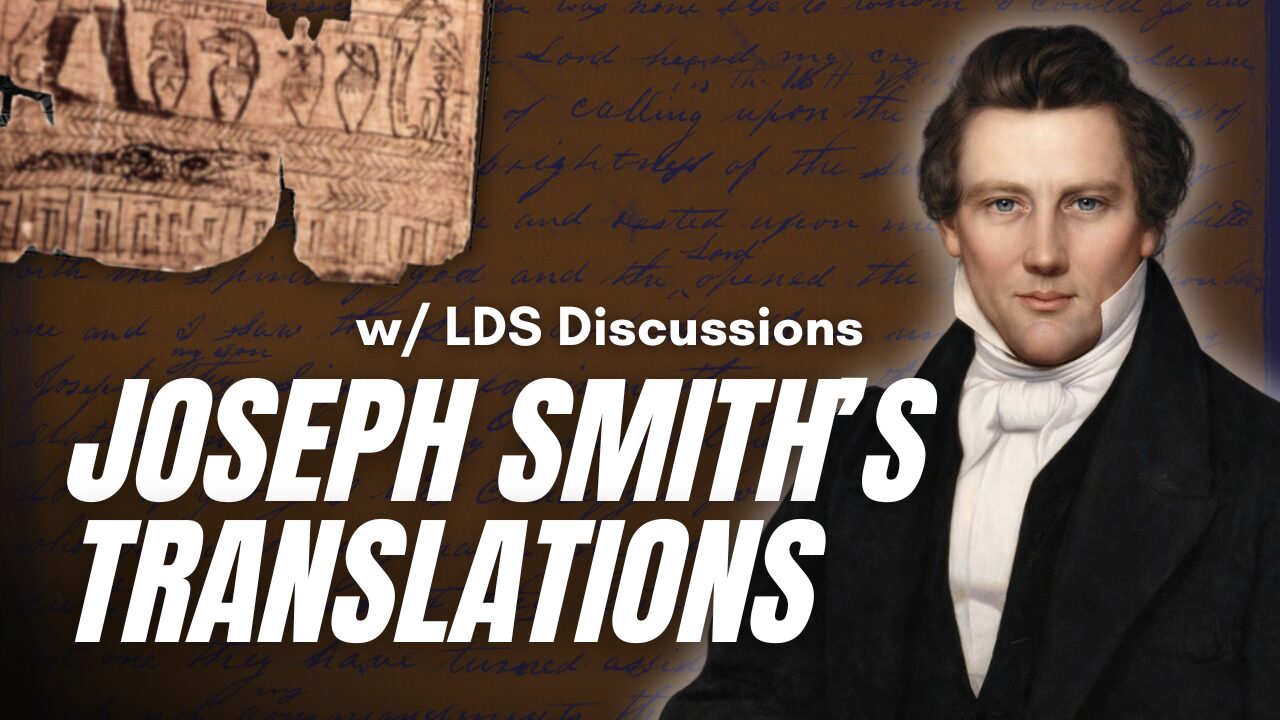
Overview of Joseph Smith’s “Translations” w/ LDS Discussions – 34
Listen on Apple Podcasts Spotify YouTube Download MP3
About this episode
In this episode we recap all the different areas where Joseph Smith claims to have translated an ancient source and we analyze his work and compare it against modern scholars and experts in the field to see how he did.
Co-host: Nemo the Mormon
LDS Discussion Essay: Overview of Joseph Smith’s Translations
LDS Discussions is made possible by generous donors!
Help us continue to deliver quality content by becoming a donor today:
- One-time or recurring donation through Donorbox
- Support us on Patreon
- Pick “Mormon Stories” as your charity on Amazon Smile or through the Amazon App
LDS Discussions Platforms:
- LDS Discussions Website
- LDS Discussions on Anchor
- LDS Discussions on Spotify
- LDS Discussions Playlist on YouTube
Contact LDS Discussions:
- Twitter: @ldsdicussions
- Facebook: @ldsdiscussion
- Insta: @ldsdiscussions
- Email: ldsdiscussions@gmail.com
Contact us:
MormonStories@gmail.com
PO Box 171085, Salt Lake City, UT 84117
Social Media:
Show Notes:
LDS Discussion Episodes
- 1620: Adam & Eve and Mormon Truth Claims w/ LDS Discussions – 11
- 1623: The Global Flood and Mormon Scripture w/ LDS Discussions – 12
- 1626: The Tower of Babel and Mormon Scripture w/ LDS Discussions – 13
- 1585: Book of Mormon Translation w/ LDS Discussions – 03
- 1599: Tight vs Loose Translation of the Book of Mormon w/ LDS Discussions – 06
- 1701: Book of Abraham Pt. 1, Joseph Smith’s Translation w/ LDS Discussions – 30
Mormon Stories Related Content
- 1388: Recreating the Book of Mormon Plates with Trent Told
- 1339-1341: Dr. Robert Ritner – An Expert Egyptologist Translates the Book of Abraham
- 1338: Haley Wilson Lemmón – The BYU Undergrad Who Discovered Joseph Smith’s Plagiarisms in his Bible “Translation”
- 1338: Haley Wilson Lemmón – The BYU Undergrad Who Discovered Joseph Smith’s Plagiarisms in his Bible “Translation”
- Mormon Stories Essays
- 1556: Adam, Eve, and pre-Adamites – Mormon Doctrine vs. Science w/ Dr. Simon Southerton #02
- 1603: John Larsen & The Tower of Babel
- 1588: Noah’s Flood w/ Dr. Simon Southerton
- 1019-1022: David Bokovoy – Applying Higher Criticism to Mormon Scripture
Other Sources
- A Recently Recovered Source: Rethinking Joseph Smith’s Bible Translation | BYU Journal of Undergraduate Research
- What Are the Book of Mormon Gold Plates? | Now You Know
- How Joseph Smith Invented Reformed Egyptian – Dan Vogel
- Rewriting Eden with the Book of Mormon: Joseph Smith and the Reception of Genesis 1–6 in Early America
Originally published on mormonstories.org.
Transcript
Machine-generated and lightly edited. Click any timestamp to jump the audio to that moment. The audio is authoritative; please check it before quoting.
Welcome and Episode Introduction
John Dehlin Hello, everyone, and welcome to another edition of Mormon Stories podcast, LDS Discussions Edition. It is January 12, 2023, and I'm super excited to have you all join us today for another episode. Today's episode is an overview of Joseph Smith's translations. And just very, very quickly, we are about 34 episodes into our LDS discussion series, which is a series on Mormon stories, where we do a deep dive into LDS or Mormon Church truth claims, trying to base all of our discussion on facts and evidence. We try to be as dispassionate as possible. We try to be neutral and objective, and we just try and look at the claims that the Church makes and then look at the evidence and science where we can and then allow you, our viewers and listeners, to make your own informed choice. We try and not do ad hominem, not do snarks, not do negativity, but just help you get the information you need to make informed decisions about your life as it relates to Mormon Church truth claims. And of course, this is based on the work of mike from ldsdiscussions.com hey, Mike, thanks for joining us.
Mike (LDS Discussions) Hey, everybody. How's it going?
John Dehlin Good. If you go to LDSDiscussions.com, you'll see essays on all of these topics that we have. Again, we've done 33 episodes prior to this. I strongly recommend that you start from the beginning because they're literally made to build on each other every time we reference previous episodes after the first episode. So you'll do better to start from the beginning. And I'll just end by saying you can watch this integrated into the Mormon stories podcast or YouTube feed. But also you can binge watch these episodes in either on Spotify under the LDS Discussions brand or on Apple Podcasts under the LDS Discussions brand. Or you can go to the Mormon Stories Podcast YouTube channel and there's a playlist for all the LDS discussions videos in a row. And of course, all the essays for these episodes can be found@ LDSDiscussions.com if you don't want to hear, you know, Mike and me and Nemo yap on, you can just go read the text and find the source material that Mike uses for these very important episodes. So, Mike, anything you want to add?
Mike (LDS Discussions) No, this. This episode's gonna be, I think, hopefully for anyone who's been following from the beginning, I think this will be a useful episode because we're going to be calling back to a lot of earlier episodes. So as you said a few minutes ago, if you didn't start from the beginning, you can watch this episode, but you're probably going to hear part three. Michael. Oh, I should probably, probably listen to that episode because it's going to have a lot more context. But I think this episode will be one of those episodes that kind of helps to summarize a lot of what we've been trying to kind of lay the foundation for over the last 30 something episodes. So I think it'll be an important one and hopefully for those of you who have been following all along the whole time, it'll give a little more context into what we've been talking about so far.
John Dehlin Yeah. If I were to, if I were to summarize the purpose of today's episodes, we're going to look at six or eight claims that the church and Joseph Smith made over the years about his ability to translate. And then we're just going to give a high level evaluation of how credible of a translator Joseph Smith was. Is that, is that kind of what we're doing today?
Mike (LDS Discussions) Yeah. So this is going to be, we'll talk about on our first slide. But yeah, it's, it's just literally just saying here's what Joseph Smith said he was translating and here is what the historical record, whether it's, you know, as we talked about the book Abraham, Egyptian scholarship or biblical scholarship, and then saying which ones is it a hit? Which ones is a miss? Which one can we not draw any conclusions from? And then see, you know, kind of as I talked about in the very first episode, when you look at this as a puzzle, now we're starting to put the pieces together with all of the previous episodes and they're fitting together really well. And so now we can then evaluate what those truth claims have, how they hold up basically with the last 200 years of scholarship.
John Dehlin Beautiful. And joining us today is a much beloved member of our LDS discussions team and of the Mormon Stories podcast family, but also his own, doing his own amazing work as a YouTuber and as a part of the Britvengers, which is a British group of Mormon and ex Mormon YouTubers and podcasters. We have Nemo the Mormon.
Nemo Hey everyone.
John Dehlin Hey. Love your, love your new studio, Nemo.
Nemo Thank you.
Mike (LDS Discussions) Looking good.
Nemo Myself.
John Dehlin Can you, can you explain to us why a taper is wearing a British flag?
Nemo Basically A horse.
John Dehlin This.
Nemo Yeah, this horse here is wearing a little British flag because When I hit 5,000 subscribers, I did a little competition and he traveled around all the Britvengers. His name's Daniel, after Tapir Dan. He traveled around all the Britvengers. And Peter Bleakley Put a union flag sock on him. And that's been his coat ever since.
John Dehlin I love it. Well, congratulations, Nemo, for hitting 10,000 on your channel.
Nemo Thank you.
John Dehlin Please subscribe to the Mormon Stories Podcast YouTube channel right now, if you can. We're about to hit 100,000, which for us is a huge milestone. It helps us with the algorithm, it helps us get better guests, and it helps you stay informed when new episodes come up. But also make sure and mash the button, subscribe button for Nemo. Nemo the Mormon as well. Okay, Mike. And Mike, we don't have this first as the first slide, but the. Oh, I'll go ahead and I'll go ahead and kick off the first slide, Mike, and then I want to add something, so take it away, Mike. Let's go ahead and jump into this episode.
Scope of Joseph Smith's Translation Projects
Mike (LDS Discussions) Okay. Yeah. So, you know, the first slide basically, is just trying to kind of look at the scope of what we're doing. And so in these episodes we've done so far, we've been highlighting the issues with Joseph Smith's prophetic works. We've been looking at all of the different ways scholars can assess the authenticity of the translations, whether it's biblical scholarship, historical analysis, and the fact that we now have the ability to translate ancient languages that Joseph Smith was unaware could be happening, such as the Book of Abraham. But the scope of this episode is basically to focus entirely on the translations that Joseph Smith made during his time of being a prophet that we either have the source material for or we have the original accounts in order to assess the accuracy of what he was doing in these translation projects. And so you're not going to hear us go on about, say, Book of Mormon anachronisms because we don't have the source material of the gold plates, but we are going to talk about the reformed Egyptian character. So this scope of this episode is more. What can we actually evaluate? Because we have source material for. And for me, it's a worthwhile exercise because it gives us a more detailed picture of Joseph Smith's ability as a prophet with tangible source material that makes very, very testable truth claims. And that's something I mentioned in a lot of these episodes, which is that in Mormonism, unlike, say, the Bible itself, there are very modern truth claims that we can now test because of the fact, as I mentioned earlier, that we have so much more scholarship and ability to translate ancient languages to basically compare to what Joseph Smith was saying. And so some of the episode will feel like a bit of a recap. Some of it's going to feel like we haven't really discussed it before. And so it's going to be a mix of kind of a lot of the foundation we've done in the past, but then also adding some new context to it to try to show how these are all kind of connected and there's a reason that they're connected. And we'll get into that as we go through it.
John Dehlin Okay. Nemo, is there anything you want to add in terms of kind of setting up today's episode from your perspective?
Nemo No, let's just dive in.
John Dehlin Okay. One thing that I want to do, Mike, that I'm scrambling to do, kind of on the fly, just because I think it's really important and I didn't see this in your slides, is I want to set up why this question of. Why. Why this question of translator is so foundational. And so I just added a slide and now I'm going to show it. What I'm going to do is I'm going to read Doctrine and Covenants, Section 107 92. For our Never Mormon viewers and listeners. Doctrine and Covenants is one of the four major members of the Mormon Church scriptural canon. We believe in the doctrine, the Bible, the Book of Mormon, what's called the Doctrine and Covenants, which was Joseph Smith's revelations and then the Pearl of great price. And so what I'm about to read you is Mormon Scripture, and it's foundational. And so I'm going to read really quickly from DNC 107, verse 92. And it says, behold, here's wisdom. Yea, to be a seer, a revelator, a translator and a prophet, having all the gifts of God, which he bestows upon the head of the church. And that's interesting for two reasons. It sort of throws down the gauntlet in my mind for Joseph Smith where he's either gotta. He's gotta show up and translate accurately because in Mormon scripture, God and Jesus themselves have declared it. So one thing that I actually haven't never thought of before, it says, bestows upon the head of the church. That would mean every prophet after Joseph Smith as well, which I don't think we have any record of any Mormon prophet after Joseph Smith attempting to be a seer or a translator, but that's beside the point. But I guess I just wanted to start by saying, you know, God and Jesus say in Mormon Gospel doctrine, in Mormon Scripture, that Joseph Smith needs to be able to translate. So that's. That's important. Right, Mike? Right. Nima, what do you guys. What do you guys have to say about that?
Mike (LDS Discussions) Yeah, well, for me, and, and this is kind of. I've mentioned this in previous podcasts. I look at what Joseph Smith is saying at face value. And, and that's why when you get into that whole argument of like, as a hat tip to Brother Jake's YouTube videos, is a translation or translation, I don't really think that that's a fair argument because as you show in dnc, as we've shown in a lot of these other episodes, like the book Abraham, we talked about it, they're making very clear that they are translating one language to another. They're translating reformed Egyptian to English. They're translating Egyptian to English. And so if you take it at face value, what does the result, how does it hold up throughout history? And so for me, I think that's really. It's just about taking it at face value. And the church is the one making this claim. We are not making a claim 200 years later that Joseph didn't make. This is what he gives us as a testable claim to his credibility as a prophet. And now we're. We're testing it.
John Dehlin Yeah. Okay, so I didn't overstate. I didn't overstate the importance of this, this issue of translation.
Nemo No, Joseph Smith said he'd be able to do it, so he should be able to do it.
John Dehlin Well, God, I guess my point is God's God and Mormon Jesus said that Joseph Smith should be able to do it too. Right?
Mike (LDS Discussions) Right. Yeah.
John Dehlin Yeah. Okay, let's. Let's go to the next slide, which is the translations of Joseph Smith we will be covering.
Mike (LDS Discussions) Yeah. And so just kind of, you know, piggyback on our first slide about what the scope is. We're going to look at the characters that Joseph Smith is going to copy from the gold plates of the Book of Mormon. We're going to look at the translation that Joseph does of the Bible after he finishes the Book of Mormon, Joseph Smith's puric language, the Book of Abraham papyri, the Kinderhook plates. And then we're going to do one at the end of the lost writings of John. And as we're saying, this is all based on where we have some source material to compare to. The one example we don't really have a direct source material is going to be the bonus one, which is the lost writings of John, but we do have what are the writings of the author of the Gospel of John that we can compare to. And that's why that one is so important as well. And this gives us something to basically assess what Joseph Smith is claiming these translations mean against what we now know through, like I said, all sorts of studies, biblical scholarship, linguistics, being able to translate languages, all of that is going to play a role into what we're going to look at today.
John Dehlin Okay. And each one we're just going to basically say pass or fail. Is that right?
Mike (LDS Discussions) Yeah, effectively. I mean, and that's the thing. So we've got six, and we're going to say at the end, how many of these six can hold up? How many are kind of, you know, we don't know. And so I think this is important because, you know, again, when you're, when you're putting the puzzle back together of all of these claims that you're. You're told throughout your life in the church and now you're. You're doing it by data and by what you could see with your own eyes. And it gives you a much different finished product of that puzzle. But they're going to. These pieces are going to start fitting really well, especially because of all of the episodes we've done up until now to give more context to these issues.
Book of Mormon Characters and Reformed Egyptian
John Dehlin Okay, so, Nemo, I'm going to. I'm going to ask you for a pass or fail for each one. You ready? You ready for that?
Nemo Yes, please.
John Dehlin Okay, I'm ready. All right, Mike, you're going to lead off on the. On the vote. Okay, so the next slide. So the first I'll say translation in air quotes because we'll see. Maybe it is a translation is the Book of Mormon characters. And I'm immediately knowing. I'm immediately noticing that characters is spelled funny. But. But let's. Let's go to the Book of Mormon characters.
Mike (LDS Discussions) Yeah. And so we, we covered this in our earlier episodes about the gold plates and the translation process, but we do not have. And I'm going to make this clear because there is always going to be this pushback that this is not the anthem transcript. And this doesn't appear to be because.
John Dehlin Explain. Explain to our listeners what we're seeing right now.
Nemo Yeah.
Mike (LDS Discussions) And so what we're looking at, if you're. If you're watching this, is. This is a set of characters that Joseph Smith claims to copy directly from the gold plates of the Book of Mormon that represents the reformed Egyptian that the Book of Mormon was recorded in. And so this is a copy of one of the. This is one of the copies that Joseph Smith made. Scholars have gone through, and I think they've identified a Handful of them now of different copies. But there is no real argument about these being authentic. So this is a copy of, I believe, in John Whitmer's handwriting off of what Joseph Smith had originally copied as the reformed Egyptian characters.
John Dehlin So is this the. Is this a. The piece of paper or something like the piece of paper that Joseph would have given Martin to take the professor Anthon to validate whether or not these were. Were, you know, whether this was Egyptian, whether they were valid ancient characters. Is that. Do I have that right or not?
Mike (LDS Discussions) Well, this doesn't appear to be the actual one that was brought to Charles Anthon. Like it? Like it. Yeah. So this would have been the same characters probably, you know, once Joseph Smith did it, they probably made multiple copies so they could show other people. I mean, they published some of these in a broad side, I think, for the Book of Mormon.
John Dehlin So.
Mike (LDS Discussions) So these characters are not just fabricated by some random person. The church printed a Book of Mormon, I think, in the 1980s with these characters on it. So there's really. No.
John Dehlin I remember that.
Mike (LDS Discussions) It's not. It's not like you could say, well, these are fraudulent characters trying to make Joseph Smith look bad. These are either a copy of a copy or, you know, something that Joseph Smith copied down. And then John Whitmer was next to him and made his own copy. But these are as authentic as we know.
John Dehlin Okay, Nemo, we gonna add something.
Nemo Yeah. Just for listeners, if you're now furiously googling Book of Mormon characters document. It's the one with the characters arranged in horizontal rows, because the one that Mark Hoffman did had vertical columns. That was a distinction that he used to try and build the authenticity of his copy was that there was some rumors that it was actually the original was to Mark Anthem was in column rather than Rose.
John Dehlin Got it. Yeah. And what. What I just did really quickly is I just, I. I just added to the slide deck the Book of Mormon that the church put out. Y.
Mike (LDS Discussions) There it is.
John Dehlin This is a gold Book of Mormon. And I remember this when I was little with the actual characters on the COVID These are the same characters, right, Mike?
Mike (LDS Discussions) Yeah. So those are the same characters that you would see on the. The image that we have. And so these. The idea that these are not authentic because it's not the actual Anthem transcript really is not a argument that's giving the full picture, because these. These characters are one way or the other, what the church has believed to be authentic. And there's really no reason to think that these are, you know, kind of talk about The Book of Abraham. This idea that, like, scribes are going behind Joseph's back and just inventing him is just. It's a nonsensical argument. So while this probably is not the anthem transcript, it is going to be a copy of the authentic characters.
John Dehlin Okay. Okay, so let's go back to the slide. I'm sorry I interrupted you. I just.
Mike (LDS Discussions) No, no, you're fine. And so the reason that we're focusing on this for this episode is because this is something we can evaluate. We don't have the Book of Mormon plates. Joseph Smith never let anyone. I'm not getting into the Witness stuff, but Joseph Smith never let anyone see the gold plates that could copy them down themselves. So this is all we have to work with. And, you know, this is the only example we have of Book of Mormon text and reformed Egyptian. And so this is what we can evaluate now to look at and say, does this hold up as an ancient Egyptian language?
John Dehlin Nemo, were you gonna say something? You know, I just thought of a point that. That's kind of really interesting if, you know, one of the. You know, it's obviously, I think the south park episode just makes fun of the fact in the Book of Mormon musical. It's like, of course, of course Joseph wasn't allowed to show anyone the plates, the gold plates, because they didn't exist. Now, of course, Joseph claims that it's because God wanted people to have faith, so he didn't allow the plates to be available. But anyone who's looking at it objectively is like, well, that's a con. Right from the start, all he had to do was chervon the gold plates, and that would be, you know, that would be proof. Isn't it interesting that while God felt like it was crucial to take the golden plates away, God allowed the Egyptian papyrus to be seen by. By and shown to everybody. Why? Why was God against. Against the. The plates being shown, but for the papyrus being shown and available?
Mike (LDS Discussions) Because Joseph Smith knew the plates would not pass visual inspection.
John Dehlin Yeah.
Mike (LDS Discussions) Be the easiest way to put it.
John Dehlin I mean.
Mike (LDS Discussions) Yeah, because it would be really easy. Oh, go ahead, Nemo.
Nemo I was saying there's a clip going around of Elder Ballard from a few years ago talking about when he met up with a group of other religious leaders and they said, oh, if you just let us see the plates. And he was like, you know better than that. To ask God to show you this, you need to. And he started just going on about faith and how faith is required. And so it's. It's deeply entrenched this idea that it's somehow positive that we don't have the original evidence.
John Dehlin Yeah, yeah. And in that case, Joseph wouldn't have ever needed the papyrus or any, any source. He should have just always been channeling revelation without ever needing a source. Right?
Mike (LDS Discussions) Yeah. I mean, in theory, because this is idea that these are records being written on plates, but if nobody else could translate it by Joseph, there's no harm in showing anyone. That really is the thing to me, that is the one of those, like, intuitive things where you're like, if no one else can translate but Joseph, what harm is there in showing. It's not like someone else can say, oh, you're translating it wrong, because no one. This is a language that has been lost. Right. So the fact that you could show the Egyptian papyru, which of course is because Joseph hands are tied there, because this guy's been touring with this, with these Egyptian papyrus fragments. So of course he's going to show them to people. But it does show, to your point, he knows those are authentic. But you know, the gold plates, if, if Dan Vogel does a really good video and he talks a lot about how easy it would have been for Joseph Smith to make a prop set of plates using tin that they used like to. To tie the barrels together. And obviously we talked in our episode about how, you know, one of the Dan Vogel series is that the reason Joseph Smith comes back home with his thumb busted up is because if you're trying to get that D ring to finish the prop set of plates, that's very easy to hurt your thumb because you're pushing with all that force. But once you wrap that in a cloth, you know that it can't pass a visual inspection because he doesn't have all these characters on the plates. And so it just shows to me that Joseph won't show those plates because he knows if he unwraps the cloth, there's nothing there. And so the papyri, he knows is authentic. So of course you're going to show people. And as evidence of Abraham and Joseph, whereas with the plates, it's like, no, sorry, God won't let me do it. It really doesn't make a lot of sense when you think about it from like an outsider perspective.
John Dehlin And I'll put in the show notes, there's a Mormon Stories episode where we have a guy come in and show us tin plates that he made that could have easily with materials that would have been available in, in the 18, you know, 20s. And that's. That's an interesting episode in and of.
Nemo And he used 19th century hand tools, I think.
John Dehlin Right, right, right, right. Using 19th century, your hand tools. Yeah. Okay, well, let's go to the next slide, which is the story behind the Book of Mormon characters, which I think we told a little bit.
Mike (LDS Discussions) Yeah, yeah, that's okay. And so, basically, for this, the purposes of this, you know, Joseph Smith is going to command via revelation that Martin Harris is going to help fund the. The Book of Mormon. We talked about this. I don't know if you could put that slide up. Just reading off my phone.
John Dehlin Here we go. Here we go.
Mike (LDS Discussions) Yeah, sorry. And so, you know, Joseph Smith gets this revelation that Martin Harris has to help fund the publishing of the Book of Mormon. Of course, Martin Harris wants to have the language verified by scholars. Lucy Harris, of course, as we've talked about in the previous episode, she is more skeptical of Joseph Smith. And so Joseph Smith is going to copy a group of characters from what he claims to be are the gold plates. And that is the famous story of Martin Harris taking them to Charles Anthon to examine. And the problem here is the same thing we're going to have with the Book of Abraham, which is no one at the time could read Egyptian. The Rosetta Stone was only being discovered. Reformed Egyptian was not considered an authentic language then, it's not considered an authentic language now. And so compounding the problem is that when you take a closer look at the characters that Joseph Smith copied from Martin Harris, it becomes clear immediately that they are strikingly similar to the English Alphabet that Joseph Smith was writing in reading at the time of this, you know, translating the Book of Mormon. And so if you go to the next slide, this is the easiest way to understand how to evaluate the characters, which is that every single letter in the. In our Alphabet and every number is in the characters, whether it's twisted, turned upside down. And the Tanners put in one of their newsletters a message using Joseph Smith's reformed Egyptian characters and turning it into a font which says Joseph Smith claimed these characters are reformed Egyptian. Some critics, however, feel they are deformed English. And when you look at that, it becomes really clear that this is not an ancient Egyptian language. Unless we're to believe that, you know, thousands of years ago they had our Alphabet long before it was developed in a crude form that was lost forever and then immediately, you know, recreated by completely different people.
Nemo You say that as though that's like, yeah, not plausible. And I get it. But to Joseph Smith and to the entire culture around this, the entire culture around him, which was that the ancient Americans can't have been the brown people that are there now because white people are better. That was the prevailing sentiment. And that's why they all sought to have this justification for, you know, Jewish ancient Americans and this sort of thing that they came from the old world. And so it makes sense in that respect that they'll be like, oh, well, this language that we use now, this Alphabet that we use now, which is amazing and brilliant and wonderful, they probably would have used that too, but it got lost. Yeah, it's not a million miles away from believable in that context.
Mike (LDS Discussions) No, that's a good point. And I think, you know, Joseph Smith, as I. I do believe he's a creative person, obviously, since I believe he wrote the Book of Mormon and we've talked about why I think that. But the fact is, you know, unless you're like, we're talking in the 1820s, but, you know, unless you even today, like, unless you're like a graphic designer or someone who's super creative, it's hard to create a set of characters that aren't going to resemble what you're already familiar with. And so to me, what we're seeing is kind of to Nemo's point is you're trying to find this language that matches some sophistication, and Joseph Smith is needing to create the set of characters quickly. And, you know, he only knows what he knows. I don't think Joseph Smith had all these books of different languages that he could kind of pull from, like, whether it's, you know, some, you know, ancient, you know, trying to think of the different languages he would have even had access to. And so, you know, it's just. To me, I know apologists have gone through. I think Hugh Nibley's gone through and he's found, like, oh, there's this one character on the character's document matches this one Egyptian language. But the problem is, if you're going to start going that route, you can find similarities in characters no matter what language you do. That's just how it works, because there's only so many ways you could draw a letter. But when you have every single Egyptian or every single English letter and number in this little document, to me, that's a pretty clear sign that the person who's writing it is not writing from an ancient text, but from something they're familiar with.
John Dehlin So just to restate for those who are listening, mostly in that characters document that we talked about, there's a bunch of these gobbledygook characters that Joseph Smith produced. Every letter in the. In the English Alphabet, plus every number can be created if you. If you pivot them appropriately, you can pretty much create every. Every letter and number in the English Alphabet, which suggests that he basically just made this up from. From letters and numbers that he was already familiar with and just kind of was. Was doodling characters.
Mike (LDS Discussions) Yeah.
John Dehlin Is that right? Okay.
Nemo Yeah.
Mike (LDS Discussions) And if anyone's interested, Dan Vogel has some videos on YouTube where he goes through, like, line by line, and he shows where they're coming from. Some of them are coming from magic, the family's magic parchments. I mean, he can tell you where these symbols are coming from. This is not like where the characters are a mystery, but they just kind of look like English. It's really clear. Okay. When you actually look at them for what they are. And so I guess in some way, to Nemo's point, this is probably what they thought at the time, that these ancient people would have been more sophisticated. And I'm sure from a church standpoint, you could say you can't prove this isn't a hit because we don't have reformed Egyptian to compare to. It's kind of the DNA argument. Right. Like, we don't have Lehi's DNA, so you can't compare. Well, I mean, again, you can look at this with your own eyes and, and look at how they mirror the English language Joseph Smith was working with and draw your own conclusions. But to me, this tells you that this is not some ancient Egyptian language because there's no connection to any Egyptian script yet there's perfect connection to what Joseph Smith was familiar with.
Nemo The question then to ask would be you'd have to go back and you'd have to go to the point. And I don't even know if this point exists where Egyptian separates off from whatever proto language there was. And these two stems go. One goes to the Latin Alphabet, one goes to Egyptian hieroglyphics. I don't even know if that point exists. That sort of, like, missing link. I don't think it does, but I could be proven wrong. But that's how. That's how you'd have to do it to then follow those arguments.
Mike (LDS Discussions) Yeah.
Nemo And.
Mike (LDS Discussions) And I've. And we obviously could do more on this, but I know, like, from people who have studied linguistics who have talked about this, they're just. No one takes us seriously because as to your point, you need to find that line where it's coming from, it, and it just doesn't exist. Because of the fact that there is no language like this before or after Joseph Smith claims to have found it. And so because there's no evidence for the Book of Mormon archaeologically, where we're seeing like maybe tablets or plates that are written that got lost in the ground, we have nothing to compare to. But since you can compare to the English language and it matches up so well, to me, that's a pretty good indicator that fits in with this kind of ongoing pattern of Joseph Smith being the person that is creating these translations and not, you know, God providing him with these ancient languages that, you know, another way to put it is if Joseph Smith's seer stone was really channeling the Egyptian characters, which is what the witnesses or the people close to Joseph Smith during the translation will tell you. At least one of the accounts says that the character appeared on the rock, then above it, the English language does. Well, if those characters looked Egyptian, Joseph could have written those down. But instead we're, you know, I mean, all of these things are pointing very clearly to the author of these characters being Joseph Smith, because it just doesn't line up linguistically. It just doesn't line up in any way outside of just saying, well, we just don't know. So we. So we're just going to assume it's true.
John Dehlin And also, it's worth mentioning, we've had one of the world's experts, you know, in. In Egyptology, Dr. Robert Ridmer from the University of Chicago on Mormon Stories podcast. I asked him point blank, is there such a thing as reformed Egyptian? And he says, no, it doesn't exist.
Mike (LDS Discussions) Yeah.
Nemo And that.
John Dehlin That should matter for people who care about evidence. Yeah.
Mike (LDS Discussions) I mean, that's the thing. If you're looking at this from an evidence lens, this is an immediate. No, there's no one that's going to tell you this makes sense, because as Nemo said, there's no line to it.
John Dehlin Yeah.
Mike (LDS Discussions) There's nothing else that resembles it. There's. There's nothing to work with here except for looking at the way we have and saying, why do all the characters line up with English? It's just. That's pretty simple.
Nemo You could see it. Sorry. Yeah, yeah. Maybe I didn't make my point clear was that essentially what I'm saying is in order for it to be reformed Egyptian, there has to be some way in which Egyptian was reformed. So it then looks just like the Latin Alphabet, right?
John Dehlin Yeah, but you.
Mike (LDS Discussions) And that's the thing. Like language. Yeah, that's what I'm saying. So. So languages evolve Right. And so you would be able to find something that would get you to that point, and there's nothing. It's. You know, it's just one of those things where, as we'll get into with the Adamic language, it's amazing how these ancient people are speaking and writing in a language that won't be creative for a lot longer, and yet Joseph Smith knows it. It would be more impressive maybe, if it was in a language that Joseph Smith wouldn't have known, even if it resembled something else. But it's just. It's immediately in his milieu.
Nemo So, yeah, if he'd gotten hold of Hebrew at that time in his life, which he will, he will come across later, but if he'd gotten hold of Hebrew at that time of his life, then deformed that and changed that up, it would have been a better con in many ways.
Mike (LDS Discussions) It'd be more impressive, for sure. Yeah, yeah, yeah.
John Dehlin All right, well, let's go to the next slide, the Church. And this is a picture that we've shown in previous episodes.
Mike (LDS Discussions) Yeah, and this is just one of those ones. Nemo and I have pointed this out in, I think, multiple areas, but the Church has the characters we showed you on the previous slide. And yet I think they made these about two years ago, maybe three years ago, and they have the series of YouTube videos called now youw Know, and they're about five minutes long, and they explain a kind of a controversial topic, and they tell you why with apologetic reasons why it's okay. The Church has the actual characters Joseph Smith copied from the Book Mormon plates. And yet in these videos, they create an entirely new set of characters to look more authentically Egyptian. And that tells me that the Church knows full well that Joseph Smith characters are crap. Because if they trusted that those characters were authentic in any way, they would use them here. And yet they're creating a whole different set of characters to make it look more authentic and not showing both members and prospective members what Joseph Smith actually copied. And I think that's extremely telling.
John Dehlin It's a little bit bothering. I wonder if linguists and specifically Egyptologists are just a little bit offended that the Mormon Church would perpetuate the idea of the existence of a language that we have no evidence having ever existed like that. That's a little bit problematic. Yeah, it's a little bit problematic to me that the Church would be advancing the idea of this language. I don't know.
Mike (LDS Discussions) Yeah, no, I mean, it's true.
Nemo But what's sneaky about that? If you see that on screen. What's sneaky about it is you can read the word your in it, right? Just above the gold plates. Y, O, U, R. Then there's a Zed, then there's an X, then there's another kind of Zed. There's a W's in there, there's M's in there, there's V's, there's a number four.
John Dehlin When you say Zed, you mean Z, right? Nemo.
Nemo Sorry. Yes, apologies. Just joking. So, but, like, they. They can't stray too far from what Joseph Smith did. They've got to, like. They've got to try and make it look a bit more ancient. So they've made it a bit more angular. Yeah, but it's still. There's still English letters and numbers in there.
John Dehlin I think. I think what you're saying, Mike, you're saying that Joseph Smith's Anton characters were so bad that even though the Church has them, they didn't want to use them in their public educational videos because
Nemo they did put them on the front of that Book of Mormon, John.
John Dehlin Yeah.
Nemo So they used to put them on public display. So why are they now hiding them?
John Dehlin That's a good point. All right, you can't make this up. All right, let's go to the next slide. The Mormon Church creates a new set of characters. Oh, did we already cover this?
Mike (LDS Discussions) We pretty much did, yeah. We can just basically say that the Mormon Church has the characters, and yet they created a new set of characters for these videos. And these are videos that are going out to the world on YouTube. So to me, it's an interesting thing that they're. I mean, in my opinion. I don't know if the word embarrass is good, but they're too uncomfortable using Joseph Smith's actual characters and. Which I think is a big red flag. So it's the same way they were
Nemo uncomfortable with showing images of Joseph Smith putting his head in a hat for a long time. Right. They knew that for a very long time. But the narrative, the thing they portrayed to the public was Joseph Smith looking at the place with his spectacles on. Whichever version that you've seen, they put that in chapels, meeting houses, on the front of church magazines. And it wasn't until they were essentially forced to start doing it otherwise that they then did.
Mike (LDS Discussions) Yeah. Yeah, that's that simple.
John Dehlin Okay. All right, well, let's. Let's jump to. Let's jump to the next slide, which is the Book of Mormon characters and reformed Egyptian.
Nemo Yeah.
Mike (LDS Discussions) And so just, you know, to basically Summarize this, this first part. It's just to say there's no evidence that reformed Egyptian was ever language. And I personally believe that Joseph Smith created this because he knew there was no one else who could translate it. Because again, you know, as Nemo said earlier, if he had said the book was in Hebrew, a lot of people could translate it. So then he would have to say, well, no, it's a Hebrew that you can't know, which. Which gets into a whole lot of issues because people could probably understand that it's not at all Hebrew, you know. So I think that for, for Joseph Smith, this made the most sense in order to create something that no one else but him could touch. And that allows him to keep himself elevated against anyone else who could kind of question what he's doing. And so I think that's why he creates Egyptian. But the problem, obviously is that now we can look at it with all of the vast amount of Egyptian. I think Robert Ritter talks in his interviews with you about all the books they have of all of these different scripts, and there is nothing in any of them that would correlate to reformed Egyptian in any statistically significant way. And as we've talked about in our previous episodes, you know, people were really fascinated by Egyptian relics at the time. So it also feeds into that kind of Egyptomania that's going on at the time. And Joseph Smith believed that every character in Egyptian held sentences worth of meaning, which allowed for him to create a book that was 273,000 plus words with just a small set of plates. And as we talked about in our episodes on the Book of Abraham, this is just not how the Egyptian language works. And as the world would learn after Joseph Smith's death, the math just simply doesn't add up. And so not only are the gold plates engraved with fast records, anachronistic, which we talked about in the gold, the episode on the plates. Joseph Smith's understanding of the Egyptian language, which he used to craft the Book of Mormon, is just wrong. And so these characters have no connection to the ancient world, but are screaming to us that they're a 19th century creation.
Grading the Book of Mormon Characters
John Dehlin Okay, so if we have to give Joseph Smith a grade for the Book of Mormon characters for our first. Our first grade for today. Mike, what are you giving Joseph Smith on this one?
Mike (LDS Discussions) I mean, to me it's, it's, it's just an obvious fraud. I mean, it's not, it's not an ancient record. So if we're going past fail, I'd say it's a. It's a clear fail.
John Dehlin All right, so. So for. For Mike, it's a fail. Nemo, what is it for you?
Nemo It's a fail. The thing I remember most is that when we covered the amount of, like, text you could get on gold plates in terms of engraving that we worked out, an entire university dissertation's worth of words were missing from every plate. Yeah, yeah, it's a fail.
John Dehlin Yeah, yeah. And I'm going to say it's worse. I'm going to say it's not only a fail, and this isn't me trying to pile on or be negative. It's just me being sincere. For me, it's. It's worse than a fail because not only is it. Is it clearly not a translation, but. But it's potentially fraud. He's making up a language so that then he can claim to translate it. So that's a fail on top of a fraud. And this is the type of thing that, you know, sometimes people like to have a good faith kind of assumption with Joseph Smith that maybe, as Dan Vogel says, he was a pious fraud, he really believed in God and Jesus. But sometimes he fooled people because he felt like it's okay to fool people if it helps them believe in Christ. But then there's always the question of, was he just making it all up? When you start making up characters and inventing a language that doesn't exist and then claiming you can translate from it, that's when you start, for me, really getting into fraud territory. So I hope I'm not coming too down too hard on him.
Mike (LDS Discussions) I mean, it's just. It's not what it claims to be. And so for me, yeah, you're. These characters were copied in part to get Martin Harris to. To fund the publishing of the Book of Mormon. So if you're creat creating fake characters to get someone to sell their property to help you fund a book, and you're doing this in the name of God. Yeah, I mean, it's a fraud. And fraud's a very fighting word. You know, it's a pejorative.
Nemo Right.
Mike (LDS Discussions) But at the same time, how else would you describe this if they're not what Joseph Smith claims them to be?
John Dehlin Yeah. And I was just thinking about this recently. Like, when Bernie Madoff, you know, creates a Ponzi scheme and bilks billions of people, we're okay using the word fraud because fraud. Frauds exist. So if the word fraud can be used in other contexts, I don't think it's fair to say we can't use it in a religious context. It's off limits because people hold these beliefs sacred. I think if the word fraud exists and if the word fraud applies, even if it's offensive, we need to be able to use it, in my opinion.
Mike (LDS Discussions) Yeah, I mean, it's just, it's a. If we're like, for the purposes of these episodes, it's about approaching it from a face value standpoint. It's not about approaching it from a faith based standpoint. So if you want to make the argument that Joseph Smith meant well and therefore creating a set of characters is okay, that's an argument you have to make in a different realm because we're looking at it from a perspective of what can we see with our own eyes and does that match? And if it doesn't match, then by definition, what would that be? If you're using that to get someone to help you fund a project which is a financially motivated reasoning which would fit fraud perfectly. And so it's, it's a very loaded term. But from a, you know, definition standpoint, it fits, especially in this particular case, because Martin Harris is going to sell property to give money to Joseph Smith to fund the Book of Mormon.
John Dehlin Yeah. And we all know Joseph Smith was super poor and got sick of doing farm work and this was literally his way to feed and support himself and his family. And we've talked about that in the previous episodes.
Nemo I think a good way to explain it maybe is to say that if Joseph Smith were asked in court, did you invent a language in order to get Martin Harris to mortgage his farm so that you could get that money? And he said yes, if he admitted to it, then you would call it fraud. Joseph Smith's denial of. Shouldn't really factor in if you're looking at it from an evidence based perspective. You would just. If, and if you want to get into that headspace, you just ask. Okay, well, what if he admitted the things we were saying? Then you would call it. Right, right, right, right. You'd find it very easy to.
John Dehlin That's great. That's a great point, Nemo. All right, let's jump to, you know, what do we call it? Evidence number two or, or specimen number two. What are we going to call?
The Joseph Smith Translation of the Bible
Mike (LDS Discussions) Yeah, I guess subject number two.
John Dehlin Number two is the Joseph Smith translation of the Bible or the jst.
Mike (LDS Discussions) Yep. And so this is a project that Joseph Smith is going to basically undertake pretty much as soon as he finishes the Book of Mormon. And just to kind of give a brief overview, Joseph Smith is going to look at the Bible, he's going to start with the King James Bible. So that's why we have the foundational text for it. And he's going to try to add to it, change it, to restore some of the plain and precious truths that were lost through the errors of man, retranslating it. And Bruce R. McConkie describes it this project the following way. He says, the Joseph Smith Translation, or inspired version, is a thousand times over the best Bible now existing on earth. It contains all that the King James Version does, plus pages of additions and corrections and an occasional deletion. It was made by the spirit of Revelation. And the changes and additions are the equivalent of the revealed words in the Book of Mormon and the Doctrine and Covenants. Reference to this section and to the footnotes themselves will give anyone who has spiritual insight a deep appreciation of this revelatory work of the prophet Joseph Smith. It is one of the great evidences of his prophetic call. And so Bruce R. McConkie is making no qualms about it. This is a work of revelation. Joseph Smith is able to read the King James Bible version, and God is going to channel through him, through Revelation what he needs to change. And so while you might not call this a translation from language to language, it is taking a text and translating it back to what was considered by early members and members today to be a more original form of the Bible that was lost through the errors of man.
John Dehlin Man, if anyone was a gauntlet thrower, gauntlet thrower down, it was Bruce Armaconki, because those are some pretty strong words. And I do think, you know, I think it might be helpful just to explain a tiny bit more, which is why would Joseph Smith even want or need to translate the Bible? And the way I piece this together is some dude comes into Kirtland at some point who knows Hebrew. Joseph's like, oh, the original Bible, parts of it were written in Hebrew. Why do we learn Hebrew in the school of the prophets? So that we can read from the original sources of the Bible and have a more pure understanding of the Bible. And then if you add to that the fact that sometimes the Bible said stuff maybe Joseph didn't like, or maybe sometimes Joseph wanted to add things so that it could justify his current beliefs. For all those reasons, Joseph thought it prudent to revise the Bible, which in and of itself is a pretty bold. It's a pretty ballsy bold move, right?
Guest 3 Yeah.
Mike (LDS Discussions) And I think most of it was done before he even established the school of the prophets. I Think. And it's definitely before he would take the Hebrew lessons with Joshua, Sasha. But I assume it was a project that was done because Joseph Smith was creating a theology that he then had to. In certain instances, he saw some of the contradictions in the Bible that we all see. Right. And so you're trying to smooth it out. And when you write the Book of Mormon, the Book of Mormon has contradictions with the Bible. And so revising the Bible allows you to fit the Bible more snugly with the Book of Mormon as well. And so I don't know exactly what the ultimate motivation was, but Joseph Smith, as we've talked about our previous episodes, is very aware sometimes of when he creates a contradiction, when he changes, say, the first vision of the priesthood restoration, and then he has to kind of retrofit revelation back into it to make it seem like it was that way all along. And that could be the case with the, the Bible itself, because there is a paper written by Colby Townsend about Adam and Eve in the Book of Mormon. And I believe in that paper he goes into detail about how the Bible and the Book of Mormons, Adam and Eve, have to be kind of reconciled. And so there are a lot of specific points here that Joseph's probably trying to accomplish. But obviously when you do a project this big, it's going to have other implications as well.
John Dehlin It's almost a form of pseudepigrapha, writing as if you are a dead person to give your writing more authority. But instead of trying to create new documents, he's just revising the original documents as if he's the author. Is that fair to say?
Mike (LDS Discussions) Yeah, I mean, Pseudepigrapha is writing in someone else's name. So if you're writing with the. Under the premise of it being the King James Bible, then yeah, I mean, it's the same thing, because doing that allows you to make changes where members are going to go, oh, wow, that, that actually enhances our meaning of it, as opposed to if Joseph Smith was just like, hey, I received this revelation that this is wrong, you know, I mean, it's a much smoother way to do it. And so, yeah, I mean, it's, it's, it's writing in the name of an established book in order to, you know, make some changes that you, you feel need to be made.
Nemo Yeah, yeah, I think, I think it's interesting. The example that comes to mind is Genesis, Joseph Smith's translation of Genesis, chapter 50, verse 33. And you would ask, well, Genesis only has 26 verses in chapter 50. And you would be right. But Joseph Smith added a load more in the JST, including 33, where he basically says the Lord will raise up a seer, and funnily enough, his name will be Joseph too. So he wrote himself into the Bible so that then there was some ancient prophecy that predicted he would come forward in the last days as a prophet and seer.
John Dehlin Yep.
Mike (LDS Discussions) Okay. Yeah. And that is one of those things. That was one of those early things. I started doing the deep dive and I saw someone mention that, I'm like, oh, my goodness. Like, yeah, what a way to do it, to write yourself into the Bible. Because obviously the Book of Mormon prophesies of Joseph Smith translating the Book of Mormon. But what better way than to write yourself into the Bible to put yourself all the way back? So Joseph Smith was. Was chosen by God, you know, at the beginning of time. Which, I mean, it, it shows a little bit of hubris on Joseph in those early days for sure. But yeah, you know, Joseph son of Joseph. And you know, it is a very interesting thing to me. And we talked about this in the Book of Abraham episode, but you know, when he. And I know we're straying a little bit from the scope here, but you know, he's going to write the curse of black skin into the Bible as well. That was not in the Bible. But Joseph Smith goes in with the book of Moses and writes in that black skin is a curse from God. And that is a 19th century racist idea of like a white supremacy, however you want to phrase it, where white skin was favored by God, that Joseph Smith is going to write back into the Bible. And those are the things that tell us that not only are they coming from the 19th century, but with Nemo's case, they're coming from Joseph because he's writing himself directly in there.
John Dehlin Got it. All right, so what's. So I guess this is all leading to the question, what's wrong with the Joseph Smith translation of the Bible? So let's jump to the next slide.
Adam Clarke Commentary and the JST
Mike (LDS Discussions) And this is a cool one because, you know, a lot of times people say, oh, you know, all the scholarship on Mormonism has been done, and yet this one came out, I think about three years ago.
John Dehlin Or that it. Or that it all comes from anti Mormons, right?
Mike (LDS Discussions) Always. Yeah.
Nemo And this is.
Mike (LDS Discussions) And this is funny too, because this study came out of BYU and it came from somebody who lost their faith over it. Because when you start to find these things and you realize, oh, my goodness, this is not what I thought it Makes you reevaluate what it is. But this was something that came out after I had started doing the deep dive and was an absolutely fascinating find because I don't think I know people knew the influence of this, what we're going to talk about, but I don't think people knew the depths of it. And so it's pretty cool that they found this because they were working on a project that was a faith based project.
John Dehlin Yeah, yeah. So let's, let's dive into it.
Nemo Yeah.
Mike (LDS Discussions) And so this BYU study that came out, it was written, I think it was about three years ago. But what they found out was they uncovered evidence that Smith and his associates used a readily available Bible commentary while compiling a new Bible translation, or more properly, a revision of the King James Bible. The commentary, Adam Clark's famous Holy Bible containing the Old and New Testaments, was a mainstay for Methodist theologians and biblical scholars alike and was one of the most widely available commentaries in the mid-1820s and 1830s in America. Direct borrowing from the source has not previously been connected to Smith's translation efforts. And the fundamental question of what Smith meant by the term translation with respect to his efforts to rework the biblical text can now be reconsidered in light of this new evidence. Our research has revealed that the number of direct parallels between Smith's translation and Adam Clark's Bible commentary are simply too numerous and explicit to posit happenstance or coincidental over overlap. The parallels between the two texts number into the hundreds, a number that is well beyond the limits of this paper to discuss. A few of them, however, demonstrate Smith's open reliance upon Clark and establish that he was inclined to lean on Clark's commentary for matters of history, textual questions, clarification of wording, and theological nuance. In presenting the evidence, we have attempted to both establish that Smith drew upon Clark, likely at the urging of Rigdon. And. And we present here a broad categorization of the types of changes that Smith made when he used Clark as a source. And this is called a recently recovered source Rethinking Joseph Smith's Bible Translation. And it just shows that it's not to say that Joseph Smith plagiarized the entire Adam Clark Bible Terry commentary into his revision, but that he heavily leaned on it to the point where it's not. You can't make the argument that, you know, it's happenstance or coincidence.
John Dehlin Yeah. And just for the benefit of our viewers, I'm adding an additional slide right now. And basically what the slide is, it's an actual picture of the article so that people can see it. And I'll add it in the show notes as well. It's the BYU Journal of Undergraduate Research, and the article is called A Recently Recovered Rethinking Joseph Smith's Bible Translation by Hayley Wilson and Thomas Wayment of Ancient Scripture. And Mike just kind of communicated to us kind of a red version of what happened. But if I can kind of just restate what I think I just heard, and Mike, you and Nemo can tell me if I understand the story right. Basically, there was a BYU undergraduate woman named Haley Wilson who is just starting to study the text of the Book of Mormon, trying to figure out some of the 19th century inspirations for the Book of Mormon. She says, what books might Joseph have had access to? She figures, huh, maybe he had access to this really popular book called the Adam Clark Commentary on the Bible. She starts thumbing through it. She starts noticing a lot of language in the Adam Clark Commentary that Joseph Smith would have had in his possession or in local libraries that was in print at the time, that was very popular. She notices a ton of similarities between that and the Joseph Smith translation of the Bible. And it's almost as if Joseph said, well, we need to revise the King James version of the Bible. Who has studied the Hebrew and really understands it? Oh, this Adam Clark guy did. Let me go see what he wrote about it. Oh, wow, that's really good stuff. So I'm gonna claim to retranslate the original Greek, and then I'm gonna create my own version of the Bible and. And in a sense, plagiarize Adam Clark's work as Joseph Smith's own revelation when he creates the Joseph Smith translation of the Bible. Now, Mike, that's just my attempt to restate what I think I just heard. Did I get it kind of right?
Mike (LDS Discussions) I think so. I mean, I think she. Did she do an interview with you as well? I know she did with Bill Real.
John Dehlin And we're gonna include that in the Mormon stories in the show notes as well as well. Our. Our interview with Haley Wilson. I think Lamont is. Is her name.
Mike (LDS Discussions) Yeah, I think. Yeah, I think her married name is Lamont. And so Haley Wilson Lamont. And. And if I remember correctly, she was doing. Trying to create a paper and trying to find if there were influences. And I think it was one of those ones where all of a sudden she was doing textual analysis and with the Adam Clark Bible commentary, just all of a sudden the alarm bells start ringing because you're finding a bunch. And then obviously, once you, once you get that, that foothold, then she started doing more and more, and then you find more and more. And so she certainly didn't go out there looking to disprove anything. She was just trying to find where the influences are. And then she started seeing that all of these, like, long phrases were being pulled directly from the commentary into the Joseph Smith translation, along with Joseph seeming on a lot of his changes to agree with Adam Clark's commentary. So maybe he's not using Adam Clark's exact language, but he's making changes that defer to the commentary that Adam Clark provides for, for the Bible. And so at some point you go, okay, that's, that's too much to be coincidence. And so, as I mentioned, it's not to say that Joseph Smith only used the Adam Clark Bible commentary. It's just that he used it enough to the point where we have a source that we can say without any question is heavily influencing something that is, as Bruce R. McConkey called, a revelatory experience that. I forgot the phrasing, but solidifies him as a prophet. And that's a problem.
John Dehlin Yeah. Nemo, anything you want to add?
Nemo Just I seem to remember that they talked about Adam Clarke's theology also being fairly distinct as well. And so some of the theological adjustments Joseph Smith made to the Bible are based, yes, Adam Clarke's theology, which, at which point, if you're meant to be getting this revelation from God, why are you using not only another man's, maybe understanding of an ancient language, but another man's theology?
Mike (LDS Discussions) Yeah, and that's something that Joseph Smith seems to do a lot, which is he's deferring these theological ideas to what's all around him and then repurposing them into Mormonism. And as a small bonus nugget for the Adam Clark stuff, we talked about this in our. I think it might have been the, the book Abraham, maybe that's the third episode. But Adam Clark is, in his commentary is the one who talks about the legend of Abraham being sacked or attempted, the attempted sacrifice of Abraham by fire, which ends up in, in the Book of Abraham. And a lot of apologists will be like, oh, my goodness, how did Joseph Smith know? And it's like it's in the Adam Clark Bible commentary, which we know without any question Joseph was familiar with, because a few years earlier he's going to use that to revise the Bible. And so that is where you start to see, you know, as I've talked about this whole series, about looking at it from an overhead view, looking at the patterns. You're starting to see the patterns. Joseph Smith is using it here in the. In the Joseph Smith translation of the Bible. He's also going to use some of these ideas in the book of Abraham. And because you have two different areas with being pulled from it, it's a really good indication that, yes, he absolutely was using them, which we could show through textual analysis as well.
Grading the Joseph Smith Bible Translation
John Dehlin Okay, so now it's time to vote. I'll set this up. So if byu, can you go back one?
Mike (LDS Discussions) Can you go back one slide? I think the slide before the one you added, we hadn't done that one yet. Oh, so go next one. Oh, no, you go. Go forward a few. Oh, okay, one more. Okay, the next one. There you go. So I just wanted to point this one out. The next slide.
John Dehlin Okay.
Mike (LDS Discussions) And it's because a lot of apologists, when you talk about this, they talk about a revelation that Joseph Smith gets where it says, and as all. It's from DNC88, and it says, and all. And as all have not faith, seek ye diligently and teach one another words of wisdom. Yea, seek ye out of the best books. Words of wisdom, seek learning, even by studying, also by faith. And so this is an apologetic response you're going to get about the Adam Clark thing, because they'll say God tells Joseph Smith to look at the best books to get ideas. And then of course, the idea would be from an apologetic standpoint that Joseph Smith reads the Bible commentary. Praise to God. God reveals, yes, Joseph, this is correct. You should go with this. Joseph puts it in. But I just want to point out that DNC88 is not going to be claimed to be a revelation until December 1832 or January 1833. At this point, almost the entirety of the. The Joseph Smith translation of the Bible is done. And so to. To cite this revelation as an answer for the Adam Clark one is kind of retrofitting history, as we've shown in other episodes. But I just want to point that out, because that is the most common response is to say, of course Joseph Smith used it. Why wouldn't he have? God told him to seek out the best books. But that's a revelation that's going to come after when he's already done it. And so it doesn't really, in my opinion, work as a, like a plausible apologetic response.
Nemo Well, it's post hoc reasoning by Joseph Smith. It's him adding in an excuse or him saying that God has given an excuse after he's already done something 100%.
Mike (LDS Discussions) It's kind of like how the Book of Mormon constantly talks about how if there's heirs of the heirs of man, as a way, it's almost like you're insecure and you're trying to kind of get ahead of the problem. Like, oh yeah, if there's errors, it's just because it's the heirs of man, which is tricky because it's coming through a rock and a hat. So God, you would think, would correct him. And so yeah, it's, it's, it's, it's one of those fingerprints that Joseph leaves almost. Because to Nemo's point, you're almost trying to give reasoning for problems that you know are out there. But yeah, either way, it's just, it's after the fact. And so to use it there, in my opinion, it doesn't work because he had already done it.
Nemo Also, it's a scripture that says if you're looking for learning, Joseph Smith shouldn't have been looking for learning. He was looking for direct revelation from God. It was a revelatory process. So this is about Joseph Smith learning some interesting stuff which, yeah, he can seek from wherever he likes.
Mike (LDS Discussions) Yep.
Nemo The source of his inspired theology that he's then presenting to people is the word of God. That has to come from one source and one source only.
Mike (LDS Discussions) Yep, exactly.
John Dehlin All right, so to tee this up, if BYU is publishing an academic article conceding that Joseph Smith almost certainly either heavily borrowed from, if not plagiarized from a specific book, the Adam Clark commentary that we know he either had in his possession or could have easily accessed. And that's, you know, our observations on the Joseph Smith translation. Mike, what does that lead you? What grade does that leave you to give Joseph Smith on this one?
Mike (LDS Discussions) I mean, I would give it a failing grade. I don't think it's as bad as the character's document because it at least has the King James Bible as a foundation. But yeah, this obviously is not going to pass what Joseph Smith is claiming it to be.
Nemo Okay, all right, Nemo, as a translation, it fails. As an attempt to make the Book of Mormon work with the Bible, it did all right, but as a translation, it fails.
John Dehlin Yeah, well, Adam Clark did all right, basically.
Nemo Well, yeah, exactly. Adam Clark did fine.
John Dehlin Yeah. And so that's, that's my point. I'm, I'm going to say obviously this is a fail. He's not translating anything. And I don't say that to be mean spirited. It's just that I'M trying to be neutral and unbiased, but it's worse than a fail again. This is maybe not quite as bad as the last one, but like, we all know what happens if you plagiarize in school. If you plagiarize, if you copy someone's work and claim it as your own in high school at a university, you, you not only fail, you potentially get kicked out. Because it's, it's deception, it's, it's, it's fraud in some sense, it's plagiarism. And plagiarism will get you fired at a university. And so that's why it's, it's not just failed translation for me, it's bordering again in a second instance on, on knowing deception or fraud. Because Joseph, if Joseph is getting these ideas from the Adam Clark commentary, he's got to know he's doing it right? Yeah, I think.
Mike (LDS Discussions) Yep.
John Dehlin Okay. All right, well, let's go on to the third. You know, goodness, 0 for 2 so far. Let's go ahead and go on to the third, which is the pure Adamic language. Tell us what that is, Mike.
The Pure Adamic Language Experiment
Mike (LDS Discussions) Yeah, so on March 20, 1832, Joseph Smith is going to produce a sample of what they call the pure Adamic language which was spoken by Adam. And this is after the church is established. And Joseph Smith was a great believer in being able to both translate English ancient languages as well as speaking in tongues. And so basically in November of 1830, Joseph Smith had already produced the verse in the book of Moses that refers to a book created by Adam in the language of Adam. Along with further clarification that Adam's children were taught to read and write, having a language which was pure and undefiled. And so he has set up this idea and this is not, I mean, I'm pretty sure this is an idea that a lot of people had that there's this Adamic language that was spoken in the earliest days. And so Joseph Smith is going to write that into the Bible. And, and because of that now has the ability as a prophet of God to channel that. And so that is going to lead him to do basically a Q A session where he is answering what certain words would be translated to.
John Dehlin And we actually have examples of that. Is that right?
Mike (LDS Discussions) Yeah. So this is, was written, it was copied down by Brother Johnson. Again, this is in 1832. And so they ask him, what is the name of God in pure language? And he says amen. And then they say, what is the name of the pure word? Amen. Wait a Minute, Wait a minute.
John Dehlin Wait a minute. Nemo has his head down, laughing. Nemo, why are you laughing?
Nemo Well, because my fellow countryman, JR Tolkien managed to create actual functional languages that do not necessarily resemble other existent languages. It can be done. Joseph Smith, with the help of deity, should have been able to do something. But no, this is what we have. The word Amen spelled differently.
Mike (LDS Discussions) Yeah, that's What.
Nemo What is that?
John Dehlin Are you saying he's just not original enough? Is that your complaint? He's just like, originality.
Nemo It just. It tracks. It tracks with the whole. Using English characters and deforming them. He's like, well, maybe if I spell it differently, people will think it's a pure and undefiled language.
John Dehlin Oh, man.
Nemo Yeah, I see.
Guest 3 We.
Nemo I see. Oh, damn, it makes me cringe. Yeah.
Mike (LDS Discussions) This one. This is one. I obviously, I never saw it as a member. And it's one of those ones where if the missionaries had sat me down and said, did you know Joseph Smith was able to speak the original language spoken by Adam and Eve? And they showed me this, I would have just. I would have been like, there is no way. No way. And it's not to be mean. It's just, as we go through it, you'll understand. This is like. This is when you're. You're. You've got someone on the spot, and they have no thought in their head of how to get out of it, and they just give you something that is. So this would be like. And I don't mean to sound mean, but this is like when you give. When kids are speaking in a secret language. You're creating your own language. This is what you do. You just scramble what you know. And this is what Joseph Smith is doing. And it gets worse as we go through. It's gonna get worse.
John Dehlin So let's continue.
Mike (LDS Discussions) Yeah. And so what is the name of God in pure language? Amen. What is the meaning of the pure word Amen? And he says, and it's funny, too, because as Nemo points out, in the actual writing, they write Amen with the W kind of bracket in there. So they almost hear him say amen as well, which is I find interesting, because as you guys said, it's like, isn't it interesting that God's name is Amen? Anyways, they ask him what the meaning of that is. He says, it is the being which made all things in all its parts, which is, you know, that's what God means. And then they say, what is the name of the Son of God in Adamic language? And they say the Son Amen.
John Dehlin Like Joseph, Joseph says the son, Amen.
Nemo Yeah.
Mike (LDS Discussions) So it's just, they're not even adding, like, not even trying to change the words. And so then they say, what is the Son Amen? And Joseph says, it is the greatest of all parts. All the parts of Amen, which is the Godhead, the firstborn. And then they say, what are angels called in pure language? He says, amen, Angelsmen. And it's, I mean, it's just so bad.
John Dehlin Nemo, Nemo, your head is down in your hands, so your face is red. What is wrong? Nemo?
Nemo It's just so cringe worthy. It's, it, he's a grown man.
Mike (LDS Discussions) Just.
Nemo Why, why would he do this? Why? I, I don't understand. The thing I can't get is what his reasoning behind this as a legitimate response to someone's request for like a language. How he goes, yeah, this will do it. I, I, I don't, I, I do not understand genuinely.
John Dehlin And everybody around him is going, going, wow, Joseph, men. Oh, wait, uncles, men for angels.
Mike (LDS Discussions) Oh, wow.
John Dehlin I just, we're being a little bit rude and mocking. But honestly, this strains seriousness, right?
Nemo It does, it really does, like you'd expect.
Mike (LDS Discussions) I mean, again, I don't want to make fun of this, and I started laughing because I blame Nemo. But the point is, you're reading this and it's so like, you almost expect Brother Johnson to write in parentheses. Yes, that's really what he said. Or are you kidding me? Because this is so bad, it reminds
John Dehlin me of, it reminds me of pig Latin. You're like, oh, that's what it is. Osif J. Myths say, I'm gonna go
Mike (LDS Discussions) with sports here, Nemo. And I apologize because I know I do that a lot. But it'd be like if someone said to me, can you give the endemic language for the game of football? And I was like, they're like, what would the word football be in Adamic language? I'd like ball of the foot, you know, I mean, like, it's just, it's, you're just scrambling what we know. And I mean, he should have at least tried to, to, he does. As he gets more and more into his prophetic calling. There's that one talk he gives where he's like, if I was speaking in Egyptian, I'd say, zion do I, you know, whatever. And if I was speaking in German, I'd say this, and he could at least try. But he doesn't have the, I, I would argue he doesn't have probably the confidence. And he doesn't have the knowledge to just throw out another language. And so he's kind of stuck trying to make up something.
Nemo Why does he just deflect?
Mike (LDS Discussions) Why didn't I know?
Nemo Oh, it is too sacred to speak out loud.
Mike (LDS Discussions) I don't know why. Yeah, I don't know.
John Dehlin Let's go ahead and finish. Let's go and finish.
Mike (LDS Discussions) Yeah, we'll finish it. So it says, what are angels called in pure language? Amen. Angles men. What are the meanings of these words? Amen's ministering servants sanctified who are sent forth from heaven to minister for or two sons. Amen. The greatest part of Amen. Sons. Sons. Amen. Sons. Amen. Amen. I'm not sure why it's written like that, but it's just, it's just, it's. I mean, this is one of those things that, like, again, if a missionary showed you this. Yeah.
John Dehlin Like you could imagine Adam say, hey, Eve. Son's Amen, son. Amen. Amen.
Mike (LDS Discussions) Yeah, I just, I just, I just, I don't want to make fun of it, but this is one of those ones where you look at it like, this is. This is so bad. Like, he didn't even try to, like, hide the fact that he's just using the English language. And I. It is, it's so bad.
Nemo I'm really glad that, like, a lot of members don't know about this. Yeah. Because otherwise I'd feel like I'm, I'm just mocking people's sincerely held beliefs. But I honestly believe that probably 80, 90% of Mormons don't believe this because they don't know about it.
John Dehlin For Mormons that are older than 53 years old, though, they will know one Adamic word very well.
Nemo Oh, yes.
John Dehlin That Joseph Smith also produced. And this is just. This will be something that actually does trigger emotion and belief and familiarity. If any of you Mormons went through the Mormon temple prior to 1990 and took out your endowment, one of the most sacred culminating experiences in the Mormon Temple, when you learned, like the second token of the Melchizedek priesthood or whatever it was, you were told to say, pay lay el pe la. And you would all be standing there in like a baker hat, a white baker hat, and your white robes and your green apron, and you're going to be in a circle in the true order of prayer, like in a circle with all these other adult people, and you're all chanting pele El. Those words, pele El, which the temple told you meant. Oh, God, hear The words of my mouth is Joseph Smith. It comes from Joseph Smith's claim to know the language of Adam. So that Pele el chant that you did came from Joseph's claim to know the Adamic language from the mind that
Nemo brought you arm men Ingolsman brings you pele ale.
John Dehlin And of course, ale. Tell us, Nemo. That's a word you might be familiar with, right?
Nemo Yeah. It's a British type of beer. In fact, a pale ale is a type of alcoholic drink.
John Dehlin No, pale ale is really a thing. Yeah, Pale ale. Oh, my gosh. So he's getting it literally from, like, commonly available.
Nemo Yeah, yeah, yeah, yeah. Pale ale is just too English words to describe. You could get. Yeah, just a type of ale.
John Dehlin Gosh, that's so crazy. So Joseph in the 1820s or 30s, that might have been a term, pale ale. Because we were just recently come from England. Right?
Nemo Yeah. I wouldn't want to say for certain.
John Dehlin Yeah.
Nemo Just in case it's a newer type of ale. Perhaps, but. Very possibly.
John Dehlin But if some.
Mike (LDS Discussions) But.
John Dehlin But someone would say pale ale in the UK today.
Nemo Oh, yeah, yeah. You describe it like, I like pale ales. Like, they're a type of ale that people like or don't.
John Dehlin Unbelievable. All right, Mike.
Mike (LDS Discussions) Yeah, I got nothing. I mean, it's just, you know, I think the Pele ale, I think probably would have been something he would have come up with in like the early 40s.
Guest 3 Right.
Mike (LDS Discussions) Because when he was creating the. The ceremony. So I don't know if, you know, I've seen people and I. I was trying to look it up and it's. I don't want to get it. I. I don't feel comfortable getting into it because I don't know how solid it is. But people have tried to compare pale ale to like, Hebrew. And someone actually has come up with, like, how it's the. The closest connection is wonderful. Lucifer. And obviously, I don't think at all that that's what he was trying to do. So I don't really know about that, but I think. I don't know how to phrase this, but we've talked in our Adam and Eve episode. Adam and Eve are not historical figures. And so to create this language, this idea that they were speaking our language effectively 6,000 years ago in Missouri, and then everybody.
John Dehlin In Missouri. This is the next slide, right? Should we just go to the next slide?
Mike (LDS Discussions) Yeah, I'll just go there. Yeah, yeah. So, you know, as we talked about, you know, they're not historical figures.
John Dehlin Adam and Eve. We have. We have a whole episode on this Adam and Eve newsflash. Sorry, everyone, I don't mean to be rude. Adam and Eve never existed. The 6,000, 7,000 year Earth model, the Global Flood model, the Tower of Babel. We've done episodes on all those things. If you're just joining us in the middle, and if this sounds shocking to you, you really do need to pause, go back and watch the Adam and Eve episode, the Global Flood episode, and the Tower of Babel episodes so that you understand what Mike is saying. So, Mike, you're saying that or Nemo.
Nemo Yeah, just before we go into this. Just before we go into this, what has been around for a long time is the word pale ale. It's been around since 1703.
Mike (LDS Discussions) Okay, that's good to know.
John Dehlin It's also okay. And I know we're going off on tangents here. There's also the story of Zelf the White Lamanite, where, like, Joseph Smith is walking around with some people somewhere in Missouri, and they come across some bones and they're like, hey, Joseph, who's that? And he's like, that's Zelf the White Lamanite. You know, and he just comes up with this stuff, right?
Nemo It's a rod for his own back. Because once you've established a precedent like that, people at any time can just come up to you and go, hey, Joe, what's this? And you've got to come up with an answer because you've told people that you can just. God will just tell you. Yeah, so he's a rod for his own back. Because then all of a sudden, he's in this situation where people see some bones and he. He's the one who knows all about the ancient inhabitants. He's there, like, right now. I've got to come up with a story.
John Dehlin Yeah, yeah, that's.
Nemo Yeah, yeah.
John Dehlin Okay, Mike. So. So now that. Now that. Now we know Adam and Eve, Tower of Babel, Global Flood, they're. They're all problematic, right?
Guest 3 Yeah.
Mike (LDS Discussions) And we talked about this in those episodes. Obviously, we're not going to redo all of that now, but they're ideological myths that are taken from earlier narratives and earlier stories. And so the moment that you want to say that you have a language from mythical characters, you have a problem. And so, as Nemo already pointed out, this follows into the same pattern of our first topic, which was Reformed Egyptian, which is that Joseph Smith once again, is just crudely modifying the language he's familiar with to produce ancient languages. And so as we talk about if the Tower of Babel is a literal story and the pure language was lost and the inhabitants on the Earth were all confused. Is it even possible that the language spoken in America during 1832 would still link up almost perfectly to a forever lost language 6000 years ago? So even if we want to make some argument that, yeah, maybe Adam and Eve are true, maybe the Tower of Babel happened, maybe the Global flood happened, which from a historical standpoint, they did not, even then, you're not going to have a long lost language that just happens to fall on Joseph's lap in the 1830s in America. Match. It just strains any credulity to think that Adam and Eve are going to speak in the English language 6,000 years ago in Missouri. It just doesn't work.
Nemo But, yeah, there's a ton of hubris in it. That similar hubris I was talking about earlier, the idea that Joseph Smith thinks, well, you know, sophisticated people use English because there's this white supremacy almost going on, this Western supremacy, so the best people in the world speak English. So therefore this exceptionalism comes out. And he's like, well, why wouldn't that have been the original and best language? It's like English. So again, there's. If you look at it through that lens, you can see why he might. I'm clutching at straws to help him out, but maybe, yeah, I mean, there
Mike (LDS Discussions) have been a few episodes we've done where there's like a. A data point or an event we're talking about, and you just go like, he. He's in a position where he just. He doesn't know what to do because he's a creative guy, but it's hard to come up with a language on the spot. And to Nemo's point, I can't believe he didn't just go, you know, God says he'll reveal it in the temple or something to get out of it. Because this is one of those things where you look at it and you could show this. I mean, I've shown it to a few people that aren't Mormon, and they laugh at it because it's so clearly. Yeah, it's just bad.
John Dehlin I want to add something if I can, and I'm going to butcher this, but I'm going to add it anyway. Mike, I think we ought to consider an episode for LDS discussions where we find an expert linguist and bring them on, because just like DNA, you can look at, like, mitochondrial DNA or just any old DNA and be able to tie people through ancestry lines going all the way back. Thousands of years. Right. Language has the same type of lineage as does DNA. And so even though language isn't biological, it is an organic material. If you read Jabberwocky, if you read Old English, you'll see what the parent of modern English is, and you'll be able to see how, along with mixing with other languages and even combining history with other languages and the way civilizations merge, then with more ancient languages, you can actually study how languages and characters evolve. And so, to summarize, what I think you're saying, Mike, is that, number one, Adamic language can't exist because Adam and Eve didn't exist. So it's dead on arrival. But also, it is demonstrably false that all languages that exist now share Joseph's Adamic, share any common language that would have existed six or seven thousand years ago, because they all would have descended and you would be able to read the languages and the previous languages, and they would all point up in kind of like a pyramid to this starting language, but that doesn't exist. But it's even worse than that because we have writings from places like China, characters and language. And, you know, is it Sumerian? What is the predecessor to Egyptian writings? We've got ancient writings that predate the time that Adam and Eve would have even existed. And they're divergent. There's Chinese, Sumerian and Chinese. Yeah, we've got cuneiform, Sumerian, Chinese languages that are written, as I understand it, that are documents that predate 6,000 years ago. So for all these reasons, this is just. It's literally silly, gibberish, infantile, pardon the pun.
Nemo John, you're speaking my language. I love linguistics. Etymology, you know, the way words come to be is something I'm really interested in. I just pulled up the language treachery from Old English, which Old English goes to Middle English, which then goes to Modern English pretty much. But you go to Old English, which is like the earliest form of the English language. So that's the. The earliest that things could look kind of like this that Joseph Smith's describing. That was kind of, kind of mid thousands. So, you know, 600, 400, 500, those sorts of years. But there goes Old English, then to Anglic, Anglo, Frisian, North Sea Germanic, West Germanic, Germanic, and then Indo European. So German is older than English. German, Germanic languages have been going on a lot longer, and that developed into like Dutch and Norwegian and Danish and English and those sorts of things. And then other language families that come off that are the Romance languages, like French and Italian and Spanish. So you can, like you said, it is absolutely a family tree of languages. And languages belong to certain families. And what isn't in the Indo European language family is the language of the Egyptians or Arabic or, you know, those languages aren't, aren't part of that family tree. They're part of a different one.
John Dehlin But they probably. I mean, maybe they converge at some point, but maybe they don't. Right.
Nemo Well, that's the thing. So people, people developed speech a very long time ago. And the problem is speech in itself is hard to track because you can only track it once we started writing it. So writing is actually the form of language that you can track more easily.
John Dehlin My understanding is that Mayan, for example, emerged completely independently of any of these other languages. Yeah.
Nemo Because people speak independently, and then these different cultures independently kind of work out how to then write it down, how to make record of it. So cuneiforms are one version of old, runes are another version. You know, Chinese characters are another version. And those kind of are separate, different. But like, like Mike said at the beginning, there's only so many ways to make markings on a piece of material. So, and, and, and given the crudity with which it was done, things like depth weren't considered and that sort of thing. So it's just how many lines and what arrangement can you put the lines in? That there's only so many ways to do that.
Mike (LDS Discussions) Yeah.
John Dehlin Now, okay, so I think we've really kind of laid out the. No. That was beautiful, Nemo. I really appreciate it. You said that way more thoughtfully and scientifically than I could have. Now, I'm gonna. Before we give our final grade, Mike, I'm gonna ask you a question, if that's okay, just to close this point. Why are we including this in the category of translations? Because did Joseph Smith ever claim to have seen any Adamic language documents or speech or language that he would have translated? How does this qualify or fit under the translation category if there's no source documents?
Grading the Adamic Language Translation
Mike (LDS Discussions) Well, this one's similar to the characters. Just because the characters document, we obviously don't have the original meaning of it. Because obviously, from my perspective, Joseph fabricating them. In this case, we have the source material of what Joseph Smith claims to be translating through God. And so Joseph Smith is claiming that he's channeling through God what these words meant in the original Adamic language and what they would mean into, you know, 1830s English. So it is not quite as easy as, say, like our next one, which is the book Abraham Papyri. But we do have the source material of what Joseph originally wrote down in what he claimed he was translating from Adamic to English.
John Dehlin Okay.
Mike (LDS Discussions) I don't know if that makes sense. Yeah, I mean, that's not as easy as a papyrus, but at least we have something to work from on that.
John Dehlin Yeah. So in his mind, somehow, in his revelatory in. In what he would have wanted people to. To believe, he would have had some sort of conversations with God or gotten exposed to, if not written, then verbal exposure to the Adamic language. He would have remembered it, and then he would have been translating it on the fly to these people asking him questions, is that why?
Mike (LDS Discussions) Yeah. Or for all we know, he might have been, you know, sitting with the rock in the hat. He might have been sitting in prayer. And as they ask him, he's sitting there and he goes, it means this. You know what I mean? So it could have been. I would guess that. Personally, that would be. My guess would be that would have been similar to how he. Because there are stories of him, the revelation is being recorded, and he's deep in prayer, or he's got the. The rock in the hat. So I would imagine it's similar to that. And so he's claiming to be getting these translations from God as he's being asked what. What these words mean. And so to me, that's a translation, even if we don't have. Even if it's not like from, you know, say, Spanish to English, it is from Adamic to English through the means of divine method of translation, which he's claiming to have as prophetic.
John Dehlin All right, so we've, We've. We've spent enough time on this one, but it's kind of a fun one. So, Mike, what. What grade do you want to give Joseph on translating the pure Adamic language?
Mike (LDS Discussions) And this one, obviously, is. Is a big, big fail on this one because.
John Dehlin Because. Why?
Mike (LDS Discussions) Well, because Adam and Eve aren't historical figures. So to have a language from mythical characters as a problem as it is. And then obviously, when you see the fact that it's. It's crudely modified English in.
John Dehlin Yeah.
Mike (LDS Discussions) That was supposed to be spoken 6,000 years ago, it just tells you immediately that there's no way.
John Dehlin All right, all right, Nemo.
Nemo I. I don't really want to answer. It's upsetting. No, it's a fail.
John Dehlin It's a tiny bit insulting. It almost feels kind of a little bit insulting.
Nemo I'm. I'm all for, like, primacy of, Of England. Like, I'm. I'm all for putting England on a pedestal. But this is ridiculous.
John Dehlin Are you an Anglophile, Nemo?
Nemo Well, I mean, it's weird because yes, I'm an Anglophile, but also I contain within me a lot of the traditional British self loathing. So I also kind of don't like England as well.
John Dehlin Yeah, yeah. And I'll say it's a fail. And if it loses points beyond fail, it's just for pure lack of originality or creativity, lack of effort. It is, it's a little lazy, right? It's a little sloppy.
Nemo It's lazy. It is.
Mike (LDS Discussions) It's like I said. And again, I don't want to make fun of this stuff. This one in particular though, it, it reminds me of like when I was at, in elementary school or maybe middle school and you're with your friends and you're trying to come up with some secret language that you, that your parents don't know or something. This would be the kind of stuff you would do. It's just, it's so bad. And even beyond that, it's just as we talked about. If they're, if they're not historical characters, then how are you channeling that language through God, if they're not real characters? And so you have all of these different areas converging on this problem to tell you not only is it not possible to have this language, but it's comically bad what he's coming up with. So as Nemo said, it's not even like he's putting in a good effort here to kind of hide what he's doing. I really, as Nemo said earlier, I don't know why he did it, but we have the source material, so it's worth talking about because this is something he claims to be translating, but at the same time it's bad.
Nemo And there's even just, just really quickly. There's even an argument that needs to be made there because believers are going to say, well, I believe Adam and Eve were real. And then boom, you've lost that point because people are going to say they were real historical figures. You're not going to get around that. But then you're like, okay, well then the Tower of Babel did happen and the languages were confounded, at which point their language was lost. So why is it then appearing? Why did they speak English and why is English now here?
Mike (LDS Discussions) Again? That's just it.
Nemo That's the other point to make if you're going to deal with those who do, who do believe that Adam and Eve are real and will step on that.
Mike (LDS Discussions) Yeah, Both forks in the road are going to lead you to the same point that this is not in any way credible.
John Dehlin Okay. All right, Well, I guess that makes Joseph Vote for three. He's already 50% fail, and we still got what, three to go.
The Book of Abraham and Its Facsimiles
Mike (LDS Discussions) Three to go. Yeah.
John Dehlin So the next one we're going to be covering is the. Is the Book of Abraham. And I do want to say that we've done several episodes on this just immediately prior. And so I don't. We don't want to strain viewers and listeners patience having them spent multiple hours already talking about it. But let's, let's do the overview. You know, kind of quick.
Mike (LDS Discussions) We'll go through this quick just because we just did three episodes. Episodes really, four with Kindhook plates, which we'll do next. But you know, as. As we've talked about in those episodes, of all the translations, the Book of Abraham is far and away the most problematic. With the Book of Mormon, we only have the characters that he wrote down and then the text of the book itself. So we have no way to judge the Book of Mormon against any kind of source record. And so that leaves us with, with only so much we could do with it. But the introduction to the Book of Abraham states the following. A translation of some ancient records that have fallen into our hands from the catacombs of Egypt, purporting to be the writings of Abraham while he was in Egypt, called the Book of Abraham, written by his own hand upon papyrus. So it's making clear that what he's translating from is the literal writings of Abraham from his own hands, which makes this as clear a translation as you could possibly get.
John Dehlin Okay. Yeah, so let's go to. Yeah, so basically, you know, Joseph Smith gets these Egyptian papyrus and he claims to translate them into the Book of Abraham. But now modern Egyptologists tell us that the word Abraham doesn't even appear anywhere in the papyrus and that they're common funerary funeral documents that you would expect to be buried with Egyptian mummies, basically. Right?
Nemo Yep.
John Dehlin Okay.
Mike (LDS Discussions) Yeah, exactly.
John Dehlin All right. And what I just said may sound flippant, but, you know, as the next slide acknowledges, the church's own Gospel topics essay on the Book of Abraham admits explicitly just in the past few years that the papyri, the Book of Abraham papyri, don't even mention the word Abraham, let alone have anything to do with Abraham. So let's talk about that.
Mike (LDS Discussions) Yeah, and so just, you know, the easiest way to put this is that we know the Papyrus dates about 2,000 years after when Abraham would have even lived. They have nothing to do with Abraham whatsoever. And they could not have possibly been written by Abraham because of the fact they're 2,000 years later and have nothing to do with them. The Church could seize those points in their own Gospel Topics essay, which says these fragments date to between 3rd century BCE and 1st century CE, long after Abraham lived. And they also say none of the characters on the papyrus fragments mention Abraham's name or any of the events recorded in the Book of Abraham. Mormon and non Mormon Egyptologists agree that the characters on the fragments do not match the translation given in the Book of Abraham. The though there is not unanimity even among non Mormon scholars about the proper interpretation of the vignettes on these fragments. We talked about this a long time in our episodes when they say there's not unanimity. They are not saying that any non Mormon scholar thinks that the Book Abraham is remotely credible. It's just that there is tiny little differences here and there. And they're using that to try to, to, you know, throw a bigger web. And basically the, the church itself is saying the papyrus fragments have nothing to do with Abraham, date long after him. And so whatever Joseph Smith translates has nothing to do with the papyrus, basically.
John Dehlin I mean, that's basically the church telling us that Joseph failed. Before we even grade Joseph Smith on the Book of Abraham, the church has already tapped out and said, all right, Joseph said he translated, but now we agree he didn't translate. And so they try and move the game and say it was Revelation, not translation.
Mike (LDS Discussions) Right, well, they'll say it's revelation or that the actual papyrus was lost. And this is just the other fragments that weren't part of what Joseph Smith translated, which we'll get into. But yeah, so I mean, it up until then it was like, yeah, we got it right, Joseph the prophet. And then all of a sudden we found out through the Rosetta Stone that he got it wrong. And we found out through recovering the lost fragments that they have nothing to Abraham. And so the church then says, well, it's a good thing that we don't have the, that the real fragments are lost or that it was revelation anyways and he wasn't actually translating. God was just making him think it. So, yeah, I mean, obviously we've gone through all of those apologetics in great detail in our earlier episodes. But, you know, taking this at face value, we can evaluate what's on the papyrus. And as we'll look at, we, we could see where Joseph was translating from.
John Dehlin So just to quickly review that, the first slide is, yes, we have the source material for the Book of Abraham.
Mike (LDS Discussions) Yeah. And so this is. If you're watching, these are two manuscript sheets of the Book of Abraham. And on the right side are the recovered papyrus fragment that just happens to be right next to facsimile one, which the Book of Abraham is telling us to look, and it tells you that the source material for the book Abraham is right next to facsimile 1. When you look at the actual manuscripts, wouldn't you know it, the characters are right next to facsimile 1. So everything lines up to tell us that, yes, we have the source material for the Book of Abraham. It's just not. It's just not credible as a translation.
John Dehlin So to use my. My summary language, we've got the papyrus and the characters, and then we have documents from Kirtland and or Nauvoo that Joseph Smith and his scribes were involved with that we can tie characters that are taken off of the papyrus to the words that are written as a clear attempt at translating each character that then go directly to the text of the Book of Abraham. Am I right?
Mike (LDS Discussions) Yeah, I mean, there's no way around this one. And obviously we did four episodes, or I guess three on the book Abraham itself. And no matter which way you go here, there's just no way around the fact that we can show, which we'll do in the next slide. Even if you want to claim a missing scroll, which goes against all of the evidence, the fact is we still have them publishing stuff contemporaneously with the symbols that Joseph Smith gets wrong. So no matter what you do, Joseph Smith could not translate what he claimed he could translate.
John Dehlin Okay, let's go ahead and jump on to facsimile, facsimiles 1, 2, and 3. And I think we're going to talk about 3 specifically because you call that. Yeah, Mike, you like to call facsimile 3 the Smoking Gun, but let's.
Mike (LDS Discussions) Yeah, I do, for sure. So for me, I always kind of, you know, it's like, it's easy. As easy as 1, 2, 3. Well, in this case, even if you want to contend that Joseph Smith was not translating the symbols that both scribes wrote in the margins, we still have facsimile 1, 2, and 3 to assess his prophetic skills by, because they were produced contemporaneously and published contemporaneously. We know what Joseph Smith was translating and what he claimed that these vignettes in facsimile, say, and Obviously, as we just said, the facsimile 3 is the most important because of the fact that it includes Egyptian characters that Joseph Smith translated, which absolutely kills any idea that a long or lost scroll would contain the correct translation. Because if you're, if you're looking at this on, if you're watching it, you could see the Egyptian characters that are above these different figures, hands. And Joseph Smith's going to translate them. And so if these characters are wrong, which they are, then why would anyone think that some sort of recovered lost scroll is going to be any different when we already know he cannot translate Egyptian characters?
John Dehlin Okay.
Mike (LDS Discussions) And so if we go to the next page or the next slide, sorry, it's going to be the same picture of facsimile three. But I just wanted to point out two of the translations Joseph Smith makes versus what they actually say. And so figure two, it says, is King Pharaoh, whose name is given in the characters above his head. And so what Joseph Smith is saying, if you look at the Egyptian characters, those characters would read King Pharaoh. But what it actually says is Isis the Great, the God's mother. So it's actually a woman and obviously is not King Pharaoh. So Joseph Smith not only got the Egyptian characters wrong, but he failed to see this figure as a woman. And as we mentioned in those episodes, Pharaoh is a title, it's not a name. So what Joseph Smith is actually really doing is kind of calling this, you know, king, King almost, or president, President, because he doesn't understand that Pharaoh is actually a title and not like a specific name. And Then in Figure 4, Joseph Smith writes, prince of Pharaoh, King of Egypt is written above the hand. So again, very clear that he's translating characters. But what it actually says is. I don't know if I think it's Matt. It could be Ma, not sure. Mistress of the Gods. So again, it's a female. Not at all what he claims to be. Which tells us that Joseph Smith could not translate the Egyptian characters that he told us he could do.
John Dehlin And we've already made a reference to this today, but I've done like 13 hours with Egyptologist, the late great Dr. Robert Ridner. And in that episode we have an actual Egyptologist, world famous, world renowned, who literally translates these exact characters in this facsimile, tells us what Joseph said they said, tells us what they actually say, and verifies what the Mormon Church has now told us all, which is that Joseph did zero translating with the Book of, With either the, with the papyrus or with the facsimiles. Yeah, There. Did I get it? Yep.
Mike (LDS Discussions) Yeah, yeah.
John Dehlin All right, Nemo, anything you want to add?
Nemo I just want to say it's here in Mormon scriptures. Right? This is my quad.
John Dehlin Okay.
Nemo This is my quad that I studied from. It's there.
John Dehlin Yeah.
Nemo Still in Mormon scripture. It is still extant. It exists. The church has said, okay, Joseph Smith made two claims to translate what was on this papyrus and that it was written by Abraham's hand. The church has said it wasn't written by Isaac Abraham's hand because the scrolls don't date from the time where Abraham may or may not have lived. 2 then does it say what Joseph Smith said? It says. Well, our Egyptologists or the non Mormon Egyptologists say that what is on that papyrus isn't what Joseph Smith said. That's it. That's all you need. Joseph Smith claimed to translate something written by a man who couldn't have written it because the scrolls aren't old enough. And it didn't say what he said it would say. Yeah, yep, done. Yeah, move on.
Grading the Book of Abraham
John Dehlin And the church is already graded. The church has already graded this.
Nemo The church graded him for us.
John Dehlin Yeah, yeah, yeah. We don't even have to do the grade. But Mike, obviously. What's your grade?
Mike (LDS Discussions) This, this is, this is the, to me, the biggest smoking gun of all of this stuff.
John Dehlin So the bigot. Bigger than the. Why is this bigger than the other three that we just did?
Mike (LDS Discussions) Because facsimile three is one of those ones where you have the source material. You know what Joseph Smith claims it is, it's canonized by the church. And so to me, all of that just. It's the most important because the church has canonized this as scripture. There's no way around it. And so to me, that's why it's the most important one. The characters document. Of course they could say, well, you don't have reformed Egyptian to compare to the endemic language. You don't have the endemic language to compare to. Obviously. You know, we went over all that. This one, you have exactly what was written. You know, it's. You know where the, you know where this document's from, you know what it says, and you know what Joseph's claimed it said they don't match, he couldn't translate.
John Dehlin Yeah, simple, pretty clear. Emo, anything that.
Nemo It's just so simple. And the church admits it.
John Dehlin Yeah, yeah, yep. So it's a fail for all of us. And the church even agrees and it's particularly condemnatory if that's a word. Because when the church has canonized a fraud, then all of a sudden that indicts potentially the entire church. Because once your scripture, I mean, and I've heard Terrell Givens, BYU professor, chief apologist for the Mormon Church in 2023, when I've heard that Terrell Givens himself has recommended to the church leaders that they remove the Book of Abraham from the canon, when your own top faithful scholars are saying, take that book out, it's a problem. Not to mention the, again, the curse of Cain racist doctrine. Joseph Smith can't create scripture without writing racism. And dark skin is a curse into the scripture. Like, for all those reasons and more, this is just a massive fail, which puts us at 0 for 4. You know, so this is looking really terrible. This is looking bleak.
Mike (LDS Discussions) Yeah, I mean, I know everyone who's watching this is surprised, given our first 30 episodes. But this is why, this is why we did all those episodes. Because now all of a sudden you can look at them all in one episode, put them all right there and look at it from an overhead view and go, yeah, this is what the results are, you know, and we'll do our final two before I guess we make our final thoughts. But yeah, this is not really a surprise, but it is the culmination of all of this background work we've been doing in the previous episodes.
John Dehlin Ye. All right, well, never fear believing viewers and listeners, because we still have two left. You still have two chances to hope that Joseph Smith could translate. And the next topic is another one that we just spent. We just recently did a full episode on. Is that right?
The Kinderhook Plates
Mike (LDS Discussions) Yeah, I think our last episode. So we'll go through it fairly quickly.
John Dehlin But yeah, the Kinderhook plates. So Mike or Nemo, who wants to just give us the high level summary of the story? Story before we start reading. Reading the words or you can combine the two, but let's give people kind of a storytelling quick summary of what happened.
Mike (LDS Discussions) All right, let's let Nemo do it.
John Dehlin Okay.
Nemo Okay. So a group of people decided they wanted to try and, you know, trick Joseph Smith. So they dug a big hole in the ground, they buried some plates, then they filled it over. Then they got some people around so that they could see them digging through that same hole. They got hold of the plates. Oh wow, look, we found these ancient plates buried. Let's take them to Joseph Smith. He'll know what to do. Do. They took them over to him. He reads them, he goes, oh yeah, this is what they say. And then doesn't really do much more with them. But those plates have survived. They haven't disappeared, unlike other plates that Joseph Smith had dealings with. So we can look at them.
John Dehlin All right. Yeah. All right, so go ahead, Mike. The kinder plates.
Nemo Yeah.
Mike (LDS Discussions) And so, as Nemo said, Robert Wy begins to Stig in Kinderhook, Illinois, uncovers the plates. He makes sure that he's got a member of the church there so that they could bring him to Joseph. He kind of knew how to lure Joseph in, I guess, so to speak. And a member of the church there would leapt for joy at the discovery. The Times and Seasons. The church newspaper noted that the Kinderhook plates would undoubtedly prove the authenticity of the Book of Mormon. And on May 1st, two weeks after the, you know, the claimed discovery, William Clayton makes a journal entry about the Kinderhook plates. And it says, I have seen six plates, six brass plates that were found in Adams pike county by some persons who were digging in a mound. They found a skeleton about six feet from the surface of the earth, which was nine foot high, because, remember, back then they thought ancient people were giants. And the plates were on the breast of the skeleton. This diagram shows the size of the plates being drawn on the edge of one of them. They are covered with ancient characters of language containing from 30 to 40 on each side of the plates. And this is the key part. President Joseph Smith has translated a portion of and says they contain the history of the person with whom they were found. And he was a descendant of Ham through the loins of Pharaoh of Egypt, and that he received his kingdom from the ruler of heaven and earth. And so William Clayton is Joseph Smith's scribe. Joseph doesn't write stuff down on his own. And so he's writing down what Joseph Smith is telling him these plates are. And as Nemo said, he doesn't do anything else with them. This is the partial translation. This is all we get, but that is a partial translation as written by William Clayton.
John Dehlin And what we covered in the Kinderhook plates episode is that up until, I believe, 1980, the Mormon Church is on record for decades and decades and decades as bolstering the Kinderhook plate translations as evidence, as additional, further evidence that Joseph Smith could translate. Am I right, Mike?
Mike (LDS Discussions) Yeah. I mean, and not only that, but the people who create the hoax do come out long after and say, yeah, we were trying to trick Joseph Smith. And the church's like, no, the hoaxers are the hoax, and they're actually authentic because now they're trying to hurt him down the road. So I'm not saying that the prophets of the Church were saying it, but scholars for the church, B.H. roberts, who was a GA, were out there saying that these plates were authentic, that Joseph Smith could translate, and this is part of his prophetic work. So they defended him all the way up until 1980. And then what happened?
John Dehlin What happened in 1980?
Mike (LDS Discussions) In 1980, they finally did. I think it's blast testing, they call it, on one.
Nemo The one.
Mike (LDS Discussions) The one plate that they found. And the method of how the plates were created matched perfectly with how the person that claimed it was a hoax said it was, which was to use, I think, acid to etch the characters. And all of that lined up perfectly with what the test results were.
John Dehlin All right, all right. Well, it's not looking good. So this final slide on the kinder plates.
Mike (LDS Discussions) Yeah. And so, you know, we talked about this in our episode with the kindergarten plates. We also talked about this with the Adamic language a bit ago, but Joseph Smith did not know these were a fraud and gave a partial translation of them. And so I agree that we have no record that the partial translation was claimed to have been through revelation or not claimed to be done through Revelation. That's a lot of people say, well, it wasn't a translation because it was just a scholarly look, but Joseph Smith still gave a partial translation that we can now assess because it was done off of fraudulent plates. And so, just as the Adamic language can't be authentic because Adam and Eve are not historical figures, you cannot have a correct translation off of a fraudulent item. And so in this case, whatever Joseph Smith says is incorrect because it's a fraudulent production that he is not aware is fraudulent. And so it just immediately tells you that this. This partial translation that Joseph Smith does is incorrect.
John Dehlin Yeah. Nemo, anything you want to add before we vote?
Nemo Yeah. Well, I mean, the other way that people try and give Joseph a break is that they try and say that, well, William Clayton wrote it. Joseph Smith didn't write this, but William Clayton is a trusted source for what Joseph Smith was saying. Not in least because he was trusted to write down sections of Doctrine and covenants, such as 124 and 125. He authored them. He wrote them down. So this is a man trusted to take down accurately what Joseph Smith says.
Mike (LDS Discussions) Yeah. And to William Clayton, the idea that he was just kind of making this up or for putting his own words in there, as we talked about in that episode, William Clayton was with Joseph that entire day and was there when Joseph Smith married Lucy Walker, which we talked about in the Polygamy episode. So there. There is all the evidence in the world to say that William Clayton, one, was trusted by Joseph. Two, there's no record he was making stuff up. And three, that he was with on that day. So it's hard to get around that.
John Dehlin All right, so. So we don't belabor the points. Mike, what are you. What are you voting on? Kenneth? Plates.
Mike (LDS Discussions) Yeah. This one obviously is a fail, because any translation, even if it's just partial off of a fraud, is going to be a fraud.
John Dehlin Yep. Nemo.
Nemo Fail.
John Dehlin Yeah. All right, that's not looking good. So now we're over five, and it's looking bad. So. But. But don't lose hope. There's one left. The lost writings of John. So give us the story on this.
Lost Writings of John and D&C Section 93
Nemo That John.
John Dehlin Yeah, not this John.
Mike (LDS Discussions) Yeah, that's John.
Nemo Okay.
Mike (LDS Discussions) And this one is kind of a bonus one. And this one is one that I don't think I would have ever known about, except for your interview with. With Dr. David Bockavoy. And he talked about this, and it really just stuck with me in showing how Joseph Smith's revelations were limited to what he knew or what he didn't know. And in this case, he is going to claim to get a revelation from the author of the Gospel of John, which is going to be able to be assessed because of the fact that we have the Gospel of John to kind of compare the writing to, to see would this fit in with the writer of John or would it not? And so this is a really interesting one to me.
John Dehlin All right, so tell us the story. I mean, a lot of us won't be familiar with the lost writings of John. So what's the story?
Mike (LDS Discussions) Yeah, and so this is basically in DNC 93. Joseph Smith is going to reveal writings, records of the author of the Gospel of John. In this revelation, Joseph Smith refers to the writer as John in the first person, which is another pattern we see in Joseph's productions. Even though biblical scholarship has shown that the authors of the Gospels are anonymous. So the person who is attributed as John is not actually John. Same with Mark, Matthew, and Luke. And regardless, what's interesting here is that as Joseph Smith produces this revelation, he's using language that the author of the Gospel of John would have never used, which shows that it's not coming from John, but from someone claiming to speak for him. And David Bachoy is going to explain this from his interview with you very well. And I think it's just a really enlightening kind of way to kind of cap off what we've been doing today.
John Dehlin Okay. All right, so let's roll the tape of my conversation with Dr. David Bachavoy and we'll include a link in the show notes to this episode. So let's. Let's roll the tape.
▶ Video Clip 1Video Clip 1 I'll show this because this is so interesting. I think so in section for our audience will probably remember that in DNC Section 93, the LDS Doctrine and Covenants, Joseph Smith restores lost writings from John, the author of the Book of John. Well, I'll notice, for example, verse 8. I'm in DNC 93, verse 8. Therefore, in the beginning the word was and he was the word, even the messenger, messenger of salvation, the light and the redeemer of the world, the spirit of truth. You'd think you were reading from the Gospel of John there. It's all Johannine language. Who came into the world because the world was made by him, and in him was the life of men, and the light of men worlds were made by him. This is all Johannine. John's literature really wants to emphasize this idea of contrast between light and dark. And then we read first person and I, John, bear record that I beheld his glory as the glory of the only begotten of the Father. And then move down to verses 12 and 13. In Joseph Smith's Revelation I, John saw that he, Jesus, received not of the fullness at the first, but received grace for grace. And he received not of the fullness at first, but continued from grace to grace until he received a fullness. And thus meaning, therefore. Meaning, because he did not receive a fullness at first, but he received it a little bit by a little bit here, and grew and grew. He was called the Son of God, and I underlined, called the Son of God because he received a knot of the fullness at first.
Video Clip 1 That's very different than what Mormons are taught, John. That's alarming.
Video Clip 1 Oh, John. The fact of the matter is the author of the Gospel of John would have been so offended by this language.
Video Clip 1 Right?
Video Clip 1 Because that's the gospel where Jesus wasn't called the Son of God. Jesus was the Son of God from the beginning. He didn't receive grace for grace. It was all from the beginning.
Video Clip 1 What was that again? What was that?
Video Clip 1 That was DNC section 93, verse 14. That's presented as if it's John's language. But John would never have said that. Mark could have said something like that, that he was called the Son of God at his baptism. But even Luke and Matthew would have struggled a little bit with that because he's born as the Son of God. This idea here reflects a theology, a Christology that is completely antithetical to the. To what the author of the Gospel of John would have written. There's no way he could have been responsible for any of this material. Yet it's presented that way in Joseph Smith's revelation. That presents a significant challenge for traditional believers once they're exposed to higher criticism in the New Testament and to see how that affects Mormon scripture.
John Dehlin All right, so for. So that's pretty powerful. But for those listeners that sometimes tune out when they start hearing academic buzzwords being used, who wants to summarize what. What David Bacavoy just said in kind of common. Common language? Nemo, you want to give it a shot?
Nemo Yeah, sure. Okay, I can give that a go.
John Dehlin Yeah.
Nemo So what David Bockavoy, the legend was saying is that the author of John used the word Johannine, meaning basically, it is in the words of the author of John. A lot of what's in D and C at first sounds like the author of John, but then the words change. The sort of words that get used, which are still Joseph Smith, still claiming from that author, they don't match all of a sudden. And not only that, but the theology, the ideas, the thoughts, the views of Jesus, the views of Jesus calling the time at which Jesus became the Son of God don't match up with what the author of the book of the Gospel of John had said. They don't match up. So it doesn't match. So he couldn't have written that, because that wasn't the. The feeling or the. The ideas that the author of the Gospel of John was trying to get across.
John Dehlin Got it.
Mike (LDS Discussions) Yeah.
Nemo Hope that makes sense.
John Dehlin Got it. All right, Mike, any. Anything you. Anything you want to add to that?
Mike (LDS Discussions) No, I mean, like I said, that was kind of more of like a bonus to what we've done, because obviously, when we're talking about translation with source material, in this case, we have the source material, which is the Gospel of John. And so we can compare what Joseph Smith is putting in the words of the author of the Gospel of John to what the Gospel of John would say. And as Nemo said, they're incompatible. And so that tells you that whoever is writing this is not speaking for John and is not portraying an accurate record of what John would have said. And so it just shows, again, this pattern of Joseph Smith putting his own theology into the. The words of others in order to give it a greater importance to its followers. But as we can look at it with textual analysis, historical scholarship, all that stuff, it just doesn't work historically. It doesn't work in this case theologically. And so it's a very big fingerprint that Joseph is leaving, which tells us that these are not authentic writings or words from John.
John Dehlin Bummer, bummer, bummer for those who wrote, go ahead, Nemo.
Nemo So the way active believers may try to get around that, or certainly the way that Joseph Smith set them up to get around it, is that pesky old article of faith says we believe the Bible to be the word of God as far as it is translated correctly. And that gives Joseph Smith almost carte blanche to try these sorts of things where he will then add a little bit like JST, or he'll add a bit here, like in DNC93. But the problem is once you start to analyze what he added, you see that it's his product, not the product of the authority. Extra words he's meant to be bringing forward thanks to God who preserved them.
Mike (LDS Discussions) Exactly.
John Dehlin All right, so to not, you know, belabor it, Mike, what are you given? What are you giving Joseph on the lost writings of John?
Mike (LDS Discussions) Yeah, obviously this would. Would be a fail just because of the fact it's incompatible with the Gospel of John.
John Dehlin Nemo.
Nemo Fail.
John Dehlin Yeah. And I'm just going to say, if Joseph has the power to just, like, in his mind, translate documents that are, like, on the other side of the world, if he's got that power, why did the Nephites need to forge and shape and fashion gold plates and scribble on them and preserve and protect them for a thousand years or however long it was? Like, why did he need to buy, you know, use precious tithing dollars to buy the Book of Abraham? And then why would God lead all these Mormons for over a century and a half to believe that all these things were translations just to all then discover in the 2000s that it's all a fraud? Why would all that happen? If Joseph could have just translated stuff in his brain, he didn't even need the Urim and Thummim, he could just do it in his brain. So this last writing, this. This power that he has with the lost writings of John, and I'm saying that with air quotes, like, if he's got that power, we got put through the wringer unnecessarily and in a way that really ended up working to defeat Heavenly Father's plan, as far as I'm making sense of it.
Mike (LDS Discussions) Yeah. I mean, it's one of the things we've talked about in a lot of these episodes, which is to say, from an apologetic standpoint, they'll say Joseph Smith believed he was channeling God. He believed he was revealing God's words. And so in the Book of Abraham, for example, he was thinking he was translating a papyrus, but God was just giving him the words. But God needed Joseph to think he was translating for it to work. And my response is always, if that's the case, one, why wouldn't God just tell Joseph that? Because otherwise, if God's plan, if the Mormon's version of God's plan is to bring everybody back to Christ, then why is the Mormon version of God setting up his prophet to look like a fraud over and over again? It doesn't make sense. Unless you want to say the Mormon version of God wants people to disbelieve, which makes no sense. So either the Mormon version of God is not very efficient at bringing people to Christ, or Joseph Smith's making it up. There's really no middle ground there. When you look at all of these translation products, projects, and none of them fit the historical record.
Overall Grades and Summary of Translations
John Dehlin All right, so let's go ahead and. Let's go ahead and go to the final slide because this kind of summarizes it. So, so, so, Mike, you're. You're a no on that. Nemo. You're Nemo. Did you vote?
Nemo Oh, yeah.
John Dehlin Okay, so I'm kind of bummed. I'm kind of bummed for believers, and I don't mean that insincerely, because nobody wants to have their beliefs ripped out from under them. And this is an important one. It looks. I mean, I'm saying fail. So it looks like we're Joseph's 0 for 6. Yeah, 0 for 6. Not even 1. And that's pretty powerful. So, Mike, you've got a concluding slide.
Nemo Yeah.
Mike (LDS Discussions) And so it's just to say we looked at the Book of Mormon characters that were copied directly from the gold plates. We looked at the Joseph Smith translation of the Bible, the Purademic language, the Book of Abraham papyri, the Kinderhook plates, and the lost writings, or, you know, lost records of John. I suppose the lost writings would be the parchment. But just looking at these six projects, Joseph Smith would not pass on any of these six. When you look at it at face value, using all of the scholarship we have that's not correlated into the Mormon Church, and as I've been trying to say throughout all of these episodes, is that the problem with each of these, all of these translation projects, they Tie well within each other. When we talk about the crudely modified English, when we talk about biblical scholarship errors, these are not one off problems that have answers with apologetics, but they're patterns in how Joseph Smith is creating scripture in the name of God. And you know, just to finish, as I've been saying with some of these other episodes is, would you trust any other religious leader, politician, organization, Anyone who went 0 for 6 on their exclusive truth claims that they are going to claim were received by divine means, or would you say you were 0 for 6? Why in the world would anyone believe that you are speaking for God? And I think that just goes to this idea that within Mormonism, we often engage in the special pleading, which is to say we can evaluate these other churches, whether it's Warren Jeffs or David Koresh or even the Catholic Church. They used to really hate the Catholic Church and see all the flaws in them. But then when it comes to all of the very clear truth claims that are false within the Mormon Church, we go, well, that's okay, because we know Joseph's a prophet. And so it really boils down to if this was any other church, how would you react? And what does that tell you about the truth claims of Mormonism in Joseph Smith?
John Dehlin Yep. Nemo, anything you want to add?
Nemo No, it's. What else is there to say?
John Dehlin Okay, well, I guess I always have something else to say. I'll say one last thing and this is the way I summarize it. Like someday we need to write a book on the, on the. The story of Mormon truth claims. Because here's the story as I understand it. You know, Joseph and his family got involved in treasure digging based on belief in folk magic and mostly the gullibility of surrounding neighbors. And Joseph Smith made money and got fame and recognition for the ability to convince people that he had special powers to find hidden treasure in the earth using a stone and a hat. But by 1826, 1827, he's starting to run afoul of the law and he needs a new gig. And so what he does is he pivots. He's got now the ability to convince people that he has special powers, but he needs to pivot so that he can continue to have a livelihood in this realm of being perceived as someone with special powers. So the production of the Book of Mormon by claiming that he found hidden treasure that had ancient writings on it and that he was able to translate, extends on his special power, because it starts with his special alleged special power to find hidden things in the ground. But then he one ups it by saying, not only do I have special powers to find hidden things in the ground, I have special powers to translate ancient languages. And. And so you should believe in me and see me as a man of God, as a man of special powers. So when he produces the Book of Mormon, it's the beginnings of a new. You can call it an initiative or a fraud or a con or whatever you want to call it. It's a new gig where Joseph is extending people's perception that he has special powers. And that's crucial because not only is that what happened, but he writes it into the Doctrine and Covenants and attributes his alleged power to translate. He alleges that it's written down and canonized by God and Jesus themselves. And so this is the foundation, in my view, upon which Joseph has and acquires his early power. And so if it was the foundation of his power and influence, if it's canonized and then if it's shown to be outrageously, thoroughly, demonstrably false. 0 for 6, 0%, probably less than 0% because we've been able to demonstrate intentional, likely intentional knowing fraud. This is, this is a powerful condemnation of Joseph Smith's not having the power that he claimed, but also as a. As a. As a obvious fraud or charlatan. And I hate to use those words, but those words apply, if those words have any meaning at all. Was I too harsh? Was I too. Amen. Aman Engelsman. Men. Right. Touche, Nemo. That was brilliant.
Mike (LDS Discussions) No, I mean, you know, and to your point, it's like those are harsh words to label him as a charlatan. But the problem is, to me, and we. We've done so many episodes now that these really do kind of blend together, but these are the translation projects that are going to get Joseph Smith followers, and those followers are going to view these translations as proof of him being prophet to the point where they will give him their daughters in marriage. Teenage girls are going to marry and have sex with him because they believe he's a prophet because of these translations. And then when you could show that when we have the source material that it's. It's simply not true. You. You kind of think about, like, all of these people who gave their lives not just to the church today, not just to the church of the last 200 years, but people that gave their, Their. Their love life, their. Their chance at romance to him. You know, teenage girls that were like 17, 18 years years old, they're having sex with him because they believe he's a prophet, and he's using that to leverage against him. And so I realized from a apologetic standpoint or believing standpoint, you might go, that's really harsh to combine those two. But you have to remember this is the vehicle that's going to get him followers, that's going to get those followers to give them their property themselves. And so, yeah, this just shows how he uses the voice of God to get what he needs. And yet we have the source material saying what he was doing is simply not true.
John Dehlin And.
Mike (LDS Discussions) And so you can't say the church itself isn't true. I know that's a matter of faith. You can show that the demonstrable truth claims are not what they claim to be. And once you have that, then you have to say, what are the implications of that? And what did Joseph Smith do to other people under the guise that these are true, knowing that they couldn't have been true? I don't know if I'm being confusing here, but I think there are implications beyond just these translations that come from him using the voice of God to do this. And, you know, it goes all the way to today where you have leaders telling the youth, don't you dare doubt, because you're going to throw it all away when you can look at it with your own eyes and go, this isn't what it claims to be. And so I don't know if I'm rambling a bit, but just to say that these are important not just for the translation, but for what these translations lead other people to do.
Nemo Yeah, I think you're right, John. This is the behavior of a charlatan. This is the modus operandi of someone who makes things up for people to believe. And when we can actually look at the thing that they claim was the thing they were translating, it just turns out not to be. But people back then couldn't check that, so they. They took his word for it, and he relied on that trust. And. And the. The fact that they took him at his word and the fact they would follow him and believe him to then get power and money and access to women.
Mike (LDS Discussions) Yeah.
John Dehlin Yep. And I'll just say, to summarize my view, if L. Ron Hubbard did this, if Keith Ranieri of NXIVM did this, L. Ron Hubbard of Scientology, if the Jehovah's Witnesses did this, if John de Lind did this, there's no if John did the things. If I did the things that Joseph smith did in 2023 and claimed to be a man of God and have the power of God. And then all the evidence shows I was making it up. Plus I asked for your wives in marriage and I asked for your teenage daughters in marriage, sometimes your 14 year old daughters in marriage. I wouldn't just be not believed. I would be imprisoned and possibly executed. And so why are we willing to extend good faith to Joseph Warren Jeffs
Nemo is in prison now.
John Dehlin Yeah, yeah, yeah. Well, I mean, we start out saying we want to be neutral and I know we come down harsh at the end, but in this case, I really do think the evidence warrants that. So thank you Mike and Nemo for today. Mike, do you quickly want to tell us what's in store next?
What Comes Next in the Series
Mike (LDS Discussions) Yeah, we've got probably about a dozen left and I think our next episode is going to be similar to this episode. We're going to look at all of the unique kind of doctrines and unique ideas of Mormonism and we're going to look at where they come from to see, you know, it's something I thought of a long time ago, which is I'm old, I'm old enough now to where I use cassette tapes when I was a teenager and we would record off the radio. You'd make your own mixtape, right? Or you'd get CDs and make a mixtape. And in a lot of ways Joseph Smith is going to pull from all of these surrounding ideas, whether it's the endowment ceremony, which we talked about in a previous episode, the Three Degrees of Heaven, the Book of Mormon, the Book of Abraham. And so we're going to look at those kind of in the same way as today's episode, to put them all in one episode to say, here are all the unique ideas of Mormonism. Do any of them seem to come directly from Joseph Smith or do they seem to come from ideas around his worldview in the 19th century? And I think it'll be a fun exercise. And then after that we've got, I believe, four episodes on revelation and that's going to kind of transit, transition us from, you know, the founding of the church to kind of the modern day to get us to that last batch of episodes. So we've got a lot left and I think it'll be fun. And I think for those of you who've been following along the whole time, this will be a good way to kind of finish up with the scriptures, finish up with some of this unique Mormonism ideas from Joseph Smith's time, and then start to work our way towards the modern day church Revelation, personal revelation, doubts, apologetics, all that stuff. So we've got a lot left. I think it'll be fun, and I think the next one will be a little like this, except it'll probably have some more stuff we haven't talked about previously. So I think it'll be a good exercise to kind of evaluating where all of these unique doctrines are coming from.
John Dehlin Brilliant. All right, Mike, as always, you're a genius. Check out ldsduccessions.com Check out the LDS Discussions podcast on Spotify and on Apple Podcasts. Or you can check it out on the Mormon Stories Podcast YouTube page under the playlist. LDS discussions. Nemo. Check out Nemo the Mormon on YouTube. Subscribe to his channel. Donate. Donate to Nemo the Mormon as well. Nemo, any final words?
Nemo No, just it's a pleasure to be here. Thank you very much, everyone.
John Dehlin All right.
Mike (LDS Discussions) Thank you. Thank you, Nemo.
John Dehlin All right. Thanks, Nemo. Thanks, Mike. Thanks, viewers and listeners. We love you guys. Please donate to Mormon Stories. If you value this content, you can go to mormonstories.org click on the donate button, become a monthly donor, and we'll keep the series going. But without any further ado, we love you guys. Be kind to each other. Be good to each other. Please share this with everyone. Please hit the subscribe button on YouTube and on Facebook and everywhere else, and we'll see you all again soon on another episode of LDS Discussions and on Mormon Stories podcast. Take care, everybody.
Transcript © 2026 John P. Dehlin. All rights reserved. Brief quotations are welcome with attribution and a link to mormonstories.org; all other use requires written permission.