Are the 3 Witnesses to the Book of Mormon Credible? w/ LDS Discussions Ep. 52
Listen on Apple Podcasts Spotify YouTube Download MP3
About this episode
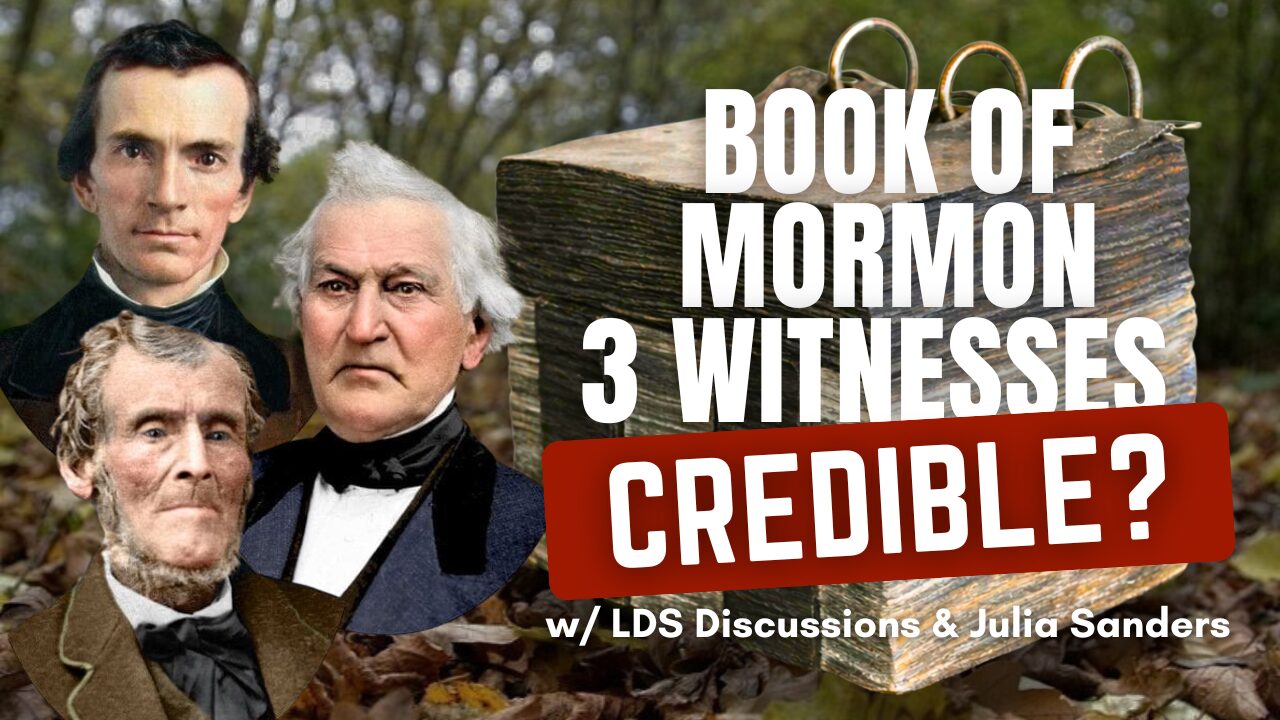
Martin Harris, Oliver Cowdery, and David Whitmer signed a statement saying an angel showed them the gold plates. Julia of Analyzing Mormonism pulled together what those three men said afterward, in letters, newspapers, interviews, and a pamphlet, and here she walks John Dehlin, Nemo, and Mike (LDS Discussions) through it slide by slide. This is part 52 of the LDS Discussions series and the first of a two-part look at the Book of Mormon witnesses; the eight witnesses get their own episode next.
Julia starts with the Book of Mormon passages and the Doctrine and Covenants revelations that promised witnesses before any had been named, then reads the printed testimony of the three and the eight. The panel spends real time on the question that runs through the whole episode: did the witnesses claim to see the plates with their natural eyes, or in vision? They read Stephen Burnett’s 1838 letter describing Martin Harris saying in public that he saw the plates only “in vision or imagination,” and a run of Palmyra newspaper items and later interviews in which David Whitmer’s account shifts in its details. They look at Whitmer’s own pamphlet, An Address to All Believers in Christ, where he had every opportunity to describe seeing the plates himself and instead copied the printed statements. Oliver Cowdery’s 1829 letter in the Gospel Luminary and his later life get a shorter treatment.
Along the way John asks Julia to profile each man’s reputation and worldview, and the group weighs Fawn Brodie’s argument that the differing versions make the three look less like conspirators and more like true believers. Julia also revisits the Mormon Stories episode in which Trent Toone built a replica set of plates from materials available to Joseph Smith in about two hours. Mike, who has long argued the witnesses don’t settle anything, gets the last word when Julia’s final slide makes his point for him.
What’s covered
- 00:00 Introduction and episode overview
- 01:57 Meet the guests and their backgrounds
- 04:22 The three witnesses: background and context
- 13:13 Revelations and testimonies regarding the witnesses
- 24:09 Spiritual vs. physical viewing of the plates
- 34:59 Text of the three and eight witnesses statements
- 44:17 Credibility of witness claims: key debates
- 52:53 Profiles of Martin Harris, Oliver Cowdery, and David Whitmer
- 1:11:58 Contemporary accounts questioning the witnesses
- 1:19:32 Harris never saw the plates with natural eyes
- 1:48:16 Discrepancies in David Whitmer’s story
- 2:09:03 David Whitmer’s later interviews and statements
- 2:13:22 The eight witnesses and their testimony
- 2:28:41 David Whitmer’s published pamphlet and beliefs
- 2:34:26 Assessing Martin Harris and David Whitmer
- 2:36:27 Oliver Cowdery’s witness and later life
- 2:51:05 Physical evidence and replica experiments
- 2:57:43 Final assessment of all three witnesses
- 3:18:35 Closing reflections and takeaways
Related episodes: Are the Eight Witnesses to the Book of Mormon Credible? w/ LDS Discussions Ep. 53 | Ep. 1895 · Additional "Witnesses" of the Book of Mormon Gold Plates | LDS Discussions Ep. 54 | Ep. 1898 · Did the Book of Mormon Witnesses Really See Golden Plates? – John G. Turner Part 5 | Ep. 2033
Originally published on mormonstories.org.
Transcript
Machine-generated and lightly edited. Click any timestamp to jump the audio to that moment. The audio is authoritative; please check it before quoting.
Introduction and Episode Overview
John Dehlin Hello everyone, and welcome to another edition of Mormon Stories podcast. I am one of your hosts for today, John Dehlin. It's April 3, 2024, and today we are having another in our epic LDS discussion series, we're going to be answering the question, how credible were the three witnesses to the Book of Mormon? This will be a two part series. Specifically today we're going to cover the three witnesses to the Book of Mormon and their credibility. And then the next episode will be the eight witnesses to the Book of Mormon and their credibility. Again, this is all part of the LDS discussion which if you haven't been following it, it's a 51, 52 part series that's sequential. We started it about a year ago. It was definitely voted probably the most important thing we did in 2023. It's changed tens of thousands of lives. Basically, it's me and Mike and Nemo and now Julia, doing our best to gather the best evidence around Mormon Church truth claims and then to present them as thoughtfully and as neutrally and as balanced as we can so that then you can make an informed decision about your thoughts and feelings and conclusions around the Mormon Church's truth claims. So we recommend that you watch these in order. If you haven't seen the first 50 or 51, we recommend you stop this, go back and start from the beginning. Then you can get the most out of today and tomorrow's episode. You can find the LDS discussion series on Spotify, as this standalone podcast on itunes and even on YouTube. We have a playlist at Mormon Stories podcast where you can watch them in order. This is of course all based on the amazing essays that Mike did@ LDSDiscussions.com but now we're adding to it with Julia's work and others. So without any further ado, we welcome back to the show, Julia, Nemo and Mike. All right, Julia, remind us who you are. Tell us about your TikTok channel and your graduate work. Really quick.
Meet the Guests and Their Backgrounds
Julia Yeah, so I'm on TikTok, Instagram and YouTube under Analyzing Mormonism and there's a website analyzingmormonism.com and I am attending Missouri State. Go Bears. And I'm getting my degree in history.
John Dehlin And you pulled together today's episode.
Julia I did, yeah.
John Dehlin Thank you. Thank you for doing that. You do great work. Nemo, tell us about how you're doing. Tell us about your channel and even if you want to, about what's going on this weekend.
Nemo Yeah, cool. I run the Nemo, the Mormon Channel where I look at the truth claims of Leaders of the church particularly, particularly their statements, how truthful they are, and, you know, kind of analyze the church in that way. I do the Nemo Co Conference halftime show, which is coming back this weekend, where me and my guests will be watching all nine and a half hours of conference, just so that people don't have to if they don't want to, because we will be providing session by session, recaps and commentary so that people know what's being said and they don't have to watch it themselves. And I will be announcing a new project I'm working on, which is secret, but that will be announced during the conference halftime shows, and it will be something that the viewers can get involved with. So that's very exciting.
John Dehlin And for those who don't know, for the Never Mormons General Conference, twice a year, the top leaders of the church are, quote, prophetic, all the 12 apostles and other leaders speak to the worldwide membership. And it's pretty boring, interesting, sometimes fascinating, sometimes controversial. So it's worth checking out Nemo's work. Anyway, thanks, Nemo. Mike, tell us quickly about you, how you're doing. Give us a quick intro.
Mike (LDS Discussions) Yeah, so just put together the LDS discussions website with some other people and then kind of did the overview project as something I did on my own within the website and doing good. Like, been pretty disconnected from all things Mormonism for the most part, for the last six months or so. And it's been kind of nice because you get burned out on all this stuff, but this is definitely an interesting topic, so I'm glad to be back for it.
John Dehlin Okay, so, Julia, we've got a bunch of slides, so obviously, those of you listening only, we welcome you. We're going to do our best to make sure you get the full benefit of this episode without seeing the visuals. But we do want to remind people you may get the most out of this from watching it. We're going to be reading a lot of slides today, but, Julia, let's turn it over to you and let's get going.
Julia Yeah, sure.
John Dehlin Should we start the slides?
Julia Yeah. Yeah.
The Three Witnesses: Background and Context
John Dehlin All righty. So first. First slide.
Julia Yeah. So first I just want to give a little bit of a background for these. So in the Book of Mormon, there are four different times where they. Where the Book of Mormon references these witnesses. We don't have to read all of them, but it's ether, chapter 5, verses 3 through 4. Then you have two Nephi, chapter 11, verse 3, and then second Nephi 27. It's referenced twice in verses 12 through 14.
John Dehlin Yeah. If it's okay for our never Mormons. Can we just give a tiny bit of background on what we're talking about?
Julia Oh, yeah. So Joseph Smith claimed to have had the gold plates. And then during the middle of his translation, he has Revelation, or the book says, the gold plates say that there will be three witnesses who will see these plates. And so that's where. So it was referenced these few. These four times in the Book of Mormon. And then, and then we can go on with the, with the rest of the history, if that's.
John Dehlin And the general idea is that out of the mouth. I remember this quote growing up. Out of the mouth of two or three witnesses shall all things be established. And then, you know, once these witnesses allegedly handled the plates and saw them and saw God or Jesus or the angels or whatever they did or didn't see, then they write this down and it's in the Book of Mormon, one of the opening pages. And then for like two centuries after, when anyone challenges Joseph Smith's claims to have seen gold plates or to have translated the book or to have seen divine spirits or whatever, the Mormon Church would say, well, there's the three witnesses and the eight witnesses. So how, you know, touche. You know, checkmate. How are you going to argue with three witnesses and eight witnesses? Is that right? Is that.
Julia Yeah, that's a great, that's a great summary.
John Dehlin Okay, so I just wanted to, for our never Mormons, I just wanted to level set on that. Okay, so you're. We're jumping to that first slide because the Book of Mormon, I guess, quote, prophesies or predicts these witnesses. Right? Okay, Julia.
Julia Yeah, So I just wanted to point out that there was four times where that happens in the Book of Mormon. And then again.
John Dehlin Let's read a couple. Let's go and read a couple.
Julia Sure. So in ether 5, 3 through 4, this is the first time, even though ether's later in the book, he doesn't the rest of those. He writes last, like he writes second Nephi later. So the first time he references it is an ether. And unto three shall shall they be shown by the power of God, wherefore they shall know of a surety that these things are true. And in the mouth of three witnesses shall these things be established, and the testimony of three. And this work in the which shall be shown forth the power of God, and also his word, of which the Father and the Son and the Holy Ghost bear record. And all this shall stand as a testimony against the world at the last day.
John Dehlin Maybe. Should we Read one more.
Julia Sure. Nima, do you want to read one?
Nemo Absolutely. I'll read second. Nephi 27:22. Wherefore, when thou hast read the words which I have commanded thee and obtained the witnesses which I have promised unto thee, then shalt thou seal up the book again and hide it up unto me, that I may preserve the words which thou has not read until I shall see fit in mine own wisdom to reveal all things unto the children of men.
John Dehlin And, Julia, just so I understand, you know, there's two options. One is that ancient Native American prophets etched these words into the golden plates, predicting that these three witnesses would bear witness to the Book of Mormon. That's option one. And then option two is that Joseph Smith is writing this book, and then he's thinking, how am I gonna make people believe that I'm actually looking at plates when I didn't allow anyone to actually see the plates? In fact, I've hid them. Either the plates didn't exist, or I meticulously hid them from everyone. How am I gonna get people to believe it? And so, as he's finishing the Book of Mormon, he comes up with this idea. I'm gonna be showing them to three people, or at least finding three people that I can convince to claim that they saw the plates so that then there'll be additional witnesses in addition to me. Did I get that right? And Mike and Nemo, you can add. I just want to make sure I and our viewers understand what's going on here.
Nemo I've got a third one.
John Dehlin Okay, Nemo.
Nemo So, because I think you started by saying that the prophets put it in there as an instruction for Joseph, the third option, just so we can't be accused of creating false binaries, is that they wrote this book, Joseph read it and saw all these references to three witnesses and was like, huh, that might be a good idea to then get. You know, he may have taken that as inspiration to then find himself three witnesses for the plates. Whereas it's not, like, necessarily a direct command. So that's the third option. So I can accuse you of creating a false binary.
John Dehlin Mike, anything you want to add to that, Mike?
Mike (LDS Discussions) No, I. I think that there's a power to having people sign a statement to say that it's real because, you know, as Joseph Smith is doing, you know, however you want to say it, writing, translating, the Book of Mormon, you've got people around him who are fascinated by it. You got people reporting on it, and not the best ways. And so, from Joseph Smith's perspective, the best Way to try to get some credibility for the Book of Mormon is have other people sign a statement so that people aren't saying, well, we're not just going to take your word for it. And I also think, as you mentioned briefly at the start of this episode, that's what the Church does today. It's like when you start to have doubts about the Book of Mormon's authenticity, you'll often hear, think about the witnesses. They were, you know, they left the church and they still believe. So I mean, there are a lot of. There's a lot of value in, in having a signed statement from people beyond yourself trying to back up what you're claiming the book is.
John Dehlin Okay, Julie, did you want to add something?
Julia Yeah, I wanted to also note that, that during this translation process, we're not talking about the translation here, but there were at least seven scribes, including Martin Harrison, Oliver Cowdery, who were the two of the three. They did not see the plates during this process. Martin Harris talks about there being a screen between him and Joseph who had the plates. They also talk about how Joseph put his face in a hat and the plates were nowhere in the building or they were hidden under a cloth, things like that. So the, the, the scribes never saw the plates. And so Joseph is needing, or the Lord needs, however you want to view it, somebody to see these plates, to have other people believe that these plates exist.
John Dehlin Got it? Yeah. Okay, great. All right, so let's. We can see that there are four instances in the.
Nemo Real quick one.
John Dehlin Oh, Nemo. Yeah.
Nemo It's just come to mind that this is the only one of Joseph Smith's three translations that we ever got to see the, that we have never been able to see the original of. So you have the Kinderhook plates and you have the Book of Abraham. Both of those we have the originals of. So the gold plates hold this special status within the works of Joseph Smith as the thing that no one was allowed to see, that got taken away once he was done with them. And so it's very significant that these individuals were included to see them and bear witness of them.
John Dehlin The source documents are not available.
Nemo Yeah, this is the only time that they're not available. The other two times we have them.
John Dehlin Got it.
Nemo Yeah.
John Dehlin Okay, Julia, next slide.
Julia Yeah, so this is just me because I was curious about the timeline, about when he. So in my head, Joseph, this is a 19th century book, but you can see this just as an understanding, even if you are a member of the church or an active, believing member, about when These come about. These. The. In the text where they talk about the three witnesses. So the translation starts in early 1828. And then, so I guess about a year later, In April of 1829, Joseph Smith comes up with. Or excuse me, these scriptures talk about there being three witnesses. So I was just curious about when. When that kind of happened. So just I highlighted and read just those two books in the whole Book of Mormon. Discuss the three witnesses.
Mike (LDS Discussions) Can I also add one little note here? And we mentioned this, Mike, before.
John Dehlin Before you do so, Julie, I want to make sure I understand. So early 1828, he begins the translation. By that fall, Martin Harris loses the 116 pages, and Joseph has to go a season, which is like, I don't know, two seasons without translating. And then Joseph Smith starts in April of 1829 in Alma. Right, Right.
Julia Yeah. So he starts again with Oliver in mind. And then, yeah, you can see that in the. So Mosiah 3 is where they. Where they. Where Oliver picks up. And then. And then you've got Alma, Helaman, third Nephi, and then Ether. He's like the. The text says three, three witnesses. And then you've got first Nephi, second Nephi, and then again there's the reference of the three witnesses. And then they go on to complete the book. And then in June, Joseph gets the copyright. June 11th of 1829. And then in June, we don't know what day they see them, but that's just shortly around him getting the copyright. The witnesses see the plates.
John Dehlin June of 1829.
Julia Yes. So, yeah, so he's had the plates for a year at least.
John Dehlin And it's sort of like halfway through his writing of. Or the translation of the Book of Mormon does this idea of three witnesses emerge?
Julia Right. So I was just curious about that.
John Dehlin So, okay, Mike, did you want to add a disclaimer or a thought?
Mike (LDS Discussions) No, actually, we're good. I want to add it later, actually. I think.
John Dehlin Okay. All right, so thanks, Julia. That timeline is. Is helpful. All right, what's. What's the next thing?
Revelations and Testimonies Regarding the Witnesses
Julia And we don't have to read all of these, but they're Joseph Smith. In addition. In addition to what the Book of Mormon text says or the plates, Joseph Smith received revelations directly from God concerning the three witnesses. And so this happens in March of 1829. This is what's canonized now as a doctrine covenant, section 5. And then again in April, DNC section 6. And then. And then in June, he gets those where they. He gets the copyright the same month. Doctrine Covenants 14 and Doctrine Covenants 17 all talk about having these witnesses.
John Dehlin Let's read the first two, Julia, just to give people a sense. Go ahead and assign readers.
Julia Mike, do you want to read the. The DNC5?
Mike (LDS Discussions) Yeah. So DNC5 says, and in addition to your testimony, the testimony of my. Of three of my servants, whom I shall call and ordain unto whom I will show these things. And they shall go forth with my words that are given through ye, through you. Yea, they shall know of a surety that these things are true, for from heaven will I declare it unto them I will give them power that they may behold and view these things as they are.
Julia Perfect. Okay. And then I'll read the June 1829. This is DNC 14. This is directly to David Whitmer. It says, and it shall come to pass that if you shall ask the Father in my name in faith believing you shall receive the Holy Ghost, which giveth utterance that you may stand as a witness of the things which you have both seen, both hear and see, and also that you may declare repentance under this generation.
John Dehlin Okay, so this is Joseph Smith, before the church is established, before the Book of Mormon is actually published, already receiving revelations and telling some of these key witnesses when and if and how they'll be likely to become witnesses. Right, right. Like months. Let's say six months. Ish. Before it happens.
Julia March. From March to June is when.
John Dehlin Oh, okay, right.
Julia March, April, May, June. So like four months?
John Dehlin Yeah, three or four months. Okay, perfect.
Nemo All right. Okay.
Mike (LDS Discussions) So this is where I wanted to add my note. And I. I know it's probably not a huge deal, but it's interesting that he claims this revelation in March of 1829, and then in April starts adding it into the Book of Mormon. It's almost like he had the idea through the Revelation, and then all of a sudden it works its way into the text, which I just find interesting from a timeline perspective. I think that's noteworthy.
Julia I'm glad you said that. And I want to plug that back in in a couple of slides or maybe even the next slide, because that's interesting to me. I hadn't thought about it that way around the time.
John Dehlin So going back to the timeline, around the time he's writing this into the book. But that's really important.
Julia It is. Yeah.
John Dehlin He's writing this into the Book of Mormon, then he comes up with the revelations.
Julia Right?
John Dehlin Yeah. Okay, that's good. That's good. And I hope Mike didn't steal too much of Julius Thunder, but repetition, I Hope not.
Julia I actually didn't have that as a talking point, but I think that's super important.
John Dehlin It's super important. Thanks, Mike. Okay, next slide.
Julia Okay, so in the Joseph Smith history, let me see if this is the one where. Okay, yeah, this is the one. So I don't know what the date is on here. I don't even know if it had it on Joseph Smith papers. But at the. I don't know if we want to read this whole thing.
John Dehlin I'll read it.
Julia Okay.
Nemo It says June 1839 at the top of the page.
Julia Okay. So I wonder if he's retroactively 29 or 39.
Nemo Sorry, 39.
John Dehlin It is 39. Okay. Okay. All right. So this is Joseph reflecting. In the course of the work of translation, we ascertained that three special witnesses were to be provided by the Lord to whom he would grant that they should see the plates from which this work, the Book of Mormon, should be translated, and that these witnesses should bear record of the same as will be found recorded. Book of Mormon, first edition. And then it goes on. Almost immediately after we had made this discovery, it occurred to Oliver Cowdery, David Whitmer, and the aforementioned Martin Harris, who had come to inquire after our progress in the work, that they would have me inquire of the Lord to know if they might not obtain of him to be these three special witnesses. And finally they became so very solicitous and teased me so much that at length I complied. And through the Urim and Thummim, I obtained of the Lord for them the following revelation. That's interesting. It's. It's almost like, does. Is that how it works? If you bother Joseph Smith enough, you get to become a witness. That's interesting.
Julia It makes me wonder because in the ether, I'm not sure if it's specifically talking about the three witnesses or if it's sort of like it seems to have the same language as the. As the New Testament, where it's like, oh, from the mouth of two or three witnesses shall my word be established. That type of language. And so I wonder if they heard that. And they're like, well, maybe they started teasing Joseph. And then I wonder if maybe he. He then in March, he comes up with these revelations and then puts that in the text of the book. Mormon in ether, in second Nephi. That's just what I was thinking when Mike was talking.
Nemo Sorry. And it was 1829. Sorry. It was okay. Double checked.
Julia But still he's retroact. He's reflecting on these Things happening.
Mike (LDS Discussions) Yeah, I mean, I think, man, I could have swore we had mentioned this in our episode on Revelation, but there's. There's a few points where Joseph Smith is either getting Revelations or things are happening around him that just happened to make it into the Book of Mormon around that time. And it just shows how, as I put it at the time, it's very convenient. And so in this case, it's just think of the. The difference between Joseph Smith saying, they kept bothering me and, yeah, of course I went and I prayed and got the answer versus 2024, where the church is like, yeah, I know all of you guys want to know who Heavenly Mother is or what our stances on certain positions, but we don't get answers like that. It just shows how Joseph Smith got answers whenever he needed him to. And leaders today have nothing. And it's just interesting.
Nemo Yeah, yeah, agreed.
John Dehlin That's good. Okay, next slide.
Julia Okay, so this is just me summarizing the story of the three witnesses from the history of the Church. And I don't know if somebody can do a better job. I don't know if we need to read it or if I can just summarize it.
John Dehlin Go ahead.
Julia Okay, so we, in the history of the Church, we read about Joseph Smith going with Martin Harris, Stacy David Widmer, and Oliver Cowdery. And it says specifically into the woods to obtain the witness. So after praying for some time, Martin proposed. Martin proposes that he should withdraw because he thinks he's the problem. He thinks due to sin or whatever, he's. He's causing this event not to happen.
John Dehlin Praying to get a visitation. From who? From God and Jesus or from Moroni, or who he.
Julia Joseph. I think Joseph was clear that the angel Moroni would show up and he would show them the plates.
John Dehlin So they're all kneeling in the forest with Joseph, Moses, Martin, Oliver, and David. And the angel doesn't show up.
Julia Right.
John Dehlin Martin thinks he's the problem and he leaves. Keep going.
Julia That's what Martin goes. And so the rest continue praying. And then as they're praying, the angel does appear and shows them the plates. And then Joseph says that he. After they all obtain their witness, he goes and he finds Martin praying. And then he prays with Martin. And then Martin is able to see the angel with the plates. And he says, it is enough. It is enough. Like I've seen, you know, and he gives this sort of testimony. So just. That's just the. The canonized history of the Church. You'll see it in their videos and in the of obviously, the history of the church. So that's just the general story.
John Dehlin Do you have commentary on that later? Julia? About, like, Fawn Brody talks about that a little bit, and there's a way to make sense of that from a secular perspective. I. I don't want to steal thunder. Do you talk about that later?
Julia Go ahead and say it. I tied in differently, though.
John Dehlin I'll ask Mike and Nemo if they have thoughts about that first, and then I'll add it if they don't.
Nemo I do have a thought. It's not what you're going to say necessarily, John, but I think it does smack a lot of Joseph Smith's days of treasure digging. The idea that the. The necessary requirements for the thing to happen are shifting and ever changing. And it required him to isolate an individual in order for them to get the special witness, and they were taken out as the problem. And it's that person then didn't see what the others saw. So it's not a collective group, and it's kind of that divide and conquer, giving people certain bits of information.
John Dehlin Okay, Mike, did you have anything you wanted?
Mike (LDS Discussions) Just two notes. One is that when we talk about the history of the church, that's written after the three witnesses who run out of the church. So it doesn't mean that Joseph Smith is making it all up. It just means that he's telling that story through his own perspective without having to worry about anyone else contradicting him. We brought that up with previous episodes with the. The Charles Anton visit where Joseph makes huge changes to the story and Martin Harris isn't there to say, no, that's not what happened. So that's worth keeping in mind because now we're going to go back and kind of look at it, you know, at least the accounts we have from that time. And then, as Nemo said, this is very much like treasure digging. You got to remember that there are early stories of the angel. At the time it was called Nephi. Right.
John Dehlin And.
Mike (LDS Discussions) And there are a lot of similarities between how Nephi is described versus how a guardian of a treasure would be described in those days. And so this is a very magical worldview. And so I think that might be where you're going, John, as far as how to explain some of this. But, yeah, you got to keep that in mind that the people Joseph Smith is selecting are all involved in this world of treasure digging. They believe that you can find treasure with. With. With rocks and that with a rod you can find water. So you got to keep that in mind when you kind of think about Martin Harris and Oliver Cowder and David Whitmer, because they are all believers already. They're primed for this.
John Dehlin And I know Julie's going to cover that later. Okay, the one thing I was just going to add, one of the revelations that Grant Palmer gave to me, academic revelations, not spiritual revelations, was this idea of spiritualized versus physicalized. And I'm sure Julie's going to talk about that later, but it's this idea of did an actual corporate. Because in Mormonism, angels and God and Jesus are resurrected beings. If they've died and then they're often reappearing and visitations are real. You're not just caught up in a vision, you're seeing actual physical beings. Joseph Smith literally saw God and Jesus with his eyes and they were corporeal physical beings. And already if, why, why would Martin Harris, if, if Angel Moroni appears presumably as a resurrected being, why would Martin struggle to see him? He's either physically there or not. And if Joseph and Oliver and David can see him, then Martin could see him. Whether or not Martin's having indigestion or a bad day. So already this is begging. This is making me wonder if this is kind of the spiritual eyes idea. And Fon Brody talks about this later. Sorry, Fon Brody talks about this in no man knows my history that her theory is that maybe Joseph was able to whip people up into sort of concocting in their brain a vision. Sort of like, can you see it now? Let me describe it to you. Can you see it now? And then people would in their mind's eye see it versus an actual being appearing and seeing it with their physical eyes. And this is already starting to make me wonder that it's probably not the physical appearance which is the problem.
Spiritual vs. Physical Viewing of the Plates
Julia Well, so I wanted to add too, if I can just take a moment. So another thing is that my thoughts, whenever you were talking, I was like, maybe, maybe it's the angel can't be in the presence of sin or people who have, are having bad thoughts. Maybe that's just like, I don't know. And so maybe that's why Martin Harris had to leave. But at the same time, angels have appeared in scripture, even in the Book of Mormon, to people who did not have faith. It appears to Alma the Younger, who was rebelling against the church. I think he was a full on atheist. I think that's kind of how the text reads.
John Dehlin Or Saul on his road to Damascus.
Julia Yes. Yeah. So there's so many instances where angels appear physically without the Person having faith. So Martin leaving would lead me to believe, like you just said, John, is that this seems to be a more. Or I guess, Fawn Brody. This seems to be more of a visionary experience rather than an actual person showing up.
John Dehlin And that comes up in their affidavits later. Right, Right.
Mike (LDS Discussions) Is this a good time to mention that we do have a very good account of how Joseph Smith might be able to work people through visions. Or should we wait till later on that?
Julia You talk about that, Julia, with Sidney Rigdon?
Mike (LDS Discussions) Yeah.
Julia I don't have any specific slides on it, so you're. Wherever you feel good to plug it in.
John Dehlin Go ahead.
Mike (LDS Discussions) Yeah. So this is just. This is one of those things, like we talk in different episodes about there's certain events within Mormonism that you can really grab to to kind of understand better how Joseph Smith is doing it or how some of these pieces fit together. And so Joseph Smith and Sidney Rigdon are basically. They're in the Kirtland Temple.
Nemo Right?
Mike (LDS Discussions) It's. Is it DNC 76. I think I could be wrong on that. But anyways, they're in here. And basically this vision is Joseph Smith saying, I see xyz. Do you see it? And Sydney Rin says, I do. I see it. I see xyz. Do you see it? Justice as I do see it. And so it's really interesting because Joseph Smith is. There's an account because kind of like what. What you just said about how if. If. If an angel came and Martin Harris walks away, he's like, you know, 50 yards away. He's gonna look and say, oh, crap, he just came. I'm gonna go back over there. No one else in. In the temple sees what Joseph and Sydney Rigdon are seeing. So they're watching the two of them talk to each other, but they're not witnessing anything because nothing is actually happening. But what's interesting is in the account, they talk about how Joseph Smith sits. This is Philo Dibble. And he says, Joseph sat firmly and calmly while Sidney Rigdon lay. Sat limp and pale and as limber as a rag. So basically, Joseph Smith is in control of this and he has no issue. Sidney Rigdon is really worked up. He's sweating, he's about to pass out, he's pale and all this stuff. And it just shows how Joseph Smith has this ability to. To get people to kind of see it. And it's the same thing again. Going back to treasure digging, Joseph Smith has made a. A living. Maybe not great, but he's been able to get money out of people by convincing them that there's something there when. When there clearly is not.
John Dehlin Yeah, that was his superpower, in my opinion, prior to 1830, because even the people that didn't see the treasure believed that Joseph Smith had power to find treasure, even though he never found treasure. So clearly he's able to convince people to believe things even when they don't see the things with their physical eyes. That's clearly his talent. And it's. It's very likely what's going on here.
Julia Yeah.
John Dehlin Okay. All right. Great analysis, everyone. All right, next slide, Julia.
Julia Okay, so this one. We'll talk about this more later, but in another revelation, Julia, June of 1829, this is D&C, 17, Joseph, it says that this revelation was given previous to them having a view of the plates. And he goes through and he lists off different items that they'll. That they will see. He says, you shall have a view of the plate and also the breastplate, the sword of Laban, the Urim and Thummim and the Directors, which he means the. I guess that's a Liahona, because in the Book of Mormon, the Urim and Thummim is called director. So that's kind of confusing. But then it says that, and I highlighted in blue different parts where it says, by your faith, you'll see these things by that faith after you have obtained faith. It is because he had faith that Joseph Smith was able to see these things. And that. And then he also says, and one of the things I think is really important, God is commanding them. He says, you shall testify of them of witnessing these things by the power of God. And this you shall do that. My servant Joseph Smith Jr. May not be destroyed.
John Dehlin Interesting. What do you make of that, Julia?
Julia Well, so we'll look at it later. There was other witnesses that said if anyone saw these plates not with God's commandment, God would destroy Joseph Smith. And so God is giving his okay here to say okay, because I'm giving permission. They can view the plates, and they're only going to view them so that they can testify. And if they don't testify, then Joseph's going to be destroyed. And we'll see those again later. So I thought that was interesting. But also the parts where it talks about having faith, again, like angels have appeared in scripture references without people having faith. Also seeing a thing like, or even doubting Thomas, he sees Christ, he didn't have to have faith because Christ is there. And then like, if a thing is. If a thing actually exists, and you're going to show it to them. Nobody needs to have faith. You just show it to them. And so I just thought that was important to point out.
John Dehlin And, Julie, as I'm reading this the way I would interpret it, not hearing your context when it says, and you shall testify of them by the power of God, and this you shall do, that my servant Joseph Smith Jr. May not be destroyed. I'm thinking that what God's saying is, is that there'll be a lot of people inclined to not only not believe Joseph, but to potentially be an antagonist to him or kill him. Except for the fact that now there'll be other people who can witness to having seen the plates. So the world won't want to kill Joseph. That's how I'm reading it.
Julia That's absolutely a good way to see it, too. I just. Just seeing it in further context or seeing other sources made me think the other way. But, yeah, I think that's totally. That's a good way to read it as well.
John Dehlin Okay. Yeah.
Nemo I think what's interesting there is that that's the reading you could definitely take if you wanted to lean into sort of the persecution complex that readily comes to early church history. This idea of, you know, you really want to amp up that idea that people are trying to kill Joseph over his ideas. Not necessarily over his actions, but over his ideas, over the things he believes, you know. But it's. It's also interesting to me that Joseph Smith uses the threat of God not only against others. You know, when he's trying to practice polygamy, he threatens people's eternal salvation at times.
Mike (LDS Discussions) Right.
Nemo And their happiness and whatnot. But he also uses threats that God would make against him. So he's saying, oh, look, God's going to destroy me if you guys don't, you know, get a witness of these plates. God's going to destroy me if I don't practice polygamy. And angels come and told me I will be destroyed.
Mike (LDS Discussions) So.
Nemo So it's an interesting psychological thing he does, not to threaten others, but to threaten himself. And he's built this relationship with people where, oh, well, we don't want him to get hurt, so we'll do this for him because we follow Joseph. It's just interesting he puts himself under threat as much as he puts others under threat.
John Dehlin Mormons believe that the God that Joseph was talking to is actually Jesus Christ or Jehovah. I'm so tired of Mormon Jesus wanting to destroy everybody, wanting to destroy Joseph. If the girls won't, Miriam Wanting to destroy Emma if she won't let Joseph have the plural wives. Like, I'm so tired of Mormon Jesus so eager to destroy people if they don't do exactly what he says.
Nemo To be a bit glib, I thought Mormon Jesus had, like, chilled out once he came to Earth and he'd, you know, he'd experienced what it was like to be mortal, and I thought he'd kind of got it. He realized it was all good because he was getting raging in the Old Testament, and I thought he mellowed, but he seems to have got raging again.
John Dehlin It's like one. It's like two seconds away from destroying, like, pretty much everybody. He's destroying entire civilizations with earthquakes just because Jesus comes. Yeah, that's annoying.
Mike (LDS Discussions) It's convenient, right? And that's the thing. So Joseph Smith, like Nemo mentioned with polygamy, it's just. It's very convenient to say, hey, Lucy Walker, if you don't marry and have sex with me, it's. It's not. You're going to lose your salvation, but I'm going to get killed because of it. Do you really want your prophet to be killed? And with the witnesses, it's just as powerful because these people are, like I said earlier, they're from that magical worldview. They're sitting around, they're seeing Joseph Smith do his thing. They're full believers. This is not. I don't believe this is a con. I think they really believe it. So it's a really powerful kind of twist to make it about you being destroyed as opposed to saying, if you guys don't profit, if you guys don't testify to the world, you'll be destroyed. It's like, no, no, you're putting it on me. And then my other note is this. Can you put the slide back up real quick on this?
John Dehlin Yeah.
Mike (LDS Discussions) So when. When this came up, when I was going through the slides earlier, I thought, this is weird because Urim and Thummim is in there. And I know for sure they hadn't created the idea of the Urim and Thummim yet because it's too early. And I looked this up. This is a revelation that was recopied. So this is not what was originally given. We have no idea what was originally written because that is gone. And the Joseph Smith's Papers project says that John Whitmer copied this revelation that was believed to have been given in March of. Or copied this Revelation, circa March, 1831, into Revelation, book one. But the page on which it was copied was removed at some point from that volume and is no longer extant, which means we don't have the original Revelation. For unknown reasons, the printers of the Book of Commandments chose not to include this Revelation text in that volume. Some language used in the version copied in Revelation Book 2 does not fit in 1829 context, such as the fact that they made up the Urim and Thummim, which we discussed in a previous episode. That is completely retrofitted, suggesting that the version was modified from the original. There's no suggesting it's absolutely modified, although the degree of modification cannot be known. That's true. We don't know how much. But what I'm saying is this Revelation is probably adding in a ton of stuff. This is likely written at the earliest in 1834, possibly later. So all of this stuff is being retrofitted back in. So we have no. No idea what the actual, actual Revelation is, but this is definitely not it.
Nemo Awesome. Can I just ask John a real quick question before we move on?
John Dehlin Yeah, yeah, sure.
Nemo Just from a psychological perspective, I've just had the thought right. Joseph Smith, if he's trying to get people to do what he wants, he's got a toolbox of methods that he can use to try, and I'm not gonna use the word manipulate, but to try and get people to do what he wants.
John Dehlin Right.
Nemo One of them is to threaten people directly. One of them is to threaten someone directly with this deity that he speaks for. But I guess what I kind of was touching on earlier, but it's just come more clear to me, is that what he's doing by telling people he'll be destroyed if they don't do X or Y, he's offering someone an opportunity to save him. He's giving someone the opportunity to be the hero. And that seems to me that will do things very differently to someone psychologically, offering them the chance to be the hero rather than making them the victim of the scenario.
John Dehlin Yeah. Who doesn't want to be a hero?
Nemo Right, Exactly. Who doesn't want to save the prophet of God?
John Dehlin Yeah, that's good.
Nemo Yeah.
Mike (LDS Discussions) Just a thought.
John Dehlin Thanks. All right, good analysis. Let's go to the next slide.
Text of the Three and Eight Witnesses Statements
Julia Yeah, so I wanted to point out. So this is the whole text of the testimony of the three witnesses. And I don't know, again, if. I don't know if we should read the whole thing.
John Dehlin Yeah, let's. Let's just go ahead and read things when they're on the slide.
Julia Sure. Okay. Mike, do you.
John Dehlin Okay. Go ahead.
Julia Mike, do you want to read this one?
Mike (LDS Discussions) Yeah. Be it known unto all nations, kindreds, tongues and people unto whom this work shall come. That we, through the grace of God the Father and our Lord Jesus Christ, have seen the plates which contain this record, which is a record of the people of Nephi and also of the Lamanites, their brethren, and also of the people of Jared, who came from the tower of which hath been spoken. And we also know that they have been translated by the gift and power of God. For his voice, voice hath declared unto us wherefore we know of a surety that the work is true. And we testify that we have seen the engravings which are upon the plates. And they have been shown unto us by the power of God and not of man. And we declare with words of soberness that an angel of God came down from heaven and he brought and laid before our eyes that we beheld and saw the plates and the engravings thereon. And we know that this is by the grace of God the Father and our Lord Jesus Christ, that we beheld and bear record that these things are true. And it is marvelous in our eyes. Nevertheless, the voice of God commanded us that we should bear record of it. Wherefore to be obedient unto the commandments of God. We bear testimony of these things. And we know that if we are faithful in Christ, we shall rid our garments of the blood of all men and be found, spirit, spotless before the judgment seat of Christ and shall dwell with him eternally in the heavens. And the honor be to the Father and to the Son and to the Holy Ghost, which is one God. Amen.
John Dehlin Okay, so they're seeing the angel Moroni presumptuously. They're seeing the golden plates, and they're seeing the engravings on the plates. That's what I got.
Julia Yes. And that's why I highlighted those in red, because. Which I think is interesting. And, Mike, I'm glad you gave that background because I'm not familiar with that, with the. I'm glad you said that about that being dated later, because Joseph was saying in the other revelation that they're going to see, I don't know how many other items, the sword of Laban, the Liahona, the Urim and Thummim. But the witnesses, when they sign the document, they. They say they only see the two things, the gold plates with engravings and the angel. And I just thought that was really interesting to pull out as well.
Nemo And also that it mentions the honor be to the Father and to the Son and to the Holy Ghost. Which is one God. Now, what we know. One of the major differences between the first and second edition of the Book of Mormon was that it changed Joseph Smith's nominally sort of trinitarian view of deity to a more Mormon view, as we would know it now, of three separate personages. But this hasn't been changed. And so I think this points to. This is a remnant of that earlier view of the people in the church at the time that they were viewing a more trinitarian. So some people will argue when I use the word trinitarian, there is a proper word for exactly what it was. I just can't remember it.
Mike (LDS Discussions) I guess modalism. Modalism for the.
John Dehlin We know if the church changed this written testimony afterwards or did they leave it the same?
Julia I just looked at them yesterday to see, because they did change the eight witnesses statement, but they only changed a couple of words in the three witnesses statement. And those ones are the same.
Nemo Okay, yeah, they're the same in this 1972 edition.
Julia They change like which to who? Or something like that. They only change like they're minor changes.
John Dehlin Okay, so any other summaries we're supposed to get from this slide, Julia?
Julia No, I just wanted to point out that they're. They're. Joseph's saying that they're seeing different things. And I just think that's interesting.
John Dehlin Okay, got it. And that's the, you know, that's the statement that the witnesses made, which is good for our audience to know. All right, let's talk about the statements.
Julia Okay, so just. These are just some facts about the statements. So in both of the witnesses statements, the three and the eight, there is no date given or time of day or location for the event. Each of the witnesses signed an already written statement. And then this is something that's just interesting originally, as you can see, the witnesses statements are published at the end of the book originally, whereas today they're published at the very beginning of the book. So that. So that they're the first thing people see. But back. I don't know why Joseph did it that way, but it's smarter to move it to the front. But I think that's interesting. Okay, and then another note is, with the exception of Martin Harris, all of the witnesses were related to the Whitmers or the Smiths. So Oliver Cowdery was married to Elizabeth Ann Whitmer. And then you have David Whitmer, Christian Whitmer, Jacob Whitmer, Peter Whitmer, John Whitmer, Hiram Page, who was married to Katherine Whitmer. And then you have Joseph Smith, Senior, Hyrum Smith, and Samuel Smith.
John Dehlin Wow. So it seems like it's basically two Faniel families, the Smith family and the Whitmer family.
Julia And then Martin. Right?
John Dehlin Yeah, and then Martin, who we'll talk about later what his motives might have been. But, I mean, I guess that it's a foreshadowing of credibility if it's just like a family thing.
Julia Right, Right.
John Dehlin Family, job.
Julia Yeah.
John Dehlin Okay. All right. Should we go to the next slide?
Julia Sure. Okay, so this is something that I found really interesting. So all the signatures, if you look at the witness statements themselves on the Joseph Smith papers, all of them are in Oliver Cowdery's handwriting. So while one could argue that the original three and eight witnesses signed what was on the original manuscript for the Book of Mormon and not what was in the printer's manuscript, which is what the pictures are here, there is little evidence that such a document ever existed. The Church says that of the nearly 500 pages placed in the Nauvoo House cornerstone, portions of 232 pages survive. The Church now possesses most of those fragments and leaves. Others are in private hands. Their owners graciously allowed those pieces to be photographed and included in this volume. That's taken from the. The Church does here. I'll just hold it up for a second. The Church, if you can. So the Church has these published. This is a huge. They're huge manuscripts.
John Dehlin What's it called?
Julia It's the original manuscript for the Book of Mormon. It's volume five.
John Dehlin Papers. Yeah.
Julia Joseph Smith papers.
John Dehlin Yeah, yeah.
Julia So if you'll go back to the slide for a second.
John Dehlin Okay.
Julia Okay. So that's where that quote is coming from. So for me, I purchased this, this whole book to see what the Church said about the witnesses statements. And there is no indication whatsoever that any original and personally signed witness statement ever existed. But I also want to say, regardless, having individuals sign a collective statement written by someone else is not as credible as having them make their own personal witness statements.
Nemo So best case scenario, they signed a document that someone else had already prepared for them, which we know is a typical Joseph Smith tactic from.
Julia Right.
Nemo It's a thing he does. Or worst case scenario, they never signed it at all. And all the signatures from the same person's handwriting as well as the document itself.
Julia Right. And so, like, I'm kind of confused, too. Just because the copyright for the Book of Mormon, like, we have all these documents that are perfectly preserved. Yes, there was a lot damaged when they were in the cornerstone, but the Church Even in this volume, they never give any kind of clue about the whereabouts. They're just like, oh, yeah, this, this thing happened. Like, they signed this statement, but they never say anything about their original, the original statement. So I don't, I have no idea if that has ever existed.
Nemo And that document was, as well as the testimony itself, was designed to increase the credibility of the Book of Mormon. Right. Was designed to shelter Joseph so that if people accused him of making it up and be like, well, hang on, these other people saw it, like John said at the beginning. But if I brought you a signed statement saying, look, these people, these people have signed a statement, said, and you went, well, none of them have physically signed it at all, then how would that, what would that do for you in terms of actually bolstering credibility of any kind? Yeah, it doesn't.
Julia Yeah. And then also with legal. So you'll see a lot of this with. We talked about John C. Bennett, and in his book, he talks about how he has or, well, he doesn't talk about this way, but there's a, there's a witness for the, there's like a judge, and then they'll say what time of day. And then it's signed, sworn affidavit, like in this person's presence. Like, that's how they, they legally do it. Which, which Oliver Cowdery is a lawyer. So I don't know why Joseph didn't do it that way. But in this one, they're just signing their names to something with no date, with. It's very vague. Like it's, it's just. And there's, there's not their own personal signatures. There's no, there's no other witnesses to them signing that.
John Dehlin Mike. Well, is there anything you want to add to this, Mike?
Mike (LDS Discussions) No. I mean, I, I just, I remember reading this when I first, first read the CS letter way back when, and I remember reading the Fair Mormon response. They basically say, well, if you think that's a big deal, it's just because you don't understand that the printer's manuscript was lost. And apparently we think that it was originally signed by them. And it's kind of like one of those games where it's like, well, we can't know, so we're just going to assume everything's fine. There are the responses that none of the 11 call out Joseph Smith for signing for them. So they're saying it's not like they disagreed with it. So, so this is one of those areas where you could kind of take your own path as to how you want to frame it, because we don't have it, so we just don't know.
Julia Right?
Mike (LDS Discussions) Yeah.
John Dehlin Yeah. On the one hand, it seems sketchy that, that it's all one person's handwriting. On the other hand, they apparently never denied it. So what does all matter? I, I. Okay. All right. What does Fon Brody have to say about this? Julia.
Credibility of Witness Claims: Key Debates
Julia Okay, so in her book, no Man Knows My History, Fawn Brody pointed out that according quote, according to the local press at the time, the three witnesses all told different versions of their experience, a fact that makes it all more likely that the men were not conspirators, but victims of Joseph's unconscious but positive talent of hypnosis.
John Dehlin And I do highly recommend no Man Knows My History for those who want someone who had really direct access to, to the source documents. And Nemo's showing it to you now. It's. I think it's the best biography ever written on Joseph Smith. That's my opinion.
Julia It's excellent.
John Dehlin Yeah.
Julia Yeah.
John Dehlin Okay.
Nemo I was just looking to see if I could find, like, the family proclamation to the world or Jesus the Christ. I know Jesus the Christ was signed and dated.
John Dehlin Yeah. Declarations. The official declaration.
Nemo Yeah. Assigned and dated. So. So it's not that the Church doesn't ever do this.
John Dehlin Yeah.
Nemo I guess it's just worth adding. Is that, like, for documents less important than someone's testimony of seeing something that got taken back to heaven so no one else could ever see it again? Things less important than that get signed and dated. So why wouldn't you sign and date?
John Dehlin I mean, it is not thinking about it now. It is kind of sketchy. Why not just write the names in a list? Why write them as if they're signatures if they're not signatures? Right.
Julia Well, I guess so. This is the printer's manuscript. So it's all. The whole thing is written in Martin or in Oliver Huddre's handwriting. So, like, I don't want to say that he's, like, forging their signatures. I just. Why?
John Dehlin They're not written, like, in a sentence.
Julia Oh, yeah, that's true.
John Dehlin They're written, you know, as if someone's signing them. Below each signature, another signature appears. That's just a little weird. All right. We beat a dead horse.
Julia Yeah. Yeah.
John Dehlin Okay.
Julia I just wanted to point that out.
John Dehlin Okay.
Julia Okay. So, yeah. So I just wanted to point these out as well. So, according to a presentation given by Richard Lloyd Anderson during a fair conference in 2004, he gave some numbers for the Book of Mormon witnesses where Quote, where they said something about the Book of Mormon. And he says, and I don't know the number. So that's why I'm pulling from him, because I. Anyway, so he says, Martin Harris was interviewed 50 times and Oliver Cowdery was interviewed 30 times throughout their lives. And then David Widmer was interviewed a minimum of 70 times. And so while I don't quite follow his math, Richard Lloyd Anderson says. He says, quote, so I've got about 200 times when one of the witnesses said, I did sign the statement, quote, the statement means what it says, quote, I saw the angel, quote, I saw the plates. Or in the case of the eight witnesses, quote, I handled the plates. So 200 very positive and specific statements in many cases. And I'm dealing today, this is during his presentation with about 8 or 10 documents. In other words, 5%. And the question is, do you believe the 95% or do. Or do you believe the 5%?
Nemo I'm sorry, the word about is doing a lot of heavy lifting in that sentence. About 200. It's 150.
Julia Right? I don't. I don't know if I understood the.
John Dehlin Julie, what's your answer? And then I want to hear other people's answer. Why is it that a checkmate 95% versus 5%, Julius?
Julia Well, if you, if you skip to the other slide, I put. I put my response up on the slide.
John Dehlin Here we go.
Julia So I say, while he is correct, that eight or ten documents give a different answer as to whether the witnesses saw the angel in the plates. The question in my mind of these documents is not whether to believe the 5% over the 95%. The question is, does the 5% change our understanding of the 95%?
John Dehlin Okay, and tell us what you mean by that.
Julia So, like, later we'll see these, this 5% or these 10 or 11 documents. They say that they only saw the place plates in a vision. And even one time, David Wimmer says, of course it was in a vision. That's how you see spiritual things. And like, if you frame it all with that mindset, like, this is how Joseph Smith, like you're talking about with Mike, with Sidney Rigdon, this is how Joseph has views revelations. This is how he walks other people through revelations is through visions or through. Yeah, and so, like, that's just how. Anyway, so. So seeing the five kind of helps you reframe the 95%, is what I mean.
John Dehlin Okay, Mike. And Mike, do you have a response to Anderson at all?
Mike (LDS Discussions) No, I, you know, I think we did an episode on Apologetics. And this is kind of that thing where, I mean, I don't want to say it's. I know they love to use the term Gish gallop, which is where you throw a bunch of stuff together. Doesn't all quite work. But because you're giving a lot, it really makes it seem like a stronger argument. And I think what he's doing is he's trying to deflect by saying, it's just a few. It's just a few statements. We don't have to worry about it. It'll be like saying the Book of Mormons, what, 270,000 words. So it doesn't matter that they change 50 words that change the. Our complete meaning of God, because the other 272,950 are the same. It doesn't matter, because what Julia said is true. What the differences are is how we can better understand and kind of recreate what might. What might have happened. And so it really is more of a deflection than it is anything else.
Nemo Yeah. What he's trying to do is create a false binary by saying that we have to put these 95% against the 5% because they're at odds with each other, they're fighting each other, which is not the case at all. You would look at all the source documents available, and you look at what they say in their entirety together about the circumstance, you'll say, okay, what we can actually tell from that is on 95% of occasions, they didn't go into the level of detail where they would state that it was a spiritual vision or et cetera, but on 5% of occasions, they did give that further detail. They don't contradict one another. It's just that they weren't as detailed in 95% of cases.
John Dehlin I mean, honestly, if this were a murder trial and the. The person accused of murder 95 times said he didn't do the murder, but then five times he said he did do the murder. Would we just go with the 95 over the 5?
Nemo Well, exactly. Or in 95% of interviews, he said I was at home doing X, Y, and z, but in 5% of them, he said I was at home doing X, Y, and Z, and then adds an extra detail that actually indicts him. That extra detail matters.
John Dehlin It does. It does.
Nemo Right.
John Dehlin I also wanted to just add something really quickly. It mentions in the. The. In the statement of the witnesses, and they have been shown unto us by the power of God and not of man. To me, that's important. Language. Because if they're physical beings and they're physical plates and they're just being shown, why does there need to be the power of God involved? It's just their physical being showing up, and you're touching the plates and you're seeing the angel. And so to me, that's code word for spiritual eyes, seeing the vision in your mind, but not actually seeing something physical. So it's kind of like they want it both ways. They want to be able to give a disclaimer that it was a vision or by the power of God. But then they will also want to make it sound like it's super physical and super real. The only other point that I wanted to make is why are they being interviewed 150 times? Why are people asking them over and over and over and over and over and over again? To me, that suggests that there's so much uncertainty or ambiguity that journalists continue to try and figure out, wait, did you see them physically? Did you touch them physically? Or was it the. Was it your spiritual eyes and in a vision? Because to the world, there's a huge difference between seeing something in a vision and seeing something with your physical eyes and touching them with your physical hands. And the fact that they were interviewed 150 times or whatever suggests that. That people remained unsure until their deaths. Maybe.
Julia I also wanted to point out that during this time. So the copyright page, the title page of the Book of Mormon was at the very end. And he doesn't get that that's part of the copyright until June. So anyway, during this whole process of getting the witnesses, Joseph is still translating the plates. So, so this is. So Joseph has the physical plates that he got from the Hill, Cumorah, and then he goes off in the woods with these three men. The angel appears with that same set of plates that the angel, I guess, had to whisk out of his house or the Widmer's house or wherever they are. And so I, so I just wanted to point that out that Joseph is still translating at this time. He had the physical plates, the plates were taken by the angel, and the angel is appearing in the woods to show them these plates, which has caused some other theories to come up about there being two sets of plates and things like that with the eight witnesses. And we'll get into that next through part two as well. But like, I just wanted to point that out, just. Okay, an interesting thing.
Profiles of Martin Harris, Oliver Cowdery, and David Whitmer
John Dehlin Okay, so, Julia, one thing I asked you to add this morning was just to. To kind of profile these three men. Martin Harris, Oliver Cowdery and David Whitmer. Just like, what was their character? What was their reputation? Because obviously if somebody has a reputation of being honest, upstanding, of high intellect, of high moral character, that's different than if somebody is sort of known as of charlatan or sleaze bag or scumbag or as dumb or as like prone to goofy supernatural thinking. Because not everybody in the, in the 1820s had the magic worldview. Many did, but many didn't. And in the episodes with Mike, we even showed like Benjamin Franklin making fun of treasure digging, you know, back in the 1700s. And you know, and it was clearly illegal to do treasure digging. So it's not, you know, sometimes the church wants it to sound like Everybody in the 1820s believed in supernatural, weird pirate folklore, buried treasure stuff, and that everybody had the magic worldview, but lots of people didn't. So I wanted you to sort of let us know about the three witnesses and what you were able to find about them. So let's start with Martin Harris.
Julia So this, there's a lot on Martin Harris because he's, to me, he's the most problematic. And I made tiktoks about this as well, but I'll try to sum it up as best I can. So before joining the Mormon Church, Martin Harris was a Quaker, a universalist, a restorationist, a Methodist, and belonged to Palmyra's Zion Episcopal Church.
John Dehlin That's getting to the point that he was a seeker or he was like flaky and he never met a church or a prophet that he didn't like. Is that the point you're making there?
Julia Right, like he was baptized into five different churches and things like that. Like he's, he's looking for something.
John Dehlin And we'll talk about what he joined after Mormonism too. Okay, go ahead.
Julia And then in 1831, the Jamestown Journal, this is online, published that Martin Harris has had seen Jesus Christ and that Jesus was the handsomest man he had ever seen and that he also saw the devil and that he was a quote, a very sleek haired fellow with four feet and a head like a jackass, unquote. And in 1840, Martin claimed, Martin says
John Dehlin that the devil was a jackass and had back hair.
Julia Yeah, like a, like I guess the head of a donkey with sleek hair.
John Dehlin All right, right.
Julia And then in 1840, Martin claimed to have walked and talked with Jesus Christ for an hour while Jesus was in the form of a deer. And this is also published in the newspaper.
John Dehlin Okay.
Julia And then according to G.W. stoddard, Martin Harris was fretful, peevish and quarrelsome. And he's a resident where he lives. And that, and that Martin Harris would frequently abuse his wife. And according to Martin's wife Lucy, Martin had a very quick temper and he had frequent angry fits and would often abuse her. He would use a bullwhip. And she says, quote, in one of his fits, he in of rage, he struck me with the butt end of a whip. My flesh was black and blue in many places, unquote. And then, according to Lucy Martin Harris was also cheating on her with the neighbor. He would go and spend all night there while her husband was gone. According to Martin Harris's sister in law, Abigail Martin had got into the gold Bible business to make money. She's, he's quoted as saying, or she remembers him saying, quote, what if it is a lie? If you would let me alone, I would make money out of it. And then Martin funded most of the Book of Mormon publication and thought that he would get greater returns on its sale. He thought the plates would also be displayed and that the people would be charged 25 cents to view them, which is the equivalent today of $8.43. And he was disappointed that the angel set the sale price for the Book of Mormon at $1.75, which actually today with inflation is $59. And then the angel reduced the price to $1.25, which is today $42 roughly. And Martin also prophesied many false things, like there would be no president after so many, I can't remember who the last one was. And then, and then after so many years, everyone would convert to Mormonism, which those things didn't happen in the 1840s when he said that they would happen. And then he was corrected on many occasions for teaching false doctrine by Joseph, corrected him because he was teaching false doctrine.
John Dehlin And my biggest question is, if Martin Harris saw Jesus and the devil, why did we need Joseph Smith? Why wasn't Martin the prophet of the Restoration but Mike and Nemo? Any reactions to that?
Nemo I've got to be careful what I say here because Martin's clearly a fellow member of the lazy eye brigade. So I want to, according to that portrait, I want to be careful. I think it. The difficult thing with this, I'm just, I'll be quick. But the difficult thing with this is if you are willing to believe spectacular things from a religious perspective, then there is no reason why the things that we kind of laugh at a little bit here or that we kind of cringe at a little bit here about Martin Harris couldn't also be true. And that, that is the thing that we have to remember here is if you're willing to believe those sorts of things, then this isn't necessarily going to put Martin Harris forward as someone that isn't trustworthy as a witness. And then as for the behavior towards his wife, etc. Well, you know, the argument will be made that profits aren't perfect, etc. Etc. Because excuses can be made for bad behavior when you have vested interest in someone being a positive figure in, in your religious movement. Okay, that's what, that's the point I put across.
John Dehlin Mike, anything you want to add?
Mike (LDS Discussions) I just point out that this is exactly what we're talking about when we say that Joseph Smith is picking people specifically because they are primed and ready to believe that they're seeing what Joseph Smith is probably telling them. And when you look at what Martin Harris also claimed to see, which we all know didn't happen. We all know, Joe. I mean, I'm assuming we're all agreeing that, that, you know, God doesn't appear as a deer. But the, the thing is, like, this is what Joseph Smith is doing as far as he's picking witnesses that I think he knows. It's kind of like with polygamy, it's like he's choosing women that I think he is pretty sure going to accept. And I think this is just showing how Joseph Smith in that time was very charismatic and knew how to choose people that would kind of get his ends, you know, taken care of.
Nemo You say he wouldn't appear as a deer, but I have two words for you, Mike. White salamander. And we know that when that letter was believed to be real, D jokes tried to defend the white salamander. So, you know, it's not. Again, it's not beyond the realms of possibility.
Mike (LDS Discussions) It's not beyond the realms of. This is the thing that I always laugh at because I always. I've said so many times in these episodes, like, look at this stuff the same way you would someone else's religion or a politician. If you looked at what Martin Harris believed in leading up to the Book of Mormon and you went to like a ward meeting and you didn't say it was Martin Harris and you kind of, you know, changed some of the details. Every person would be like, that guy's a nut job. And it's like, yeah, it's one of your witnesses. They'd be like, oh, no, no, not that guy. He's cool. And that really is ultimately that's the point. Yeah, that's the point you're making.
John Dehlin And, yeah, people can make their own decisions. We're just letting you know the background and you can make your own choice.
Nemo Yeah.
John Dehlin Yeah. Okay. Well, what about Oliver Cowdery? Julia?
Julia Yeah. So, Nemo, do you want to read this one? Yeah.
Nemo He looks like a fine, upstanding fellow. Oliver Cowgy was a clerk, teacher, justice of the peace, a lawyer and a newspaper editor. He was raised as a Congregationalist. He lived in Portney, Vermont, which is also where Ethan Smith lived. Author of View of the Hebrews. In an 1829 revelation that was later edited, it said that Oliver had the gift of working with the sprout. Or in other words, a divining rod.
John Dehlin What is it? So tell our listeners and viewers what that means.
Julia So a defining rod is. I don't know if somebody has a better. So to my knowledge, it's. Sometimes it's a met. It's a metal thing, sometimes it's wood. And sometimes they'll look different. It'll be. Sometimes it's a forked or a Y shaped piece of wood, and the person will hold the two ends and. And they'll, I guess, manifest where. Like a thing. Like, where can I find this thing? Or. Or things like that. Or it can be the shape of an L and they'll hold the smaller ends. And when the. When the rods cross, that means the answer is either yes or no. And then. And if it moves away. Yeah, there you go.
Nemo It's often used to find water, I believe.
Julia Right.
Mike (LDS Discussions) Water, witching.
John Dehlin I've got a picture of someone, you know, drawing Oliver Cowdery with sort of a, you know, dividing rod.
Julia Right, right. And so I just wanted to point out that this. So not. Martin Harris, obviously, can see visions and things like that, but it wasn't just him who had the magic worldview, like we were pointing out, is that. So did Oliver Cowdery. And also, one thing that I'm. I've always been confused about. This is kind of off topic, but Joseph Smith says that he could translate using the divining rod. And I don't. I don't know how you translate with that, but that's neither here nor there with this. But anyway, just pointing out that he also has a magic worldview.
Nemo Well, I suppose it's the belief that holding a magical implement of some kind, whether it be a seer stone or a divining rod, helps you channel the divine in order to enact the.
Julia I guess because, like the seer stone, they say the words appeared on it and I. Anyway.
John Dehlin And didn't they change how the Doctrine and Covenants describes Cowdery's rod?
Julia They changed it twice. Yeah.
Mike (LDS Discussions) What was it before?
John Dehlin What was it?
Julia It was the gift of the sprout and then the gift of the rod and then the gift of Aaron.
John Dehlin So they changed it. They upgraded it to make it sound versions of the Doctrine and Covenants.
Julia Right?
Mike (LDS Discussions) Yeah.
Julia Yeah.
Mike (LDS Discussions) Because, you know, again, I. I don't want to beat a dead horse, but when you hear apologists especially, or the church about Alvar Cowdery, they talk on being like this really intellectual, respected person. I think he was. The dude thought he could walk with a piece of wood and find water in the ground by having a twitch in his arms. That is today. If you went to a ward, it said, yeah, there's this guy, he walks around with a piece of wood, he thinks he could find water in the ground. They'd be like, that guy's a nut job. This is what I'm trying to say. Like, I don't. I'm not trying to defame these people. I'm just saying this is common at the time. And even people that may have been respectable in other ways are kind of believing in things that are crazy. And Oliver Cowdery, when he goes to Joseph, is claiming. After he hears about the plates, he claims to be having dreams about the plates. They talk about how he's obsessed with. With the translation process. So it's not like Oliver Cowdery's like, this lawyer is like, oh, sure, I'll be your scribe. This guy was obsessed. He was all in and believed in all this magical stuff and. And people like to strip that away, but you can't.
John Dehlin If it's okay, I'm going to share just one more thing because I know we're going to get people mentioning this. I. There's. There's an article about. It's called water dowsing. And this is by usgs, which is some official.
Nemo I'm on that website right now.
John Dehlin Yeah. What is water dousing? And it says, water dousing refers in general to the practice of using a fork, stick, rod, pendulum, or similar device to locate underground water, minerals, or other hidden or lost substances, and has been a subject of discussion and controversy for hundreds, if not thousands of years. And you can see a photo of a dude kind of like Oliver Cowdery, you know, allegedly using one of these. And I'm just gonna read what it says at the bottom. What does science say about dowsing case historians and demonstrations of Dowsers may seem convincing, but when dowsing is exposed to scientific examination, it presents a very different picture. The natural explanation of successful water dowsing is that in many, many areas of underground water is so prevalent close to the land surface that it would be hard to drill a well and not find water. In a region of adequate rainfall and favorable geology, it is difficult not to drill and find water. You know, some water exists under the earth's surface almost everywhere. This explains why many water dowsers appear to be successful to locate groundwater accurately. However, as to depth, quantity and quality, several techniques must be used. And then it goes on to talk about that. So I know we're going to get people talking about that and that still it's a practice that some, I guess, farmers and people use today.
Julia I'll even say from my own personal experience, before leaving the church, I was sort of a geographical apologist for the church. And even today, a lot of members, I guess because of Oliver Cowder, because of this magic worldview that many members still have or just have in general, because of the religion, many members still use divining rods today. Like, I, like I've been with a group of people who, they used the dividing rods to find ancient Nephite temples and Nauvoors and places like that. And even in Ohio, like, they'll, they'll take them. And I've seen them do that to try to figure out where these ancient inhabitants or whatever are. So I just. So it's, it's. There are still members that still use that.
Nemo But just to be fair to Oliver Cowdery, you know, of all the sort of magical worldview and all that sort of stuff that was believed at that time, divining rods is like, pretty tame by comparison to a lot of what was believed at that time. And like I said, like John said, and I was going to kind of point out, I watched a show when I was a kid where they were like, kind of busting the myth of divining rods. Like, it's still a. It's more mainstream than a lot of what was going on. I would say, yeah, I mean, into
Mike (LDS Discussions) the, the article's point. I mean, it talks about how if you dig somewhere, you're going to find water likely. So it's not like, you know, of course you're like, I told you guys my rods, but in yours I found a bigger puddle than you. But at the same time, today we know it's nonsense.
John Dehlin It's.
Mike (LDS Discussions) So I guess that's why I'm just saying, like, this is when you talk about Oliver Cowdery. Yes, he was. You know, I think he was the most respected, certainly more than Martin Harris. But there are a lot of things that allowed him to be primed for this, this testimony, and to be a part of this. And I will note, and this might not be as relevant to this part, but we do know that Oliver Cowdery was willing to make stuff up and to go along with lies in order to benefit himself and the church, which we talked about in the priesthood restoration episode. So while he may not have been willing to do that in 1829, we don't know, but he was willing to do it throughout his time in the church.
Julia Yeah.
John Dehlin Okay. That's Oliver Cowdery. And now let's look at David Whitmer.
Julia Mike, do you want to read about David?
Mike (LDS Discussions) David Whitmer was born in Pennsylvania, but his family was born in Germany. Before converting to Mormonism, the Whitmer family belonged to the German Reformed Church. David Whitmer believed in seer stones and had at least two of them himself.
Julia Yeah.
Nemo So I 10 a penny, those seer stones.
Julia Yeah. And you can see his seer stones. You can look, just Google them. You can see both of them. I don't know a lot about David Whitmer, but all the. Again, the. The Whitmer family had this perspective. Like, even Hiram, Page one of the eight witnesses, he also had a seer stone. They. They could see things. Yeah. Much like Joseph Smith's seer stone.
John Dehlin So they were involved in the treasure digging, folk magic, seer stone business before Joseph ever produced the Book of Mormon or started the church.
Julia Yeah.
Nemo I think that's really important to mention that they had their own seer stones, because that's where one of the apologists sort of takes will be. Right. We have the Urim and Thummim, and that's special, and that's different. But even the church admitted, for convenience, Joseph would use the single stone. And that single stone is so common that, you know, Whitmer had two of them. Other members of his family had them. I was being glib, but they're fairly common because you just find a stone that seems to speak to you in some way when you're digging a well or whatever, and that becomes. Becomes your seer stone. Right.
Julia Well, and then Joseph had, I think, five in his life. He had five different ones.
John Dehlin And this. This always begs the question for me just. Just because I think it's important. Like, look, either seer stones have magical powers and should be used, or they Shouldn't. Why isn't Russell M. Nelson using seer stones today and encouraging other members to use them if not only Joseph Smith and Oliver Cowdery used them, but Martin Harris and the chases and all the people around Joseph Smith used them? And if it was valid for Joseph Smith to use a seer stone translating the Book of Mormon, why again, why are prophets, apostles and members today all encouraged to use seer stones if apparently they're super good, useful things and not goofy, uncredible embarrassments?
Nemo I think I can answer that. Okay, there's two answers. First is that according to Uchtdorf, seer stones have been surpassed by iPhones. They're much better. They're much more, you know, they work, work better. And he has made that comparison.
John Dehlin Well, but that's silly because they, they can literally translate English.
Nemo Yeah.
John Dehlin Languages.
Nemo Second, and I think most importantly is that you've seen that video where Russell M. Nelson is sat in a church historic site and he takes the hat off the table and he goes. And sometimes he would put his head in and he goes to do it and he realizes. You can see the realization on his face. I know what this looks like. I know how this story comes across. And we do not want to peddle it because we know that actually you can see that he knows within himself. To show what that looks like would actually undermine what they're trying to say. I mean, this is my seer stone back here. It's a piece of granite from Utah. Right. It's. It becomes nonsensical at that point. So I think Russell M. Nelson knows, I think that leads the church know what it looks like.
Julia And so I'll add to that as well. They, they were going to put the white hat in one of the recent videos that, that they produce at For Nauvoo or wherever the visitor centers. And they had the, they have the, the hat in there like for two seconds, but they never have him. They have pictures of it. You can see pictures of Joseph sitting or the actor sitting with the hat, but they never put it in the video of him putting his face in the hat. I think they just know how ridiculous it looks.
Mike (LDS Discussions) Yeah, that's just it. Like watch the south park episode and then you know how stupid it is. And I will also point out when we talk about seer stones, Hiram Page is one of the eight witnesses. He is the guy that said he was getting revelations through his seer stone. The witnesses believe that he's getting real revelations that Joseph Smith's like, nah, that's the devil destroying that thing. So, I mean, yeah, they were using Sears stones beyond Joseph Smith. That's part of the reason Joseph Smith is choosing them. And Joseph Smith then runs into issues where Hiram Page is like, dude, I'm getting my own revelations here. And it's so believable that the other witnesses are like, dude, check out Hiram Page. So it really is a, like a battle of charisma. And it just shows why. Yeah, this is why the church doesn't use it today. Because the leaders don't want members thinking they can get revelations from anyone, but from the leaders. And the leaders know how stupid it looks. Let's just be honest.
John Dehlin And if we look at history, it explains why the church hid the Seer stone in the hat thing for what, 150 years? And I think it was Hugh Nibley. We covered this in one of the previous episodes. I think it was Hugh Nibley who said that if this Seer Stone in the hat treasure digging thing turns out to be true, it's going to be one of the biggest problems ever for the church. And it has turned out to be a big problem.
Nemo Was it the Grand Richards that denied having it? I have a feel.
Julia I can't remember. Who was it?
Nemo Yeah, like it was the Grand Richards.
John Dehlin Watch the past episodes because we cover all this.
Mike (LDS Discussions) I think, I think Hugh Nibley was about that 1826 trial record, I think. Was that where you were saying that could be one of the biggest problems and then it ended up being a trial record? But yeah, yeah, yeah.
Contemporary Accounts Questioning the Witnesses
John Dehlin Okay. Well, so I guess the summary is certainly all three of them had a magic worldview. Certainly all of them were related to Joseph Smith, which means that there was a family connection there.
Julia Or in the case of Martin, he was in it for maybe money reasons.
John Dehlin Apparently he's in it for the money. And they, you know, they had some goofy worldviews. Right. They weren't scientists and super respected scholars and thoughtful people, for example.
Nemo And again, just really quick, what's interesting is that Martin Harris envisaged that they would charge for people to see the gold plates. They didn't, but they did charge later on for people to see the papyri, if I'm not mistaken.
Julia Yeah, yeah, but that was for Lucy. Lucy got the money for that one, though.
Nemo Yeah. Martin must have been annoyed.
Mike (LDS Discussions) Yeah.
John Dehlin Okay, so what are we going to say about Martin Harris now?
Julia Okay, so these are some, some sources going through with Martin Harris seeing the plates. This one is kind of different. This is later in 1840, in 1834.
John Dehlin Okay, wait, so now we covering their. When their accounts are different than what we just got through reading and exploring.
Julia Yes. Okay, so this one, this one's a little bit different because it's. It's coming out in 1834, so it's after the witness statements, but this is Isaac Hale. This is Emma, Joseph's father in law talking and he's sharing this experience, this, that. That Martin is sharing with him. John, do you want to read this?
John Dehlin Yeah. Yeah. Okay, so this is Emma's dad, Isaac. And this is from the Susquehanna Register, May 1, 1834. So this would have been five years after it occurred. And. And clearly Isaac Hale was. Was close to these events. He writes, quoted. It was said that Harris was wrote down 116 pages and lost them. Soon after this happened, Martin Harris informed me that he must have a greater witness and said that he had talked with Joseph about it. Joseph informed him that he could not or durst not show him the plates, but that he, Joseph would go into the woods where the book of plates was and that after he came back, Harris should follow his track in the snow and find the book and examine it for himself. Harris informed me afterwards that he followed Smith's directions and could not find the plates and was still dissatisfied. Okay, Julie, I've got two things there. One is why all this goofiness? Like if God is going to show Martin Harris the plates later, and if earlier Martin was literally allegedly in the room with Joseph while Joseph was allegedly translating the plates, why wouldn't God just let Martin Harris see him while he's acting as a scribe, let alone all this goofiness and making him wait until the end? That's the first question I have. And then the second question is, yeah, why this different account from Isaac Hale where Martin was supposed to go out and find them himself? That seems contradictory.
Julia Right? I don't. So it continues on the next slide if. I don't know if we want to.
John Dehlin Let's do it. Yeah. Do you want. Who do you want to review? You want me to continue?
Julia Oh, yeah, you can just keep going if you don't mind.
John Dehlin The next day after this happened, I went to the house where Joseph Smith Jr. Lived and where he and Harris were engaged in their translation of the book. Each of them had a written piece of paper which they were comparing and some of the words were, quote, my servant seeketh a greater witness, but no greater witness can be given him. There was also something said about three that were to see the thing, meaning, I suppose, the book of plates and that quote if the three did not go exactly according to orders, the thing would be taken from them. That's Nemo's point about Joseph's treasured dignity, conditionality. To finish Isaac Hale's comments, I inquired whose words they were and was informed by Joseph or Emma. I rather think it was the former Joseph, that they were the words of Jesus Christ. I told them then that I considered the whole of it a delusion and advised them to abandon it. Okay.
Julia Yeah, so I don't know if I have answers to all of your questions, but it seems like as we were talking and as we're reading this, like Joseph's giving him very specific instructions and Martin's following them and he's reporting back to Joseph's like, hey, I followed your footprints. There was no plates. And then Joseph, Joseph may be priming him for. Will you actually listen to me? Will you actually do what I say? Or just reflecting on the, on the magic worldview where in that last slide where he's kind of referencing that. I don't know what this is. I don't. Because this seems to be happening before the witnesses. Because, because this is during Martin still translating the plates. And then you would say that just a few months later they all three saw them. So I don't, I don't really know what, what's happening here. It's just a really interesting account and to my knowledge, Isaac's a very, a good, good source. He hasn't, to my knowledge, nothing that he has said has been false that people have found. So I don't know why he would lie.
John Dehlin Yeah, I think people, like believers and apologists like to discredit him because he thought Joseph was a fraud. I'll say that if he's the father in law of Joseph and he went on treasure digs with Joseph and he thinks Joseph's a fraud, that should be taken into greater consideration, not dismissed, in my opinion. Mike, what do you think?
Mike (LDS Discussions) Yeah, I mean, he's an antagonistic source because he, he sees Joseph Smith. Well, I mean, he feels Joseph Smith is a fraud who's taken his daughter. So you can understand why he might be. Have more motivated reasoning to try to expose him. But at the same time, there are details here that are pretty kind of, they seem to fit well with what's going on. So you can't dismiss it out of hand just because you don't like the fact that he doesn't like Joseph Smith. And I do think that, like, when we take all of these things as a whole, it really does start to Paint that picture, and that's why it's important.
Nemo And if what he's saying about Joseph Smith is true, then he has good reason not to like Joseph Smith. And we shouldn't just assume that because someone is biased towards one direction or another that they are wrong. Like, when you're studying the bias of sources, you have to acknowledge the bias. But if what they're saying is supported by other evidences, then they can be right and also biased. He can have a thing about Joseph and have a vendetta against Joseph and want to take Joseph down and still be saying correct things in the pursuit of that aim. If those things are corroborated by other things, does that make sense?
Mike (LDS Discussions) Yeah. And think about it. From taking that one step further, it's like you are witnessing a guy who, you know is defrauding people through treasure digging. He has now gone and taken your. Your daughter away. He's doing things that, if you believe Isaac Hale's earlier accounts, where Joseph Smith promises not to do, and all that stuff, and then he does it, you're going to want to warn the people around him, don't give him your money. Don't give him your time. Because you've already seen that he's defrauded other people. So, yeah, it's kind of like saying, oh, you can't trust them. They're a whistleblower. And the whistleblower is like, dude, I got all the receipts here. I could show you exactly what I'm talking about. I have evidence. They're like, no, no, you're a whistleblower. You're biased. It's like, no, I mean, Isaac Hale is likely trying to get people not to give their money, give. Give their time to Joseph Smith. So of course you'd expect that.
John Dehlin Got it. Okay. Yeah. So that's important info. Thanks for sharing, Julia. All right, what's. What's next?
Harris Never Saw the Plates With Natural Eyes
Julia So this next one is a letter from Stephen Burnett to Brother Johnson. And this was from April 15th of 1838. Nemo. Are you able to read this one?
Nemo Yeah, sure. When I came to hear Martin Harris state in public that he never saw the plates with his natural eyes, only in vision or imagination, neither Oliver nor David. And also that the eight witnesses never saw them and hesitated to sign that instrument for that reason, but were persuaded to do it, the last pedestal gave way. In my view, our foundation was sapped and the entire superstructure fell in heap of ruins. I, therefore, three weeks since, in the stone chapel, renounced the Book of Mormon. After we were done speaking, M. Harris arose and said he was sorry for any man who rejected the Book of Mormon, for he knew it was true. He said he had hefted the plates repeatedly in a box with only a tablecloth or a handkerchief over them, but he never saw them. Only as he saw a city through a mountain. And said that he never should have told that the Testimony of the 8 was false if it had not been picked out of him. Me, but should have let it pass as it was.
John Dehlin Okay, Julia or Mike, can one of you give some. Some Kirtland, Ohio, context for what is being discussed in this quote? Because I understand it there. There was an apostasy that happens in Kirtland, and some of it was potentially around Martin Harris. Some people believing that Martin Harris was equivocated a bit about his witness to the Book of Mormon. Do I got that right?
Mike (LDS Discussions) I think so.
Julia I think you'd probably better. What year was this again? Was it 34?
Mike (LDS Discussions) This is 30. This is 37.
John Dehlin It says 38 on the slide.
Julia So this is also the Kirtland bank failure. So a lot of the members, a lot of the leaders of the church are leaving around the same time. I think this is when all the Whitmers left as well. And so I think just a lot of people are struggling. And then you can see that Martin's like, well, I shouldn't have said that about the eight witnesses. I didn't really see the plates just like you see a city through a mountain. It was in a vision only.
John Dehlin This is Kirtland, right? We're sure this is Kirtland, right?
Julia I don't. I think it's like that's where they were in 1838.
John Dehlin Okay. And there. Here it has Martin saying that he never saw the plates with his natural eyes, only in vision or imagination. And this is what Grant Palmer talks about in his book, An Insider's View of Mormon Origins. This distinction between the physical eyes and his spiritualize. Or he uses other terms for it. Do you guys remember the term Grant Palmer uses
Nemo Second night?
John Dehlin Second.
Mike (LDS Discussions) Second sight's.
John Dehlin One of them is. Is another way he describes it. But. But this account clearly casts questions about whether Martin tried to dephysicalize his. His witness to the Book of Mormon. Right?
Nemo I mean, yeah.
Mike (LDS Discussions) So the only thing I could think of is there are these meetings that they're having. I think they're in the Kirtland Temple, because they are basically. They've had enough of Joseph Smith. He had the bank failure. And so they're having this meeting to basically say, do we still believe in The Book of Mormon, you know, we don't believe in Joseph Smith, but we still believe in the Book of Mormon. I believe that might be the context of these meetings. But yeah, and I know Dan Vogel talked about how, like the phrases, I have faith, I have my mind, those are very common revivalist languages about having those visions. And so these, these actually fit really well into that revivalist mindset of having these kind of visions that are like second sight, you know, not, you know, your spiritual eyes. So it fits in really well. And that's why a lot of times we look at it now, we're like, man, that's so weird. At the time, it wasn't as weird. It just takes away the physicality of the gold plates, which is really necessary for the entire Book of Mormon story to make any sense.
John Dehlin Okay, did you. Julie, did your name will have anything to add to that?
Julia Not. Not really.
John Dehlin I just want to. I think this is important. This is one of the reasons why I care so much about this whole topic. One more thing I want to show. And Wikipedia isn't always like true per se, obviously, but in the Wikipedia article, I'll just read what it says on Martin Harris. It says, in 1838, Harris is said to have told, quote, he never saw the plates with his natural eyes, only in vision or imagination. And then it goes on to say a neighbor of his, of Harris in Kirtland, Ohio, said that Harris, quote, never claimed to have seen the plates with his natural eyes, only spiritual vision. And then the reference is Reuben P. Harmon's statement. And I guess it says around 1885,
Julia but then again, I quote both of those.
John Dehlin And then it has this Stephen Burnett to lyman Johnson in 1838. So you know that that's significant. In my mind, it does. It's not an open and shut case, but to me, it's. It's something everyone should know about.
Julia Well, and then maybe another important thing that I should have said earlier is in 1837, Martin Harris was excommunicated from the church. And we'll talk about that later. But yeah, so in those two accounts, we'll see. We'll see the P. Harmon one. Rubens in a few slides.
John Dehlin Okay, but, yeah, and Mike, you know, you've sometimes communicated to be on the fence about whether or not this whole topic of witness credibility is important or not. I just want to give you a chance to, to sort of state on this particular quote, if there's reasonable contemporary evidence to believe that Martin Harris said publicly that he didn't see the plates or the angel necessarily with his physical eyes. Is that significant for you or not? And if so, or if not, why
Mike (LDS Discussions) it's, I mean, it's significant. It's just. Okay, so to, to answer the first part, the reason I don't find the Witnesses to be a super compelling topic is because if the Book of like we, we did, how many, however many episodes we've done, if we know the gold plates could not have existed as they, as they are claimed, because we know that based on the fact that it, the technology didn't exist. There's no long records on gold plates. There's no such thing as reformed Egyptian. We know that the Book of Mormon itself is not historical. We know there's, you know, no Nephites. We know that Joseph Smith Smith was pulling stuff from the New Testament, pulling stuff from like the long ending of Mark that didn't exist. Sermon on the mouth with mistakes. If, if all of that tells you the Book of Mormon is not what it claims to be and that there were no gold plates with engravings, then all of this is kind of irrelevant. It'd be like if someone was saying they had a vision of something more modern times, that that wasn't historical, you'd be like, well, I don't know what you saw, but that doesn't exist. And so that's why I don't think it matters, because we could show historicity and truth claims a lot better from other aspects. Why it is important is because the church puts so much emphasis on the, the witness testimonies as a way for members today to believe. So it's like, well, if you're doubting, you can lean on those testimonies. And that's why it's important because if, if the witness testimonies aren't as they are, if they're a lot more complicated than the Book of Mormon presents, then members should know that so that they know what they're leaning their testimony on. As to this statement. Yeah, I think there's is, you know, Julius putting together a bunch of different statements about Martin Harris that tell you without any question, he is admitting that he is not seeing this with a natural eye or with, you know, feeling it with this physically, you know, physically touching the plates. And so that is really important because it further kind of gives us more depth into the whole idea of what's going on in the early church. So I don't know if that really answers your question, but to me it's not compelling to the truth claims of the church, but it is very important because of the fact that the Church still emphasizes it so much today,
Nemo I. I think it's all. It's also important just because if you have someone who doesn't necessarily believe the reasoning you've given regarding the Book of Mormon, or, you know, if someone's more inclined to believe the testimony of these witnesses over you, Mike, or anyone else who tries to kind of put the claims about the Book of Mormon, tries to deal with those, then addressing this is just another way in which you can show someone what the point you're trying to achieve.
Mike (LDS Discussions) Yeah, that's a good angle.
John Dehlin All right, Julie, should we go to the next slide?
Julia Yeah. Yeah.
John Dehlin All right.
Julia Okay. So this is Jesse Townsend to Phineas Stiles. I don't know how to. If it's stills or Stiles. And this is published on December 24th. It was actually. So the. It was actually published in 1867 in Pomeroy Tucker's Origin, Rise and Progress of Mormonism. But it's dated December 24th of 1833, so there's that. Mike, do you want to read this one?
Mike (LDS Discussions) Yeah. At that time, Martin Harris was worth five or six thousand dollars, while the Smiths were not worth a cent. The latter used Martin's money freely. And some other men, having a great dislike to labor, joined Joe and his deceptions, among whom was a sort of schoolmaster named Cowdery, who assisted him in writing or transcribing the Book of Mormon as a pretended translation of the golden plates, which he affirmed he had been directed by the spirit of the Lord to dig from the earth. This was all done in the most secret manner. At the same time, it was assumed to the uninitiated that it would be immediate death for any except the translators to see the plates. Poor Martin's faith was apparently strengthened by this pretension. But afterward, the command was modified, and he claimed to have seen the plates with his. With spiritual eyes.
Julia Yeah. So did you have comments?
John Dehlin I mean. Go ahead, Julie, go ahead.
Julia I was just going to say, like, that one was interesting to me because he says, what is it? Immediate death if they see the plates. And then we'll look at. In the eight witnesses and other witnesses. One of them. One of them says that he sees a corner of the plates as it's passing through the window. I can't remember his name at the top of my head. And he says that it was like the color green, but nobody was destroyed. Nobody was like either Joseph or this person didn't die. So I just. I thought that was interesting. And then again, Martin Harris is It's reiterating that he saw them with his spiritual eyes.
John Dehlin Yeah, I'm pretty sure that. That we can find quotes where Joseph Smith is basically saying, yeah, you know, Emma, Isaac, Martin, Oliver, none of you can see the plates because if you do, you'll die. And for me, number one, that's weird. Is that really the way the world works? But then secondly, why would God make it so? In all those early instances, you die, but then in this special instance when the witnesses are supposed to see it, all of a sudden they won't die. I mean, if anybody else was doing that sort of garbage, like Mike often likes to say, you would say they're making stuff up.
Nemo There is precedent for that. You only have to look at the Ark of the Covenant in the Old Testament to see that God allows certain people to handle his sacred objects.
John Dehlin Touch the Ark of the Covenant.
Nemo Right. Yeah.
Julia But then you have, in the Book of Mormon text itself, you have Moroni running for his life trying to protect the plates from the Lamanites. If this was true, why the Lamanites would have just dropped dead. Right. If they had seen or. I don't know. I just, I.
John Dehlin Didn't Emma pick up the plates when she was dusting under them?
Julia Yeah, there's stories of Emma and the dad moving them.
Nemo Yeah.
John Dehlin We really want to think that Emma never peaked, ever. She's literally picking up the plates to dust, but she doesn't lift up the. The cloth to look at them.
Mike (LDS Discussions) Yeah, well, I mean, I think from what I. I looked at this in this a while ago, but if I remember correctly, from an apologetic standpoint, all of the quotes about the people who look at them dying are from sources that would be considered antagonistic. And the only one we have, if I remember correctly, the only we have that's from either Joseph Smith or, like, church documents is the one we did earlier, which said that Joseph himself would die if other people looked at him. And so apologists will say that, that, that part of the revelation got twisted by people down the road. And so, yeah, if I remember correctly, there's not really anything that's like super duper solid to say that, because otherwise. Yeah, that would be the thing. Like when Joseph's running through the woods and claiming to be attacked by three different groups of people at three different times, he would just hold the plates out and then they just fall dead, and he just. He could just walk slowly. So, you know, I. I don't really know what to make of it, but I would say that from an apologetic standpoint, And I think they're right in the sense of there's nothing really official that says that the people who look at them will die. It is, that is coming from sources later on that are, that are not friendly to Joseph Smith.
Julia Right. And then the one coming from the scriptures you could, like John was saying, you can reinterpret it as, or interpret it as Joseph's. Won't be seen as credible and like it will be healed to be destroyed that way rather than physically.
Nemo Okay.
John Dehlin It's just. Yeah. I mean people have to make their own decisions. To me it's just super weird that sometimes they can see him with if God says so, but other times they can't see him.
Nemo Inconsistent narrative. But then I think throughout all this, the behavior of God certainly as Joseph Smith describes it, is quite inconsist, consistent.
John Dehlin I mean a non Mormon's gonna look at us all and say you're all like, this is like hobbits and dwarves and elves. Like you're all trying to take serious this account that strains all credibility from the start. In the material world, angels don't deliver golden plates to humans.
Nemo Yeah.
John Dehlin But here we are trying to stray like okay, wait, why did he hide it and when did he see it and did Martin mean it? What he said it was his physical eyes or not? Like it's kind of interesting that we're even taking this seriously, honestly.
Mike (LDS Discussions) Well, it's like when we did our book Abraham episodes. We did, I think three episodes. Right. And I believe it was Nemo at the start of the first episode who said this should be a 15 minute episode. Joseph Smith said the book Abraham Papyrus said this. He said it was written by Abraham on his, by his hand upon papyrus. He said it was dated this time and now we know this is what it said. It was dated a thousand years later has nothing to do with Abraham. I mean that should be your episode. But because of the way the church sounds like me. Yeah, because of the church has built these, these different apologetics and these different goalposts moving up. You have to spend all this time, we're an hour and a half in about something that in all honesty should be a 15 minute episode. When we talk about the discrepancies in the witness, witness statements, who the witnesses are and yeah, to your point, I mean I've explained this to a story.
John Dehlin It's just a basic story.
Mike (LDS Discussions) Yeah. I mean I've explained this to a few people that are not members of the church and, and just watching their expressions, it's like they look at you like, you were a part of that. And it's like, yeah, but when you're in it, it sounds good because you're not getting all. You know, you're not really thinking about it critically. But yeah, if you. You know, to use that same example, if I go to a ward meeting and I try to explain this to someone, they'd be like, that guy's making it up. It's like, yeah, that's Joseph Smith. They're like, oh, no, no, not Joseph Smith. He was real, though.
Nemo It's like, don't give away my secrets, Mike. Because, like, people don't realize my entire channel is basically based around looking at what John does in three hours and going, I can do that in 15 minutes. Yeah, that's essentially how I make my living.
John Dehlin It is.
Nemo But, you know, the thing.
Julia But.
Mike (LDS Discussions) But the Book of Abraham, you can't do it in 15 minutes because then go. They go, why don't. Why aren't you looking about the. The lost scroll? It's like, well, that. That's a stupid argument. Why aren't you looking at the long scroll? Well, here's why. That's a bad argument. So you have to do it, because otherwise you're accused of leaving that out. But at the same time, yeah, this is. This is not something that should take that long. But we have to, because we have to address what the church has reframed this all as. And that's why it's so frustrating. And that's why, to John's point, to anyone outside the church, they're like, this is nonsense. But when you're in it, you have to really go through all the details. And even then, most people won't believe you anyways.
John Dehlin And Nemo, the ghost of Robert Ritter is going to haunt you. I can tell you that right now.
Nemo Yeah. Yeah.
John Dehlin The ghosts of Michael Coe and Robert Rittner are going to terrorize you till your dying day.
Nemo That's fair. I'll take it. There are worse people to be haunted by.
John Dehlin Spirits will not exist. Okay, Julia, what are we doing with John A. Clark here?
Julia So this is a book called Gleanings, by the way, and it was published in 1842. Do we want to read this whole thing?
John Dehlin Yeah.
Julia So this is John A. Clark. He says to know how much this testimony is worth. I will state one fact. A gentleman in Palmyra, bred to the law, a professor of religion, an undoubted veracity, told me that on one occasion he appealed to Harris and asked him directly, did you see those plates? Harris replied, he did. Did you see the plates and the engravings on them with your bodily eyes, which is an interesting way of asking a physical. If it was a physical thing. Harris replied, yes, I saw them with my eyes. They were shown unto me by the power of God and not of man. But then the person's asking, but did you see them with your natural, your bodily eyes? Just as you see this pencil case in my hand? Now say no or yes to this. Harris replied, why? I do not see them as I do that pencil case? Or I did not see them. Excuse me, Why I did not see them as I do that pencil case, Yet I saw them with the eye of faith. I saw them just as distinctly as I see anything around me. Though at the time, they were covered with a cloth.
Nemo Pedaling 101.
John Dehlin So he saw him through a cloth.
Julia That's what this account is saying. And this is what I say. 1840 is when it was published.
John Dehlin Interesting.
Julia Yeah, I saw them, but not. But in a spiritual sense. And they were covered with a cloth.
John Dehlin So. Okay, yeah. All right, let's go to the next one.
Julia John, do you want to read this one?
John Dehlin Yeah. So this is Martin Harris interview with Anthony Metcalfe sometime in the early 1870s. So this is Martin Harris himself. All right, Martin Harris, who was one of the three witnesses to the Book of Mormon, was living in Smithfield, Cache Valley, or close to where I used to live in North Logan with his son Martin. I called to see him and he gave me his history from his youth up. This occurred in the winter of 1875-76, which makes those dates wrong. Above. Following is the. I think following is the history as related to me, including all his connections with Joseph Smith, the pretended prophet and the founder of the Mormon Church. He told me all about the translating of the Book of Mormon and said he had given $5,000 towards his publication. And he said, quote, so this is Martin. I never saw the golden plates, only in a visionary or entranced state. I wrote a great deal of the Book of Mormon myself, except I got lost as Joseph Smith translated or spelled the words out in English. Sometimes the plates would be on a table in the room in which Smith did the translating, covered with over with the cloth. I was told by Joseph Smith that God would strike him dead if he attempted to look at them. Now, that's Martin saying that, and I believed it, of course, through Anthony Metcalfe. So I was told by Joseph Smith that God would strike him dead if he attempted to look at it. And I believed it. When the time came for the Three witnesses to see the golden plates. Joseph Smith, myself, David Whitmer, Oliver Cowdery went into the woods to pray. When they had all engaged in prayer, the. They failed at that time to see the plates. So weirdly, Martin Harris's righteousness affected Joseph, Oliver and David's experience. But I continue, they all believed it was because I was not good enough or in other words, not sufficiently sanctified. Again, that's treasure digging vibes about not killing the chicken properly. But I digress back to Martin. I withdrew as soon as I'd gone away. The three others saw the angel and the plates. In about three days I went into the woods to pray that I might see the plates. While praying, I passed into a state of entrancement and in that state I saw the angel and the plates. Now that's different from the church's version of what happened with Martin. Right.
Nemo Isn't that just smack of the kid that got left out? Like, he goes and all his friends get to see the thing and. And then. So he, a couple of days later, then claims that he saw it too, because he doesn't want to be left out. Like, that's the vibe I get from that.
Julia Yeah. Wait, I just wanted to point out with the timeline. So he's so sorry. Anthony Metcalfe had this interview with him in 74, 75, whatever it says on the slide. But his book wasn't. He didn't publish this until 88, if you look at the. On the other side. So, yeah, he's. So he's. He's reflecting about the. This other. The winter events. Anyway, so that. Yeah, so I just wanted to clarify that. But yeah, so he's saying one thing. Yeah, that of course he's saying Martin Harris in this account, he's saying that three days later he goes into the woods and has his experience. Whereas in the official history of the church, Joseph's version, it was just the same afternoon. He just goes. They have their experience and then he goes off and finds him praying and then he. Then he, with Martin have that vision again.
John Dehlin And on the one hand he's old and it's many years later and sometimes people's memory gets foggy. On the other hand, when you're literally seeing angels and golden plates, you think you kind of remember when that happens. Mike, thoughts on this?
Mike (LDS Discussions) No, it just shows, you know, like I said, the Joseph Smith history is written after Martin Harris is kind of booted out of the church. And so that's why you're getting some of these discrepancies. Martin Harris isn't there to say, no, Joseph, that's not what happened. It was actually three days later. And it also shows to a certain extent why this could be a quick episode, because you could say, here's what the original witness statement is. Here's why we know that's not how it happened. Once you could show that they made changes to get that harmonized statement of the three witnesses, it now shows that it's unreliable because, you know, they've already altered it to try to make it fit all three of them at once. And I think that's where, you know, once. Once you could show it's unreliable. It's like, well, then how do you trust it, especially given all of the surrounding context?
Nemo And again, there's precedent for people not quite remembering the exact nature of very, very important heavenly visitations. Let's just look at Joseph Smith and his multiple accounts. The first vision.
John Dehlin Yeah, we got a couple more. Let's go ahead and get to them. What's the next one, Julia?
Julia Okay, so this is John H. Gilbert. This is in his memorandum, and it was published on September 8th of 1892. So this is a later source, but he says, Martin was in the office. When I finished setting up the testimony of the three witnesses, Harris, Cowdery and Whitmer, I said to him, martin, did you see those plates with your naked eyes? Martin looked down for an instant, raised his eyes up and said, no, I saw them with. With a spiritual eye.
Nemo John, can I get your best impression of that? Like a look down and then a look up.
John Dehlin It's like, no, I saw them with the spiritual eye. I don't know.
Nemo That's how you sell it right there.
John Dehlin And I mean, that is super late. I mean, that would be the criticism of that quote. It's super late, but it's. Go ahead.
Julia I was just gonna say, but it's. It's confirming these other ones that we've said.
John Dehlin So, and do we know John H. Gilbert's position with the church? Was he a hater? Was he.
Julia I don't. I don't know.
Nemo Like, I. Like I was saying earlier, it kind of almost doesn't matter what his position was. If this just corroborates all the other stuff we know.
John Dehlin Yeah.
Nemo Then it kind of stands on its own, really.
John Dehlin Okay.
Mike (LDS Discussions) Okay.
John Dehlin And let's go ahead and do. Let's do the next one. Pomeroy Tucker.
Julia This one's just. Pomeroy Tucker is just kind of setting up in this one. He's just setting up Martin's perspective, his Magic worldview. And he says, how to reconcile the act of Harris in signing his name to such a statement in view of the character of honesty which had always been conceded to him, could never be easily explained in reply to uncharitable suggestions of his neighbors. Martin used to practice a good deal of his characteristic jargon about seeing with a spiritual eye and the like. As regards the other witnesses associated with Harris, their averments and this and other matter could excite no more surprise than. Than did those of Smith himself.
John Dehlin Read that last sentence again, Julie.
Julia Sorry. As regards to the other witnesses associated with Harris, their averments in this or any other matter could excite no other. No more surprise than did those of Smith himself.
John Dehlin Okay, so, Nemo, translate that for us.
Nemo Oh, okay. You have to put it back up on screen.
John Dehlin Just my last sentence. What are they saying?
Nemo Yeah, so. So regarding the other witnesses of Harris,
John Dehlin what's an avert.
Nemo Aversion? Is that what that's meant to be?
John Dehlin I think to say something happened, but
Mike (LDS Discussions) hopefully I didn't spell that assertion of fact.
Nemo Yeah. Okay, so their position. No one's gonna get surprised by the fact that they hold this position any more than they'd be surprised if Joseph Smith held this position. Basically, they're saying that they will sync up. That's what I'm taking from the spiritual eye.
Julia Yeah, well, and Joseph, even Joseph himself even calls it a vision. And I'm pretty sure he says that in the history of the church. Like, he. He uses that similar language. And so, like, that's just how he has these things occur.
John Dehlin Okay. Yeah. And again, on the one hand, Mike, to your point, if it's all visionary, then it's all possible. If you believe in visions. On the other hand, the whole point of the three and the eight witnesses is to say that it wasn't visionary, but they saw with their own eyes and touched with their own hands. So we can't. It can't be both ways. Right.
Nemo Because they're designed to take away that element of faith, aren't they?
Mike (LDS Discussions) Yep. That's just it. It's kind of like someone had said it earlier about. Well, if it was true, I forgot what it was. But when we talk about the book of Abraham, I've been told this by multiple people to say, if Joseph Smith got the translation correct, there'd be no need for faith. And I'm just like, what? Like, you know, and this is the same thing here. It's like, well, if the witnesses were more credible or the statements locked up more, then there'd be no need for faith. It's like, that's silly. And, you know, to. To make a point that I would have made earlier in the episode actually, you know, is there are three witnesses here. There are all these people that are ridiculing Joseph Smith. Why not pull some of them in and be like, hey, you're a local journalist. Come on over, let's do this. You know, maybe that's more for the eight witness episode. But, yeah, it just. It just shows how none of this really makes sense from the standpoint of looking at it from the outside. And it just, you know, it reads as silly to us today because it is. But from when you're in the church, it just makes sense. And I guess that's where it's so hard to kind of untangle that.
John Dehlin And certainly the church never taught us about these various, you know, versions of what Martin did or didn't see. It was meticulously and thoughtfully and intentionally hid from all of us, which should also be its own witness, so to speak. Let's go ahead and go to the last slide with Martin Harris. Julia.
Julia Okay, so this one you referenced before, this is Ruben P. Harmon, and it was published in this newspaper called Naked Truths about Mormonism in 1888. And he says, I was well acquainted with. With Martin Harris, who was often at my house for days at a time. I have questioned him much about the plates from which the Book of Mormon purports to have been translated. He never claimed to have seen them with his natural eyes, only spiritual vision.
John Dehlin Okay, well, I think. I think that's an important summary of Martin Harris and his credibility as a witness.
Julia Yeah.
Nemo Yep, as a witness with the intent that you would imagine witnesses are for, which is to remove that element of faith and to provide a testimony of something very real and very tangible. Not everyone gets. Because this was the idea. Well, of course not everyone could go see the gold plates. People were trying to steal them. People are trying to take them away from Joseph. They'd try and rob him. So trusted people had to put their name to it and say, yes, we did in fact see them. Also, you should believe Joseph Smith. But when there's a big asterisk that says, we didn't really see them, we saw them in a vision guided by Joseph Smith, you're like, ah, okay, well, then that doesn't provide the assurances that a witness was meant to provide. Provide.
John Dehlin And I'll just add two really good resources for this, I think would be Fon Brody's. No man knows my history but also Grant Palmer's An Insider's View of Mormon Origins. Julie, have you read that book yet?
Julia I. I think it's, like, either really expensive or it's not available anymore. I don't have it yet.
John Dehlin I'll send it to you because I. Oh, okay. Yeah, let's get that to you. And, Mike, did you ever read Grant Palmer's Insider's View? No. No.
Mike (LDS Discussions) I mean, I've read chunks of it, but I haven't read, like. I've read chunks that are online, but I haven't read.
Nemo Me neither. I think it's time for John de Lind to send books to everyone.
John Dehlin All right.
Nemo All right.
John Dehlin Well, that's good. All right, so that. I mean, my. My view is that Martin Harris isn't a super credible guy, based on what I've seen. And his. His witness statement appears to. To strain credulity based on his equivocating after the fact. So that's just my summary so far. All right, Julia, well, that's. That's enough about Martin Harris. I guess it's time to now talk about David Whitmer. Shall we?
Discrepancies in David Whitmer's Story
Julia Yeah.
John Dehlin All right, let's do it.
Julia So the. This next one's from the Palmyra reflector. And this was one of the early newspapers that Fon Brody was mentioning. This was published on March 19th of 1831. Nemo, do you want to go ahead and read this one?
Mike (LDS Discussions) Sure, sure.
John Dehlin Oh, and just to be clear, we're now calling out stories that again, relate to David Whitmer, that don't jive with the official church's version of the Three Witnesses story. Is that right?
Julia Right. Because, like the. Like the Guy said there's 70 accounts from him, and these are just a few that don't or that change our understanding of the other ones that. That have been published.
John Dehlin Okay. And just to remind, just because I'm a little bit rusty. So we have how many total, you said? Where's that slide?
Julia Oh, it's from earlier. It's from Aunt Richard Lloyd Anderson or from the Fair Conference.
John Dehlin So Martin Harris had 50. David Whitmer has a 70.
Julia David Wimmer was the most interviewed of the three.
Nemo Someone else had 30.
John Dehlin Okay, so. So this is just a sampling of seven.
Julia Yeah. These are just the, like, little. Yeah.
John Dehlin All right, go ahead, Nemo.
Nemo No worries. Whitman's description of the Book of Mormon differs entirely from that given by Harris. Both of whom, it would seem, have been of late, permitted not only to see and handle it, but to examine its contents. Whitmer relates that he was led by Smith into an open field on his father's farm near Waterloo. When they found the book lying on the ground, careless, Smith took it up and requested him to examine it, which he did for the space of half an hour or more. When he returned it to Smith, who placed it in his former position, alleging that the book was in the custody of another, intimating that some divine agent would have it in safekeeping.
John Dehlin Okay, I'm already disturbed, because where are the three, Right. Why is it in a field? Where's Angel? And is it the book, or is it the plates? Like so. And that's also disturbed that it's 1831. That's. That's like two years after the event happened. That's super recent.
Julia Right. And then only one year after it was published, because their testimonies were published in the Book of Mormon in 1830. And so it's just one year after their official statement's already out. So why are we hearing stories of him going to an open field? And. And they're using. Yeah, they're using the word book instead of plates. Like, they called it the gold Bible business. And so that could be what they're meaning, that it's the book, the gold Bible, or. I mean, like, that. They're just using that interchangeably. Like book means plates. I don't know.
John Dehlin But I'm also wanting to remind our viewers and listeners about the episode we did with you about David Whitmer and the Melchizedek priesthood and how David Whitmer was a whistleblower, that Joseph basically made up the Melchizedek priesthood stuff after the fact. Right, Mike?
Mike (LDS Discussions) Yeah, I mean, he did that way later than this, of course. But, yeah, I mean, I think. And. And it does. To Julia's point, this interview clip, or however it's being reported is a little bit ambiguous. And so I'm sure from an apologetic standpoint, you just say they didn't really understand what David Whitmore is trying to say. But at the same time, it. It also gives you that kind of idea that these guys don't really have the same story, even though they signed that harmonized statement. And that's why, as Julia said, you know, you look at the ones that show you the inconsistencies, because as we talked about at the beginning of the episode, when you have those inconsistencies, it really does call into question the reliability of all of it.
John Dehlin Okay, Julia, sorry we interrupted you.
Julia Oh, no, that was good. That was great.
John Dehlin Okay. Okay, so that's one. What's next?
Julia Okay. So this next one is. David Wimmer was interviewed by Orson Pratt, and it was published in the millennial star in 1878. And this is sort of a conversation between the two of them. Nemo, do you want to. Do you want to read this one?
Nemo Yeah, yeah, can do. So, Elder Op Awesome. Pratt, it says, do you remember what time you saw the plates? David Whitman responds, It was in June, 1829, the latter part of the month. And the eight witnesses saw them. I think the next day or the day after that is one or two days after Joseph showed them the plates himself. But the angel showed us the three witnesses the plates, as I suppose to fulfil the words of the book itself. Martin Harris was not with us at this time. He obtained a view of them afterward. The same day Joseph, Oliver and myself were together. When I saw them, we not only saw the plates of the Book of Mormon, but also the brass plates, the plates of the Book of Ether, the plates containing the records of the wickedness and secret combinations of the people of the world down to the time of their being engraved, and many other plates. The fact is, it was just as though Joseph Oliver and I were sitting just here on a log when we were overshadowed by a light. It was not like the light of the sun, nor like that of a fire, but more glorious and beautiful. It extended away round us. I cannot tell how far, but in the midst of this light, about as far as he sits. Pointing to John C. Whitmer, sitting a few feet from him, there appeared, as it were, a table with many records or plates upon it. Besides the plates of the Book of Mormon, also the sword of Laban, the directors, that is the ball which Lehi had, and the interpreters. I saw them just as plain as I see this bed. Striking the bed beside him with his hand. And I heard the voice of the Lord as distinctly as I ever heard anything in my life, declaring that the records of the plate of the Book of Mormon were translated by the gift and power of God. Elder Rawson Pratt. Did you see the angel this time, David? Yes, he stood before us. Our testimony as recorded in the Book of Mormon is strictly and absolutely true and as it is there written.
Julia Thank you.
Nemo But oddly, there's extra things in this that aren't right.
Julia Yeah, that's the main thing I wanted to point out was. I do want to also notice at the very beginning he talks about the time. I don't. The church doesn't have it. The church is like, we don't know what day or time this was. And we don't know about the eight witnesses either, but he's saying it was late June and that Martin saw it on the same day. And then the next, he said the day after or the next day after the eight witnesses obtain their witness. So that's. I thought that was really interesting. But also that contradicts what Martin said in a later account where he says it was the three days later that he saw the angel and had his experience. But also if. Yeah, if you go to the next slide, so. So you'll notice that David Wimmer lists a bunch of different items that were not. That. Were not that they didn't witness. They were not witnesses for. So. So you have the golden plates, which is, of course, why they had the witness. He says also the brass plates, the plates of ether, the plates of wickedness and secret combinations, many other plates, a table, the sword of Laban, directors, interpreters, or the Urim and Thummim, or the spectacles and the angel. And so what I'm also noticing is that earlier when we talked about the first revelation that Joseph was giving in June where he's like, oh, yeah, you'll witness the. You'll witness the Urim and Thummim, the Liahona, the sword of Laban. David Whitmer is even adding more items. He's saying the brass plates, the plates of the secret combinations and things like that. So there's even more items. Or even this table. Nobody else describes this table except David Whitmer.
Mike (LDS Discussions) I kind of wonder a little bit if David Whitmer is being led by the revelation being changed, because we know it was changed because Urim and Thummim was not a term at this time. I just wonder too, like, because these. This account is so late. David Whitmer has seen that revelation because I think that would have been published. It wasn't in the Book of Commandments. I'm not entirely sure exactly when that gets published, but if he sees that revelation that has all that added stuff, he just kind of remembers it. Or if him remembering it is what puts it in the revelation. But either way, yeah, you're right. It's at odds with everything else.
Julia Yeah. Another thing I noticed, too, is that he's. He describes this table that's a few feet away from him, and they're witnessing things kind of at a distance, which I thought was really interesting. Just like, it's not even a very. I don't know. Have you seen the show? Is it cake where they, like, have the cakes really far away? They're like, yeah. Anyway, it kind of made me think of that where it's like, it's not even a very good witness.
Nemo My understanding from what's written in the front of the Book of Mormon about what the Book of Mormon is made of, is that it's an abridgement of these different things that he's describing as individual objects. He's talking about the plates of brass and the gold plates, as though they weren't abridged by the ancient prophets and all put onto the gold plates. I thought I could be completely wrong here, but I thought the point of Nephi going back to get the brass plates was to preserve them and they got kept. And then the gold plates were made towards the end. They were made as an abridgment of all these records that have been kept over time. That's why we have gospel artwork of prophets sitting down with written records, sat engraving them with a stylus. So why are we being shown these things all separately in kind of. It's weird.
Julia Yeah.
Nemo Is it just me or is that.
Julia Yeah, it's. It's a little weird. Yeah.
John Dehlin I mean, tell me if I'm missing something here. As far as this slide goes, I, I could see a logician just saying, well, that's a bunch of extra stuff. But, you know, the church just focused on the most important thing, which is the golden plates, because that proves the Book of Mormon is true, and they eliminated the other stuff, either because it's not central to the gospel or the validity of the Book of Mormon, or because frankly, they thought it was weird and just didn't want it included. I think that's what a logician might or an Apollo might say.
Julia Well then why was that retroactive, like what Mike was saying that Revelation was written. Why did Joseph write that saying that they would view all these other items, like, if the gold plates are the most important, then why did he do that?
John Dehlin Yeah, yeah.
Julia But also why. Why is David the only witness of the three that ever describes these extra items? To my knowledge, like, anyway, it's just.
Nemo And I mean, some of these extra items we know now weren't particularly used in the translation process. Like these, for example, these interpreters. Right. We know that for convenience, Joseph Smith often used the peep stone. So it's. I don't know whether they're like trying to add them in to add legitimacy to their existence when they weren't really part of the problem process, but you would think with a kind of a, a view forward that they would just take the interpreters out of the story entirely because they weren't used. So why would, you know? I mean, they just, they aren't part of the narrative now, but they were back then, sort of thing about the
Mike (LDS Discussions) interpreters to the Book of Mormon, the.
Nemo The urine.
Mike (LDS Discussions) Yeah. I mean, it's, it's, it's integral. And it's one of those things, too, where we talked about that with the revelation to Oliver about having the water witching. And it's just, I feel like they tried to strip out that magical stuff as much as they could, because when you're in that early church, everybody's in that magical worldview, right? And then you're trying to expand it, and you meet all these people who are like, yeah, that's all absolute nonsense. And like, well, it's not really that magical. This actually happened. The other stuff is magical. And I do feel like there's an effort to strip it out because you want to make it seem as like, you know, I don't want to say secular, but at least as physical as possible as opposed to magical.
John Dehlin All right, well, let's keep rolling. This is fascinating, Julia.
Julia Yeah. Okay, so this next one is David Whitmer's interview with John Murphy. And so this one I thought was really interesting. So in an 18 Inter. 1880 interview with John Murphy, David Whitmer was asked about what the angel looked like. David Whitmer responded, it had no appearance or shape. Murphy says, then you saw nothing nor heard nothing. Widmer says, nothing, Nothing in the way you understand it. Murphy then says, how then can you bear that? How then could you have borne testimony that you saw and heard an angel? Whitmer, have you never had impressions? Murphy Then you had impressions as the Quaker when the Spirit moves, or as a good Methodist and giving a happy experience, a feeling. Whitmer just so
Nemo merely a feeling.
Julia Yeah. So he's saying that there was. That the angel was. Had no appearance or shape, and, and that it was just an impression.
Nemo But 50 years earlier, he was saying that he saw, yeah, an angel stood there right in the midst of light.
John Dehlin And I mean, traditionally, with historians, the earliest account is usually best. Is assumed to be best. And I'm just wondering if we can think that way about these witnesses, because when there were members of the church, they were sort of under Joseph Smith's control and influence, and they would have been more susceptible to his pressure and his power. And I'm just wondering if we can trust the witnesses more while they were under Joseph Smith's power or more once they had left the church. And left Joseph's orbit.
Nemo What are you saying? Like, later sources is when they're actually then kind of working out for themselves what really happened.
John Dehlin Able to be more honest.
Nemo Yeah.
John Dehlin Without worrying about repercussions. I. I don't know. Mike, what do you think?
Mike (LDS Discussions) It's hard, right? Because we have, like, Whitmer saying, you know, that Joseph Smith never talked of, like, the Melchizedek priesthood originally, which we covered in the priesthood episode. And. Yeah, because obviously when he was in the church, he's not going to blow the whistle on Joseph Smith there because he's got a position of power. Oliver Cowdery, in that same episode on the priesthood restoration, was given the second in the church by basically fabricating the story of Peter, James and John. And then when he comes back to the church at the end, he kind of pulls back some of the grandness of that story when he's talking to people in the church, like after Joseph died and he comes back. So it's hard because the memory is going to change over time. As we all know, those stories change. They. They kind of. You focus on different things at the same time. You're not having to, you know, kind of take one for the team either. So it. That's a hard one.
John Dehlin Yeah. Yeah. All right, well, that's fascinating. And it jives with some of the stuff Martin was saying, right, Julia?
Julia Yeah, yeah. He's how Martin saw it in a vision.
John Dehlin Yeah.
Julia Yeah.
John Dehlin Okay, let's do the next one.
Julia So this next one is when. So David Whitmer in a. Hang on, let me get my bearings straight. Okay, so. So this is the same thing. And concluding his interview to his audience, the editor of the Hamilton newspaper, John Murphy, stated. My impression, which I think to be as good as his or his angel, is that he ought to reconsider and contradict his former testimony to a delusion or perhaps a cunning scheme being a fact which has resulted in so much woe to many. And as he seems to be nearly 80 years old, he ought not to delay. So this is so. So the interview was published in this newspaper and John Murphy's giving his, like, final, like, like his conclusion of his speech to these people, to the editor. I mean. And so he's saying, he says David Wimmer should just recant his testimony. He should just reconsider. Like, you know, and then later you'll. This next slide. David Wimmer responds to him publicly. And that's one of the reasons why he published his pamphlet. I can't remember the name of it this second. And Address to all believers in Christ. And so we'll re. We'll read his response, but so he just shares. So John Murphy shares the interview, and then he's like. It sounds to me like he didn't really see the angel, so he should just reconsider. He should contradict his former testimony, and he should do it fast because he's. He's an old man and he's going to die soon. So just. Anyway, so I just. So that's important context for this next slide.
John Dehlin Okay, keep going.
Julia Yeah. Okay. So, Mike, do you want to read this one? The rebuttal.
Nemo Yep.
Mike (LDS Discussions) So this is on March, 1881. David Whitmer responds to John Murphy's claims. He says, it having been represented by one John Murphy of Polo, Caldwell County, Missouri, that I, in a conversation with him last summer, denied my testimony as one of the three witnesses to the Book of Mormon to the end, therefore, that he may understand me now if he did not then. And that the world may know the truth. I wish now, standing as it were, in the very sunset of life and in the fear of God once for all, to make this public statement that I have never at any time denied that testimony or any part thereof, which has so long been since been published with that book. As one of the three witnesses, those that know me best well know that I have always adhered to that testimony and that no man may miss lip, may be misled, or doubt my present views in regard to the same. I do again affirm the truth of all of my statements as then made and published. He that hath an ear to hear, let him hear. It was no delusion. What is written is written, and he that readeth, let him understand.
John Dehlin Sorry. So, Julia, what do you want us to take from that?
Julia So he. So a lot of people point to this one. They're like, see, he never denied his testimony. And so the thing that John Murphy wasn't pointing out, that he was denying his testimony, which I think is really interesting. So the word delusion means that's a falsehood. So I think David Whitmer, or it sounds like these witnesses actually saw what they said they saw, but in a visionary state. And so he. And he was trying to say, no. David Wilmer says, oh, they weren't really there. It was like. It wasn't. What did he say? That it wasn't in a form, it had no appearance or shape, and it was just an impression. And then. So I think what he's. I think what David Wimmer is responding to is this idea that he gives that. John Murphy says, oh, he should just reconsider pulling his testimony or recanting it because he didn't actually see the angel. And then David Wimmer's reiterating, yes, I did see him, but I think so. I think they're just misunderstanding each other. What were your guys's thoughts when you read this?
Nemo I have a. I have a couple of thoughts on that one, if you could just put it back up real quick. I think it's really interesting the way he says it was no delusion. Almost speaks like someone that's trying to say, I wasn't tricked. Because what's hard for someone to admit, even if their beliefs have changed, is admitting that they were ever tricked about something. So he's unlikely to do that, regardless of what he truly believes. And it's a problem. We talked earlier about psychology, and I'm going to kind of throw a bit of my pseudo psychology out there, and then John can speak to it kind of professionally. But my. The idea that's put out there that it's more important for human beings often to appear right than to be right. We place more importance on appearing correct to others. So he doesn't want to ever be seen as someone that was tricked or someone that is, you know, had said something at one point that they now no longer support. So of course he's taking that position of supporting it, even if he has changed the story over time. Because the earlier tellings was that he saw something physical, and now the tellings he is. He's telling it in a more abstract way. And that seems to me to speak of someone that's trying to show a way in which this can make sense. Oh, no, it was all abstract. It was all abstract without having to fully recant their previous testimony saying that they saw these things, they can say they saw them in a different way. They're shifting the goalposts so that they still appear correct in what they did. Because regardless of his relationship to the church now, he doesn't ever want to be seen as someone that put his name and his testimony to something. Particularly at that time in history when your word was very important and was kind of, you know what people took you by a lot of the time, if you signed a testament to something, you don't want to be seen as someone that does that lightly or incorrectly. That's my thoughts.
John Dehlin Yeah. And I would just add, in addition to being tricked, he wouldn't want to be seen as. As a charlatan or a fraud, someone who's deceived other people. Right?
Julia Right.
John Dehlin Yeah.
Nemo Either way.
John Dehlin Yeah.
Julia Yeah.
Mike (LDS Discussions) Okay.
John Dehlin All right. All right, what's next? And, Mike, feel free at any time. All right, Mike?
Mike (LDS Discussions) Yep, I'm good. No, yeah. All I would say is, like you guys said, it's their legacy. So, I mean, David Whitmer is not going to want to say I conned you guys on his deathbed and have his entire legacy be trash. And like you say, this one, say that he was tricked because that makes him look like he lived a lie. And as we all know from. From people around us, nobody, when you first tell them about even stuff with church, the church's claims, most people are immediately gonna. Gonna retrench because they don't want to ever have to come to terms with the fact that they were raised in something that's not true. So not really a surprise there.
John Dehlin Got it.
Julia Yeah.
John Dehlin Okay, what's next, Julia?
Julia So this is just part. So this is from Dan Vogel. I love his work. And he's published a lot of these early Mormon documents. He's got, I think, five volumes. Anyway, he. He kind of gives some commentary about this interview. He pointed out that, as the editor of the Kingston Times subsequently noted, quote, the studious reader will fail to see wherein Mr. Murphy alleges that Elder Widmer denies the being a witness. So I pointed that out earlier where. Where John Murphy didn't say he denied his testimony. He's just saying we need to see it. In my head, it's like we need to see it as a different understanding. Like, he. He saw what he says he saw, but it wasn't a physical thing.
Nemo Whereas David Whitmer built up a straw man and accused him of saying that he did something and then got to defend that.
Julia Yeah, yeah, exactly. Yes, very straw man.
John Dehlin Interesting. Okay.
David Whitmer's Later Interviews and Statements
Julia Okay, so this next one is David Wimmer's interview with Joseph Smith III. And this happened in 1884. John, do you want to read this from the Saints Herald?
John Dehlin Yeah. And is the context here that Joseph Smith III is older now, he's leading the reorganized church, and he's just trying to learn more about his dad and what really happened, and he's interviewing people to find their stories. Is that.
Julia Yeah, that's. That's a good summary. Yeah.
John Dehlin Okay. All right, so. So again, this is The Saints Herald, 1-28-19, it says.
Julia Yeah, so. So it's published. So, yeah, these happen. Yeah, so it's published in 1919. 60, 36. But it was. The interview happened in 1884. So, like, I try to keep both dates on There. Because I don't want to be accused of, like.
John Dehlin Yeah, got it. Okay. So this is a document that they would have had in their possession, but it. It. They didn't publish it formally, you know, of. Until that date. Okay, quotes. So this is David Whitmer speaking. No, no, no, no. Okay, I'll start. Whitmer was interviewed by Joseph Smith III in the presence of others, not all of whom were disposed to believe his account. Significantly, he listed several items that he had seen besides the golden plates. Okay. That's consistent with the past accounts we read rather suggestively. Colonel Giles asked if it might not have been possible that he, Mr. Whitmer, had been mistaken and had simply been moved upon by some mental disturbance or hallucination which had deceived them into thinking he had saw the personage, the angel, the plates, the Urim and Thummim and the sword of Laban. How well and distinctly I remember the manner in which Elder Whitmer arose and drew himself up to his full height, a little over six feet, and said in solemn and impressive tones, no, sir, I was not under any hallucination, nor was I deceived. I saw with these eyes and I heard with these ears. I know whereof I speak. All right, well, you're just proving the church is true.
Nemo Julia, John's a little over six feet. John, can you stand up?
Julia And so I added this one in there. So this one isn't contradictory to the story. But what I want to point out also is I feel like this is a strawman thing again, because he says, I saw with these eyes, and then I heard with my ears. So no one's. No one's saying that he didn't like. But what we're saying and what he seems to be implying with all these other accounts is that it was not an actual physical.
John Dehlin How. How do you imply it there? I didn't see that.
Julia Well, not here, but he's. But he is. But in these other ones.
John Dehlin Okay.
Julia Like right here, he's saying. Like, he's saying, I saw with my eyes. It was no hallucination. But, like, you can see, still have hallucinations and see with your eyes and hear with your ears. I guess that's what I mean. Like, it's just a little bit. Okay.
John Dehlin Yeah.
Nemo I mean, I'm seeing a lot of defensiveness in this. I'm seeing a lot of. Like, he's. Because essentially, someone's accused him of being tricked or having a hallucination, and he wants to put that idea to bed. Because, like, we were talking about earlier, it's like, no, no, that's not what happened to me. But then if you were to dig deeper into it, the spiritualized thing would probably come out again.
Julia Right? Yeah, yeah. I was gonna say, I think with the. With the concept of hallucinations and things like that are sort of, like, seen as negative, like, oh, this is from the devil. But he sees this as a very spiritual experience, and so I don't think he would have ever used those words to describe it, nor have they. They say. They say it's in a visionary state or things like that that are more. More scriptural or more holy words.
Nemo I guess probably a who station implies that your brain's tricking you essentially into seeing something.
Julia Right, Right. Exactly. Yeah.
John Dehlin Okay, cool. All right. And that's. It's also good. We don't mind sharing affirming corroborative evidence on this podcast. We're trying to be balanced, and so we're trying to show lots of different accounts. So that's good. Julia. All right.
Julia Okay. So this next one is from. This is from a book called the Pub. It's public discussions of the issues between the Reorganized Church and the Church of Christ. So there are two. They're. None of these are the mainstream church. These are different churches. And the authors are Kelly and Braden. And this was published in 1884. And it's. This is just giving, like, kind of an overview of their opinion of the statements. Mike, do you. Are you able to read this one? Just. You can start it. Yeah, we are now ready.
The Eight Witnesses and Their Testimony
Mike (LDS Discussions) Yeah, so it says, we are now ready for the eight witnesses. Their testimony is worthless. They testify that they saw and handled certain plates that Joe showed them, that the plates had on them characters of ancient workmanship and were of ancient and curious workmanship, that they saw as many plates as Smith had translated. How did they know that he had translated the plates before them? How did they know that Joe had translated any plates? That the plates had been given to him by an angel, that the Book of Mormon was a translation of the plates before them or of any plates. The only thing that they could testify that was that Joe had showed them certain plates. All the rest they could not know, and lied when they said they did not know or and lied when they said they did know. Another fatal objection to the testimony of both the three witnesses and of the eight is that the is they are all of the gang of low villainous followers of Smith and interested in the fraud. The 13 are as follows. Imposter Joe, author of the fraud Old Joe, his father, a notorious drunkard, liar and thief. Hiram Smith, his brother, afterwards, a leader in Mormonism. Samuel H. Smith, I think another old Mr. Whitmer, David Whitmer, Christian Whitmer, Peter Whitmer, John Whitmer, Oliver Cowdery, Hiram Page, brother in law of the Whitmers, Martin Harris, old Mrs. Whitmer, and Emma Smith, Joe's wife. Six Whitmers, one family member of the. One member of the family, four Smiths, Oliver Cowdery and Martin Harris.
Nemo That's pretty antagonistic, huh?
Mike (LDS Discussions) Yeah. Wow.
Julia So I think even as an active member of the church, I remember thinking, processing, like, what? Seeing gold plates doesn't mean that you know that the translation is correct. And that's what this book is trying to point out. Like, seeing the plates, it doesn't help Joseph's case. And so I just thought that was an important.
Nemo This almost strikes me as like they're describing the beginning of what is a trope in Mormonism to this day, saying, you know, things that you can't actually know. We say, I know the church is true. You can't know that. You can believe that. And that's fine. That can be your belief. But using the word know, know to ascribe certainty to a position that's held purely in belief because you don't actually have any evidence. So therefore, you can't know that. That we see that language there. And that's something that's happening today in testimony meetings all around the world.
Mike (LDS Discussions) Yep.
John Dehlin Yeah.
Julia Yeah.
Mike (LDS Discussions) Well, I mean, look at the characters document. We've done an episode talking about that. The characters document has no place anywhere. I know, like, Pokemon Central has done things where you finally take, like, 20,000 characters, you find like, 10 that match or whatever. Um, but they don't. You know, you talk to Robert Rittner when he was still alive, he's like, no, this is nothing. So even if Joseph Smith had found a way to take a prop set of plates and carve some symbols in the top, it wouldn't actually mean anything because we already have the character's document, which is nonsense. And that was from Joseph Smith. So if those characters are nonsense, what's to say he couldn't have, in that year figured out a way to carve some in? I mean, I doubt he did, but if he did, like Julia said, it wouldn't matter.
Julia Well, and you pointed out, too, we have. Or maybe it was Nemo, that we have the scrolls from Abraham and the Kinderhook plates, and those are both incorrect. And so, like, even if they had. Even if the plates did exist, the witnesses seeing them does not mean that his translation is. Is true.
Mike (LDS Discussions) No, if they would have. If they could have passed physical inspection, Joseph Smith would have showed them forever to everyone. He could have.
Nemo I mean, that's just because he thought Kinderhook plates and. Yeah, and the Abraham Papyru particularly would pass physical inspection.
Mike (LDS Discussions) Yeah, I mean, the Kinderhook plates, I know he only had for a real brief time, but they book. The papyrus from the Abraham. I mean, he. No issue there. And he was translating off of them and everything. I mean, he. I think, honestly, with the book Abraham, he probably thought, no one's gonna be able to translate this, so I can do what I need to. And then lo and behold, you know, it wasn't a short time after.
Nemo But.
Mike (LDS Discussions) Yeah, I think Dan Vogel pointed out, I remember listening that once when I was first going through this, and he was like, yeah, he didn't show them to people because it wouldn't pass inspection. It's like, oh, yeah, that makes a lot more sense then God has told me, I can't show you this, but I can show you the papyrus and I can show you, you know, all this other stuff. It's like, no, it doesn't make sense. And I know the apologist will say, well, just because you think, it doesn't mean God does. But again, let's, you know, just use common sense here and it kind of tells you all you need to know.
Julia Yeah.
Nemo Next slide.
John Dehlin All right, let's keep going.
Julia Okay, so this next one is an interview with Anthony Metcalfe. So in response to a question by Anthony Metcalfe, Whitmer attempted to clarify the spiritual versus natural viewing of the plates. John, do you want to go ahead and read this one?
John Dehlin Yeah. Quote, in regards to my testimony to the visitation of the angel who declared to us three witnesses that the Book of Mormon is true, I have this to say. Of course, we were in the spirit when we had the view. Oh. For no man can behold the face of an angel except in a spiritual view. Unless you're Saul on the road to Damascus or Alma the Younger, but I continue. But we were in the body also, and everything was. In other words, they were alive. Sorry. And I'm editorializing. And everything was as natural to us as it is at any time. Okay. Martin Harris, you say, called it, quote, being in vision. So he's acknowledging. I think that's important. He's acknowledging that Martin diverged. I'm sorry, I'm probably stealing your thunder, Julian.
Julia Oh, no, you're fine.
John Dehlin But he's acknowledging that Martin diverged in his story as a witness, so we have to take that seriously. So Martin Harris, you say, called it, quote, being in a vision. Close quote. We read in the scriptures, Cornelius saw in a vision an angel of God. He's using the word vision. Daniel saw an angel in a vision. Also, in other places, it states they saw an angel in the Spirit. A bright light enveloped us where we were that filled at noonday. And there, in a vision or in the spirit, we saw and heard, just as it is stated in my testimony in the Book of Mormon. I am now past 82 years old, and I have a brother, J.J. snyder, to do my writing for me at my dictation. Signed David Whitmer. Okay, that's sounding very much like spiritualized vision language to me. Mike, what do you think?
Mike (LDS Discussions) Yeah, I mean, it is. It's. It's kind of like saying, yeah, you know, it wasn't physical, but it also was real. And it's. It. You know, it. You get to a point where it's like, if you want to do that, then every other person who's had a vision of all sorts of other religions, whether it's a vision of Muhammad or a vision of, you know, ancient religions, you gotta be like, well, then theirs is true, too. And no one in Mormonism is going to do that, because, of course, you know, Mormonism has, you know, is the one true church. And so it's just. This is where it falls apart. And that's why, you know, I keep saying, like, to a certain extent, once you realize this isn't a physical thing, and even if it was, you have the Book of Mormon as your evidence. But, yeah, this is just. It's screaming to everybody out there who's paying attention to the wording. I guess I would call these weasel words that he's saying, yeah, this is spiritual. I'm just gonna try to frame it differently.
John Dehlin Julia, did you have insight, you wanted to say in your reaction?
Julia I just. I just like this one. Can you put the slide up again? So this one, I think, is one of the clearest Images of the 5% that he was talking about earlier. He's like, could you believe that 5% or the 95? But he's putting it into very clear perspective. He's like, of course we were in the spirit. And he's like, Martin Harris said he called it being in a vision. And then he gives examples of other people being in vision. He's like. And then he says that He, He. He says, this is exactly how I stated it in my testimony of the Book of Mormon. Like, so he's saying that's how it was. And so it's just. To me, it's a very. I don't know how to read it any other way except for that it was in the spirit, it was in a vision.
John Dehlin So I have a. And I want to hear. Get Nemo on this if he's got something to say. But I. What, what, what about the apologist argument that it's just so late that you can't trust anything that's written, what, 50 years, 60 years after the fact? And so it's just so late we have to discredit it purely because it's so late. I know we talked about this earlier in this episode, but what would y' all say in reaction to that?
Nemo If we want to talk about discounting things that are late, then we want to start Talking about the 12 years it took Joseph Smith to write about the first vision. That's. That's my immediate comeback. It's like, right, okay, if you want to start playing the game of, if it's after a number years, we can't trust it, then we need to start looking really hard at some other things.
John Dehlin I'll be an apologist and say, Nemo, what about 60 years? That's way worse. That's six times worse than the first vision.
Julia Well, it was 20 years before God was a character in the first. I mean, but also, like, if you're going to not trust later sources, so many of these interviews come from later sources. So just. Are you going to throw all those out, too? What about the last one that we just read where he says it wasn't a hallucination? Should we just throw that out too? Like, I don't know, it's hard to play these little games of which ones to accept and which one's not. I think what matters is which ones. Which ones fit. And I think this one shows really well that it fits because he says, of course we were in the spirit. Martin Harris called it in a vision. He gives all those examples, and he's like, this is just as I testified in my witness in the Book of Mormon.
Mike (LDS Discussions) And the one thing I'll say, Julia kind of mentioned this a second ago, the Richard Lloyd Anderson thing is like, was it 90 verses 10 or 95 versus 4, 5% or whatever? And you're saying, well, we gotta. We can't look at the 5% because all of this is. Is. Is. Is gelling. But what you're seeing is that 5% or the 10% is when they're getting push back. And when they're getting push back, the story changes. When they're getting pushback, they have to make those clarifications. And that's why the 5 to 10%, whatever percent it is, is so damaging to the rest, because the rest of it, a lot of times it's kind of like. Let's just picture, like, a church leader who's giving talks to firesides or giving, like, youth devotionals, and they know all the answers. And then let's just say they happen to go into, like, a BBC interview and they're getting pushed back. They look like fools. Because when you have someone who knows what they're talking about, who can push back on their questions, Russell M. Nelson will look like a complete fool because he cannot back up the claims of the church, which is why he sits in a big office building and is terrified to go talk to regular people. That may sound horrified, horrible to, like, a believing member, but let's just be honest here. The church leaders are terrified to talk to people who know what they're talking about because that pushback will destroy their complete narrative. And that's why the 5%, when they're getting pushback in these witness accounts, is so important, because it's one of the rare chances we have to see what they do when their story is being questioned in real time. And that's why these interviews are so important.
Nemo Shout out to John Sweeney. I believe that's what you were referencing there, Mike.
Mike (LDS Discussions) I was hypothetically speaking, but total hypothetical.
Nemo Yeah.
Mike (LDS Discussions) Not pointing that BBC interview at all, but, yeah, that's. That's the point.
Nemo Point.
Mike (LDS Discussions) I mean, those. In the times when they're getting pushback is when everybody can pay attention, because when they're not getting pushback, you can push whatever narrative you want. And if you're around a bunch of members of the church, you're gonna be like, oh, that's so beautiful. But when you have someone knows what they're talking about, like, hey, what about this? This and this? And all of a sudden you realize they have no answers. It's like, oh, yeah, they're. They're. They're full of it. But this is what we're seeing with the witnesses. When people are like, hey, we've got people saying it was spiritual. And then all of a sudden, like, well, it was. It was natural, but it was spiritual. You start to see those pieces fit, like Julia said, and. And all of a sudden that puzzle Makes a lot more sense because now we have those later accounts and. Yeah, later accounts aren't as reliable, but they're fitting with the story. And it's the rare time when we're getting that pushback, and that's why it's so important, at least to me.
John Dehlin All right, that's good. All right, what's next, Julia?
Julia So this is a Zenus. H. Gurley interviewed David Wimmer on January 14th of 1885. So, again, it's a later source. And do. Do you guys want to do some. Can we do a weird thing and you guys do back and forth?
John Dehlin Yeah, yeah. Assign. Let's just assign who's who.
Julia Nemo, do you want to be Zenus?
Nemo Zenus. Okay, which one's that? One Q,
Julia I guess that you be all the Q's and.
Nemo Okay, yeah, and then I'll be the Q's.
Julia John, do you want to be. Do you want to be David?
John Dehlin I'll be the.
Nemo All right. Do you know that the plate seen with the angel on the table were real metal? Did you touch them?
John Dehlin We did not touch nor handle the plates.
Nemo Was the table literal wood or was the whole a vision such as often occurs in dreams, etc.
John Dehlin The table had the appearance of literal wood as shown in the vision. In the glory of God.
Nemo Did you see the Urim and Thummim? What was it?
John Dehlin I saw the Interpreters in the holy vision. They looked like whitest stones put in the rim of a bow. Looked like spectacles, only much larger.
Nemo Who was the angel that showed the plates to you and Cowdery? And have these plates been seen since?
John Dehlin I do not know, as no name was given. I have never seen the plate since. Okay, that's interesting. What are you pointing to?
Nemo I was just picking these up. Okay, these are the large spectacles.
John Dehlin All right, Julia, what did you want us to get from that?
Julia Yeah, if you can put up the slide again. So. So one thing I thought was interesting, he says that he did not handle the plates. And then he. He asked the question, did. Were they literal? Like, was it literal wood? And he says it has the appearance of literal wood, but it. But then he calls it a vision. And then. And then when once asked about the Urim and Thummim, he again calls it a vision. And also, one thing that I think is really interesting is because in the. If you ask any. Any Mormon, they're. I think they'll tell you that the angel that appeared was Moroni. But whenever, like David, I guess can't remember, even though it's a late source. He, he doesn't seem to know the angel's name, which is also.
John Dehlin Do we, do we ever have him saying it was Moroni?
Julia I don't know.
John Dehlin Does the original statement say it's Moroni? Now? I'm trying to even.
Julia No, I don't think so. I don't think it has Moroni's name.
John Dehlin Interesting. I don't think it's Moroni.
Julia But also this, this kind of makes me wonder. And I, and I think I bring her up in the eighth witnesses, is Mary Whitmer the, the mother David's or. Yeah, David Whitmer's mother. She says that, she said that an angel appeared to her. He was just wearing regular clothes and it was in a knapsack. And she always called that man Brother Nephi. She didn't call him Angel Moroni. And I think she kept that name until she died. So, like, even, even the witnesses don't know who, who this angel is. So anyway. But yeah, twice he calls it a vision.
John Dehlin Yeah, yeah. The, the, I just looked at the original official statement. It just says an angel doesn't say Moroni. Okay, fascinating. I, I, that's true. I've just always assumed it was Moroni.
Nemo I always found this weird about touching or handling the plates. I always found it weird that you would think the three witnesses being the most important, they would, like, be the ones that did the most. They see the engravings. They, you know, see the plates as a whole. And then you would think they would also handle them. But it's interesting, and maybe this will come up. But it's interesting that the eight witnesses hefted the place. I think that's the word they use. They describe hefting them, but they don't see them. And I think that points back to what Mike was saying earlier about them not passing visual inspection. Because these guys saw things in a vision, but never connected that to their physical sense of touch. The eight witnesses used their physical sense of touch but never saw. And those two things have been compartmentalized. Almost as though you know what I'm trying to say.
John Dehlin Yeah.
Julia Yeah.
John Dehlin Fascinating. Okay, this is good. I think this is really good. Let's keep going.
David Whitmer's Published Pamphlet and Beliefs
Julia Okay. So this, this next one we're talking about his publish his pamphlet called An Address to Believe. All Believers in Christ. So David Whitmer had so in this pamphlet. So he publishes it in response to many things, and he exposes a lot of different things, like we talked about, like the, the priesthood restoration not being, like, retroactively being fitted in. And then he had the perfect opportunity in this pamphlet to give his own personal recollection of seeing the gold plates. However, he doesn't do this. Instead, he copied both witness statements as they stood in the Book of Mormon. And this is on page 13 of his pamphlet. And, and in another place, he quotes a Richmond, Missouri newspaper that states, quote, there is no doubt that Mr. Whitmer, who is one of the three witnesses of the authenticity of the golden plates from which he asserts that Joseph Smith translated the Book of Mormon, is firmly convinced of its divine origin. And so I just think that's super interesting. So he, he never at any point in his own publication, he never gives his own account of what happened that day. He just copy and paste, copy and paste.
Nemo And also there's this misnomer that keeps cropping up, and now I can't unsee it, where they talk about him being a witness of the authenticity of the gold plates, which he just isn't. They never were. They were witnesses perhaps of the existence of such plates, but they're not. They're. None of them are witnesses to the correctness of Joseph Smith's translation of what was on this object, if that object existed.
Julia Right.
Nemo I think actually that's one of those things that once you see, you kind of can't unsee.
John Dehlin Mike, what do you make. We talked about this quite a bit in one of our past episodes. Mike, what do you make of him not mentioning that really crucial event in his own. In his own pamphlet?
Mike (LDS Discussions) I think he knows better. I mean, I think that's the whole point. If you retell the story now, he, he knows all anyone's going to focus on are what the differences are. So that's my guess as to why. And I think to Nemo's point, you know, yeah, they aren't witnesses to the authenticity of the plates, but that's really more of like what we think now that we're no longer believers in the church. I think to them, if you see plates in a vision and you believe God is speaking to you, saying it's translated correctly, then in their minds they are witnesses to the authenticity. So I don't think they're lying or anything when they say that, but I think it's that matter of perspective. Like, do you believe that they're having witnesses of these plates that we've talked about are just non. They're non starters as far as being plausible. But yeah, you know, I, I just think it's like when you go to like a big company today and you ask them for a comment on something like, on a statement they make, and they're like, we stand by your statement. I think that's kind of. His point, is like, I'm not gonna open myself up to people doing textual analysis to see where I'm changing my story now.
John Dehlin Interesting. And, Julia, you've got a second slide on this, right?
Julia I think so, yeah. Yeah. So without expanding on. On his experience in this simple pamphlet, the same pamphlet. Excuse me. David Whitmer proclaimed the following. It is recorded in the American encyclopedia, the Encyclopedia Britannica, that I, David Wimmer, have denied my testimony as one of the three witnesses of the divinity of the Book of Mormon, and that the other two witnesses, Oliver Cowdery and Martin Harris, denied their testimony. Testimony of that book. I will say once more to all mankind that I have never, at any time, anytime deny that testimony or any part thereof. I also testified to the world that neither Oliver Cowdery or Martin Harris ever at any time denied their testimony. They both died reaffirming the truth of the divine authenticity of the Book of Mormon. I was present at the deathbed of Oliver Cowdery, and his last words were, brother David, be true to our testimony of the Book of Mormon.
John Dehlin Nice imitation.
Julia So I also like to hear. Can you put it back up again?
John Dehlin Yeah, yeah.
Julia So people will point to this one. They'll say, oh, on their deathbed, they. They said they stay true to their testimony. The. The thing that we're arguing.
John Dehlin Oh, keep going.
Julia I was just gonna say the thing that they're arguing. We're not. I'm not trying to say that they didn't see the plates. I think they did. I don't. I mean, I. It's some kind of. But I think it was a visionary state. I don't think it was a physical experience.
John Dehlin You're saying neither of these statements negates the possibility that they still think it was spiritual. So, yeah, he could say that the Book of Mormon is divine because he believes somehow it was inspired by God. Freaking. Even progressive Mormons that don't believe the Book's historical today are willing to say it's divine. So that's not a stretch at all. And then he's saying he's never at any time denied even that statement. I've never denied it. Doesn't mean that he denies it. It just means that he's saying he's never denied it. Those statements are conclusive. Right.
Nemo And also, it's like, of course he's never denied it, but that doesn't mean he's never change. Changed his testimony. Right. Does it mean that the story's not evolved over time? And that's really what most of the accusations actually are, going back earlier to that. That one where he kind of pushed back in his pamphlet. It's like the guy wasn't saying you denied it. The guy was just saying the story's changed.
John Dehlin Right.
Mike (LDS Discussions) I mean, it's the same. This is what Nemo said earlier. It's kind of like a straw man argument because he knows he can't really address the spiritual versus natural. So he changes the argument to denying the testimony, which is an easy one to push back against. You know, and I don't want to jump too much, but, like, this is why the historicity of the Book of Mormon is so important. Because if the Book of Mormon is not historical, like you said, there are a lot of progressive members that go, well, it's not historical, but it's still from the divine. This whole story gets exploded if the Book of Mormon is not a historical record. And if this gets exploded, you know, I mean, like, the. The. That's why the church can never, ever change the narrative that the Book of Mormon's not historical, but it's just like a revelation. I know they're trying to soften that, but to go full out that it's. It's just a revelation, it's not actually history. It would completely undermine all of this. And so all of these episodes are doing would be meaningless because it would just show how the story just completely crumbles underneath. And. And that's why they're in such a mess right now.
Assessing Martin Harris and David Whitmer
John Dehlin All right, well, I. So that's two down. We've now done Martin Harris and David Whitmer, and I'm, you know, as the judge. I'm a judge in Israel today. I'm an ex Mormon judge in Israel. I think there's problems so far with Martin and David's accounts in terms of them being literal, physical, tangible, temporal witnesses. Oh, go ahead.
Julia But in the case of a court case, I'm not bringing up all 95% that say that their witness statement's fine. But I like what Nemo said earlier. He was talking about. I think it was Nemo, where, like, kind of like a court case where they tell this story, but then he. Sometimes they give a little bit more detail. They kind of change their alibi. And so I think that's what these are. I'm just showing these little ones that give a little bit more detail. Like, the story always stays the same, but it's a little bit More detailed to let you see it in a different kind of context.
John Dehlin Well, that, yeah. And again, this is kind of goes back to the kind of maybe some of the off screen debates that Mike and had. Mike and I have had a little bit. I'm, I'm, you know, I'm just saying is there enough smoke to where it looks like, say there's fire in terms of reasonable doubt that they had physical, temporal, literal, bodily experiences. And all I'm saying is so far for Martin Harris and David Whitmer, there's enough evidence, even that 5% to convince me to cast serious doubt on the probability that they had physical, temporal experiences. Witnessing the plates in an angel. That's me.
Mike (LDS Discussions) Oh yeah, yeah. And I wasn't, I wasn't arguing against that at all. I'm just saying it doesn't matter. Like, I'm just saying his historic, like for, for the truth claims of the Mormon Church, this doesn't matter. But I do believe that there's way more than you need to show that the, the witness statements don't. They. The what happened doesn't match what Joseph Smith had them sign. Absolutely right.
John Dehlin Okay. All right, well that's two down, one to one to go in terms of the three witnesses. Then we've got some final slides.
Oliver Cowdery's Witness and Later Life
Julia Yeah. So I think there's just a few on Oliver Cowdery. I think there's probably like three.
John Dehlin Yeah.
Julia Okay, so this is Oliver Cowdery. He. So a letter from Oliver Cowdery was published in the Gospel Luminary on December 10th of 1929. Oh, excuse me, 1829. That reads as follows. You also wish Mr. Harris to inform you respecting his seeing this book, whether there could not possibly have been some juggling at the bottom of it. A few words on that point may suffice. It was a clear, open and beautiful day, far from any inhabitants in a remote field at the time we saw the record of which it has been spoken, brought and laid before us by an angel arrayed in glorious light, who ascend, descended, I suppose, out of the midst of heaven. Now this is human juggling. Judge ye yours with much esteem, Oliver H.P. cowdery. And then he gives the reference.
John Dehlin Now tell us what Mike tell or Nemo. Tell us what that word juggling means in, in this context.
Nemo Mike, you got it?
Mike (LDS Discussions) I don't, I don't know. Unless they, unless they mean literal juggling. I don't know.
John Dehlin My understanding is, is that juggling was another way to describe the treasure digging sort of charlatan like behaviors. Whether it's Glass looking or peeping for me? I think, Julia, I probably should have just asked you because you're deeper into this than all of us. Isn't juggling interchangeable with peeping, glass looking, scrying, those sorts of.
Julia I actually don't know, but that makes total sense.
John Dehlin That's. I remember that from the Grant Palmer stuff. It's scrying, peeping, juggling. Those are all interchangeable terms for sort
Nemo of the treasure, then, John.
John Dehlin What's that?
Nemo I said, I'll trust you on that. I would have gone with equivocating, but.
John Dehlin Oh, it might be. It might be that. It might be that, too. And it might, I think, is it. As a Brit, you might be closer to the language back then than. Than we are now? No. Okay. All right.
Mike (LDS Discussions) All right, so hang on real quick. I looked up the 19 or. Sorry, the 1828 dictionary, and it says the playing tricks by sleight of hand are deceiving. So that's probably what he means.
Julia Yeah, just deceiving. That's how I read it before. But if it has further meaning about that, that's really cool.
Nemo Okay.
John Dehlin Nemo for the win. Okay, so, Julia, what else should we get from this slide?
Julia Yeah, so I thought it was interesting. He points out a location. He says it's a remote field, which David Widmer had said in his. The early one from the newspaper in 1831. He's like, oh, it was a field, but it was with him alone and Joseph.
John Dehlin And so I thought, why did I think it was a forest?
Julia Because that's the official account that we read earlier. It was in a grove of trees or in the woods.
Mike (LDS Discussions) So.
Julia So we're getting different accounts of where it's. Where this happened.
John Dehlin 29. This is 1829. Like the book of Mormon's not even published yet.
Julia Right.
John Dehlin Okay.
Julia So. So remote field. And then we have that 31 that says the same thing.
John Dehlin Okay.
Julia And then the. The church history, when. When it says woods was written later. Yeah. So. And then he says, the angel appeared, brought, and lady before our eyes. I guess there's really all I wanted to point out from that one.
Mike (LDS Discussions) Yeah.
Nemo The change to trees could be to try and kind of firm it up with the first vision that that happened in a grove of trees also. And that could be, you know, try to tidy up the imagery or.
John Dehlin Interesting. Okay. All right, that's one. What's number two?
Julia So on April 13th of 1859, a report was published in the Deseret News from Ruben Miller. Reuben gives a report of Oliver Cowdery's speech at Council bluffs, Iowa, on October 21st of 1848. According to this report, Oliver stated, I beheld with my eyes and handled with my hands the gold plates from which the Book of Mormon was transcribed. That book is true.
John Dehlin Wow.
Julia Yeah. So all I wanted to point out here, really, was that he's handling this. And whereas other accounts say that they did not handle them. And so I just think that's really inconsistent. Yeah.
John Dehlin Nemo. Why? Wow.
Nemo The mainstream LDS belief is that the three witnesses did not handle it. Like I was kind of saying that thing earlier, the official account, what everyone was taught in seminaries. The three witnesses saw it, and the eight witnesses handled it.
Julia Right.
John Dehlin Interesting. I've always been confused about which did what.
Julia Yeah, well, there's a reason you're confused. All right, so this one's from Everett Stevenson. This is his reminiscence. And this was published in the millennial star in 1886. Mike, do you want to read this one?
Mike (LDS Discussions) Yeah. It says, I have often heard him, Oliver Cowdery, bear a faithful testimony to the restoration of the gospel by the visitation of an angel in whose presence he stood in company with the prophet Joseph Smith and David Whitmer. He testified that he beheld the plates, the leaves being turned over by the angel whose voice he heard, and that they were commanded as witnesses to bear a faithful testimony to the world of the vision that they were favored to behold, and that the translation from the plates in the Book of Mormon was accepted of the Lord, and that it should go forth to the world and no power on earth should stop its progress.
Julia Yeah. So. So the. The angels turning the leaves, they hear a voice, which I also think is interesting that they. They call this. They. They talk often about they're hearing a voice, but if the angel standing in front of them. That seems like an interesting thing to say, because the voice would be coming from the angel, I suppose. But also, he calls it a vision. But then I had this thought, as you're reading, Mike, that Joseph Smith, he calls his first vision a vision. So I guess the apologetic view could be like, oh, vision doesn't mean you're not. That it's not actually happening. But we've seen from these other. From David Whitmer and Martin Harris, that vision does mean that it's not actually physically there.
Nemo Yeah. But then, yeah, like you said, in Joseph's case, vision is almost shorthand for heavenly visitation.
Mike (LDS Discussions) Yeah.
Julia Right.
Nemo So there could be a little bit of equivocating in there.
John Dehlin Yeah, I'm. I'm curious why Oliver's number is 30 in terms of him being interviewed and Martin's was 50 and. And Whitmer's was 70. Why is Oliver so relatively infrequent in terms of how many people asked him about what happened and why is his account so consistent when the others are so inconsistent? Any theories on that witness seems to
Nemo me like the sort of guy that likes to run around bragging about this sort of thing. That's my take.
Julia So I will. We'll see. I put in slides about what happens to Oliver after he leaves the church, and that's what I think is reflecting into this, is because he. He seeks to join the Methodist Church and he has a conversation with the Methodist leaders, which I don't know if we should talk about now or wait for that, but let's go ahead and.
John Dehlin Yeah, let's go. So I'll just say of the three, Oliver seems the weakest in terms of what evidence we have of contradictory information so far.
Mike (LDS Discussions) Yeah, yeah. We've dealt with this throughout these episodes. Oliver just does not give us much to work with as far as the translation, the witness, I mean, any of it. We just don't have a lot from him.
John Dehlin The only thing I will say is I'm theorizing is Oliver has the most to gain by sharing a consistent story because he was the main witness for the Book of Mormon that we have now. He was like co president of the church. He had the most power. He had the most status, the most influence. Until he accused Joseph Smith, rightly accused Joseph Smith of adultery and was excommunicated. But until that point, he was like, in the inner circle for way longer than Whitmer or Harris were. And he wielded much more power and probably knew where a lot more of the bodies were buried. Is that. Is that safe to say?
Julia Yeah, I think so.
Mike (LDS Discussions) Yeah.
John Dehlin So he would have had the most interest to. To stay tight on the story. I don't know.
Mike (LDS Discussions) Yeah, I mean, maybe.
Nemo I.
Mike (LDS Discussions) It's hard. I mean, he definitely makes that power play with the priesthood restoration, but, you know, at the same time, before that, Joseph Smith seems to trust other people more than Oliver. So it's. It's hard to say.
John Dehlin Okay. All right. All right, Julia. Well, that's good. So now we're. Now we've concluded that review and you're going to, what, summarize the inconsistencies?
Julia Yes, we're going to talk about the inconsistencies. So as far as who's handling the plates, that's really inconsistent in Each of the scriptures discussing the three witnesses, along with the testimony of the three witnesses and the history of the church. So these are all like official. Yeah, they're all official documents. Thank you. None of the three witnesses handled the plates. However, in 1831, David Wimmer testified that he went with Joseph to a field and handle the plates before setting them down again. And again in 1848, which we just read, Oliver Cowdery said that he too handled the plates.
John Dehlin Yeah.
Julia And years later in his interview with Zenas H. Gurley, David Wimmer said that they neither touched nor handled the plates.
John Dehlin Interesting.
Julia Yeah.
John Dehlin Okay.
Nemo That's why I was like, yeah.
Julia And then so again, another inconsistency is where and or when they saw the plates. Joseph Smith says that the three witnesses all happened on the same day. And we have some of that in the other witnesses statements. But Martin Harris said on one occasion that about three days after David and Oliver saw the plates, he had his own witness of them. After passing into a state of entrancement, Joseph Smith says that he and the three witnesses retrieved to quote a piece of woods convenient to. Mr.
John Dehlin Sorry, retired.
Julia Oh, excuse me. The three witnesses retired to a piece of woods convenient to Mr. Widmer's house. Yet both Oliver and Cowdery. Excuse me. Yet both Oliver Cowdery and David Whitmer said that they were brought to an open field with Joseph Smith and there saw the plates. Okay, so it's. So we're not sure on what day and we're not sure where.
Nemo Okay, those seem like pretty important facts to have straight.
Julia Yeah, why would you not.
Nemo The specific details I can understand changing over time, particularly as things get later, but certainly where it happened and whether it happened on the same day as the others or or not, you would imagine would be fairly consistent over time.
Julia Well, and then with the. With on which what I think is interesting is Martin Harris. Nobody else is with him except for Joseph when he has this vision. And he's the one that said it happened three days later. But it was a late account, but it was him. And so I'm wondering like, why are we like. I guess I would put more weight on his. Because he was the one that had the experience rather than everyone else.
Nemo Yeah, but yeah, see if this is secondhand.
John Dehlin Totally. Okay.
Julia Okay. So another inconsistency is what. What did they see? The official statement of the three witnesses says only that they saw the angel and the plates. In a revelation In June of 1829, Joseph Smith listed many items that they would see. Neither Oliver Cowdery nor Martin Harris ever described seeing a table where they. When they obtained their vision of the plates, nor any of these other items. David Whitmer describes seeing many items on a table during this experience. However, only the plates are mentioned in the testimony of three witnesses. And so then I'm just curious. Why were they not also witnesses to these things? Why would the angels show them those. Those other items in the first place? Why are the other witnesses silent on these items? So, like. Like, if. If it's all a divine thing, why. Why aren't they witnesses to those?
John Dehlin Yeah, and I remember talking to Grant Palmer about this. Like, how. If. Let's just say that Joseph was able to convince people they see things that they're really not seeing. How do you get everyone to see the same thing if they're seeing it in their mind's eye? You have to kind of plant and suggest, okay, I see an angel with gold plates. Do you see it, brethren? And then they're like, oh, okay, now I see it. Right? You have to prime or prompt them or in some way coach or seed or shape what they're seeing, or else everyone's going to say they saw something different. Right?
Mike (LDS Discussions) Yeah, that's exactly it. I mean, Martin Harris claimed he saw the. I think the. The morning of. He claimed he saw an angel in the field, and he was told he was called to be one of the witnesses. And then he, you know, also said that, you know, there's a story which kind of leads into the Mary Whitmer one where he claims to see a man with a sack on the journey. And then they ask. They asked Joseph Smith who it is. And Joseph's like, oh, that's Moroni with the plates. I asked God. That's what he told me, you know, and. And so then they say, oh, you know, David Whitmer said, I. I feel like the plates under the shed. And Joseph's like, yeah, dude, that's where I hit him. So you have all these kind of, like, little areas where Joseph's kind of preparing them for what you're gonna see. And he's also kind of getting them kind of in line with, like, how they kind of need him to guide through these unexplained things. And so it makes sense that Joseph would be the. The one. The constant between being there with. With Martin Harris separately versus, you know, also being there with. With David and Oliver. And it just shows how without Joseph Smith, these visions don't happen. And that is very consistent throughout the early history of the church with so many other things. As well.
John Dehlin The treasure digging stuff specifically.
Julia Yeah, yeah.
John Dehlin Okay. All right. Very good.
Julia Okay. So then I have a whole list. I just got all the ones that we just read, and I put them on this list. So in at least 10 accounts, the three witnesses did not see a physical angel with a physical set of plates, but saw only a vision of the angel in the plates. And should we run through these again?
John Dehlin Yeah, absolutely. So these are. This is spiritualized vision stuff versus physical eyes. Physical stuff, right?
Julia Yeah.
John Dehlin Okay. Yeah, let's read them.
Julia Yeah. So Stephen Burnett, he says it was a vision or imagination and that all hesitated to sign. And already written testimonies. Jesse Townsend, Martin said that he saw the plates with his spiritual eyes. And from John A. Clark, we get that Martin saw the plates with the eye of faith. Anthony Metcalf with Martin says that he passed into a state of entrancement and saw the plates, the angel and the plates. From John H. Gilbert, we get that Martin saw the plates with a spiritual eye. And from Reuben P. Harmon, Martin Harris saw them with only. Only in a spiritual vision. And from John Murphy, David claimed that the angel had no appearance or shape and that the experience was an impression. And from Anthony, Anthony Metcalfe, David said, of course, we were in the spirit when we had the view. From Zenas H. Gurley, we have that. David said that they did not handle the plates and it was only in a holy vision. And Edward Stevenson said that the witnesses were favored with a. A. Favored with a vision.
John Dehlin Julie, you left one out.
Julia Wait, which one?
John Dehlin David Whitmer acknowledges. Oh, yeah, Martin Harris saying that he saw him in a vision.
Julia Yeah, so.
John Dehlin And that's. That's actually David Whitmer himself. Not a second source, right? Yeah, that's a pamphlet he published, right?
Julia Yeah, that's true. In his own pamphlet. Yeah. So. So 11 accounts where they say that they're in a vision and not. It's not an actual experience that they're having.
John Dehlin Yeah. Yeah, that's fascinating. Okay. Yeah, that's significant. That's interesting.
Physical Evidence and Replica Experiments
Julia Okay, so this is something that. This is one of my favorite episodes on Mormon Stories. It's like the shortest episode that you guys have ever done. So on Mormon Stories, how long is it? 20 minutes.
Nemo That is. Wow.
Julia 20 minutes.
Nemo Were you okay after that, John?
John Dehlin Like, Nemo, chill out.
Nemo Did you need to go, like, take a run to burn off the rest
John Dehlin of your energy or back off Nemo?
Julia So on Mormon stories, episode 1388, Trent told recreated a set of plates that match the description of the plates using a material that Joseph Smith would have had access to. It took Trent two hours to create his own set of plates.
Nemo Yeah, John's gonna heft his set. I got set set by Trent as well that are currently in the kind hands of Peter Bleakley while John's doing his best Bane impression in the background there. These things are cool. So when John's gonna.
Julia Heavy.
John Dehlin Oh my gosh, they're so freaking.
Nemo I am also. I have handled these also.
John Dehlin They're sharp and so you cut your fingers on them. And I think he said they're so freaking heavy.
Julia Right. And Trent said that people guess that
John Dehlin it's listeners are like what in the fetch are they talking about? I'm holding these tin plates that I keep on a shelf. They're freaking heavy. And. And you said they were made how quickly?
Nemo Two.
Julia Two hours.
John Dehlin Oh gosh. Ah, okay, sorry. Keep going.
Julia So I think one thing that Trent said is he said it people, people will guess how much those weigh. And I've. And I've carried those before and people will guess 50 to 70 pounds. And I think he said, if I remember correctly, I think he said they were 37 pounds which is like cuz
Nemo all 15 kilos for the Europeans listening.
Julia Yeah. So most across the board, the witnesses, except for one of them, they'll. They'll keep the same kind of weight. They're like oh, it's between 40 and 50 pounds. And so like anyway, yeah, I could
Nemo tell you I carried my set of those home from the post office which is only like a 10, 15 minute walk at the, at the time. And it was heavy. Right. I, I was, I was, I, I plan one of these days to do an episode where I get the replication cassette that are here in the UK and I try and do the three mile run that Joseph Smith claimed to do home. And I'm going to get some people to try and hit me with sticks while I do it.
Mike (LDS Discussions) Three separate groups of attackers.
Nemo Yeah, yeah. Just to see how well it goes.
Mike (LDS Discussions) Yeah.
Nemo All we need is one more of us to see these physical plates that Trent made and we have our own three witnesses to Trent's tin plates.
Mike (LDS Discussions) So that's true.
Julia So the reason I bring this up though is because he. Trent shows the tools that he uses and they're all ones that Joseph, they would have had access to and it only took him two hours to do this. So. But Trent is very, he's. He doesn't give an opinion either way whether he thinks Joseph really made plates or whether there were plates at all. And I think I'm kind of in that boat right now where it's like. I don't really know, but it's. It would not shock me if Joseph Smith did make a set of plates.
John Dehlin It almost seemed. Go ahead, Mike. You talk first. Mike?
Mike (LDS Discussions) No, I was just gonna say. Yeah, I mean, I think that that makes the most sense because you have something under a cloth, and if you have people afraid to look at it because they think it's either going to kill them or it's going to kill you, then you can have something that people could see you rustling, you can have carrying around, and it gives it that legitimacy. And then you have that kind of magical. You can't look at them thing, which. Which allows you to have that kind of, like, prop without needing to have a pass. Visual inspection.
Nemo Also, doesn't Dan Fogle talk about Joseph's injured thumb? Yeah. Possibly coming from bending those D rings.
Mike (LDS Discussions) D rings, yeah, and that. And that happens. You know, Joseph Smith says, you know, he buries it, he uncovers it. Emma has to go with them, but she can't look, which is also kind of, you know, one of the we covered at the time. It's goofy. He hides him in a log, which is also goofy. Then when there's these rumors that they're gonna go get it. And then he. And I think it's Emma runs up. She's like, joseph, Joseph. People are going for the gold plates. He's like, hang on a second, baby. He looks in his hat with the rock. He's like, they're fine. And you're just like that when you read those stories. And that's why I'm saying, like, all of this when you take a step back and. And I have. I've talked to just a few people who are not members of the church, and when you tell them this, they start laughing because it's so. It's so absurd. It just is.
John Dehlin Spirit of understanding. Mike.
Nemo Yeah, it's Mike. No, hold on a second, baby. I got this impression that sent me.
Mike (LDS Discussions) Yeah. Anyway, so. So the point is. So then Joseph has to go and bring the plates home. And so as Nemo said, Dan Vogel's theory is that because he's finishing getting the rings on there, and then all of a sudden, if you're trying to push those metal rings that is hard, it could pop your thumb. So when he gets home, he uses this idea of being attacked as, like, that cover for why his hands all messed up.
Julia Yeah, I like that theory, too. I think his thumb was dislocated and he had his dad or somebody Push it back.
Mike (LDS Discussions) Yeah.
Julia Something. I think his mom talks about it in her. In her biography.
Mike (LDS Discussions) Yeah.
John Dehlin So that's Mormon Stories, episode 1388 with Trent. Is it told?
Julia I think it's told.
John Dehlin Yeah.
Julia Yeah.
John Dehlin Good one. It's a good one. It's a party.
Julia Yeah, it's a good. It's a short one. Okay, so one thing that I think is also important is to talk about what happened to these three witnesses. So with Martin Harris, he was excommunicated on in 1837 and later joined the church started by James Strang. For a time he followed William McClellan. Later he followed a self proclaimed Mormon prophet named Gladden Bishop. Both of these men, McClellan and Bishop and actually James Strang did as well. They all claim to have plates A, Urim and Thummim and to be receiving revelation from the Lord. Martin Harris is one of Gladden Bishop's witnesses to his claims. And to my knowledge, Martin Harris has never recounted re. Renounced his testimony of these other plates. Martin later rejoined the Mainstream Church in 1870.
John Dehlin Holy smokes. I just googled. Why was Martin Harris excommunicated? Pop quiz. Do any of y' all know.
Julia Was it counterfeiting?
Mike (LDS Discussions) No. Was what was it close?
John Dehlin Now this is just what it says, you know, in an immediate Google search. During 1837, a time of intense conflict within the church, Martin Harris clashed with Sydney Rigdon and refused to join church sponsored safety society.
Julia He lost too much money issuing paper money.
John Dehlin So basically he didn't want to join a free fake bank scam. Is that why Martin Harris is excommunicated? Because that, that's as, that's, that's as bad as Oliver Cowder.
Nemo It's the one good idea he's ever had to go, maybe we shouldn't back money with.
Julia I've lost too much money with this. What is he, he lost 5,000 or something like that?
John Dehlin Yeah. At least know that though.
Mike (LDS Discussions) Yeah, that's weird. I feel like there's.
Julia Yeah, we should cover that in the. We should cover that in the episode of the leaders being excommunicated. And then. Have you guys done one on the Kirtland bank? No, with a sand. You should do that one.
Final Assessment of All Three Witnesses
Nemo I have a point on Martin Harris, if I may, which is this idea that he kind of. He decided he was just going to go on and join people who are making the same claims as Joseph Smith. And it really kind of made me think about how we always think that the thing we grew up with and the thing that we believe is right and everyone else is wrong. And it kind of. Oh, that is a way that a lot of people can think. And so this just shows that he found it equally believable that Joseph Smith had this experience that James Strang was doing the same, that, you know, McClellan was doing the same. And that's even happening now here in the uk. There is a offshoot of the church by someone that grew up lds who then decided that they would make the claim that they had had visions and that they received ancient scripture delivered on their doorstep and their dad's a witness to that ancient scripture. And that is the story of the ancient inhabitants of the UK and the people that built Stonehenge, etc. Right. I think Steve Pinek has done an interview with him or whatever. But like, the point is that that is a story that can get redone and redone and people will believe it each time. And Martin Harris is just an individual that would just keep going with whoever's telling that story next. If he was still alive, he'd probably join this guy in the uk. That's a story that clearly speaks to him. But we laugh and we look at these other people and go, oh, that was wrong. But apply that to your belief in Joseph Smith's story. And what makes him any different to Strang McClellan, our friend up in the UK today? What makes Joseph Smith any different? Because Martin Harris is willing to believe all of them.
Julia Yeah. Yeah. I think if the 5% didn't exist of. Of these contradictory sources or what them calling it a vision, just knowing that Martin Harris was a witness, saw other people's plates and was witnesses for those and never denied those, that. That ruins the credibility in my mind of him being a witness for Joseph Smith's plates.
John Dehlin Yeah. I remember going to some event where basically the point was, what profit or plates? Did Martin Harris not end up moving in? Right. Like he was super gullible or super believe, you know, believe. Believed anything. Just had such a supernatural, magic worldview that he would believe anything. And that's what. That's what makes him less credible as a witness to, you know, for many.
Julia Yeah.
Nemo And then, you know, I would just invite people to say, right, well, if you don't believe he's credible because he believed McClellan as well, they're like, well, what makes McClellan wrong and Joseph Smith. Right. I guess is the point.
Mike (LDS Discussions) That's what it comes down to. It's like, okay, well, he was a witness for this. This the. Was it shaker in the roll or whatever that was. Is that what it was that he was the witness for the shakers plates or whatever. And you're just like, well, okay, so why is that? Why, why do we laugh at that? But the Book of Mormons, real. And it just, it, I, I, I think he was probably. Well, he didn't sound like he was the greatest person, but, you know, I think, I think with regards to his testimony, I think he means well in that regard. I just think he also, as we could show, is just constantly jumping from one thing to the next. And, and as you said, John, that that does not lead to someone being a reliable witness. And as I've said with other things in our past episodes, if God really wants everybody to come back to him, he sure did a bad job with picking witnesses that would give credibility to this whole story. And, and that's what we'll see even more in the eight witnesses.
John Dehlin Yeah, well, Mike, how can 16 million people be wrong?
Julia Is it only 16? I thought it was 17.
Nemo There's a billion Catholics.
Mike (LDS Discussions) Yeah, I was gonna say it's just like that. Yeah. I mean,
Nemo or two. I don't know.
John Dehlin Okay, next slide.
Julia Okay, so this next one is what became of David Whitmer. Nima, do you want to read this one?
Nemo Absolutely, I do. Right. David Whitmer was also excommunicated in 1838 and later became the president of the Church of Christ, or the Whitmerite Church. David never rejoined the mainstream LDS Church. In a pamphlet he later published called An Address to All Believers in Christ, the one we've been reading from earlier, he stated that Joseph Smith claimed to have been visited by Peter, James, and John, and also John the Baptist. He claiming that did not happen until much later, believing that Joseph had made it up. He also did not believe in the two priesthoods, Melchizedek and Aaronic, and said that Sidney Rigdon helped Joseph to come up with that idea. He believed that Joseph Smith was editing Revelations. He also said that if you believe my testimony to the Book of Mormon, if you believe that God spake to us three witnesses by his own voice, then I tell you that in June 1838, God speaks me again by his own voice from the heavens and told me to separate myself from among the Latter Day Saints, for as they sought to do unto me, so it should be done unto them.
John Dehlin I mean, yeah. How can the church hold him up as a witness when he's also witnessing that God told him to leave the church? That Joseph Smith made up the Melchizedek priesthood and the visit from Peter, James and John? How can the church have it both ways.
Nemo And he's connecting it himself. He's going, if you believe what I said about these things, then also you should believe this, which is that I'm right and the church has gone astray already. And it's. Yeah, all right.
John Dehlin Those are two that so far, Harris and Whitmer are serious problems.
Julia Yeah.
Mike (LDS Discussions) And everything. Whitmer. Oh, go ahead, Julie.
Nemo I'm sorry.
Julia I was gonna say a lot of people tout Whitmer as being. Oh, because he never. Because he never goes back to the church. People say, oh, he had the greatest reason to deny the faith because he didn't have any connection with it or whatever, anything to gain from it. But, like, his just seems like the most problematic to me.
Nemo And I think what we're seeing here is that, yes, they didn't deny it, but what that witness, or whatever it is you want to call it means to them and to the truthfulness of the church isn't as clear cut. So apologists can say they never denied it, they never recant it, they never took it back. Sure, they didn't. But one of them's using it to leverage his own offshoot religious movement, and another one is willing to do it for other people, too. So, yes, they may not deny them, but they didn't deny them.
John Dehlin But many of them contradicted them and undermined them. Right.
Nemo Yeah, yeah, yeah, that too.
Mike (LDS Discussions) Yep. And all of those statements by David Whitmer in that last slide are true. The Melchizedek priesthood is a late invention. It was brought over by Sidney Rigdon. We talked about that in our episode, Peter, James, John. It's a completely fabricated story that was put in, what, five years later? So if you want to say David Whitmer's a reliable source, a reliable witness, you then have to go, Joseph Smith made up Melchizedek priesthood. So which way do you want to go? You know, and that's the thing. Apologists want to go. He's super reliable on that. But the rest were just going to pretend didn't happen. But you can't have it both ways.
Julia Yeah. And you can still. He can still be reliable. If you want to believe that he did this was all a visionary experience, then he's 100% reliable. Yeah. If you just see it that way, like he says to. Yeah. Okay. So.
John Dehlin All right, one left. I'm. Oliver's going to rescue this. I know it.
Julia You want to read this one?
John Dehlin Sure. Oliver Cowdery was very opposed to polygamy and accused. Oh, this is what became of Oliver Cowdery. So Oliver Cowdery was very opposed to polygamy and accused Joseph Smith of having, quote, a dirty, nasty, filthy affair, close quote, with their live in maid, Fanny Alger, sometime around 1833-1835, which now the church acknowledges as being true. That's me. Oliver Cowdery was excommunicated in 1838 for, quote, probably persecuting the brethren and, quote, falsely insinuating that Joseph was guilty of adultery, which he actually was guilty of, and for, quote, not attending meetings, for, quote, selling his lands not under the direction of Joseph Smith, and many other reasons that all seem manufactured to cover up the fact that he was accusing Joseph, rightly, of adultery. Later, Oliver Cowdery joined the Methodist Church, which is weird. Why is he joining that church when it's the one true church? And in the times and seasons, in 1841, two lines were published that read, a Book of Mormon, not his word because denied by Oliver. Question mark. Now let me read that again. In the Times and seasons in 1841, two lines were published that read, quote, or Book of Mormon, not his word because denied by Oliver. I don't understand that, Julia.
Julia So if you go to that. Here, let me just go to the next slide. So we'll pause there for a second. So in the times and seasons, John H. Johnson, he wrote a poem, and I just thought it was really interesting that in this poem that he's writing, he's acknowledging, or he seems to be acknowledging, that Oliver Cowdery has denied his testimony of the Book of Mormon, because, as we've just read, he was trying to join the Methodist Church. And so, like, I don't know, for some reason, the members had it in their head, or for whatever reason, they think that. That. That Oliver denied his testimony anyway. So I just thought that was really interesting that it was even published in the church's newspaper.
John Dehlin Okay, okay. Additionally, one member of the Messenger Church shared a conversation with Oliver in which he said he would be willing to recant his testimony of the golden plates. And we didn't mention that reference earlier, is that right?
Julia Yeah, that's. This is a different one. This is from the. The book. The True Origin of the Book of Mormon. It's the. The. The testimony comes from a man named G.J. keen. And he was like. He had this conversation with him and he said, oliver or. Yeah, Oliver said, I. I'm the. He was a Methodist preacher. And he was like, would you be willing to deny your testimony if you're going to join? And he was like, yeah, I'd be willing to do that. But they didn't make him do it because that's just a really nice thing to do. And he was a little bit worried because it would. It would sully his name. It would, like, make him not as trustworthy. So he'd like, I'd rather not, but I will. But they didn't make him do it. But anyway, I just thought that was an important thing to add.
John Dehlin Why didn't I get a slide for Oliver?
Julia Oh, just because it wasn't about the plates specifically, but maybe I should have just made it a slide.
John Dehlin Okay, okay. It wasn't about the plates. It says there we can testimony the golden plates.
Julia Oh, I guess that's true. We can go to the link if you want to.
John Dehlin I was just curious, but, I mean, we just said it so people can reference that if they want to. All right, the last sentence is Oliver, even though he wanted to join the Methodist church or whatever, he.
Julia I think he did for a while, but he was eventually rebaptized and eventually
John Dehlin he re baptized into the church. All right, so what do y' all make of that?
Nemo Ten years after being excommunicated, he comes back, comes back four years after Joseph Smith died, which I actually think that's interesting. I'm trying to work out exactly what my thoughts are about that. But he comes back after the death of Joseph Smith because perhaps he feels somewhat guilty that this person he knew has been killed, and maybe that stirs up some of his affection for the church. Or maybe he feels like he can now go back because Joseph's out of the picture. Maybe he feels like maybe polygamy's now stopped because polygamy gets a little bit low key, and then they head to Utah and it gets massive again. And we don't know what his thoughts on it were out there. As far as I know my thoughts.
Julia Yeah, I was gonna say, I think Oliver didn't stayed away for so long because he was waiting for an apology, which didn't come. And so I guess after his death, he was like, well, I might as well go back. I don't know the specifics about. About later in the Utah period, if he even went over there. But. Yeah, sorry, I should have given that its own slide. The conversation with. With G.J. keen.
John Dehlin It's fine.
Julia Yeah.
John Dehlin Okay, that's good. All right, so what else. What else you got, Julia?
Julia So I just have some questions that I want to ask. So many of the witnesses had strong or things to point out. I guess many of the Witnesses had strong motive to never deny their testimony of the Book of Mormon as they continue to associate themselves with factions of the Mormon Church and many later rejoining the mainstream church. Except, and I guess you could say, with the exception of Oliver Cowdery who said by that witness he said he was willing to deny and by the Mormon publication in the Times and Seasons, he maybe did deny his testimony. Being a wit. And another point I wanted to make is being a witness to a foreign language that you are not knowledgeable about, even if it is engraved on golden plates, does not mean that the translation is correct. Yes, and we've made that point earlier. And also never denying your testimony of the Book of Mormon is not the same as never denying that you physically saw an angel with a physical set of gold plates. And I feel like that's one of the main things we've been trying to convey. Never denying your testimony of seeing an angel with golden plates does not mean that the angel and the plates were physically there. So that's another point we're trying to make. Never denying your testimony does not mean that your testimony is true. And I think that's a, people don't often understand that, that just because you believe something your whole life and you, you proclaim it on your deathbed, that doesn't mean that it's true.
John Dehlin And, and before we jump to Martin, to Mark Twain, I'll just say one thing like there every, you know how like Andy Warhol, I think it was said everyone has like five minutes of fame. Like if you think about, I, I'll just pick scholar Richard Bushman, right? You know, obviously Richard Bushman is well respected, he's well loved, Harvard trained, Columbia professor, great scholar Richard Bushman will, will never be more important than anywhere else in the world than in a room of believing Mormons because very, very, very, very few people, even scholars in my opinion care about his work on what colonial America compared to the level of passion and care and gratitude that people have to Richard Bushman for writing rough stone rolling and basically for bolstering and affirming his faith in Joseph Smith as a well respected scholar. And so you have to just realize that once somebody has reached the pinnacle of, of their fame, of their importance, of their relevance to a large group of people there, why, why would they ever later on in their lives want to like a balloon, pop a pin in that and have it go away, it's going to be the only thing that people really want to remember your name about. It's going to be the only thing you're irrelevant about. And it's going to be the only way you can get people to want to care that you're still around. And so in my view, just that alone. Why else would Oliver Cowdery. Why else would anyone have ever given an F about Oliver Cowdery, Martin Harris or David Whitmer, aside from his association with. With this book? So for me, that's the biggest motivation for them to never deny its divinity, because it's literally the only thing they ever did that really mattered to anyone other than, let's just say, their immediate family. And that's my. That's my soapbox on that.
Mike (LDS Discussions) Yeah. I mean, think about if you ever watch interviews with athletes that retire and they'll say, what's the thing that you miss the most? And they're like, either like the. The way the enthusiasm in the locker room or the. The roaring of the fans. I mean. Yeah. When you walk away, you miss being loved. You miss being sought after as being someone, something of a celebrity. So. For sure. And to Julia's last slide. You know, just because you say something doesn't mean it's true. And. And the. The line that always comes to my mind is from Seinfeld, from George Costanza, where he says, it's not a lie if you believe it. And I always think of that with this stuff because someone will say, like, oh, so you think the missionaries are just lying to people for two years? It's like, no, they're not. They don't think they're lying. They believe it. It doesn't mean it's true, though. And so I think that that line always sticks in my head now because. Just because of that. Because it really, to most people. And it's true. It's not a lie if you really believe it's true. It's just that it doesn't mean that it's true.
John Dehlin Yeah. All right, well, let's get to what Mark Twain, the sage, has to say about all this. Julia.
Julia Yeah. Yeah. So in his book Roughing it, published in 1871, Mark Twain stated, and I'm sure you've all heard these before, all men have heard of the Mormon Bible, but few except the elect, have seen it or at least taken the trouble to read it. I brought away a copy from Salt Lake. The book is a curiosity to me. It is such a pretentious affair, and yet so slow and sleepy, such an insipid mess of inspiration. It is chloroform in print. If Joseph Smith composed this book, the act was a miracle. Keeping awake while reading it, at any rate. Or keeping awake while he did it was at any rate.
John Dehlin Okay, yeah, we've. We. I think we've all heard that quote for sure, but it's still fun to hear.
Julia Yeah. Mike, do you want to read this next one from the same book?
Mike (LDS Discussions) Yeah. It says the Mormon Bible is rather stupid and tiresome to read, but there is nothing vicious in its teachings. Its code of morals is unobjectable. It is smouched for smouched from the New Testament and no credit given.
John Dehlin I think that's important. He's basically calling out the plagiarism of the Bible in the Old Testament really early, right?
Julia Yeah, yeah. I also think it's interesting that, like he says, there's nothing vicious in it. This is all from the New Testament. Joseph wasn't. The Book of Mormon doesn't really challenge a lot of beliefs, except for the fact that Joseph Smith is a prophet or that prophets exist now. But like, Mormonism isn't in the Book of Mormon. You don't have the. The three kingdoms. You don't have the two priesthoods. There's so much baptisms for the dead, Temple marriage. Temple marriage. We could go on and on. Yeah, it's not. It's not in there.
Nemo What does it say about Mark Twain's views on race, though? There's nothing objectionable about it. But he's read Second Nephi too, right?
Mike (LDS Discussions) Yeah, yeah, yeah. Maybe that's true.
John Dehlin God murdering thousands of people when Jesus comes again or all the stupid wars. You know, there are problems with the Book of Mormon, if I could tell
Mike (LDS Discussions) you just from being a convert. I remember reading it when I was taking the missionary discussions, and I remember thinking like, there's really. It really does feel like, you know, it's a sequel to the New Testament in that regard, or at least to the Bible as a whole. And so it is interesting that Mark Twain is noticing that Joseph Smith is just pulling from the Bible, which we talked about in our previous episodes on where Joseph Smith was getting a lot of material from the New Testament and the Old Testament. But to a certain extent, if you're reading it and you're not really thinking about, obviously there is that racism. But Mark Twain also lived maybe in a time where they.
Nemo I don't know.
Mike (LDS Discussions) I mean, I don't know if that was a focus of the Book of Mormon as much, but yeah, it does. It didn't feel to me as a convert like it was anything different.
Nemo And.
Mike (LDS Discussions) And that's what actually made it feel more comfortable because it just felt like it was kind of like an extension of what we already had in the Bible.
Nemo I think that's why Joseph Smith took the effort to write it in that King James style.
Mike (LDS Discussions) Oh, yeah, for sure.
John Dehlin Familiar to people, which makes zero sense.
Mike (LDS Discussions) It's a lot more comforting when you read it, though, that way. And. And, yeah, I mean, it makes. It makes sense why he wrote it that way, because that was the language, the religious language of the time. And obviously, as we've discussed in so many episodes prior, it makes sense why the Book of Mormon contains certain themes and certain beliefs that were really exclusive to that time, because Joseph Smith was living in it.
John Dehlin Yeah. Yeah. That's so crazy. It's. It's. It's really. Is Bible fan fiction. The Book of Mormon is like 19th century frontier America Bible fan fiction.
Mike (LDS Discussions) Yeah, I mean, it is.
John Dehlin It is. Yeah. Full stop. All right.
Julia Okay, so there's another one for Mark Twain. Nemo. Do you want to read this one?
Nemo Yes, please. Whenever. Sorry, I sound way too keen. Whenever he. Joseph Smith found his speech growing too modern, which was about every sentence or two, he laid it in a few such scriptural phrases as exceeding sore and it. And it came to pass, etc. And made things satisfactory again. And it came to pass was his pet. If he had left that out, his Bible would have been only a pamphlet.
Mike (LDS Discussions) That's good.
Nemo That's fair.
John Dehlin That's good.
Julia I just like that one.
John Dehlin All right, Julius, bring us home with the final slide.
Julia Okay, so even if the witnesses truly saw a set of golden plates, like physical gold plates, this does not change the fact that during the translation process, Joseph Smith did not always use the golden plates, and they were not always in the same room. Much of the content for the Book of Mormon is anachronistic, I.e. deutero, Isaiah or the Sermon on the Mount, etc. That there were thousands of changes to the text. I think the number is somewhere around 5,000. That it is not supported by archaeological or DNA evidence. That most of the ideas in the Book of Mormon coincide with material that was available to Joseph Smith at the time, and that scholars today acknowledge that the Book of Mormon is a 19th century text.
John Dehlin Yeah, full stop. And that's why y' all need to go back and watch the other 50 episodes of the LDS discussion series if you haven't yet, because we've got 50, 51 episodes where we go into deep, deep, deep discussion about problems with the truth claims of the Mormon Church and the Book of Mormon specifically. Yeah. All right, well, Julia, great work.
Closing Reflections and Takeaways
Julia Thanks.
John Dehlin And Nemo. And Mike, it's just so lovely to have y' all still around for the LDS discussion series.
Mike (LDS Discussions) Yeah, that's fun. And it's nice because Julia did all the hard work. And I will point out for the record that you guys all gave me a hard time for saying the witnesses don't matter. But Julia's last slide here should be titled this is why the Witnesses Don't Matter. I'm just pointing that out.
Nemo My first thought was Julia wrote this to satisfy Mike, and she.
Mike (LDS Discussions) Yeah, exactly my point. That's what I've been trying to say.
John Dehlin Like, this is saying it's so not true that the witnesses don't make a difference as to whether the book is true or not.
Mike (LDS Discussions) Yeah, that's just it. Like, that's the whole point. And that. That's why. That's why I've tried to tell you what we talked previously. It's like me, it's not that they don't matter because the church puts so much on them, but they don't matter if you're trying to assess if the church is true or not. And I think Julia so perfectly did that for me. So thank you.
John Dehlin That's awesome. All right, well, Mike, any. Any final things about you or your life that you want to share with everybody?
Mike (LDS Discussions) No, this was. This was nice. And. And a huge thanks to Julia for. For doing all the research on it, because I really never tackled the witnesses for the reasons we talked about. So it's kind of nice to do this because it really does, I think, give a pretty, I would say, convincing exclamation point on the fact that these. The witness testimony in the Book of Mormon does not match what the witnesses say later. And I think that is a trend we see with other topics. And so it's another area to put to kind of shine a light on is the. I think the. The analogy I heard, and I've probably mentioned it before, but I think it was a John Larsen. He's like, you know, you're in a room, and you. The lights are out, and you have a flashlight, and you put a flashlight on one brick, and you're like, oh, that brick is completely cracked. And then the person next to you is like, you don't have to worry about every other brick is fine. And then you shine on a different brick like that bricks cracked, too. And the point is, until you turn that flashlight, until you turn the light switch on, you don't realize that every brick is just about to fall. And that really is how Mormon history is. And I think the witnesses is kind of that same thing where the church will tell you, like, if you're doubting, remember, the witnesses never denied their testimony. Lean on that. And it's that same thing where it's like until you turn that light switch on as a member, you don't see all of the surrounding problems. And I think that these episodes, hopefully when people are ready to turn that light switch on, can help them kind of see it.
John Dehlin Love it. All right, Nemo, what. What closing words do you want to share, including plug in your stuff?
Nemo Would like to apologize to my fellow countrymen. Maven's pointed out to me in the chat that I got far too enthusiastic at one point and that's unbecoming British gentleman. So I shall return to my demure demeanor. So thank you very much, John, for having me on here. If I assume this is going out after general conference, so if people want to come back after general conference and watch my coverage, I'll be doing a halftime show after every session. So if you're not going to catch it live, go back and watch it. It'll give you a really good recap of what's happened. I'm going to do some even shorter recap videos as well. So I'm going to be the home of summarizing conference. Although Julia also does an excellent job. So, you know, I would definitely go and check out her work as well.
John Dehlin And Nemo, if you want to make a little cheddar cheese, we can, if you can just do like a one or two hour summary of all the things we know need to know about conference that we missed, I'd have you back on Mormon stories next week to
Nemo do a panel like we did last time.
John Dehlin Okay. If you're, if you're down for it. I'm down for it.
Nemo Yeah.
John Dehlin Excellent. All right, Julia. And of course, subscribe to Nemo the Mormon on YouTube on Instagram TikTok. Follow him there as well. Julia, final words.
Julia I don't know. I feel like those slides did a really good job. Like, I don't, like I don't have a problem with the witnesses having seen the plates. I don't think they were physical. And even if they were physical, if Joseph made them up or the, the, like I just showed the. The Book of Mormon is a 19th century text and there are so many problems in the text already. So like Mike said, it's. This doesn't really matter very much.
John Dehlin Well, I think you did a great job, Julia. Check out Julia analyzing Mormonism on TikTok. And Instagram. Thank you, Julie, so much for doing it. And I'll just say I get the final word because I'm, you know, it's my podcast. No, I. I think it totally matters because for, in my view, the Witnesses are one of the main things the Church holds up as. As a witness, as evidence, as proof that the Book of Mormon is legitimate. So if. If we. If people are aware of the holes and the problems with their story, that, you know, that undermines a very important pillar that the Church wants to use to hold up the Book of Mormon. And again, for the church, the Book of Mormon is the keystone of the religion. So if the witnesses to the Book of Mormon don't hold up, then that's another reason why the Book of Mormon falls. And then that allows people to make decisions about what to do with their lives if the Book of Mormon isn't what it claims to be. So for me, that's why I insisted on this episode being done. And we're not even done because we haven't covered the Eight Witnesses yet. So, believe it or not, we just went through all this with the three witnesses. Julie, is the eight Witnesses still interesting, or is it kind of just repetitive and dumb?
Julia Oh, I like it.
John Dehlin Okay. All right, well, Julia, you're smart. So if Julia likes it, come back for the eight Witnesses, because we've got even more coming to you on the LDS discussion series. All right, I'll close. Thanks, everyone, for joining us today. You guys are awesome. And I'll just remind everyone just to end that this LDS discussion series, this is like the 52nd episode. You'll want to check them all out in order. You can do that on Spotify. You can do that on itunes. Wherever you get your podcast, check out LDS Discussions. You can read the essays@ LDSDiscussions.com and. And you can go to YouTube and watch these episodes on the LDS Discussions playlist, which you'll find on the YouTube homepage for Mormon Stories podcast, Spotify. We also upload the videos so you can watch them on Spotify as well. Please subscribe to Mormon Stories podcast. Please like these episodes. Please share them. And most importantly, we can do this without your donations. We pay everyone on this panel and everyone who is in production, and it costs money. So if you value this content, if you want to see it continue, please, please, please become a monthly donor@mormonstoriesgmail.com, click on the Donate button, sign up for whatever donations you can afford, and thank you to everyone who donates to Mormon Stories and the Open Stories. Foundation. We could not do this without you. As well as thanks for the super chats on YouTube and Venmo donations, et cetera. Be good to each other, be kind to each other, and we'll see you all again soon on another episode of Mormon Stories podcast. Take care everybody.
Transcript © 2026 John P. Dehlin. All rights reserved. Brief quotations are welcome with attribution and a link to mormonstories.org; all other use requires written permission.