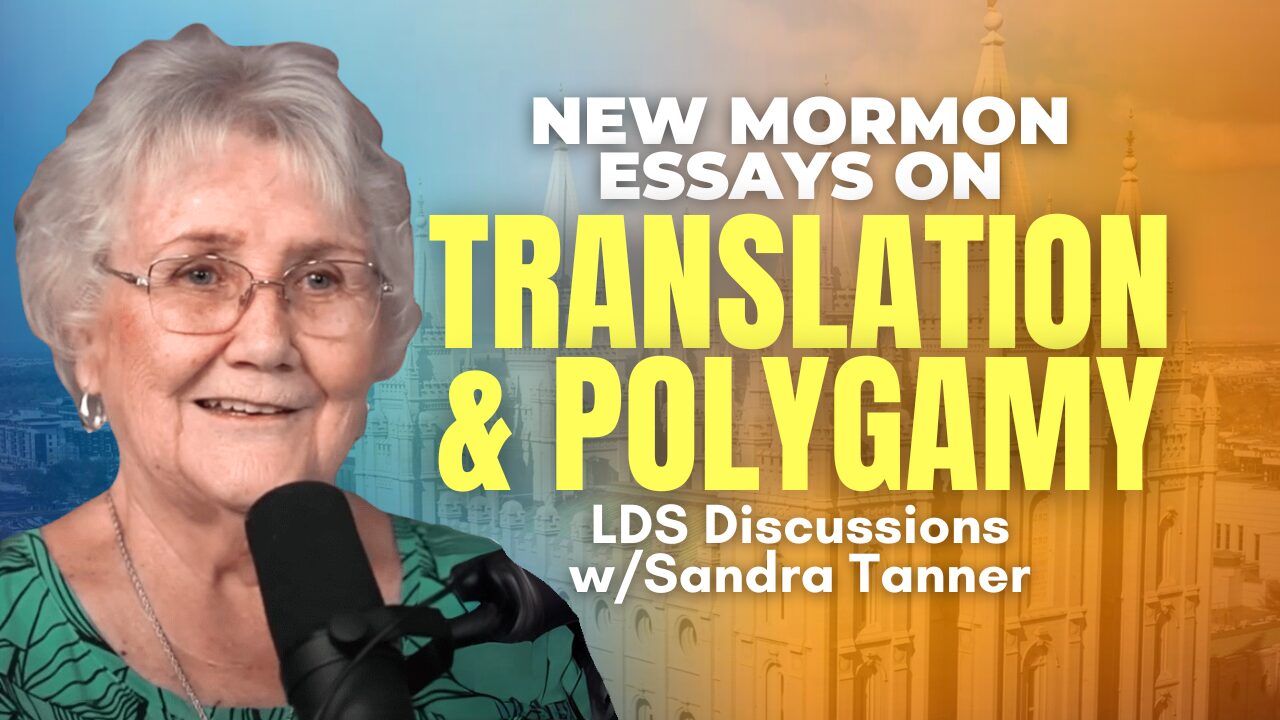
New Church Essay on Translation and Polygamy w/ Sandra Tanner
Listen on Apple Podcasts Spotify YouTube Download MP3
About this episode
We are thrilled to have Sandra Tanner as a guest on our LDS Discussions series this week! Along with John, Julia, and Nemo, Sandra is here to offer commentary on three new essays recently released by the LDS Church, addressing the issues of Book of Mormon translation, polygamy, and Joseph Smith’s character.
In part one of this two-part episode, we will focus on Joseph Smith’s “translation” of the Book of Mormon and on polygamy.
Among the topics we’ll cover:
-“Translation” vs. “Revelation”
-Joseph’s use of the seer stones
-What became of the Eight Witnesses
-The polygamy manifestos
-The Nauvoo Expositor
You won’t want to miss this fascinating conversation with the one and only Sandra Tanner, as we dissect the essays point by point and offer a unique perspective on these issues.
Thumbnail Credits: Main image of Sandra Tanner from Mormon Stories Studio; Background image of the Salt Lake Temple from National Park Service
Originally published on mormonstories.org.
Transcript
Machine-generated and lightly edited. Click any timestamp to jump the audio to that moment. The audio is authoritative; please check it before quoting.
Welcome and Guest Introductions
John Dehlin Hello everyone and welcome to another edition of Mormon Stories podcast, LDS Discussions Edition. I am your host for today, John Dehlin. It is August 28, 2025 and we have really important news. The Church of Jesus Christ of Latter Day Saints, otherwise known as the LDS or the Mormon Church, has released three very important pages or essays, depending on how you want to describe them, to its Gospel Topics Essays series, where it finally, around 2013, 2014, started to publicly take responsibility and own up to problematic LDS or Mormon Church history and or truth claims. It's added three new essays or pages as of August 2025 and the three topics are plural Marriage, Joseph Smith's Character, and Book of Mormon Translation. They're all very important topics that have been addressed at some level before, but there's new information, updates, clarifications, and there's even some new sort of historical or cultural context that we could discuss that help frame and explain why the Church is making these updates. But most importantly, I think we're all thrilled that the LDS Discussion series on Mormon Stories Podcast continues. What is that? Years ago we brought on a brilliant human named Mike who has a website called LDS Discussions where he spent a lot of time covering multiple topics about LDS Church truth claims in as much of a fact based or an evidence based, objective manner as he could. We started this series on LDS discussions where for 40 or 50 episodes or more, we brought Mike on in a panel format to discuss these LDS Church truth claims. It's absolutely one of the most important projects Mormon Stories has ever been involved with and we constantly hear from you that you want to hear it continue. So for those of you who have not heard any of them, what we always like to say is that these episodes are best enjoyed in sequence. So you can go to the LDS discussions playlist on YouTube. We think that's the best way to consume it. So under the Mormon Stories podcast page or brand or whatever, you can go to the LDS Discussions playlist and watch them or listen to them in sequence. You can also do that on Spotify, either integrated into the Mormon Stories podcast feed, just look for LDS Discussions, or we've created a dedicated Spotify and Apple podcast series so you can just view or listen to them in sequence there as well. So that's we recommend you do that, catch up and then consume Today in Sequence if you can. But otherwise, again, what you're going to hear today is us doing our best. And as analytically and as neutrally and as objectively as possible, we're going to analyze these three essays, give context and give analysis. And I'm super excited as a core panelist for today to have Back on Mormon Stories podcast, the woman, the myth, the legend, the hero upon whose shoulders, along with her late husband Gerald, we all stand. We have back on Mormon Stories in Mormon Stories podcast studio, the one, the only, Sandra Tanner, everyone. I'm sorry, I'm getting a little bit. Well, Sandra, how are you today?
Sandra Tanner I'm good.
John Dehlin Welcome back to Mormon Stories podcast.
Sandra Tanner Right. With an introduction like that. Wow.
John Dehlin How do I. How do I up that next time? How do I do it? I can't. How you been doing?
Sandra Tanner I've been doing good.
John Dehlin Yeah, you look great.
Sandra Tanner Yes. Well, there you are.
John Dehlin All right, well, we're glad to have you back. Thanks for joining us. And also joining us today, our two regular panelists on the LDS discussion series. You probably won't get as celebrated of an introduction, but we have Nemo back. Hey, Nemo. Hi.
Nemo Yeah, I don't deserve such an introduction, to be honest with you.
John Dehlin It's just Nemo the Mormon, everyone. Just Nemo.
Nemo Yeah.
John Dehlin And that aligns with your British sensibilities.
Nemo If you could refer to me as just Nemo from now on, that would be great.
John Dehlin All right. All right. Just Nemo. Thanks for joining us, everyone. Check out Nemo the Mormon's YouTube channel. Subscribe to his channel as well as to the Mormon Stories podcast, YouTube channel and Spotify. Wherever you consume. Please subscribe and comment. And like that really helps. Also, back on today's panel, she is. She is producing this episode. She did the research, she did the slides, and she will be kind of leading today's discussion. We have back Julia. Julia from analyzing Mormonism. Hey, Julia.
Julia Hi. I got more of an intro than Nemo did.
John Dehlin Do you want just Julia or do you want Julia? Which do you want today?
Julia Oh, just Julia's fine.
John Dehlin All right, well, that's all we have for introductions today. Any. Any pre comments before we jump in? Everyone? We good?
Julia I just have something for clarity. But I have something for clarity. So. So if you're looking for these gospel topics, or if you. If you're looking for these essays or pages, they're not in the gospel topics section, they're in. They're in manuals slash gospel topics. So just like, just to clarify what they are. So, yeah, this is the church's newsroom. They've added three new essays. So as John said, they are the Book of Mormon translation, plural marriage, or the manifesto, and then Joseph Smith's character. So we're going to go in that order that I have Stated. So we're going to start with the Book of Mormon translation, if that's okay. Does anyone have more comments before we get started?
John Dehlin Sandra, do you have any comments or context for just you? Have you been able to read these three yet?
Sandra Tanner Yeah, I have. I don't know that I've read everything on all three of them, but I think it's interesting how they start out. There's just kind of an assumption that there's a basis for a discussion. When they say Book of Mormon, we're starting from ground zero. We have no evidence, no artifactional document, you know, so. Well, we'll get into that.
John Dehlin Okay, so you're. You're saying. Okay, so when we talk about the Book of Mormon essay, that they're not giving a lot of the important context to. To then build upon the discussion. Is that right?
Sandra Tanner Right. Okay, well, all three of them, I found them all to be very scripted and directed in a way that you don't realize what the starting question should have been.
John Dehlin Yeah, yeah. And I'm guessing that might have been by design, I would assume. Yeah. But let's go ahead and jump into it. So go ahead and take over, Julia.
Julia Yeah, that's great. So I don't want to. So on the slides, you'll see there's more of the text than I actually want to read. So I've just highlighted the most important parts in blue, so that's what I'm going to be concentrating on.
Overview of the New Church Essays
John Dehlin Okay. Can I ask you a question, Julia, before we start?
Julia Yeah, of course.
John Dehlin So, as I understand it, the. The church has released at least three essays on polygamy already. I just want to. I want to try and process what's already been out there before we jump into to the new stuff. So with polygamy, there was something about Josephus. Polygamy in Nauvoo. Right. There was something about, you know, polygamy with Brigham Young and after. And post manifesto stuff. Right. Is there what. Could you even remember what the other.
Nemo Polygamy, Kirtland, I think.
Julia Okay, so there's actually 1, 2, 3, 4, 5. Wait, 1, 2, 3, 4 of them. So plural marriage in general. Plural marriage in Kirtland and Nauvoo, plural marriage and families in early Utah. And then the manifesto in the end of plural marriage. So there's. So there's the three on the Gospel topics essay page.
John Dehlin Okay. Just on polygamy.
Julia Just on polygamy in that section. Yeah.
John Dehlin Okay. And. And so Joseph Smith's character. I know they've. I know I've seen And read stuff on, like, his trials, you know, what legal entanglements he's involved with. And of course, the polygamy essays address his character. But I'm. This is. I think this is the first time they've tried to hit his character head on. Is that right?
Julia That is correct. Yeah. If you go to the gospel topics list, there's nothing on. I mean, like, sure, they'll talk about his character in some of those, but there's nothing labeled his character. There's nothing quite like what they've. What they've just published.
John Dehlin Okay. And then as far as Book of Mormon translation, I'm pretty sure they talked about Stones in the Hat in at least one of the prior essays, I don't think. And I think they've covered DNA in the Book of Mormon.
Julia Yeah.
John Dehlin What can you tell me? What do you. Do any of you remember what essays already existed before this one?
Julia Yeah, so I'm looking at.
Nemo Yeah, there was DNA, there was Book of Mormon translation, There was the polygamy essays.
John Dehlin Okay.
Nemo I think those were the main ones.
Julia I'm looking at them right now. So there's the. Are Mormons Christian Becoming like God? The first vision accounts, Mother in Heaven, peace and violence, which talks about the blood, atonement and things like that. Race in the priesthood, and then the translation of the Book of Abraham, as Nemo said.
John Dehlin Okay, so nothing specifically on Book of Mormon historicity. So that's kind of new. They've talked about translation and DNA, but not historicity as a broader topic, Correct?
Julia Yeah.
John Dehlin Okay, good. That's helpful just as context for what's come before. And if people want to access these earlier gospel topics essays. Julia, Nemo. Where do they go?
Julia They just type in. What I always do is I just type in gospel topics essays in Google. I don't even know if I know how to, like, navigate that. People have made videos of how hard it is to get to these essays, but I just. If you just type it into Google, it'll bring it up.
John Dehlin Okay. All right. Thank you for that context. Yeah, that's helpful.
The Book of Mormon Translation Speed and Process
Julia Okay, so the first thing I wanted to talk about was this idea. This is in the overview. It says, Joseph Smith dictated the book to scribes at a breathtaking pace, completing almost the entire translation between April and June of 1829.
Nemo Before you jump on that, Julia, there's something at the top of that paragraph, if you just pop it on screen a second, which says, the Book of Mormon came to us through a series of miraculous events. I feel like this speaks to what Sandra was Talking about this sort of presumptive language, the presupposition right at the beginning that the Book of Mormon came through miraculous events. That is just a stated fact according to this essay. They're just presuming underneath it all that this is a miraculous book, which I think is the point Sandra was making at the beginning. And there's just some evidence of that.
Sandra Tanner Yeah, they're starting right off with giving you an assumption of a fact that has been given no basis.
John Dehlin Okay, so to claim it's miraculous at the outset, I don't want to say
Sandra Tanner poisons the well it is given without any backup to it.
John Dehlin Okay, that's a good point. Okay, Nemo, That's a good point.
Julia Yeah.
Nemo Sorry. Carry on, Julia.
Julia Yeah, so the breathtaking pace. And I pushed against this before in other LDS discussions episodes, but if you
John Dehlin look at the timeline, Julia, I'm going to be really annoying and people get mad when I interrupt, but this is going to discussion, so I just want everyone to chill out. We're just all discussing. And so that's what this is going to be. Throw that back up. And I know that you wanted to jump through it to the final sentence, but the second sentence, it is the translation of an ancient record engraved on plates that was preserved for centuries and entrusted to Joseph Smith. Like, I'm already bristling at the use of the word translation because my understanding is the Church is backing away from calling it a translation in 2025. And instead of, they're. They're leaning more towards calling it a revelation than a translation. So I'm confused as to why they would use the T word in the second sentence. Am I, am I just nitpicking there, or is there something to that?
Julia I think the Church is trying to have it both ways. They're trying to have it be a translation, but inspired revelation. So they're just trying to have their cake and eat it too.
John Dehlin Okay. All right. Well, it's at least a reasonable question, right?
Julia Yeah. Yeah.
John Dehlin Okay. Okay. All right. Sorry, sorry.
Julia No, that's good.
John Dehlin Okay, keep going.
Julia So, yeah, I just like this idea that a lot of the church historians or apologists, I should say, they say, they claim that it was 65 to 75 days at the breathtaking pace. But if you step back and look at it, Joseph was telling stories of the Book of Mormon from 1823. And I know that the Tanner have talked about this as well. And. And if Joseph took a break from translating after the 160 pages were lost, and then also in his first Vision accounts. He talks about his extensive study of the Bible. And so if you add. And that was in 1818 that he was studying this from age 12 to 15. So if you, and if you take a step back, Joseph Smith had roughly between 5 to 10 years to come up with the text of the Book of Mormon. And so the church claiming that it was a breathtaking pace, critics can step back and say, well, it's really not that breathtaking if you look at it overall.
John Dehlin Okay. And Julia, I want to press on a word you used. You said come up with the text. And that would imply that maybe he had pre. Wrote it all potentially by hand. Maybe I would tweak that and say he had five to 10 years to come up with the narrative and the stories and the narrative structure. Does that, does that seem fair? Because I don't think anyone's claiming that he pre wrote it out by hand. Sandra, can you speak to that?
Sandra Tanner Well, his mother talks about how Joseph used to entertain the family in the evening with stories about the Indians and their habit of dress, religion, travels and all those things. So that says to me he's practicing his story through these years. And when you're able to keep telling a story time after time to your family, it's like practicing a speech to an audience of friends before you give it publicly and you find out which areas work better, what brings the crowd's attention. It's a way of practicing the whole thing before you give the final run through on it. So, yeah, I don't think he wrote it out. He may have had some sort of outline, but I think he's a storyteller and you see that with his revelations where he's able to just on the spot come up with a story, a revelation or something, that his gift is really a gift of storytelling, not translating.
John Dehlin And correct me if I'm right, Sandra. And panelists, he tells the world that he is going to. Well, in his mind, he believes, and maybe he tells the world that he's going to eventually obtain these plates and produce a book as early as what year? 1823.
Sandra Tanner Yes, there's evidently at least one man's memory of Joseph talking to him in 1823 about this story. So that's why we know that he had years to work on it is from that recollection. Well, and Joseph's claim, I mean, he says the angel came to him in 23, so that sets the date right there that he's got all these years.
John Dehlin So he's got, by his own account, he's got seven years to develop the core narrative structure, the components, you know, the major stories, whatever text he plans to incorporate. Like the Old Testament, like Isaiah, like the New Testament, like his father's dream, you know, whatever he ends up incorporating, he's got seven years to practice that and organize and structure it.
Sandra Tanner Right. And from. He says that from the age 12, he studied the Bible. So he's going to revival meetings studying the Bible.
John Dehlin Oh, the Protestant sermons, the Grand Palmer sermons.
Sandra Tanner He has all sorts of influences through those years to help him develop his story.
John Dehlin Because if we think about the sermons of King Benjamin or Mosiah or others, everyone pretty much agrees those are basically Protestant sermons. That, again, his theology. His Protestant theology would have developed the 10 to 12 years prior to 1830 that he could put in the mouths of Mosiah and Alma and King Benjamin. Is that fair? Is that fair? Okay, Nemo and Julia, anything else on that timeline question that you all want to tease out or highlight?
Tight Translation vs. Loose Revelation
Julia Well, I just wanted to say I like that criticism that it's not. I don't think he was coming up with a text. I don't think he was writing it down and then using it. I think he was just coming up with the stories. And you mentioned Grant Palmer. His book is Insider's View of Mormon Origins, is an excellent read. He shows how. How much the Bible influenced or was a direct foundation for the Book of Mormon text in a lot of ways. So another part, this is an. Again, the church is moving towards this different perspective. It says we do. We do know that the translation was divinely inspired.
Nemo Can I take exception to the just phrasing of that sentence for a second? How do you know that? How do you, like, actually, like, know that? You may believe it, but how do they know it? Again, this is this presumptive language that just. I know it's rubbed me up the wrong way this evening.
Julia Yeah. Okay, so this is. Again, this is the same idea that we just talked about. The hero. It says, what did Joseph Smith mean when he said he translated the Book of Mormon? And I don't know if we want to go through the whole thing, but it says at the very last sentence, the text of the Book of Mormon came by revelation. And again, this shouldn't be the case because Joseph. This is a translation that he's directly reading off of the stone or the. The Urim and Thummim. There should be no revelation involved. Nemo and I talked about this before. Nemo, do you have anything to say on this matter of Revelation?
Nemo I do I think there's a place in here where you can really play with words and kind of make it work. Because it was a divinely inspired translation, as it were. That it is, if you believe it happened even as we now understand it. Now the Church is being somewhat honest about it that the words appeared. The tight translation model is the words appeared on the stone and he read them and he wasn't allowed to carry on until they were correct. The way in which they appeared on the stone was still miraculous. So in some sense that is a revelation from God. He's revealing these words to him upon a device within a hat. Right. So you could claim, while still holding to the tight translation model, that it is a revelation. Well, one of the questions I'm happy to take pushback.
Sandra Tanner One of the questions I would have on this is if we were to suddenly have access to the plates, would a scholar translate those plates the same way that Joseph Smith did? Now, I realize translators aren't all going to come up with exactly the same words. Everyone's going to have a little different choice of what English words they would use for the thoughts of another language. But they want to present the Book of Mormon text as somehow being this divine, transmitted record of a real civilization. And yet the Church wants to make space for Joseph bringing in his own influence. And so that would say to me that a scholar wouldn't get the same message off of those plates as Joseph Smith did because he's adding in his own concepts. So the whole question of translation becomes very muddied. You have to allow for modern day influences coming into the Book of Mormon story. So I don't know how you make any of their concepts work consistently.
Nemo Agreed. And I think what, what that takes us to then is the question of when the problems occur. So as we're going to get to other things later, other issues and text changes and all that sort of stuff, that then becomes a question of who are we assigning the blame to here for when things aren't as we would expect them to be? Who is at fault for the anachronisms? Right. Is it Joseph for taking his own ideas and applying them, which doesn't work with the tight translation model, or is it God for giving him the wrong words? If it's a revelation and it's a direct tight translation, you can still call it a revelation. But then what that does, if it is a revelation, is that shifts the problems onto God for giving Joseph incorrect information, anachronistic objects and words, giving him, you know, verses that then need to be changed, all that sort of stuff.
Sandra Tanner Right.
John Dehlin Just for people who don't know the context here. The reason why the church has to thread this needle is because, number one, Joseph claimed to be translating, you know, reformed Egyptian into English. But secondly, the Doctrine and Covenants declares him a prophet, seer, translator and revelator. And so, you know, he's kind of stuck. And I even think, I think I'm remembering, if I'm remembering right. In the school of the Prophets, slash, the Kirtland Temple, he created a translation room and he called it the translation Room. But, but then the other problem is everything we know about any other work Joseph has produced, whether it's the Kinderhook plates, failed translation because it was a fraud to begin with with made up characters, Book of Abraham, clearly a fraudulent, inaccurate translation. You know anything else? Even with the, with the biblical, with the Joseph Smith revisions of the Bible, we know that he was largely borrowing from the Adam Clark commentaries. He's shown no ability to translate. He barely knows, you know, Hebrew. So, you know, it's, it's the, the, the, the word translation is kind of a non starter. It just doesn't belong other than the Church is stuck with it. Is that right?
Sandra Tanner Yes, but that's why they're trying to move it away to some way. It's Revelation.
John Dehlin Yeah.
Sandra Tanner They want, well, I think Nemo used the phrase earlier. They want their cake and eat it too. They want it both ways. Translation and inspiration.
John Dehlin Yeah. Okay. Okay, Julia, back to you.
Julia Yeah. So there's another thing I want to push back on or ask a question of the Church. So in the essay it says the Church has worked to ensure that the Book of Mormon's Witness of the Savior is available in many of the languages of the world. However, we know that the Church has the Seer Stone and has had it since the beginning of when Joseph had it. And in 2015, the church publicly published images of this stone. And even as a member of the Church, I was kind of shocked by it. But one thing that I want to ask is that the Church has this stone and there are 15 prophets, seers and revelators that have access to this. Why don't they use it to translate the Book of Mormon into every language? Because that's what it was originally used for. And so my question is, why don't they. And one of the things that I think is because they haven't done that, that it doesn't actually work.
John Dehlin Oh my goodness, that's a good point. Actually, my cousin, Dilworth Parkinson is currently revising the Arabic translation of the Book of Mormon as we speak. And that. That just. You make such a great point. They're prophets, seers and revelators. They've got the Seer stone. Why do they need academics?
Nemo I'm sure they can find a good. And, and that point. Yeah, they, they. For the Book of Mormon, it comes about as a divine translation. So when you're taking reformed Egyptian and putting it in English, you require God's revelation. Right. When you're taking reformed Egyptian through English and then putting it in literally any other language, you can just let any Tom, Dick and Harry translate it.
Julia Yeah.
Nemo So it can be a translation when it's going from English to other languages, but it can't be a translation like a traditional translation, as Sandra was talking about, when it's reformed Egyptian to English. I wonder why that might be.
Sandra Tanner Well, we have a few clues that it may be because we have someone inventing a story and not using actual historical records.
John Dehlin Yeah. And the other, the other, to extend your point, Julia, a little bit, why can't Angel Moroni deliver the golden plates today to church headquarters so that they can be used as a translation? Why don't. Why did Joseph constantly have angels appearing to him, you know, Peter, James, John, whoever else, John the Baptist, Elijah or Elias, even if they're the same person, etc. Not to mention God and Jesus. And he can tell us that. Why Amaroni, Why can't modern prophet seers and revelators both have angelic visitors and tell us about it? Is that.
Nemo I wonder if. I wonder if it's the same reason why DNC remains pretty barren after, you know, a couple of visions after the death of Joseph Smith. But predominantly he's the only person whose revelations exist within Doctrine and Covenants. Why are they not continuing to canonize the ongoing restoration of the church or the revelations that are given to God's prophets?
John Dehlin And they'll often say it's because it's too sacred, but it wasn't too sacred for Joseph to share. So if it wasn't too sacred for Joseph to share, why couldn't they? And also, isn't that the whole value of the apostasy and the restoration? Cedra, if the problem was that God withdrew the miracles and the visitations, but then with Joseph, he brought them back right then why wouldn't they continue from Joseph's death to now, not just in private visitations, but in visitations we can all know about. Isn't that the value proposition of the restoration?
Sandra Tanner Well, that's the way we were taught. And growing up in the church, I was taught that the brethren at the top got revelations all the time, how to run the church. But the odd thing was that they never added them to the Doctrine and Covenants. So there was some sort of shift somewhere along the line to where Joseph seemed to, you know, every week come up with some divine revelation that had to be written down and published. And yet today, supposedly, they're operating on the same system, getting revelation all the time, how to run the church. But nothing's canonized. Nothing is put down as actually what God said. So it takes away the ability to do testing on whether their prophecies or divine directions are really from God, because we have no record to check on. So it seems convenient that you see the church moving away from publishing revelations. It seems like they learned their lesson. It's better not to write it down. Just tell people you had a revelation,
John Dehlin because then you're not accountable if it doesn't come true or if you want to change later.
Sandra Tanner Right.
John Dehlin Nemo, did you want to say something?
Nemo Yeah. To your point, John, about it being too sacred. Right. Well, the things of the Doctrine and Covenants aren't all particularly sacred. I don't think there's anything particularly sacred about the funding of the Navi Mansion house, which is laid out in excruciating detail.
Sandra Tanner Right, right.
Nemo How much of a share people can buy if God is giving those sorts of levels of detailed, sort of autocratic instructions, and that's getting written down as part of the Doctrines and Covenants. Russell M. Nelson's revel on. Well, I said Russell Nelson's revelation, the revelation that was supposedly received that excluded children of LGBTQ parents from being baptized. That's got to go in the Doctrine and Covenants. Surely that is a more significant theological revelation than how much money people can pay to fund the building of Joseph
John Dehlin Smith's house or even the proclamation on the family. Right.
Sandra Tanner Well, and back on the money thing, God seemed to be very specific in Revelations on, like, building the Nauvoo house and how much money you can invest in it. And what is $50? You couldn't do more or less or something. I don't remember how the revelation worded, but it's so specific on things. And yet today they can invest billions of dollars with no accounting and no public statements on what's going on with the finances. And so it seems like such a shift in how things are done from the early church, where financial matters actually got written up in Revelations and published publicly, but now the church gives no Public statements on specific things or I mean, did they get a revelation to do the mall downtown? If so, we didn't get the written record of it.
Julia Yeah. So one thing that I was thinking with Sandra, you're talking about the details of the or nibon to the Nauvoo Mansion. People always use the apologists or. I've heard this argument several times where Joseph didn't get instructions. He didn't get clear instructions on how to live polygamy. So he wasn't sure about polyandry or he wasn't sure about marrying underage girls or things like that. So it's like, oh, he just didn't know what he was doing. He wasn't given clear instructions. Why is God not giving clear instructions about something so important? But he's giving super detailed instructions on the rooms of the Nauvoo Mansion, how much money they can invest and where it's going to be, everything like that. Why is that so specific? But polygamy is not.
John Dehlin But also Julia, that's true. And there's a lot of very specific instruction in DNC132, like the law of Sarah that Joseph disregards. So, you know, he also disregards a lot of the specificities. The other point I was going to make is that the common apologetic for why they don't add to the DNC that I remember hearing, hearing as a missionary is that every General Conference now is Revelation. And all those revelations are published in the Ensign in the conference edition of General Conference. So I guess it's this idea that the DNC would be too long. There's so much revelation. There's revelation twice a year given in General Conference. So for all revelations after DNC ends, just go to your Ensigns and read the General Conference talks and you'll get all the revelations there. What's wrong with that?
Sandra Tanner Well, as long as you exclude all of them from Brigham Young up until President Hinckley.
John Dehlin Because the dog. Because the Journal of Discourses. You're saying Journal of Discourse?
Sandra Tanner Well, not just Journal of Discourses, but the guys after that. I mean they, they want to make everything accountable. Only in our current memory that they don't want you going back to the old conference talks to Ezra Taft, Benson's
John Dehlin anti communist reads in the 60s.
Sandra Tanner You're saying, right, if we are to view today's conference talks as the equivalent of Scriptures, as in the Doctrine and Covenants, then why is the Improvement era not on the Church's website? You can't look up the kind of conference talks I grew up Hearing.
John Dehlin Were they different than the ones today, Sandra?
Sandra Tanner Well, they were a lot more. There was a lot more contrast between the speakers. They've gotten more correlated in recent years. You used to hear a different quality. I don't know what you'd say. A different kinds of messages from different people speaking.
John Dehlin More diversity of points of view, even.
Sandra Tanner Different points of view, yes. Different personalities.
John Dehlin Yeah.
Sandra Tanner And in today's conference talks there, you could just shuffle the deck and have any one of them read the other one's sermon. I don't know that we get that much diversity. There was more diversity when I was growing up in Mormonism.
Nemo So you feel like the diversity of opinion between the leaders of the church was more on display at conference. It was more sort of openly seen. You could tell that Hubie Brown was not a fan of Harold B. Lee, vice versa, you know, that their views were different.
Sandra Tanner You had more personal difference of personalities. Not just personalities. Differences of opinion amongst them.
John Dehlin Interesting. Okay. All right, Julia, back to you. This has been a good. This is useful. Back to you, Julie.
Joseph Smith's Seer Stone and Treasure Seeking
Julia Yeah, so this next part, I want to specifically talk to Sandra Tanner about this because the church has. Has slowly started to. To admit Joseph Smith using the seer stone for treasure digging. So this one says Christians believed objects such as seer stones could be used to find lost objects or to search for buried treasure. Joseph himself had used his stone for similar purposes.
Sandra Tanner Well, I find that one very, very funny. They make it sound so general. Christians in Joseph Smith day didn't all think seer stones were a great idea or use them. That's why the Methodists wouldn't let Joseph Smith join their church because he was using a seer stone. That's why he was had that trial hearing, whatever you want to call it, in 1826, where he's charged with being a glass lurker. It wasn't the common experience. It was something that happened in Joseph's day. Yes, but it wasn't everybody thinking this was a wonderful idea.
John Dehlin I mean, it seems like with that paragraph, as I'm reading it, they're trying to say it was a common Christian thing. They're trying to Christianize that practice. But when I think of the practice, they're drawing stars in the ground, they're sacrificing dogs or goats, the blood is coming out, it's at night. It feels way more occultish than it does Christian. But it seems like they're just trying to say, well, it's a common Christian practice. Sandra, am I reading that right?
Sandra Tanner Well, it was a practice among Some Christians, but that was not the norm. There's a difference between something being done in a given era and whether it was the norm.
John Dehlin And there's also. There's a difference between Christians doing something because what, There weren't a lot of Muslims and Jews hanging around upstate New York. Pretty much everyone was Christian. So is there a difference between Christians who do things versus people doing things that are Christian? Does that make sense?
Sandra Tanner Well, the churches obviously had a different view than the populace that might think tarot cards were kind of fun or something. But Christian churches were not approving of seer stones, tarot cards, Ouija boards, magic circles, sacrificing dogs, binding the spirits, looking for treasures using occult methods that. I mean, I don't have a problem with someone going out and digging up their backyard if they think some budding 200 years ago buried the family treasure there. It's when you say we're going to go out and do it through a magical practice of drawing a circle, binding the spirits, doing an incantation, all of these things, then it becomes a superstitious sort of magic thing, not a standard part of Christianity.
John Dehlin And you're saying that's what Joseph. Joseph did all of his work. That's what Joseph is saying as a part of his searches.
Sandra Tanner Right.
John Dehlin Okay, got it. Okay, Julia.
Julia Yeah, those are all really good. So this next section is why has church artwork depicting the translation focused on the interpreters buried with the plates rather than the seer stone? And they say.
John Dehlin It's a good question. Yeah, we've talked about that quite a bit on Mormon stories is why. And you have too, like Cedra, why has the church not depicted Joseph's translation accurately?
Sandra Tanner Yes, and they want to say, oh, well, they didn't know about the. As more knowledge has come out, then we've got a clearer picture of this. No, the knowledge was always there. The church has always had the witnesses, statements of how the translation was done. They didn't lose the knowledge. They had the stone in the vault. In the vault?
John Dehlin Yeah.
Sandra Tanner I mean, they kept it from us. That's why the rest of us didn't have the knowledge of it. That's why I grew up always seeing all the artwork, all of it depicting Joseph with the plates in front of him, running his finger over the plates to dictate to his scribe. I never saw any other presentation of it.
John Dehlin Yeah. Yeah. Okay, Julie, keep going.
Julia Yeah. So the part that I wanted, that I have highlighted is memory of the seer stones faded among many Latter Day Saints and artists and narrations and artists and narrators depicted the translation based on this partial understanding of early Church history. So they're saying, oh, the memories faded. And so that's what they're basing their. Their artwork off of. Is this faded, incorrect memory of the translation?
Sandra Tanner Yes. But why did it fade? It faded because the Church quit telling that part in the public discourse. The Church framed it always, to us, as this one type of event. Plates on the table, and Joseph looking at the plates. They directed the idea of the artwork. The artists should have been told the very first time then that, oh, wait a minute, guys, that's not exactly right. We know from what's in our vault that he was using a stone in his hat and wasn't really looking at the plates. I mean, the Church leadership is guilty on this one all the way through. They're responsible for the memory fading of how it really happened.
Nemo And I think this. This is trying to paint the impression of kind of like, oh, well, we just told them to paint. We said to these artists, paint the translation of the Book of Mormon by Joseph Smith. And then through their incomplete understanding, they produce these works of art. Now, even if that was the case, like Sandra's saying, the Church would have still had to approve those pieces of art and then publish them. The Church could have gone, no, that's not quite right. But also, that's not the way that commissioning artists works. You go to them and you say, I want you to paint this scene, and you describe the scene to them. So I want you to paint. Joseph Smith sat at a table with gold plates in front of him, running his hand over them, looking through Urim and Thummim, for example, and that's what they'll produce for you. And then you make tweaks, etc. You don't just go paint this. This thing, not when you're a church, like the Mormon Church, not when you're trying to produce religious artwork.
Sandra Tanner Yes. This isn't like early Christian art where the artist, Michelangelo or whoever is commissioned to do a certain painting where he had discretion to paint the way he wanted to paint it. This is a church that orchestrates everything they do. They don't have to just accept some artist rendering that they don't approve of. They could just say, no, we won't use that one. We're going to use this other artist who did it more accurately.
The Stone in the Hat and Church Depictions
John Dehlin Can we dig on this just a tiny bit more? I have a couple questions. So was there ever a point where the Church taught the stone in the hat as the base narrative? And then Got away from it. In other words, even in the, in the early to mid-1830s when Joseph talked about it, was a generally known stone in the hat or was it always perceived as urimum thummim? No stone in hat from 1830 to, you know, 2015. Do we know of any point where they for sure knew about and or spoke openly about the way it was, the actual mechanics with the stone in the hat, do we know?
Sandra Tanner Well, the earliest witnesses, the witnesses to the Book of Mormon were all around in those early years of the church. So the people talking to them at different times would have heard them describe this.
John Dehlin Well, would they have said that? Like I'm trying to imagine a Kirtland or a Nauvoo talk where Martin or Oliver gets up at a meeting with the brethren and say, I beheld Joseph and he put the stone in the hat. And you know what I'm saying? Or was Joseph like, don't talk about it. Martin and Emma and Oliver don't talk about how I did it because it's embarrassing because I'm getting put in jail over the stone in the hat. And so let's just stop talking about the stone in the hat. I'm wondering.
Sandra Tanner Well, Joseph does a little bit of backpedaling when he does his 1835 doctrine and covenants where he has to backpedal on Cowdery's working with the rod and downplays it to the gift of Aaron. So you do see Joseph starting to reframe the narrative to make it less magic sounding. But many around him are still thinking in terms of the stone as having special powers. And I mean, you got the Salem trip where Joseph's going to go off and look for this treasure that supposedly God's revealed to him is buried in some guy's house and they're going to go dig it up in the basement.
John Dehlin And he's using a stone for that
Sandra Tanner and he's yeah, getting revelation that way. So he's still involved in magic. But yes, Joseph does start changing. I don't know if you say changing the narrative, but lessening the mention of magical elements. And as the witnesses leave the church in 3738 time period, then going into Nauvoo, you would have had less people in the community that would have been privy to these men's early statements of the witnesses telling about the stone in the hat. So you could see the ideas kind of fading by Nauvoo, partly because the main witnesses are out of the church and not there for people to ask for them to tell it. But they do tell it. And you have, like Whitmer later in, what, 77. 78, where he writes his. No, 1887, where he writes about the stone and the hat. So, yeah, it's. I think you see Joseph downplaying the translation process, but the witnesses are still telling it if they are asked, but they aren't in the church in the same way to give a everyday account.
John Dehlin That makes sense. And I guess I'm just wondering about when Urimum Thummim with plates in front of them sort of got adopted as the official church narrative.
Sandra Tanner Right.
John Dehlin Because it seems like at some point it's Urim and Thummim with gold plates on a table. And then that just continued until 2015 or.
Sandra Tanner Well, when he goes to Kirtland, you see this shift. He's moving away from the obvious outward. Speaking of things in terms of magic, Kirtland didn't seem to have the same kind of experience of the money diggers of New York, of the magic worldview. So in Kirtland in the mid-30s, you see Joseph trying to give a more polished look to the story to make it sound more normalized rather than coming from this magic worldview.
John Dehlin Yeah. And the reason why I'm asking y', all, I've. I've. I've talked to historians who know and who have spoken with modern Mormon church apostles like El Tom Perry, like Boyd K. Packer, like Holland and others, even Ballard. And I've been told that many of the apostles, modern Mormon apostles, perpetuated the false narratives because they themselves were. Weren't ever taught the correct narratives. And so there's this idea that when Leonard Arrington, when Fawn Brody and or Leonard Arrington burst on the scene, or the tanners in the 40s, 50s, 60s and 70s, that the apostles would have been distrusting of any of those sources to begin with. So they're not going to listen to Fawn Brody, they're not going to listen to Gerald Sandra Tanner. They're not going to listen to even Arrington and Michael Quinn, for example, and they would have been taught the official narrative that was wrong. So there's this argument that the modern apostles in the 70s, 80s and 90s and 2000s were learning along with the rest of us because they also didn't know. So it weren't that they were knowingly passing on a false narrative, it's that the truth had been withheld from them as well. Does that make sense? I want to hear people's reactions to that. All of you. Sandra's smiling, too.
Sandra Tanner Well, I think that you. You have Dallin Oaks and Gordon B. Hinckley that are writing on early church history. And they know this. They all had to, at some point, read Whitmer. I can't imagine them not running across references to Whitmer's testimony. Because they all want to say Whitmer's dying testimony was to the Book of Mormon. Well, surely they read more than just the one sentence. If they were aware of Whitmer's dying testimony, they had to be aware of what the rest of it was. That it was the stone in the hat with literal dictation, word by word.
John Dehlin Okay.
Julia I do also want to add. So in the. The essays do admit that the. This, you have the Seer stone, and then you have the Urim and Thummim, or spectacles. And the Church says that they use the term interpreters interchangeably. And so I think what happened is that term took over to mean both. And then the idea of the seer stones fell away. And so people only thought of the interpreters as being the Urim and Thummim. Because like you said, Sandra, he's moving away from this treasure digging, this occultic ritual stuff, and trying to look at more. More divine, more from God. And so I think it was just a natural thing, like John, like you said, people are learning. The leaders are learning along with us.
John Dehlin Nemo, were you going to jump in?
Nemo I was, but then I was going to say exactly what Sandra said. So.
John Dehlin Okay. Perfect. Okay. That's pretty impressive, Nemo, that your instinct is to say what Sandra is also going to say.
Nemo Yeah, it's frightening. I don't think I'll ever be this brilliant again.
John Dehlin Okay. All right, Julia, what's next?
Julia Yeah. So not only did the idea of the seer stones fade away, but some of the leaders specifically said that it was not translated through the Seer stone. So Joseph Fielding Smith, in his book Doctrine, this is the prophet. In his book Doctrines of Salvation, he says he's talking at the seer stone, and he says the information is all hearsay. And personally, I do not believe that this stone was used for this purpose, meaning to translate the Book of Mormon. So not only is the church specifically not talking about it, they're saying it did not happen this way.
Nemo But I don't think that represents an honest belief by Joseph Fielding Smith. And the reason I say that is because this is the same man that cut out the 1832 account of the first vision and stuck it in a vault. He was a man who was very aware of information that could be challenging to people's testimonies and hiding that information. So that sounds to me like a denial rather than him not believing it because he's been taught a different thing. That sounds to me like someone who knows that it's there but knows that it could be challenging to people and so is trying to deny it.
Sandra Tanner And this is one of the problems I had when Gerald and I were first studying and trying to sort all of this out. My bishop told me that Joseph Fielding Smith doctrines of the salvation and answers to Gospel question was the place to go to get the answers for all these things. But I already was reading David Whitmer's pamphlet. And so it doesn't help me to. To say go read Joseph Fielding Smith when he's saying it's all hearsay. And I'm reading David Whitmer's actual words where Whitmer says this is the way it really happened, then it isn't hearsay, it's firsthand people in the first generation telling how the events happened. And the church wants to hold on to Whitmer's dying testimony, but not all of it. And so Joseph Fielding Smith knowingly was leaving out that this was David Whitmer that gives this account of how it was translated, not hearsay.
Julia Yeah.
John Dehlin Julia, just to be clear, that quote from Joseph Fielding Smith that you just read, that's not acknowledged in the essay, right?
Julia Nope, not acknowledged.
John Dehlin So the essay doesn't come clean that modern day church sponsored historians and or prophet seers and revelators openly provided disinformation, whether intentionally or unintentionally provided disinformation that miseducated the general public, the general membership of the church. Is that right?
Julia Yeah, that's right. And actually this is a little bit ahead of my slides, but I'm going to show it anyway. So the church is not also coming forward about its own publication and how what I'm showing on the screen are different manuals and including Preach My Gospel, including the things you give investigators, including
John Dehlin what's taught Gospel principles.
Julia Yeah. In seminaries. Yeah. All of these talked about the translation and none of them mentioned the stone in the hat. So the church itself is not open that the leaders were saying it didn't happen and that they themselves were perpetuating the idea that not perpetuating the idea of the seer stones being used.
John Dehlin Got it. Okay. Yeah, yeah, that's important. And don't you think these essays are a chance for the church to come clean and admit maybe where they've made mistakes or, I mean, they kind of do with the race in the priesthood essay where they say, yeah, those racist things that were said, they were said, but they were opinions and, you know, theories were product. Theories are products of their time, you know, so the Church has tried to come clean on some things, but in this case, it appears like it's not taking as much accountability as it could or should.
Sandra Tanner Well, it's sort of like mistakes were made, but not by us.
Nemo Yeah, yeah, it was the artist. It was the bloody artist.
Sandra Tanner Everybody else.
John Dehlin Yeah, okay. Okay, keep going, Julie. That's great.
Julia Nemo, can you read this? This whole paragraph?
Nemo Yep. In recent decades, the Church has worked to provide carefully researched and more complete historical accounts of Chur history. This expanded understanding helps artists more accurately depict the miraculous story of the Book of Mormon's translation. Portraying the use of the Seer Stone, as well as the interpreters like that.
Julia This.
Nemo That paints a picture that, oh, well, as we've discovered this unfolding information, we've then passed it on and everyone's been, like, fed and nurtured by this new information. And there's the implication that had we known it earlier, we would have revealed it earlier. But as Sandra's already made very clear, they knew it earlier, They've always known it. So it's not this unfolding historical landscape that they're just learning about. It's this historical landscape they've always known about, but they're just suddenly starting to be open about it with the world and then let the artist paint what truly happened.
John Dehlin It's also not, I think, giving credit where credit is due, because it's making it sound like the historians, the Church historians, were the reasons why the clarifications and the corrections got made. But the truth is it was Brody, the Tanner, Arrington, Church history Department that got shut down. And then historians and scholars, and then you add to that the Internet, you know, with Mormon stories and CES letter and all the other YouTube and podcast channels that I think, can't we just all agree that forced the Church's hand to then come clean? That's not how they frame it, what they frame it as. Once we started doing really good history, you know, we came clean based on our own motives and evolved understanding through our good works in history. Do you know what I'm saying?
Sandra Tanner Well, it's obvious when you look at the history of the Mormon Church Historical department that the historians, since at least the time of Brody, have been moving forward on trying to be more accurate. In how they tell things. Their hands are tied by their boss, who wants a more faithful sounding history. And so they continue to shape the narrative by what they allow. It isn't the church leaders leading the parade. They're the ones being drugged to the parade and conceding what the historians wanted to tell all along.
Julia Yeah. So I also want to say we've said this before. If the church really wanted to tell this story of the seer stones in the hat, they would have commissioned an artist. Hey, will you paint this scene? Specifically, the church has enough money that they can commission artists. They've commissioned artists before. And also the church says, you know, in recent decades they've tried to push this new idea. But. But in 2016, the church created the film Days of Harmony where they took several studio photos of Joseph Smith using the hat to translate. And here I'm showing a picture of one of those. However, in the final cut of this, this movie that was really made within the last decade, the hat is barely seen, and most often the viewer, it is missed by viewers. So the church. The church was like, almost there. They could have showed it, but they didn't. So the church on purpose still is not showing this idea in their media.
John Dehlin Didn't we wait, but didn't we feature a BYU professor artist and show all these paintings that he's produced? And hasn't the church in its Liahona or Ensign or even its friend. I don't even know the publications are named these days. Isn't the church starting to show alternative art in its publications and on the Internet?
Sandra Tanner They never have. They never have Joseph Smith's head in his hat the way the witnesses said it happened. The table is there, and they may have the hat there, but they don't show him looking in the hat.
Julia I will push back because Anthony Sweatt, because we did an episode about that before, and while he himself has paintings of Joseph's face in that hat, I don't think that's been published. And I can be corrected, but I don't think that's been published in any of the official church manuals or in anywhere where a regular member just consuming this information from the church itself. I don't think that's been published there.
John Dehlin Got it.
Sandra Tanner Not officially.
Julia Yeah, not officially.
Nemo I wish we had. Which is Russell M. Nelson beginning to put his head inside the hat as he's talking about the translation process. He goes to do it, and you can see it cross his face that he realizes this is a bad idea. I shouldn't do this. And he kind of then just puts it back on the table because he was about to do it, and then he's. Oh, actually, maybe not.
Sandra Tanner Yeah, I love that clip.
Nemo Yeah. It's about as close as they've got.
Sandra Tanner Yeah.
John Dehlin Yeah. Okay. All right, Julie.
Role of the Gold Plates in Translation
Julia Okay, so the next part is they asked the question, what role did the gold plates play in the translation of the Book of Mormon? And they discuss the eyewitness accounts, and they say the presence of the plates and the accounts of those who saw or held them provide important testimony of the Book of Mormon record. But what they're not telling us, well, they go on and they say that, are these witnesses reliable? And they talk about Martin Harris saying that he only saw them with his spiritual eyes, or the David Wimmer who says that, of course, we were in the spirit when we had the view. And they're like, oh, the church says. But he simply was using scriptural language to describe a miraculous experience. So, again, oh, sure, yeah.
Sandra Tanner Well, why is he taking the three witnesses out in the woods to pray? So that they can see the plates. If they were sitting open on the table while he's doing the translation, it seems like everyone in the Smith family would have a vision. Excuse me, A literal experience of seeing the plates. They wouldn't need to be taken out in the woods to pray to see the plates. They would have already, in normal life, have seen Joseph with the plates spread out on the table, doing his translation work. So the very fact that he has to take them out to pray about it tells you they never were visibly laying out there on the table.
John Dehlin Yeah. Can you show that first of the two slides again that you just showed Julia? The presence of the plates and the accounts of those who saw or held them provide important testimony of the Book of Moral Record. Yeah. I just want to add that by all accounts, the plates weren't in the room when the translation was happening.
Sandra Tanner Even if they were in the room, they were covered. There's no one seeing them physically uncovered.
John Dehlin I'm just saying that the plates weren't that important. They weren't important, or they would have been in the room when the translation was happening. But by all accounts, with the Book of Mormon that we have today, Joseph never used the plates in his translation. They were in the woods somewhere and he had his face in the hat. So the plates weren't important.
Sandra Tanner Yeah.
Nemo The only way they would provide important testimony is if we had any way of ascertaining that the book Joseph produced bore any resemblance to what was written on the plates. And because we can't examine the plates. And because we know they weren't even directly involved in the process, they don't provide any sort of testimony to the work that Joseph produced.
Julia Really well also Nemo, you've mentioned before airing that the witness is saying I saw literal gold plates, even though some of them said it was in the spirit. That does not mean the translation is correct. Those two are not the same thing.
Nemo Yeah, exactly.
John Dehlin And also just add John Turner. I love my episodes with him as a, as an independent, no dog in the hunt sort of scholar. He's like the fact that Joseph was constantly hiding the plates immediately is the red flag. Why is he hiding them? Why is he burying them? Why is he sticking them in a big barrel with, with bushes over him? And the argument that he had to protect him again we've made this point before makes no sense because he also taught that if anybody looks upon them, they will perish. And so all he had to do, anyone who tried to steal them, they would immediately die as soon as they grabbed them and looked at them. So they were self protecting. According to Josephson account, there was no need to protect them. Am I wrong, Cedra?
Julia Right.
Sandra Tanner And why can't poor Emma see these? Why is she the one that has to move them to dust? But they're covered and she never looks under the COVID And yet Joseph evidently can have him just laying open on the table and Oliver sitting there with him translating it. Just.
John Dehlin But Oliver never saw plates in the translation, right? Yes,
Sandra Tanner but the visual image we were given as children was that Oliver sat across from Joseph with the real plates open to public view.
John Dehlin Yeah, yeah.
Julia Well I'll add to this too. There's the story when Joseph first retrieves the plates that he gets them out of the ground and he sets them down and he's like looking away and when he looks back, the plates are gone and they're back in the hole again. So like again, why, why does this miracle happened where the plates are are placed correctly when Joseph's not paying attention, but Joseph's hiding them and he's never letting people see or he's worried about people stealing them. So like the plates can miraculously move? Like why aren't they, why can't they move?
John Dehlin Oh, that's a good point. If the thieves were to have stolen the plates, God and the angel could have just withdrawn them back to the hole. There was no need to ever protect the plates or hide them. Right.
Nemo Because if they're the Ark of the Covenant and you know if you touch them, you'll be struck down. There's a reason they then didn't try and hide the Ark of the Covenant. They let anyone come over and try and touch it if they wanted. And get struck down.
John Dehlin I mean, I guess apologists could argue that Joseph hid the plates to protect anyone from actually seeing them. Is that possible?
Nemo What's the purpose of that?
John Dehlin Well, to say to save the lives of the baddies.
Nemo I see.
John Dehlin Or the. Just. What if someone stumbled in and accidentally saw them and then fell over dead? They were just being kind.
Nemo Why is it on Joseph to save the lives of the people that would fall into a trap that God created? God could just make it a non lethal thing to protect his own place.
John Dehlin Make the plates non? Lethal?
Nemo Yeah, they said it to stun. I don't know.
John Dehlin And again, the three and the eight witnesses saw the plates.
Nemo Yeah.
John Dehlin So, like, clearly God could make them non lethal. Why didn't he just make them all non? Lethal?
Nemo Yeah.
John Dehlin Or selectively lethal?
Nemo Yes.
John Dehlin Lethal only when the bad guys were trying to get them. But non lethal when Emma needed the dust.
Nemo Yes.
John Dehlin Right.
Sandra Tanner Well, she's.
Julia So maybe that's. But maybe that's why Martin Harris says they were in a spirit, so that they wouldn't automatically perish.
Nemo I mean, the point of this, in seriousness, is if you're claiming something as a supernatural object and it has the ability to move itself and it has the ability to defend itself and to slay people. And to slay people, you need to then justify those things. You need to justify why it couldn't then also do other miraculous things. That would mean you could treat it
John Dehlin more sensibly, like grow legs and run away, or grow wings and fly, or
Nemo remain on earth for people to see. Perfectly safe.
John Dehlin That's awesome. Okay. Yeah. So the simple. I mean, Occam's razor, sort of the John Turner razor, is the fact that he's hiding him is the dead giveaway that they never really existed. Which is also John Turner's conclusion. After spinning years and writing an entire book, he'll say every episode. There were never gold plates. Okay, keep going, Julia. This is good.
Witness Testimonies and Changes to the Book of Mormon
Julia Yeah. So I just wanted to point out the sources. We've shown these before on LDS discussions, but there I have found at least 13 accounts where the witnesses did not see a physical set of plates. And this doesn't just come from the three. It also comes from some of the eight witnesses. And so, like, the church can't really say. Oh, these witnesses talk about the physical importance of them and that they really existed when and in reality Some of them said that they were in the spirit when they had the view or that they weren't. It wasn't really a physical experience. And I think that that's. That's like a linchpin. It's a. It's a really important thing for the. For the Book of Mormon, the plates of the Book of Mormon to be historical, to have the Book of Mormon be authentically a book of these ancient people. And if the. If the witnesses aren't seeing actual physical plates, then this story seems to be made up.
John Dehlin Yeah. Okay. And the essay is not owning up to that, clearly.
Julia Yeah, no.
John Dehlin Okay.
Julia Additionally, the church claims in this essay that the witnesses continue to affirm their testimony throughout their lives. However, as we've discussed previously, there's a story of Oliver Cowdery where he was trying to join another church. And the person who is involved in that church, this is Charles Shook, he tells the story of. Or I guess it was Keanu, who were. Oliver was like, I'm willing to deny my testimony. He says, if the church require it, this new church, I will submit it to it, but I authorize and desire you, the church, to publish and make known my recantation. And he said he was sorry and ashamed for his connection with Mormonism.
John Dehlin Like, usually the church wants to kill any account like that as either being late or hearsay or from an anti Mormon source. Julia, do you know whether this source qualifies as late, anti or hearsay?
Julia So it's the person's interview with Oliver, but yes, it is late. It's in the 1885. And so like, yes, you could argue some of those, but it's the guy telling the story that, oh, Oliver told me these things. So, like, sure, it's late. You could call him anti. He's just a regular member of this other church who's just having a discussion about. About the situation. So I don't know if anti really
John Dehlin qualifies, but I don't mean to neutralize your point. I was just trying to.
Julia Oh yeah, that's good.
John Dehlin Sense of fairness. Trying sanity check. Because that quote's shocking to a Mormon to hear that any of the three ever came close to recanting. That's a shocking, preposterous. Sandra, was it your sense that none of them ever recanted their Book of Mormon witness?
Sandra Tanner Well, when Oliver Cowdery left Mormonism, he. Few years later, he joined the Methodist Church and he had to recant his testimony to the Book of Mormon, to the board elders, whatever it was, to join the Methodist Church. In that town. And I don't think any of the historians contest that Cowdery did join the Methodist Church. He was the secretary for the church for a period. And the Methodists at that day are not going to accept someone into their church that's firmly attesting to the truthfulness of the Book of Mormon. So the very fact that they let him join, he had to denounce it.
John Dehlin I'm blown away because in all my studies I've forgotten that Oliver Cowdery literally joined another church. Or I never either never knew it or forgot it. But like, that's shocking. If Oliver knew that the LDS church was restored because it was the one true church and all of their creeds were an abomination, I mean, he was there for all those revelations, why would he ever go join another church? That seems in and of itself to neutralize his Book of Mormon witness, at least for a significant part of his life.
Sandra Tanner Right. And it's not just Oliver Cowdery. You have Martin Harris, who was sort of a gadfly on joining churches. He had joined something like five churches before he joined the Mormons and he joined like another eight after he left the Mormons.
John Dehlin Right.
Sandra Tanner And he goes as a missionary for the Strangites to England.
John Dehlin Yeah.
Sandra Tanner So these are these people stable enough that you would make this serious of a choice in your life on the basis of their statement of a religious experience. Experience. When they have a history of changing their religious experiences through the years, I don't see them as that persuasive.
John Dehlin And this essay is not owning up to their flakiness.
Sandra Tanner Right. And even David Whitmer, who always maintained his belief in the Book of Mormon, said that God spoke to him and told him to leave the Mormon Church and that he believed Joseph was a fallen prophet and only called to bring out the Book of Mormon. So if we're going to say these men were so reliable, are we going to accept David Whitmer's statement that God told him to leave the church and
John Dehlin that the Melchizedek priesthood was never actually delivered to Joseph Smith. Correct.
Sandra Tanner Right.
John Dehlin Yeah.
Sandra Tanner I mean, Whitmer lists all sorts of problems with the church after the Book of Mormon.
John Dehlin Yeah. But these essays only want to highlight the parts of the witness testimonies that
Sandra Tanner affirming to the narrative, which statements they made that are faith promoting.
John Dehlin Yeah.
Sandra Tanner But they don't explain how we are to navigate through all of their statements. That would detract from confidence.
John Dehlin Yeah, got it. That's very good. Thank you, Sandra. That's important. Julia.
Julia So another part that I wanted to add, and I don't have a date written on this, maybe Brooklyn behind the scenes can look it up. But there is another part where in the church publication the Times and Seasons, a poem was published by a man named J.H. johnson where he says, there's a line. There's two lines that say, or Book of Mormon, not his word, because denied by Oliver, meaning Oliver Cowdery. And so they're publishing here to the whole church body to read is that Oliver Cowdery was denying his testimony of the Book of Mormon. He's like, yes, it's just a poem. There's not. It's not from Oliver himself, but the whole, you know, the church is of this mindset that Oliver is denying his testimony.
John Dehlin Yeah. Oh, go ahead, Nemo.
Nemo Please push back on that. Because I think as a rhetorical device, it could be that it's a rhetorical question in the poem to ask the question that, would the Book of Mormon cease to be true if Oliver. If Oliver were to deny his testimony. Right. It could be asking a hypothetical of the reader rather than making an actual statement that Oliver was running around denying his testimony.
Julia It does read more, though, like, because denied, which to me makes it not an if, but. But I get what you're saying.
John Dehlin Can you put that back up for a second? Can you put that back up so. Or so I'm reading the two lines before. So. Or prove that Christ was not the Lord because that Peter cursed and swore. So Peter did curse and swear. So the previous line is saying something problematic. That's true, not speculated. So then go ahead and go back to the slide, Julia. And then it says, or Book of Mormon, not his word, because denied by Oliver, Julia and Nemo. You're right. It's possible your interpretation could also be considered as valid. But in the context of the poem, if it immediately is preceding acknowledging Peter's swearing and denial of Christ, which we know is true, then the structure of the poem would suggest, as far as the context, that I'm, as I'm reading it, that Oliver did at some point deny. And by the way, it would make sense that Oliver would deny, as I'm reading what happened in Kirtland in Missouri, Oliver ends up getting excommunicated, calling Joseph Smith an adulterer, and getting kicked out for telling the truth. By the way, one of the things I never understood, Sandra. And you can confirm this, Joseph didn't just excommunicate Oliver for calling him an adulterer. Joseph denied that he had an affair with With Fanny.
Sandra Tanner Right.
John Dehlin To all of his contemporaries. So he's not just punishing Oliver for how Oliver framed the indiscretion or the scrape or the affair. He's lying about it and denying it to everyone around him. That's different.
Sandra Tanner Right, right.
John Dehlin So it would make sense to me that Oliver might deny the Book of Mormon. And then if you go on to say he joined the Methodists.
Sandra Tanner Right.
John Dehlin I think that's pretty compelling evidence that the church in this essay is misrepresenting that none of the witnesses ever denied. So, Julie, I. And Emo, you can still respond. But, Julia, I think you're providing some important context along with Sandra's.
Julia Yeah. And I will just add. So Brooklyn did do some research. This man's name is Joel Hill Johnson, and this was published in 1841. So I believe that he was kicked out of the church in 38 over the issue of Fanny, if I'm not mistaken. So this was during the time he was out of the church, during Joseph Smith's lifetime, that this is being published for the body of the church to read.
Nemo Okay. Yeah, I think that's fair points, and I appreciate your pushback there, John. I think that's a very valid point if you look to the other parts of the poem as well. For me, this is one of those things that, with other evidence would support it rather than being like, out and out. You look at this on its own and go, yeah, that's proof that Cowgy was denying his testimony. But in the broader context of the other things going on, yeah, it seems to support that idea.
John Dehlin Okay, cool. Thanks, Julia.
Julia Yeah. So going on, the church was. Is saying, like, oh, none of the witnesses denied. They. They kept this testimony their entire lives. And I know that we've shown this before and we've talked about this, but that's really not as impressive of a claim, same as the Church is trying to make it sound. So. So Christian Whitmer, he died in 1835. Jacob Whitmer was excommunicated in 38. Peter Widmer died in 36. John Widmer was excommunicated in 38. Hyrum Page left the church in 38. Joseph Smith Sr. Died in 1840. Hyrum died in 1844. And Samuel H. Smith died one month after his brother, the Prophet, in 1844. So really, there's really only three of these men that can like, persist and talk about the. The truthfulness of the Book of Mormon for even very many years. And then I think the only one that really. That really Talks about it is John Wimmer. And even he was one of the ones that said that it was a spiritual experience, not an actual physical experience that Joseph showed them these plates.
John Dehlin Yeah. That's crazy. So many either died or were. Or were immediate family to Joseph, which. Which does remove some credibility if it's Joseph's immediate family. So that. That's a great slide to remind us that they really didn't have much of a chance.
Nemo Like, if this was like a. Like a Mafioso film. It's like cleaning house, Right. Leaving no actual witnesses. Because by the time Joseph Smith has died, a month after he dies, they're all either out of the church or dead. Like it is is none of them went past 1844, either as members of the church or living.
John Dehlin Of the eight, but, but, but Oliver Martin.
Nemo Oh, yeah, yeah.
John Dehlin All did.
Nemo Yeah. Of the eight that we're looking at,
Sandra Tanner the three that lived past Joseph Smith did not give clear testimonies that would give confidence in their early experience where David Whitmer never came back to the church. Died saying Joseph Smith was a fallen prophet. Cowdery has a sketchy history. He comes back in to Mormonism in the, what, 1848 or something after the Mormons have started to go west, but he rejoins in Council Bluffs and then is too poor to get an outfit to go west. So he goes back to David Whitmer's home where he dies. And Whitmer says that Oliver died believing just like him, which would mean that the Book of Mormon was true, but that Joseph was a fallen prophet. Martin rejoins Mormonism after the Mormons have come west, but he's an old man and kind of funny and doesn't have a very good public history of being. Sounding very reliable. He's got funny stories about the devil being under his bed or something. I can't remember what all the stories are, but he's. He's a little funny when he gets out to Utah. So even though he lives longer, he's not someone you would hold up as a reliable witness.
John Dehlin Yeah. That's fair.
Julia Yeah. Yeah. I like that story of the devil sitting on Martin Harris's chest. But going on the church. One thing that I've noticed with these three essays is that the church likes to say something and say it's not a big deal. And so, like, the next part, they talk about the changes to the text. They're like, oh, a lot of changes were made, and it doesn't really affect the truthfulness of the Book of Mormon and so on. This slide I'm showing the church shows some of the things that were changed, like changing white to pure and the wilderness, and then the coming forth of the waters of Judah or adding the words son of, talking about Mary and Jesus. And so one of the things I wanted to show is that this yellow cover here, it's 3913 changes in the Book of Mormon, but so the church. So that's published by Sandra and Gerald Tanner when they. They publish this. I think this is one of the. Is this correct in saying that you guys were one of the first to publish these changes openly, Sandra?
Sandra Tanner Right. Yeah. I don't know of anyone else that had done a full list before.
Julia Yeah. So the church, they showing in the slide, oh, it's not a big deal. These things were changed, but it's not a big deal. Sandra, can you talk about why these. These things listed here could be a very big deal?
Sandra Tanner Well, the witness's testimony was that every word appeared on the stone for him to read off the translation, and he didn't get the next sentence until that sentence was written down accurately. And so there would be no excuse for making almost 4,000 changes in the text. If it actually was delivered to Joseph Smith word for word on the stone, and he couldn't get the next sentence until it was written down correctly, then you don't have an excuse for making all these changes, which is why the church has to change the narrative to. Oh, no, no. It was the thought concept, and Joseph framed it in his own wording. But that's not what the witnesses said. That is a church construct to try to do away with the problem of making changes in the text, because otherwise
Nemo you would have to say God gave Joseph Smith information that then needed to be corrected. And why would he do that?
John Dehlin Also, Sandra, tell me if I'm right, that it's not like the errors were just spelling or grammar or, you know, printing errors or scribe errors. Some of the corrections correspond with the evolution of Joseph's own theology and understanding of God or of Jesus or of Jerusalem or of Mary or of other things. Is that right?
Sandra Tanner Right. Right. And getting the names of the kings wrong, whether it's Benjamin or Mosiah, would not be mistakes that would have been made at the time on the plates, because if you write in real history, you don't mix up a future king and a past king. So that's a bit of a problem. And the whole theology of Mary being the mother of God or the mother of the Son of God are real distinctions. Now, some people Want to say, oh, well, same difference. No, it isn't. In the theology of the Book of Mormon, there's only one God. The Father, Son and Holy Ghost are one God. And so you have the Book of Mormon talking about he's the Father because of the Spirit and the Son because of the flesh and it being one God. So that to say Mary would be the mother of God in Joseph Smith's understanding of God in the 1820s is consistent. It's later that he changes his view of the Father and Son being separate deities, that he makes those changes. In 1837, in the second printing of the Book of Mormon, after the Kirtland Lectures on Faith and Joseph's expanding understanding of the Godhead, then you have to go back and plug in the Son of. In what, about five different instances.
John Dehlin Yeah.
Sandra Tanner Where. Because of his changing theology.
John Dehlin And that's, that's. That's kind of like a, A dead ringer. I mean, that's.
Sandra Tanner Yeah.
John Dehlin Unassailable. Yeah. Yeah, that's great.
Julia Yeah. It's interesting. It's interesting that the Church will say these are changes were made and that they won't say like, oh, this is the. This, therefore these can cause these problems. Or like with Joseph Smith's changing theology. Another thing that the Church doesn't talk about in this essay is, like you were saying, Sandra, is that the very specific way that the translation process happened. So there's an article here that. This is from Russell Nelson, who is the prophet today. This is from July of 1993, where he says this. The. He talks about the specific. The specifics of what happened during the translation. He says Brother Joseph would read off the English to Oliver Cowdery, who was his principal scribe. And when it was written down and repeated to Brother Joseph to see if it was correct, then it would disappear and another character with the interpretation would appear. So again, the Church isn't open about this. There's no room for other words to be added into the text based on this way of translating. That came from David Widmer's An Address to All Believers in Christ and to
John Dehlin the point we made before. If we're going to say we should believe David Whitmer that he never denied the divinity of the Book of Mormon, then we have to believe how he describes the mechanics of the process. We can't just pick and choose what parts of David Whitmer's testimony we're going to believe or not.
Sandra Tanner Well, and also that Joseph was a fallen prophet. A little detail that Whitmer adds there that they Always want to overlook.
John Dehlin All right, Julia.
Julia Okay, so the next. So the next part. The next essay that completes the Book of Mormon translation.
John Dehlin We did essay one.
Julia Okay,
John Dehlin 20 minutes. All right. Nice job, everybody. Good job, panel.
Nemo Any.
John Dehlin Any subjective points we want to make about, like, why did the Church release this? I guess it's because it hadn't addressed it up until now, and it realized that it needed to and it wanted to, what, craft the message? Like. Yeah. Do we have theories about why the Church released this, why they waited till now, and overall evaluation of this particular essay? Sandra, we'll start with you. And then.
Sandra Tanner I don't know why they had to do this one.
Julia Yeah, well, I have a thought.
John Dehlin Okay, please.
Julia So on Mormon stories, we've covered James Huntsman's. He's. He's trying to push back on that. He donated so much money in tithings, I think millions of dollars in tithing, and he's saying that the church was not honest with him and what they were going to do with it or even the church's history. I know that there are several cases where members are pushing against this idea that they weren't given informed consent and that they want their tithing back or they want some kind of settlement. And so, like, I wonder if the church is trying to be more transparent so that cases like this don't go through and then they can just be dismissed. That's just a theory that I'm. I'm just thinking about.
John Dehlin Okay, that's valid. Nemo, do you have any other. I guess it would be speculation as to why now they're finally releasing this.
Nemo Yeah, I don't. I don't know on this one. The next one I have.
John Dehlin Okay. Yeah.
Nemo Really good understanding of why now.
Julia Oh, yeah.
Grading the Church's Translation Essay
John Dehlin One other question then, just before we move on. Let's give the church a grade. Let's just say A is full transparency, all the important facts, accepting responsibility. And let's just say F is like garbage of information, false information, spin and deception. Sandra, What. What do you give this particular essay a grade A to F? What's your grade?
Sandra Tanner Oh, maybe C. Okay, so what's the
John Dehlin good and the bad? Do you have a sense for, like, what you like about it overall and what you don't?
Sandra Tanner Oh, no.
John Dehlin Okay, so why is it a C and not a B?
Sandra Tanner Because it's all just framing the sentences in ways that presuppose the literalness of the plates, the truthfulness of the witnesses, statements, the reliability of the men, and it sets up a scenario that doesn't give you a Clear picture of how to evaluate those claims that they just assert and carry on the discussion as though that's been established. I mean, I don't know that there were ever any plates, and yet they talk about plates like it's a foregone conclusion. Yeah, we had plates. We don't know that they had plates.
John Dehlin And. And that the witnesses. Actually, there's concerns about did they really
Sandra Tanner see the plates, or did they have a vision experience, and did they really
John Dehlin maintain full testimonies until the end?
Sandra Tanner Were they reliable witnesses?
John Dehlin Yeah. Yeah. Okay, so is it fair to summarize your concern that this essay is incomplete and manipulative? And manipulative with the intent of manipulating people towards belief?
Sandra Tanner Yes.
John Dehlin Without giving a fair and honest treatment. Is that. Is that fair?
Sandra Tanner Yeah.
John Dehlin Okay, Nemo, Any. Any react. Do you want to give it a grade A to F or anything like that?
Nemo I still not sure I quite understand your grading system, but as the foreigner in the group. But what I would say is that of course it's biased. Of course there's spin. But I do want to give them some credit for at least talking about things before they spin them.
Julia Okay.
Nemo They're not just denying things are happening anymore. They're at least saying that they happened, and they're at least acknowledging that they happened before. They then turn around and go, oh, but it doesn't matter. Like Julia said, it's always, this happened, but don't worry about it. And a lot of people see through the app, but don't worry about it because they go, well, no, hang on. I am worried about it. So I'm gonna. I'm gonna look into this more. Got it.
John Dehlin Okay. Julia, any final thoughts? A grade on this. The candor, honesty, quality of this essay before.
Julia Yeah. So I think I like Sandra. The sea. So, like, the sea is probably pretty good. They're not really honest about the timeline. Critics can push back on that. Did they really deny their testimonies? Were they actually faithful? Are artists to blame for not understanding the Rock in the Hat translation process? There's just a bunch of things where.
John Dehlin Like, were we deceived by church leaders?
Julia Right. Or, like, the changes to the text. Oh, they're really not a big deal. Like, the church is putting things on the table because it has to, but it's not really taking responsibility for what those actually mean and how that actually affects the historicity or the truthfulness of these claims. So probably a C. Okay.
John Dehlin All right, cool. Well, good job, Church for the good in this essay. All right, Julie, what's the second Essay.
The Plural Marriage Essay and the Manifesto
Julia So the second essay is on plural marriage. And the picture is about the manifesto. So that's mainly what this is talking about, is the manifesto. So one thing that I. Right away, the church is. The church talks about the Bible. They say polygamy was okay. It was commanded and people lived it in the Bible. And one thing that I am pointing out here is the footnote that says some of these cases occurred in biblical times. The footnote takes you to the Doctrine and covenants and specifically 132. But the doctrine and Covenants was penned by Joseph Smith. It's not anything based in the Old Testament or New Testament times. It's just. It's just modern. So. Because I think if the church were to put a footnote in for the Old Testament, we can easily see that it's not God commanding these plural marriages. It's the women who want children. It's the culture of the time. It's not God who's doing this. And so I think that that felt a little deceptive to me. I don't know if you guys have thoughts on this.
John Dehlin Yeah, no, that's sketchy. That the footnote is they're saying biblical. I mean, I can see why, because DC132 talks about, you know, David and Solomon and Abraham or whoever. Right. So, but. But I can see why if they're going to be citing biblical prophets, they should be citing Old Testament verses that support it. But to your point, Julia and Sandra, you can say, if you agree, there's never a point in the Old Testament where God is commanding plural marriage. Is that right?
Sandra Tanner Right. The plural marriage that happens in the Old Testament is a cultural phenomenon. It's. It's not God directed, it is not doctrinally presented.
John Dehlin Got it. Yeah. Because like, Muslims also allow polygamy.
Sandra Tanner Right.
John Dehlin And they come from a similar cultural background.
Sandra Tanner Right?
John Dehlin Yeah. Okay. Yeah. So that is sketchy, Julie. I agree.
Julia Yeah. So another part of this essay talks about the manifesto. So this says the ending of plural marriage took some time, but since the early 1900s, people who enter into marriages or promote into plural marriages or promote its practice cannot remain members of the church. And kind of going along with this, if there's research done by D. Michael Quinn, and I'm pretty sure this is the reason why he was excommunicated, is because he was posting, he was publishing on post Manifesto Polygamy, if I'm not mistaken. And in one of his papers, it's called LDS Church Authority and New Plural Marriages from 1890 to 1904. And he says in there. It was not until 1904, under the leadership of President Joseph F. Smith, that plural marriage was banned finally and completely everywhere in the world by the church. So the church is being honest here, where they're saying by the early 1900s, it was done away with. So 1904 is specifically the date on that. And then also they kind of explain why this happened, why the first manifesto didn't really work, and why they needed a second one. And then D. Michael Quinn quotes the first presidency secretary in 1984, who said. He's explaining that under this view, plural marriages performed outside the United States, for example, in Mexico and Canada, were immune from the prescriptions of the manifesto. So they're just explaining that this is the reason why. It's because, like, in the United States, the government was cracking down on this practice. And we've talked about this with Abraham Lincoln and things. But then. So they were able to do polygamy in Mexico and Canada, but then by 1904, President Joseph F. Smith says, no, we have to completely stop. And so the church is being honest here. So I think that's really interesting that they're admitting post manifesto polygamy, which is exactly the same reason that D. Michael Quinn was excommunicated. So I just think that's interesting. And, Sandra, I wonder if you have comments on this that so many people who get in trouble for saying something back in the 60s or 50s or 40s, they're saying them now publicly, and nobody's. I don't know, that just felt like a.
John Dehlin Or 90s or 2000, you know, but.
Sandra Tanner But they're framing it still in ways that you don't see how messy that all was. They were done in Mexico and Canada, but they were also being done in Salt Lake City. It wasn't that everyone just fled out of the country to do it. They were still doing it.
John Dehlin Here you're saying plural marriages into the 1900s and 1910s, and you had to
Sandra Tanner know the right people. And a book long out of print, but Solemn Covenant by Carmen Hardy, a professor that was in University of Nevada, I believe. But in his book at the back, he lists out 200 names of men who practiced plural marriage after the manifesto. These are 200 apostles, 70s stake presidents, mission presidents, bishops, leaders of the church, 200 of them that took plural wives after the manifesto. And this includes my own great grandpa, Brigham Young Jr. Who took one or two plural wives after the manifesto.
John Dehlin Was he an apostle?
Sandra Tanner He was an apostle, yes. And so it's really deceptive the way they're Framing this. They admit that. I think it's in that essay that they Admit there were 200 cases of post manifesto polygamy, but they don't tell you who. Where's the accounting of this? Being church leaders that had some sort of special behind the scenes king's X on their ability to do this, but not the rank and file. These were top leaders, not just some Joe Blow that hadn't heard what the restrictions were out in vernal CEO Mexico. Right. Yeah, that's. And the church was deliberately sending people to Mexico with coded messages for the church leader down there to give them a plural marriage. It was all very deliberately done by the leadership to circumvent what the government had been promised that they were going to give up polygamy. And they weren't doing it. They were. The Mormon Church was going behind the government's back and they weren't excommunicating people for this. And this is why in 1904 they had to give the second manifesto because the government says, hey, wait a minute, you guys seem to still be doing plural marriage. Doesn't look like a good faith promise on your part. You aren't even doing anything about punishing those that do take plural wives. So the church. Okay, sorry guys. We really, really, really mean it now that we're not going to do polygamy anymore. And they still keep doing it. And so finally they make an example of. Who is it Matthias Cowley and Taylor's
John Dehlin son, that John W. Taylor something.
Sandra Tanner John Taylor's son. I don't remember what his initials name are, but those two men are finally disciplined as a way of showing the government that they're serious about stopping polygamy.
Nemo Yeah. The thing that always puts it out there for me now since I learned about it, is the fact that Wilfred Woodruff's own son. So Wilford Woodruff, who puts out the 1890 manifesto, his own son dies 11 years after that visiting his post manifesto plural wife in Mexico. He dies of smallpox because he refused to get vaccinated against it. But. But yeah, he died visiting his post manifesto pro life. So Wilford Woodruff, the prophet who tried to stop it in 1890, didn't manage to stop it within his own family, let alone amongst the broader church membership.
Julia Interesting.
John Dehlin Yeah. And wasn't the impetus for the second manifesto the Smoot hearings and you know, basically a Washington D.C. federal hearing on the Mormon Church lying and hiding around the manifesto, and they refused to seat Senator Smoot and the church had to issue the second manifesto to address the Lies and to promise not to do it again. But also as a condition to have the senator even get seated back in the Senate.
Sandra Tanner Right. Yeah. They Smoot hearings brought out testimony that proved there were post manifesto polygamy situations that were church approved.
John Dehlin Yeah.
Sandra Tanner And you have this crazy story of Joseph F. Smith going on a train ride with. Is it Abraham Cannon and a woman who it in the Smoot hearings they talk about. Well, to Joseph F. Smith. Well, didn't you find it odd that he was. Smoot was. Or Cannon was traveling with this woman? Oh, no, I didn't even ask about it. What, you didn't even, you didn't even find out who this woman was that was traveling with your apostle? No, it wasn't my business. You know, and so it became obvious that the church leadership was purposely trying to circumvent the law and hide the fact they were going on in plural marriage. So when the Smoot hearings uncovered all of that, then the church had to show the government that they had good faith, promise, we are going to stop polygamy.
John Dehlin And even then, they didn't stop it. 1905.
Sandra Tanner Right.
John Dehlin Even after the second manifesto, they kept going, correct?
Sandra Tanner Yes.
John Dehlin Yeah, yeah. And yeah. And I want to refer everyone to the Brian Buchanan episode that we did on this recently in response to the church acknowledging now that the letter that John Taylor's son claimed to receive as a revelation from his dad, John Taylor, that polygamy would never be taken again from the earth. Now the church in 2025 is acknowledging that that letter was legitimate. And Brian Taylor, Brian Buchanan gives a really good, long, extensive history on post manifesto polygamy all the way up to the 1920s, I believe. So that's important. The other theme that I keep getting in this whole LDS discussion series is, and tell me if I'm wrong, the Mormon church and its leaders have to be forced to do the right thing. They never make changes on their own. They're forced by public pressure or governmental pressure. And then only then do they do the right thing. And then later they punish the people that forced them to make the change. And then they claim, you know, later that they did it by divine direction without ever acknowledging that it was pressure that forced them. But whether it's getting rid of polygamy the first time or the second time or the third time, or, you know, the priesthood ban and the temple band pick whatever change the church made, somebody forced them to make it, they didn't make it. Or even the gospel topics essays. Right. They didn't just do it because historians were doing great work. And the Church wanted to be honest. In every instance, when the Mormon Church makes a big change, it's because they're forced. Am I wrong?
Sandra Tanner Right. And in past history, the people that wrote it and told that particular narrative got punished.
John Dehlin Yeah, yeah, yeah.
Nemo Don't you find it interesting that the 1890 manifesto is in canonized in LDS scripture? Right. Official declaration number one. Where's the second manifesto? Why is that not in there?
Julia Good point.
Sandra Tanner Good point.
John Dehlin It's not. It's not. No, it's not in there because it
Nemo goes official declaration one, which is the 1890 manifesto. And then official declaration two is the revocation of the priesthood and temple band.
John Dehlin And I thought, for some reason, I thought that was in the scriptures, but it's not.
Nemo I've got a quad here. Let me check.
John Dehlin Okay. All right. All right. You can let us know. All right, Julia, let's go ahead. Back to you.
Polygamy, the Afterlife, and Church Teachings
Julia Yeah, so the next part, we're switching gears a little bit, but the Church asks the question, will there be unwanted marriage arrangements in the next life? And the Church says no. The purpose of Heavenly Father's plan is the eternal happiness of his children. God will not force anyone to enter or remain in a marriage relationship he or she does not want. And what I want to push back on is that during Joseph Smith's life, women, I'm going to say the word forced, were forced to enter polygamy with him. First of all, Nehemiah made this point, too. Joseph Smith himself was forced by an angel with a flaming sword or a drawn sword, or however you want to word it. He was forced to live polygamy. Women were forced or coerced to live polygamy. So why. Why would God force this in this life but not in the next? I'm confused by the. By this. This the way that the Church is wording this. God will not force, but he will.
John Dehlin Also, wasn't Emma forced in DNC132, wasn't Emma kind of forced by threat of literal destruction? That was the actual word used. Wasn't Emma forced, Sandra?
Sandra Tanner Yes, absolutely. But all of this is the Church's effort to try to soothe the fears of today's Mormon wife that she will not be forced to live in polygamy. But what they don't explain is what that would translate to be what it would look like for her family in the hereafter. So, okay, your wife number one, you die. Your husband remarries another woman in the temple. Your husband has children by you. Now, later, he has children by the second wife. And if you're all sealed in the temple, then in the resurrection, will the first wife be forced to live polygamy? And I think this is the real fear behind this whole thing. They're trying to tell the women, no, don't worry about it. You won't be forced to live polygamy. But what does that mean? Does that mean the first wife can then say, oh, I won't live polygamy, so I'm dropping out, but I'm leaving behind my children with my husband and his second wife and her children when they want to give these warm fuzzies about it's going to be happy heaven. No one's going to be forced to do anything that would make them unhappy. You can't work these things out when you have multiple ceilings and multiple children. Two different women with one man, and you insist that these ceilings truly make eternal family ceilings. How can you work that out? How can you keep everyone happy? Do the kids have to make a decision if they leave with their mother or stay with their father? It's. They don't have an answer for this.
Nemo No one. One of the women's going to be unhappy, right?
Sandra Tanner Yeah, someone's going to be unhappy.
Nemo Someone's gonna lose.
Sandra Tanner Yeah.
Nemo Just not the man.
Sandra Tanner No. Well, he may be unhappy that several of his wives left him.
Nemo Oh, yeah, that's that.
John Dehlin What if one of the wives changes their mind and says, okay, I was okay with polygamy, but now I'm not. Now what are they going to do?
Sandra Tanner Right?
John Dehlin I mean, that. That's also.
Nemo Well, hang on, John. You've got to listen to David A. Bednar there. Once you've made a decision and a commitment in the church, you've lost any ability to change or even do anything differently. That's. That's not how agency works, John. Once you've handed over your agency to Jesus by saying you'll do something, that's it. You don't have agency anymore. I wish I was joking, but that is his position.
John Dehlin Yeah. And, Santa, you make a good point. The church is between a rock and a hard place. Because on the one hand, Joseph Smith all the way through, I don't know, Lorenzo Snow or Joseph F. Smith. All the prophets, early modern prophets, were polygamists. They all taught that it was a requirement for exaltation. It's in the dnc. So, like, the church is going to have a hard time rescinding it or getting rid of it. It really is stuck with polygamy, but it's. But today it's not going to want to remove Section 132 for the doctrine and Covenants. That's problematic. And it's not going to want to denounce the polygamy as a practice. So then that leaves the women to have angst and probably far too few men to have angst over what's going to happen to them. So their answer is just to say, it's going to be happy heaven, everything will be fine in the afterlife. Don't worry. God's just. But if that's true, why did they need to implement it to begin with? Like, God could have allowed polygamy in the afterlife and just never required anyone to live it here. Am I wrong?
Sandra Tanner Right. Yes. If we're going to do work for the dead, for all these people, we could have solved all this without having to live it here on Earth.
John Dehlin Yeah. Why was it ever allowed begin with?
Sandra Tanner It didn't need to be on Earth. It could all just been for eternity.
John Dehlin And then the Book of Mormon would say, well, to raise up a righteous seed.
Sandra Tanner But they. But Joseph didn't. Where is the seed from these different women? 40, almost 40 women and no seed. Then that's not the reason it was instituted.
John Dehlin Yeah.
Sandra Tanner Joseph Smith's polygamy is not allowable under the parameters he gave for it or for the Book of Mormon.
John Dehlin Well, the doctrine covenants, section 101, the 18 what, 35 version.
Sandra Tanner Yeah.
John Dehlin Of the Doctrine Covenants prohibited polygamy.
Sandra Tanner Right, Right. That's a little sticky problem. They don't mention that one.
John Dehlin And DNC132 wasn't implemented during Joseph's lifetime, it was implemented decades later. Is that right?
Sandra Tanner Right.
John Dehlin Yeah. Okay. Okay. Yeah. It's a real problem. So they're trying to thread the needle here. Are they solving this issue? Are they making it better?
Sandra Tanner Sandra and Julia, they're just making more confusion.
John Dehlin You think so? So they're just saying, everyone's going to be happy, don't worry about it.
Sandra Tanner Yes. Except who gets the kids.
John Dehlin Yeah. No, but for modern Mormon women, it's just like these are not the droids you're looking for. Don't worry about polygamy. If, if you don't want to practice it, you won't have to. That's a good solution, right? Modern.
Nemo No, because if they don't, if they don't survive, their husband, if they die and their husband remarries, like the two, two most senior members of the first presidency of the church, they have no control over that.
John Dehlin Got it. Okay. That's what you're saying. Yeah. So there's nothing to protect the first wife if she dies from her surviving husband to enter in to additional marriages.
Nemo And Nelson's dad.
John Dehlin Yeah. Okay, interesting. And again, they'll say, God will. God's fair, and he'll work it all out in the end.
Sandra Tanner I mean, how can he work it out if you seal children to parents.
John Dehlin I get it now.
Sandra Tanner And the parents are sealed. Split up.
John Dehlin Yeah.
Sandra Tanner Who gets the boys? Who gets the girls? It just. It can't work.
John Dehlin Okay, got it. Okay, now maybe I'm slow. Thanks, Julie. Go ahead.
Julia Hey. I was gonna say. I was gonna be snooty and say maybe he'll take away the amygdala, the ability to feel emotions. Yeah, that doesn't really make any sense. So this next question is, is. Does the church teach that plural marriage is required for exaltation and. Nemo. Do you mind reading this whole paragraph?
Nemo I don't mind at all. Does the church teach that plural marriage is required for exaltation? No. No scripture or revelation teaches that plural marriage is a requirement for exaltation. Nor has this been an established doctrine of the church. That's a lie. And it's worth mentioning. They say in the 19th century, some church leaders taught this idea. Okay, so then how does that not make it a doctrine of the church? To John's point, earlier, when we were talking about. Every General Conference, talk is revelation. Well, then if these leaders are teaching it, surely that makes it an official position of the church.
John Dehlin In General Conference, right?
Nemo Yeah, in General Conference, or in my. My benchmark has always been, if you are speaking in your official capacity as a prophet, seer, and revelator, if you are speaking in your official capacity as a leader of the church. Not chatting to your wife on the sofa, not chatting to your neighbor over the fence, but if you are speaking or publishing your remarks in that official capacity, then it counts as the church's position. I can't. I can't see what's wrong with that.
John Dehlin Got it.
Julia Okay. Do you want to.
Nemo So, yeah. Sorry. Since that time, however. So since the 19th century, the consistent, unanimous teaching of church leaders is that only monogamous temple marriage is necessary for exhortation. They have also emphasized that such a marriage will eventually be available to all who worthily seek it. Now, that last line, Julia, what does that sound like? Because there are some. There are some LGBTQ members of the church who are worthily seeking marriage. Is that a promise to them that they will eventually be able to attain such a marriage, A temple marriage?
Julia And does that just mean that God will take away the gayness. Yeah, that's a good. That's a good point. So, yeah, going back to this idea because Nemo says, you know, the church is admitting some leaders taught this. And then they're like, oh, but consistently we've not been teaching it. But what they're not being clear about is that who was teaching it. So here's a list that I have compiled that comes from the Journal of Discourses from various prophets and apostles such as Brigham Young, Joseph F. Smith, John Taylor, Heber C. Kimball, and Wilford Woodruff, who all imply or state specifically that polygamy is required for exaltation. And not only that, in the Doctrine and covenants section 132, verse 63, where it's discussing polygamy, it's discussing specifically 10 virgins. And it says they are given, these women are given for their exaltation in the eternal world. So to me, it's saying it is for the exaltation, not just Brigham and everybody else, but Joseph also says that it is for the exaltation. So it's not very fair of the church to say some leaders taught this when it was prophets, seers and revelators. Several of them, for several years later or decades later, they're saying this thing. And, and now the church is saying. But, but we're consistently. We're saying that it's not the case.
John Dehlin Can I. Will you put that. So we put that original quote back up? Because I, I think every sentence. No, no, no, no. The. The church essay, part one more back.
Julia Oh, sure.
John Dehlin So no scripture revelation teaches the plural marriage is a requirement for exaltation. That's false. Right?
Nemo That's just a lie. It's a straight up lie.
John Dehlin Keep going. Keep that up. I just want to. Nor has this been an established doctrine of the Church. That's a lie. Right? So those are two lies in one sentence. Am I wrong?
Julia No, yeah, you're right.
Nemo Correct.
John Dehlin And then there is a truth. It's like two truths and a lie. There's a truth. In the 19th century, some church leaders taught this idea. And then it's saying, since that time, the consistent, unanimous teaching of church leaders is that only monogamous temple marriage is necessary for salvation. I mean, is that true? That seems to be the consistent and unanimous since.
Nemo Since sort of 1900 ish. It does seem to be the case, however, to that point where it says some church leaders did teach this. What they're not saying is that was Brigham Young the prophet. That was John Taylor. The prophet. It was. It was senior leaders of the church teaching it Pre sort of 1900.
John Dehlin Yeah. They're trying to downplay. They're trying to minimize how that this is scriptural and that multiple prophets and revelators taught it as doctrine across almost 100 years.
Nemo Says the beginning, exaltation is gained through the new and everlasting covenant. The new of an everlasting covenant, as it is described in DNC132 is plural marriage, is eternal plural marriage. So if exaltation is gained through that, then it is a requirement for that.
John Dehlin Well, that's one of the apologetics that Brian Hales wants to advance, that the new and everlasting covenant is different than plural marriage. Right. New and everlasting covenant is about families sealed together for eternity. Polygamy is that thing we discontinued.
Nemo That's Brian Hounds being a weasel.
John Dehlin Well, is that true? Sandra is.
Sandra Tanner Well, the church leaders defense to the world why they couldn't give up polygamy when the government was coming down hard on them in the 1860s and 70s. The whole point was this is part of our eternal exaltation. You're asking us to give up. This is essential for our position with God, salvation.
Nemo Right.
John Dehlin Our exaltation.
Sandra Tanner Our exaltation hinges on this. Otherwise they could have just given it up real early.
John Dehlin So Brian Hales is basically saying he knows better how to interpret DNC132 than four or five prophets, seers and revelators in succession. Is that what I'm hearing you say?
Sandra Tanner Yes.
John Dehlin Okay.
Sandra Tanner They all thought they can't give up polygamy because it's essential. That's why John Taylor gives that revelation. The church finally now is admitting that they had Nevolt for years.
John Dehlin Yeah.
Sandra Tanner That said they were never to give it up. Why was that so important? Because it was tied to the whole. Eternal exaltation was the polygamy principle.
John Dehlin So we did. So is the new. In your mind, Sandra, is eternal marriage inextricably linked with the new and everlasting covenant?
Sandra Tanner It's with polygamy. You cannot weed polygamy out of eternal marriage without damaging the whole. It's integral to the whole concept of exaltation.
John Dehlin Okay. Nemo.
Nemo It would be interesting to look because it says during the 19th century, and obviously 1904 was the second manifesto. And so that's when you really start to clamp down on polygamy. And at that point, you're gonna have to change the teaching because if you've been teaching these people this whole time that you have to Enter into polygamous marriage. If you want eternal exaltation, you have to enter into the new and everlasting covenant. Then they're gonna have to change that definitionally. And, and, and that's why we will have seen that change around that time. We don't have it here. It would be interesting to see whether the church did speak to that at all or whether they did their typical thing of just pretending like it's always been a different way and letting the members kind of work that out for themselves.
Brian Hales and Polygamy's Role in Exaltation
John Dehlin So, Nimo, you call Brian Hales a weasel. Them's fighting words. Tell me why you feel so strongly that Brian Hales is being deceptive on this point.
Nemo Well, it's not that he's necessarily being septic. He's trying to weasel his way through gaps in language to try and avoid the clear definition of what the new everlasting covenant is according to canonized LDS scripture and according to the prophets who taught it as a principle required for salvation, for exhortation.
John Dehlin Got it.
Nemo That's. He's. That's what he's trying to weasel around. And, And I don't appreciate when people try and make unclear what is very clear because it means they. They avoid actually dealing and confronting with the issue. They try and muddy the waters by separating terms and separating definitions that were never separate in the minds they want. They cry presentism at people like us all the time. And they're now applying their sensibilities about what it means to be sealed and what the new and everlasting covenant means 100 years after polygamy stopped, certainly temporarily. What Brian Hales needs to do is go back to the minds of those who were teaching it when it was a principle amongst members of the church. And what was their mindset? What were they teaching? What did they believe?
John Dehlin So it's like when they say maybe when they said horse, they meant taper. Maybe when they said translation, they meant revelation. Maybe when they, you know, said peep stone in a hat, they meant interpreters. You know, it's that sort of changing the meanings of words that were all obvious to the people at the time those words were used and written.
Sandra Tanner In today's world, the Church is trying to say that section 132 has two parts to it. There's eternal marriage and then there's polygamy. And they want to parse this out of this one revelation without looking at the whole reason we have sex. Section 132. Joseph Smith already had a couple dozen wives. Emma's having a terrible time with this whole concept of polygamy. She agreed to Joseph having the two Paris sisters, young girls in the home, that she says, well, you can marry them. But then she backs out of that, says, I can't deal with this. Then Hyrum says to Joseph, oh, well, if you'll just write that revelation down, I'm sure I can convince Emma of this. What's the problem here? He's not trying to convince her of eternal marriage of just him and Emma.
John Dehlin Oh, yeah.
Sandra Tanner The whole point of writing it down is so she'll accept the Lawrence sisters and the Partridge sisters and two dozen other women that he has been sealed to, that Emma will accept this or be destroyed. The whole point of 132 was to get her converted to polygamy, not eternal marriage of just her and Joseph. It's to accept all these other women.
John Dehlin You know, and I've always. Thank you, Sandra. And it was always disturbing to me. Oh, my gosh, I'm just having another one of those light bulb moments. It was always disturbing for me that Joseph hidden his first 20, 22 plural wives from Emma.
Sandra Tanner And.
John Dehlin But it's. I. I don't remember. I don't. I don't think enough about the fact that Joseph was sealed, eternally sealed to 22 women before he ever got around to being sealed to his first wife. Why was Emma, the 22nd or 23rd wife, to be sealed eternally to Joseph?
Sandra Tanner Because she wouldn't accept polygamy.
John Dehlin Well, he could have been sealed to her first and then hidden, lied about the subsequent polygamous marriages and sealings. Why didn't he start by getting sealed to Emma?
Sandra Tanner Because one would wonder.
John Dehlin What?
Sandra Tanner One wonders.
Nemo Yeah, because it is intrinsically connected to polygamy. The concept of eternal ceilings are intrinsically.
John Dehlin Exactly. Exactly. That. I think that's what I'm starting to understand. And, Sandra, you're helping with that, so thank you.
Sandra Tanner Okay.
John Dehlin Yeah. All right, Julie, keep going. This is really good.
Julia Yeah. So the next part of the essay talks about the reasons that polygamy was commanded. And so it says, the Lord did not reveal his reasons for restoring plural marriage. However, the Book of Mormon talks about how that it is for the purpose of raising up seed. And then it says plural marriage among the early Saints did result in the birth of many children into faithful Latter Day Saint families. However, what they don't say is someone
John Dehlin like Brigham Young in a relatively short.
Julia In a relatively short time. Good point. So one thing they don't say is that Brigham Young had 56 wives and 57 children. So on average, that's one child per wife. So however, if you were. If. If you left these women alone to have their own husbands and their own. Just their own husbands, I guess they would have had. They could have averaged between five to 10 children. So polygamy really doesn't increase children in the community. It just increased children for 1%. So. So this really isn't a good reason because it's not accurate. If God was trying to bring in more children, he would not have commanded polygamy.
John Dehlin And Julia, those stats go beyond Brigham Young, if I'm understanding. Yes, they've done. They've done it. They've done. Averages of number of children per wife produced in Polygamous marriages Overall vs average number of children produced by wives in non polygamous marriages. And non polygamous wives produced more children on average than polygamous wives. Is that true?
Julia That is correct. Yeah. And I'm pretty sure Lindsay Hansen park specifically talks about that in her podcast. What is it called again?
John Dehlin You're a polygamy, You're a polygamy, You're a polygamy.
Julia Yeah.
John Dehlin Or podcast one of the two. Yeah. Sandra, do you have anything to add on that?
Sandra Tanner Oh, that's okay.
John Dehlin Okay, okay, okay. The only other thing they could say is that maybe it's not more children, but it's more righteous children. That somehow the offspring of polygamous marriages became the leaders of the church and had super extra special spiritual power because they were born, I guess, by super righteous prophets and top church leaders. Like, what about emphasizing the high density of spiritual power of polygamous children, not the just pure number becomes nepotism.
Nemo At that point it just becomes like, it becomes Brigham Young making his son an apostle at the age of 11 and Lorenzo Snow having to change the rules so that it's the longest serving member of the quorum, not the longest ordained apostle that becomes the next president to try and preclude him from that. Sorry, Sandra. I believe that's one of your.
Sandra Tanner Yes, they cut out Grandpa Young from being president.
Nemo Yeah. Right, so. And Wilford Woodruff did the same thing. The son that died visiting his post manifesto wife was also made an apostle at a ridiculously young age. So you can see the science of these men trying to create these spiritual dynasties. And polygamy really does help with that because it gives them more children, not more children for the community, as Julia said.
Julia Yeah, that feels very like elitist to say that that theory, John, of like, why not emphasize this part? Because, like, you have people like Zina Huntington's Henry, Henry Jacobs, where he served eight missions. And Joseph took her. Or Brigham, I guess Joseph or Brigham or both took her from him. And then you have others that. Woodward. Flora Woodward. She was trying to like, date people in the church. But. But once the. Once people found out that she was already married to Joseph, they were like, whoa, whoa, you should have told me. So, like, these women are being removed from already faithful members of the church. So like, it's just very. If that's where they're going, like, that's very elitist of them to just be like, oh, we can be better because we're. We're prophets and apostles than these regular church members to be polygamists.
John Dehlin So, like, yeah, it is cringey.
Julia That was just interesting.
John Dehlin It's cringy for sure.
Julia Yeah.
John Dehlin Yeah. Okay. All right.
Julia Okay. So another aspect that the church says, they said it was among the most challenging aspects of the restoration for Joseph personally and for other church members. And I just wanted to hear Sandra talk about this. This difficulty.
John Dehlin It did get him killed.
Sandra Tanner Yes. It was very difficult for him to sneak around behind Emma's back for. To try to arrange meetings with 22 women without Emma knowing about it. Yes, that's very diffic. And it's very hard. And it probably gave him a lot of headaches. And I feel so sorry for him. Not.
Why Joseph Smith Instituted Polygamy
John Dehlin What do you think about the argument that lots of people have affairs? They just go and have affairs. They don't have to create an entire doctrinal and procedural scriptural process to have affairs. If Joseph just wanted to have affairs, he would have just had affairs.
Sandra Tanner Well, and he did with Fanny Alker. And evidently he wanted to keep doing it. So then he came up with a theological reason for it.
John Dehlin No, no, that, that, that. I. To answer my own question, I'm reading John Turner's book and he says, yeah, clearly Joseph didn't need the doctrine of plural marriage to have an affair because he did that with Fanny Alger. But what he did need is a justification for it if he wanted to keep doing it. Because I didn't realize the Fanny Alger affairs almost was the undoing of the church in Kirtland. I always thought it was just the Kirtland bank scandal, but he had several people who bordered on defection, who were top close level leaders of the church. If he hadn't have done damage control, excommunicated Oliver and then lied to his inner circle, hid and hidden Fanny Alger and. Or lied about could have been his undoing in Kirtland. And I didn't realize that. Is that accurate to you?
Sandra Tanner That's. That's very fair.
John Dehlin Yeah.
Sandra Tanner Fanny is the big embarrassment for the church because they have to put her as the first plural wife because otherwise you have to say it's an affair. The church can't say there was no affair, there was no union with Fanny. They know the evidence is too
John Dehlin overwhelming,
Sandra Tanner overwhelming to just say, no, that's all a myth. They know there was a relationship with Fanny, so it has to be a marriage. And they do everything they can to try to make that so. But in the time frame, it wasn't seen as a theological position at the time. It was seen as an affair. And so if you're going to move forward from Fanny and you still have some sort of desire for more women, you better come up with a doctrine that you can force on the inner circle to make them accept your association with other women. And he starts out with his own connection with different women, but then he brings in other men into the practice so that thereby ensuring the secrecy and the COVID up for him by converting these men into the same action. And of course, you got Brigham Young saying, oh, he wished he had died. It was so horrible to think about this. Well, I don't know how long that horror lasted. He seemed to embrace it pretty fully by the end of his life with having debate on the count 55 to 57 plural wives. He only had children, by the way, by 16 of the women. So I don't know why he needed to rack up 57 plural marriages. But by Joseph bringing in his inner circle into the practice, it guarantees no one's going to squeal on him because Joseph has the dirt on them as well. So it ensures his secrecy and his cover for this arrangement he's got going in Nauvoo. Hence you come up with this whole theology for Emma to get her on board.
John Dehlin Yeah, because again, by, you know, when, when the Fanny Alger stuff breaks, there's no ceiling power restored yet. So the. There can't. That can't have been a ceiling. And then of course, There was no DNC132 or polygamy revelation. And in fact, DNC101, the 1835 version, prohibited it. So there's no way it's a plural marriage. There's just no way.
Sandra Tanner And then this, these articles on plural marriage, they want to say, oh, but there was always. Joseph got the consent of the girl and her parents. Where's Emma's consent on all these women? He doesn't go to Emma first on all these different marriages, and like with the Partridge girls, he already married them before Emma gives her consent. And then he has a second marriage for Emma's benefit rather than tell her, oh, well, actually I already married those two. Emma, can you pick a couple others? No, we'll just have a second ceremony so I don't have to tell Emma this.
John Dehlin What do you make really quickly? I've talked to John Turner quite a bit about the church's claim that Joseph Smith was getting pre, let's just call it proto revelation about polygamy as early as 1831. And then they cite, some cite the Native American revelation allowing Mormon missionaries to the Native Americans in Oklahoma and Missouri allow them to take on Native American women as wives. John Turner says there's no evidence of any 1831 polygamy revelation or proto revelation. Those are my words, not his. Do you. What do you make of that, of the church's claim that there was likely revelation as early as 1831?
Sandra Tanner I think there's evidence that to show that something. There's something to that. But even if you say, okay, let's remove that from the argument, you still have him working on the Old Testament revision with Abraham and David and Solomon and all that, which is just as much a part of the equation. I think of the early thought about polygamy is what is he's doing that revision of the Old Testament that he's, oh, polygamy, wow. I wonder why God let him do that. That starts the wheels circulating in his brain of trying to rationalize why these men would have gone into polygamy. So if they're prophets of God, then of course it had to be okay with God. Therefore it must be okay for modern prophets to have plural wives as well. So you can see a jump off point with that. I still think the missionary situation is important, but it's not a hill. I'm going to die on that. It has to be a part of the narrative.
John Dehlin Go ahead, Julie.
Julia Can I ask, can I ask, Sandra, do you see the Book of Mormon, I think in Jacob 2 where he says the reason for polygamy is to raise up seed? Is that like a precursor to this, this polygamy revelation? Do you see that?
Sandra Tanner Well, I think that he was always bothered reading the Old Testament, why these guys have got plural wives. And so the Book of Mormon he's trying to. He's already got the problem in his mind. And so when he does the Book of Mormon, he's solves the problem. Oh, well, it was just to Raise seed. It was so they could have an heir. And so that's why it was in there. You can't have polygamy unless it's. You got to create a. Bring forth an heir to carry on your name. So then when he works on his Bible translation, he develops it further in his mind. I think it was always something that he struggled with. Why is that? In the Old Testament. And eventually it blossoms out into a theological justification for it really quickly.
John Dehlin The preamble to the 1835 D&C 101 section that ultimately prohibits polygamy begins by saying something to the effect of owing to the reports of polygamy or plural marriage amongst Mormons, as much as we
Sandra Tanner have been accused of the crime of fornication and polygamy, we declare that one man has one wife and one wife, one husband, except in the case of death, when either is at liberty to marry again.
John Dehlin Okay, beautiful. Of course, Sandra has that memorized, and that's awesome. So I asked John Turner, like, what are the reports of what polygamy and what of fornication? I asked him whether there was. There have been people like Grant Palmer that alleged that maybe Joseph's tar and feathering in the. With the Johnson farm in Kirtland or other things were tied to early indiscretions, sexual indiscretions on Joseph's part prior to Fanny Alger. And John. John Turner seems to think he's not aware of any credible allegations or evidence of sexual impropriety by Joseph Smith prior to Fanny Alger. Do you have an opinion on that?
Sandra Tanner The very fact that they have to make that statement in the section 101 of the 1835 DNC tells me there were things going on before that publication that connected Joseph Smith to polygamy. I mean, what other church has to put a statement in their official book of Scriptures that in as much as we've been accused of the crime of fornication and polygamy, who's accusing of this?
John Dehlin Well, what John Turner said when I asked him that was there were the Oneidas and other. There were other communal churches in upstate New York in the early 1830s that either were practicing polygamy or that there were rumors of sexual liberal. Liberal sexuality. And so what John Turner seems to want to suggest is that it was just. If you were a small cult, like, early communal religious group that just came. Those types of allegations sort of just came with the territory of. Of being an early communal church in the 1830s in upstate New York.
Sandra Tanner Well, it probably helps with the Rumors. If you have a very attractive 15 year old girl living in the house with this prophet as his housekeeper. I don't know. Why would you have polygamy be in there? Not just fornication.
John Dehlin Okay.
Sandra Tanner Why does it say fornication and polygamy?
John Dehlin Okay.
Sandra Tanner That there's. It's more than just adultery. Adultery, A vague background thing. Well, maybe Joseph's doing something he shouldn't be doing. There seems to be in the community some sort of under the behind the scenes acknowledgement of at least affairs, if not some sort of marriage covenants, ideas that are going around that they have to squelch it by putting in an official statement.
John Dehlin Does the word polygamy imply religious doctrine?
Sandra Tanner I would think so.
John Dehlin Okay. Yeah.
Sandra Tanner Because otherwise it's just all fornication and
John Dehlin then the tar and feathering. Do you like the Johnson brothers and
Sandra Tanner one of his sisters? I always thought it was Nancy Mirinda having an affair with Joseph, but they want to say no. I think it's a little suspect that later on he still takes her as a plural wife down the road. So I don't know, it just. There's a lot of smoke in that early period that the church wants to say there was no fire, but I want to know why there was smoke.
John Dehlin And Turner says the castration attempt during that tar and feathering doesn't necessarily denote sexual indiscretion either. That they. Sometimes people would be castrated just as a punishment for a non sexual related offense.
Sandra Tanner Yes, but also was for sexual offense.
John Dehlin Right.
Sandra Tanner I mean, so why wasn't it for sexual offense? I think we have reason to make assumptions that it was for sexual problems or questions because of Joseph's total history.
John Dehlin Right. Julia, were you going to jump in?
Julia Oh, no, I just. I love all this and I was just thinking of my master's thesis and like how. How I kind of want to delve into this a little bit more, but yeah, this is a really good question, Sandra. So the next part of this essay I think is the most important part of what I'm seeing is the reason why this essay was created or the possible reason why it was created. So the church asks the question in the essay, did Joseph Smith practice plural marriage or was it introduced by Brigham Young and others? And the very first sentence is Joseph Smith introduced the practice, not Brigham Young. And then another thing that I think is interesting is that at least nine times throughout this essay they are very specific that this revelation came to Joseph Smith, not Brigham. And so like to me this feels like a direct response to people like Michelle Stone who say that Joseph Smith did not live polygamy, that there was. These are just made up stories later. And then it was started by Brigham Young. And do you guys have thoughts on this?
Sandra Tanner I thought this was the funniest thing. Did he or did he not? And what an odd turn of events for the church that now they've got to absolutely say, oh yeah, it was all Joseph. You can't pin this on Brigham. Joseph was all responsible for this. And well, yeah, I agree with him on that. I think that's true. It's all Joseph Smith introducing it. Brigham just carried it forward. But how strange that now they have to go on the defensive on proving the very thing they'd like to forget was yes, Joseph's responsible for polygamy.
Nemo Something years denying they're now like, yeah, no, we're actually gonna have to come down and say, yes, he did because there's people, we're trying to be more open now and there's people trying to deny it and we're gonna have to get them in line. And I, I often have the thought what? And I'd love to ask Michelle this and, and get her response and know, talk to her about it rather than just about her, but know how she feels that the church has come out so explicitly and told her she's wrong because that's what they're doing here. She can, you know, she can believe her version of events from the sources she's read and the research she's done and she's come to her own conclusions. But the church is stating categorically that they are saying institutionally as a church, their position is that she is wrong. And I'd love to, to know how that works for her.
Sandra Tanner Yes, I, Michelle's very nice person and it's a shame that she's been put on this horns of a dilemma with her love of the LDS Church and the dilemma of what to do with polygamy. And it's a problem for the, the church in general. If you try to divorce Joseph from polygamy and say that Joseph didn't live polygamy, that his public statements were true statements that when he said he wasn't involved in polygamy, those are true statements, then that makes all of the prophets since Joseph Smith in a state of apostasy, then you have to say the whole church today is wrong because the church leaders today are insisting Joseph did live polygamy. So why put any confidence in Mormonism at all if every prophet since Joseph Smith has told a lie and saying that Brigham started it, Joseph started it, when it would Israeli Brigham. It really is a catch 22 for a lot of these people. You can't have it both ways. You can't have Joseph Smith be totally honest and the church today being totally the work of God, they're fighting against the real work of God. Then
John Dehlin I think it might be worth showing Brian Hales has produced like this iceberg slide that I think might be worth showing because it basically shows why in Brian Hale's mind, this polygamy teaching, this Joseph Smith never practiced polygamy teaching is kind of apostasy. If you could unshare your slides for a second, Julia, I'll share this slide that I've pulled up up really quickly. So here it is. And Sandra, I'm curious to have you respond to it as well. But basically it says that claiming this is Brian, this is Brian Hales saying why Michelle Stone is an apostasy. And anyone who follows her claiming Joseph Smith did not practice plural marriage is just the tip of the apostate message. Iceberg. So the message is Joseph Smith did not practice polygamy. But what comes with that is it's anti church leaders, that past leaders lied, that current leaders are deceived. So that's answering your question, Sandra and Nemo. I think that Michelle believes that past leaders lied and that current leaders are being deceived.
Nemo Hang on, John, before you go any further. She believes that certain past leaders lie, but she believes Joseph was telling the truth. Because no matter which way you slice this, some church leader lied. Either Joseph lied about it and was actually practicing polygamy or he was telling the truth and the other leaders lied.
John Dehlin No, she believes Joseph would never lie. Michelle Stone has this love affair with Joseph Smith.
Nemo I know, I know he would never
John Dehlin tell a lie and he would never cheat on his wife. That the Fanny Alger thing was Fanny just exaggerating or telling wives tales or, you know, missing misinterpretation.
Nemo But the point is, what Brian Hales is saying here is, oh, well, if you, if you try and say Joseph didn't practice polygamy, then you're implying that church leaders lied.
John Dehlin And I think that's exactly what Michelle believes. She believes that Brigham Young was a scoundrel. John Taylor and Wilford Woodruff and Lorenzo Snow were all liars. They were in on forcing false affidavits on these women that they forced to claim that Joseph Smith took them as plural wives when in reality they were coerced and forced to sign these affidavits because they're bad, evil, lying, conniving sexual predators. Right. That's Michelle Stone's belief.
Nemo Absolutely. But what Brian Hales is failing to acknowledge here is that either way, you end up in this apostate iceberg. Because if you hold the narrative that Joseph Smith did practice polygamy, then you have to admit he lied about it. Joseph himself lied about polygamy because he denied doing it when he actually did.
John Dehlin I think Brian would just say it was really hard. You know, it was really difficult for Joseph. He was tormented, he was embarrassed. He wanted to protect his own life. He wanted to protect. Protect the church's life. And so I think Brian Hales does admit that Joseph Smith wasn't. He would probably use the words not fully candid, not fully, not fully transparent. But I do think the point I'm
Nemo making that, like I do, I do, I do.
John Dehlin But I think for modern apologists, they're starting to open the door to admitting that Mormon church leaders sometimes make mistakes. And so they would just write this off as Joseph doing the best he could. He was put in a tough situation. He wasn't fully honest, but he was still God's chosen prophet on the earth.
Sandra Tanner Well, the Mormon Church wants to say, oh, well, the passagers made mistakes, but they don't want to list out what ones they were. And sometimes they misrepresented things. So you don't find them delineating who and when and where they made these bad representations or misstated or made mistakes. So was Joseph Smith lying about polygamy a mistake? Was it just self preservation? Where do we draw the line on what we can have as a prophet of God? How do we determine when to trust his word or when to follow his counsel? If he can lie publicly about a private doctrine, then you have no way of ever testing him on anything. How do we determine what is the true state of things? When the church leaders at the time of the manifesto say, oh yeah, everybody quit living polygamy, but we have a king's ex. We get to do it behind the scenes for us. But not you guys out in the rank and file of the church, just the church leaders get to do this. And they lied about it. They continued to lie. So it puts the whole concept of profit in this quagmire of when do we trust them? How do we know when to trust them? The church has continually lied about different events in the church from the very beginning. And I believe they still are misrepresenting things. It takes away all confidence in what they say to us because we never Know if this is the time they made a mistake.
John Dehlin And I do remember being constantly taught as a Mormon kid and teen and young adult that the prophet will never. What?
Sandra Tanner That never lead us astray.
John Dehlin Right. And then when you say, well, what about polygamy? It's like, well, that's not leading the church astray.
Sandra Tanner Well, when they lie to the government about it, isn't that leading us astray?
John Dehlin Yeah. Yeah. Okay. Well, I want to come back to the iceberg. Nemo and Julie, anything else? Any other responses about Brian Hales and what we've said in the iceberg so far, or do I keep going?
Julia I think we're good. I think. Yeah.
John Dehlin Okay. Help me understand this. So Brian Hales is saying that Michelle Stone and polygamy deniers are dangerous because the implications of their teaching that Joseph Smith didn't practice plural marriage is anti temple ordinances. And then he writes, the endowment was not written down until 1877. Late recollections cannot be trusted. How is the belief that Joseph Smith never practiced polygamy anti temple ordinances? Can someone explain that to me? Because this feels weird to me, and I don't understand what he's arguing here. Do you know what he means? Is Sandra by the endowment was not written down until 1877. Late recollections cannot be trusted.
Sandra Tanner Well, I guess he's meaning that if you're going to dismiss these later statements of Brigham Young and the different church leaders, then how do you know to have confidence in the temple ritual since it's not written down till later? So if you're going to say these church leaders after Joseph Smith were deceptive, where do you draw the line? All you have for the temple ceremony is late recollections as well.
John Dehlin Okay. Any other. Any other insight? Julia and Sandra on that. Julia and Nemo on that.
Julia I'm just cut off by guard. Caught off guard by this. His saying that late recollections cannot be trusted. Is he giving any kind of reasons why. Why the late endowment?
Sandra Tanner I think he's trying to say to her, if you can't trust their late recollections on polygamy, then you can't trust their late recollections on temple ritual.
John Dehlin Well, because that's what you. That's my understanding of what Michelle does. And again, she's a friend. I really like her as a person. I really. I really do. But anytime anybody ever says they were involved in Joseph Smith polygamy, either they're an anti Mormon, they can't be trusted, or it's not an original document. It's a be, or it's a late source, or it's an anti Mormon that said it, or it's a forgery. Like, there's always something that questions the credibility of the document or the source. And one of the most common, she says, is that's a late source. That's a late source. And so he's. So Brian Hales is saying, if we throw out all late sources, then we have to throw out the temple.
Sandra Tanner The temple ceremony goes as well.
John Dehlin Okay. Okay. Now, I understand that, Santa, really quickly, I've heard people say that, that you can't even separate plural marriage from the original Nauvoo Temple endowment ceremony, that the Nauvoo endowment ceremony was all about polygamy. Is that true in your understanding?
Sandra Tanner Well, I think it's true, although I'm not studied up on all of the particulars for that.
John Dehlin I mean, it's Adam and Eve and it's handshakes and it's law of consecration. How. I'm just trying to do any of y' all know the argument that the original Nauvoo endowment was all about implementing and guarding polygamy.
Nemo If I recall correctly, and people feel free to correct me in the comments on this, I believe that the first people to receive the endowment were polygamists. It was. That was like an in group. It was a marker of being engaged in polygamy that you were receiving the endowment, at least at first. So that may be one of the ways in which it's inextricably linked, is that those who are receiving it were those who are practicing polygamy.
John Dehlin Go ahead, Julie.
Julia Can I also add. So I understood. I have heard that theory before, too. I also understood that the endowment was only first given to men, not to women. And so that's one of the reasons why it was so late with. With Emma. Is there any. Does that still. I guess you can still tie it to polygamy. If these. These specific brethren are going in and having this specific ritual done with them or for them or to them like that, that's. That it can still involve polygamy even though women weren't technically involved in the temple. Is that. I don't know. I just was wondering about that.
Sandra Tanner I. I could be mistaken on this, but I'm thinking that the first men. Yes, it was. At first the ritual was just for the men, but I think the first men would have been ones that he had revealed polygamy to. But I. I'm not 100% sure on who all was Given the endowment.
John Dehlin I also, I think I remember hearing people speculate that the, the death oaths, the, the ways you'd be killed if you revealed was tied not just to keeping your name sacred or the signs and the tokens of the covenants, but also you'll be killed if you let people know you're practicing polygamy. It's, it was a way of enforcing secrecy around polygamy too.
Sandra Tanner Well, the marriages were ceilings and the ceilings as part of the temple ritual so that the death oaths would have covered ceiling promises which would have been ceilings in polygamy.
John Dehlin Okay, okay, all right. Okay. Going back to the iceberg, the final point that Brian Hales makes is, is that to believe that Joseph Smith didn't practice polygamy, its anti eternal families because it's rejecting D&C 132 and rejecting the authority to create eternal families.
Nemo But then Brian Hales selectively rejects D&C132 when he tries to pass out ceilings from the new everlasting covenant and polygamy and he tries to break it apart. He's not accepting D&C132 for what it is and how it was originally received, as Sandra very well put it as, as a revelation that was received in order to convince Emma of polygamy, not of eternal marriage, but of polygamy specifically. So it's, it's hypocritical of him to say that. And DNC132 is a problem that he and others have not dealt with. So he's him saying rejecting it is a problem, but I would argue that ignoring it is equally a big issue.
Julia Yeah.
John Dehlin Any other thoughts on that point, DNC 132? No.
Julia Julia, part of me wants to know what is happening in the overall church. For the church to say this specifically, to say it nine times in this essay, that it was not Brigham, it was Joseph. Are they losing members? Are the members like doubting the current authority of the church? Because there's that break with Joseph and Brigham as far as if Joseph didn't live polygamy. Like, I just wonder what's happening in the church overall that they feel the need to address this so specifically and head on. Like, because I think of cases. Yeah, like I was just thinking like the cases like Lori Valo and Chad Dabel where they, they believe in and devil possession. I don't think the church has ever come out and said, oh no, we don't do that. Even though, like that's caused a lot of deaths. I just wonder what's, what's shifting in the church overall that they feel the need to address this?
John Dehlin I mean, what I, what I know for sure is that, is that Michelle Stone took down her entire YouTube channel. And my, my sense is that she did that because she was threatened with her membership if she didn't. And that what you know, as Bill Real or I, or Jeremy or Sandra and others know is that once you start gaining a following and gaining a lot of traction with the critical mass of the membership, that's when the church cracks down and tells you to, to stop and it's, and to, you know, delete or get rid of anything that's problematic. So if I'm connecting the dots, it's that Michelle's got too big of a following. You know, we know that her channel on YouTube had over a hundred thousand subscribers. And you know, each video had tens of thousands of views, if not more. So clearly there were tens of thousands of Mormons believing, Michelle, that Joseph Smith never practiced polygamy, which in immediately pulls the belief that several prophets, seers and revelators who were subsequent to Joseph Smith were liars and deceivers. And that then others, the modern ones, are just misinformed, don't have because, because Russell and Nelson and Dallin H. Oaks are both celestial polygamists today, living prophets, sees and revelators. So I just think her movement got too big. And this is clearly the church trying to stem and cut off this movement before it grows. In addition to them threatening her with excommunication if she doesn't take her YouTube
Nemo channel down and it's bled out into the real world. Because I've seen stickers on cars. I've been sent pictures of stickers on cars saying Joseph only had one wife. Things like this, pictures of him and everything.
John Dehlin There's, there's billboards being purchased along i15, the Wasatch Front, that say what? Joseph was honest. You know, Joseph didn't lie. And the whole campaign of Joseph didn't lie. One, it's a response to someone's Joseph Lyde campaign.
Sandra Tanner It's the start of another only true church. As the reorganized church has capitulated on the polygamy issue. We're going to possibly see another church spring up that goes with just the Joseph Smith claim. And it will be like the original reorganized church split off, that you'll have another church putting out those same arguments. The church, the LDS Church, sees the writing on the wall that they're just. This is part two of the whole fight they had with the Reorganized LDS Church. It's just starting all over again. And in today's world, it's going to be really messy because historical research is too readily available. Photos are too readily available. It just makes a messy dialogue that will focus people's attention on an area of church history that the church is trying to forget and put behind them. And it just brings it all back to the forefront. Who's responsible for polygamy? And why do we have this mess? And do our ancestors all have to live in polygamy? Yeah, it's a crazy mess that's all just brewing up again.
John Dehlin Yeah. All right, well, for the sake of time, we probably need to move on. Sandra, you have to leave all the time to leave. Not right now.
Sandra Tanner Yep.
John Dehlin Okay.
Sandra Tanner I have to go. I have a one o' clock doctor appointment.
John Dehlin Okay. So how do you all want to handle. Should we do the last one without Sandra?
Nemo This slide here was one I specifically wanted to ask Sandra about. So I would rather, I guess, leave it there.
John Dehlin Do you have time for one last question?
Sandra Tanner Yeah, just one.
John Dehlin Okay. All right, let's just. Brooklyn. Let's just splice in the next slide and then we'll let Sandra go. Is that okay?
Sandra Tanner Yeah.
Julia So, Nemo.
Nemo Cool. Let's do it.
Julia So, Nemo, I'm going to have you. Oh, shoot. Nemo, I'm going to have you just take over this whole slide.
Nemo Yeah. Yeah. Sweet.
Julia If that's okay.
John Dehlin Start with Nemo's image then. And do some segue, Nemo.
Sandra Tanner So that.
The Nauvoo Expositor, Consent, and Closing Reflections
Nemo Okay, so I really wanted to ask. This is one of the slides I've added to this presentation. I really want to ask Sandra about this, so if you could throw that up on screen. Julia, They've asserted that Joseph Smith started to practice not Brigham Young. And to back that up, they say credible contemporary sources document Joseph's practice of plural marriage. When you look at what those credible contemporary sources are listed, there is the affidavits contained in the Nauvoo Expositor. Sandra, I want to ask you how you feel about the fact that in 2025, the church is admitting that the newspaper William Law published the affidavits that it contained therein, and the newspaper that Joseph Smith destroyed to try and hide his practice, practice of polygamy is now being called a contemporary, a credible contemporary source. How do you feel about that?
Sandra Tanner Yes, I think it's very ironic. And I think that they ought to print the whole Nauvoo Expositor section on polygamy so people can see just what that evidence is when the laws And Foster and who all else writes on this? They are all maintaining this God driven demand that they live polygamy. And the Church for years has tried to tell us the Expositor was printing libel, it was printing slander. And that's the justification for destroying the printing press is because it was telling lies, not because it told the truth.
Nemo And now it's a credible contemporary source.
Sandra Tanner Credible. Yes.
John Dehlin That's wild. That's crazy.
Sandra Tanner Yes.
John Dehlin Yeah.
Sandra Tanner I'm glad to know that it's credible now.
John Dehlin Yeah. Because for the past 200 years, they've. The church has denounced it as anti Mormon lies.
Sandra Tanner Right? Absolutely.
John Dehlin Yeah.
Sandra Tanner Yes.
John Dehlin That is a major deal. Nemo, I'm glad you teased that out and said, I'm glad every. Is it really quickly, is it fair to say that the Nauvoo Expositor alleges sex trafficking from the standpoint of intentionally bringing young teenage girls and young women from the, you know, from Western Europe to the United States, unbeknownst to them, to then become plural wives of church leaders?
Sandra Tanner I don't know what the actual proof would be for that claim at that time period. I don't know. Joseph obviously was opening his home to young girls that were without parents. Her parents had died coming to America or whatever, but wasn't planned that way. I don't know.
John Dehlin But also other leaders ended up with these.
Sandra Tanner I think it was true later on.
John Dehlin Yeah.
Sandra Tanner I think under Brigham Young out here in the west, that you had a deliberate effort to convert young women to bring them into Utah for polygamy. I don't know what the evidence would be for Joseph Smith's day.
John Dehlin Well, when I read William Law's own account in the Nava Expositor, we did a whole episode on this. Did Joseph Smith engage in sex trafficking? I got the sense that William Law was, without using those words, expressing concern about the missionary efforts to bring young women to Nauvoo to then be parceled out.
Sandra Tanner Yeah.
John Dehlin As polygamous wives. What? Yeah. Okay. All right. Well, dang. Now that I'm looking at the clock, we're about, you know, two over two and a half hours into this episode. So I'm going to call an audible, partly because Sandra had to go to a doctor's appointment, but also because we've got so much more to cover, and frankly, we want to cover it all with Sandra. So what we're going to do is this. We've covered all of Book of Mormon translation in this episode and most of the plural marriage essay, but there's a little more that we want to do. So what I'm going to do is just let's make the call to go ahead and conclude this episode before it reaches three hours. It's going to have, you know, end up being a focus of Joseph Smith's translation, the Book of Mormon, and most of plural marriage. And then what we'll do is when, when Sandra's able to come back for the next part, we're going to close out the polygamy plural marriage section. We're going to talk a little bit about allegations of Joseph Smith's, what, physical abuse both of Emma and of other people. Is that right, Julia?
Julia Yeah, yeah. There's evidence there between the relationship with Joseph and Emma. Yes, there is evidence of domestic violence. And then. Yes, and then a lot of these court cases, Joseph Smith did invoke violence to, to try to get his point across, I guess.
John Dehlin Okay, so we're gonna. That's gonna, that's a little teaser for how we're gonna close out, how we're gonna begin next episode. And then we're gonna have a full, full episode dedicated to Joseph Smith's character as a way to close out this series. So the good news for you is two for the price of one. And so that's what we're going to do really quickly. Please like and subscribe to these episodes. If you like the LDS discussion series, we would love you to become a monthly donor to Mormon stories. If you value the LDS discussion series, if you're not already a donor, please become one. If you are a donor. Thank you. Your donations make this possible. To be a donor, you just got to go to Mormonstories, dog donation donations, and become a monthly donor that will help us feel incentivized to keep this LDS discussion series going. Because we paid Julie, we paid Nemo, we pay Brooklyn, we pay me. And Sandra doesn't want our payments, but we need your support to keep these going in addition to the long form warmer stories interviews that we do. So please support us. Please subscribe and like to our channel. But before we end today's episode, I want to bring it back and just say Nemo. And Julia, any final thoughts on what we covered today with Book of Mormon translation and with a plural marriage? You go first, Timo.
Nemo I think the church is having to now finally take some positions on things that it didn't want to and that for years it has denied even happened. And I think what we're seeing now is them trying to thread the needle on this. Them trying to make this work in a way that doesn't Just shatter the faith of people whose faith they made quite fragile in the first place by denying these things. A lot of the shock, a lot of the upset, a lot of the faith crisis around the revelation of this information comes from the fact that it is a revelation at all, and it's not just stuff that people knew and that it speaks to concepts of church leaders that they were taught that turn out also not to be true. I think the biggest example of this is the problem with polygamy with Joseph Smith, where Brian Hales is suggesting that if you go down the rabbit hole of saying Joseph didn't practice polygamy and he was telling the truth, then that means other church leaders were lying. But either way, someone was lying. And. And those church leaders, later church leaders lied about whether Joseph did it anyway when they were denying that he did it for a long time. So what can you do? And I think what can you do sums up the church's position here best, because I don't think they know exactly what to do, but they feel like they have to do something.
John Dehlin So, Nemo, if informed consent is kind of the most important value that drives Mormon Stories podcast and the LDS discussion series for both the Book of Mormon translation and the Plural Marriage new pages or essays, you've already said that you do believe that it moves the informed consent football a little bit forward. Is that. Is that fair to say?
Nemo Yeah, it's a move in the right direction, but it's obviously completely subsumed by the desire to try and make it as faith promoting as possible, which means it's not always honest. They're talking about things they were never talking about, which is good, but now they need to start talking about them a little bit more honestly.
John Dehlin Okay, Julia, what's your summation?
Julia Well, like, so the church is putting a lot of these things on the table. They're like, you're saying they're giving information, but they're not. Not. They're not really taking a responsibility for it. Where they say, like, oh, some church leaders taught that it was necessary, polygamy was necessary for exaltation. But they're not being clear that it was the prophet, sirs and revelators, like, the next four or so afterwards. So they're like, trying to have it both ways. They're like, yes, these things happen, but also, like, it's okay. And so their church is just trying to play. Yeah, just like you said, Nemo, threading that needle of trying to make it okay. They're trying to say, here's people think these are problems, but they're not.
John Dehlin Not.
Julia So they're. They're. They're not doing a very good job. It does feel like they're still being deceptive. And I'm not really convinced that these are going to help. Like, these don't. Like, yeah, sure, they're trying to have informed consent, but it's not really hitting that mark for me.
John Dehlin And then also, as we were kind of discussing towards the end of the plural marriage section, the church is clearly taking Michelle stone and the 132Problems YouTube channel and all of what some refer to as the polygamy deniers. The church has taken them head on, basically denouncing and condemning that movement without actually acknowledging the movement or naming Michelle Stone or any of her followers. This is fair to say this is a pretty direct smackdown and denunciation of Michelle Stone and her movement followers.
Julia Yeah, I agree for sure. I was counting nine times that that one essay talks about how it was not Joseph or how it was Joseph and not Brigham. So, yes, it was. It seems directly geared towards Michelle Stone or that movement.
John Dehlin Yeah. And I just. I think it's always important to see that the biggest way to make the church change or to come clean about something is for there to be public pressure. You know, we see it once again that the church pretty much only comes clean when they're forced to. And when they're forced by the hand of people speaking up, which is why we speak up. Which is why, Julia, you speak up. Nemo. It's why you speak up. We're all just trying to get the church to engage in informed consent, to be open, to be honest, and to address the problems head on. And in a weird way, we have Michelle Stone and her supporters to thank for helping drive some of this advancement in transparency, disclosure, and informed consent.
Nemo Yeah. If the thing that makes the church more honest is their need to try and put the record straight on people that they disagree with, then it sucks for people like Michelle who love the church, but it ultimately will increase the transparency, hopefully.
John Dehlin Yeah. Amen. All right, well, Julia, you were the main research and intellectual force behind this episode. Do you want to tell us what. What is to come in the next. Next episode, Part two?
Julia Yeah. So in the next episode. So we're again, we're finishing up this polygamy. In the manifesto, there's some. There's Church just admitting to certain things is really shocking as to why maybe they stopped without actually addressing that that could be the reason why they stopped polygamy. And then, of course, Joseph Smith's character where he was arrested so many times and like, what type of person he was and things like that. So that's what we have to look forward to. And these, some of these things are just kind of surprising to me that the church is even saying it out loud.
John Dehlin All right, well, Nemo the Mormon, you can check out his channel on Emo the Mormon on YouTube. You can also subscribe to him, donate to him through donorbox.org Nemo the Mormon, you can support his Patreon at patreon.com Nemo the Mormon. But Nemo, we're. We're rooting for you and your increased health, your improved health and for the continued success of you and your channel. And we're super grateful that you would come on Mormon Story. So thank you.
Nemo Thank you very much for having me. Thanks.
John Dehlin And you too, Julia. I see a resurgence in analyzing Mormonism videos. I think I heard that you started grad school again. The semesters heating back up. Did you say you have narrowed down on your master's thesis topic or. Not yet.
Julia No, not yet. I'm still not even sure I can go there out of the thesis because they might not have enough staff or whatever. But yeah, that could be within the next couple of semesters. I might be able to be doing my master's thesis. So.
John Dehlin Yeah, and then always again, check out your Instagram channel and your YouTube channel and TikTok. And Julia, is there a way for people to donate and support those efforts for you?
Julia Yeah, so I, I'm actually on Patreon as well. I don't like putting things behind a paywall. So pretty much everything I release, I release also on Patreon. And if you go to my website, which is just analyzingmormonism.com, there's a donate section where you can also donate to donor box for me. So. Yeah.
John Dehlin All right. All right. Well, Julia, Nemo, thank you so much. A huge thank you to Sandra Tanner, who had to leave to go to her doctor's appointment. We hope to have her back for the next part and for many other episodes. Last but not least, we hope you've enjoyed today's episode of LDS Discussions edition of Mormon Stories Podcast. You can check out the whole LDS discussions series. It's best consumed in sequence at the LDS discussions playlist under the Mormon Stories Podcast YouTube channel. It's also released on Spotify in video and in audio under the Mormon Stories Podcast feed on Spotify. And we also release it on Spotify and on Apple Podcast as its own dedicated LDS discussions feed video on Spotify and audio only on Apple podcast. But we're just doing all we can to get this great series. Are we up to 70? How many total episodes, Julia, of LDS discussions now?
Julia Oh, I actually don't remember if Brooklyn. Maybe Brooklyn can look it up really fast.
John Dehlin That's fine. Somewhere upwards of 70 episodes of objectively evidence based analysis of Mormonshurst truth claims. Check it out. It'll probably change your life. We're constantly told it's the most important, one of the most important things we've done on Mormon Stories. So thanks again Sandra, Nemo and Julia. Thanks to Brooklyn for her help today. She always does so much important work behind the scenes. Thanks to our Open Stories foundation board that keeps the wheels on the wagons. Thanks to Margi as the co host of Mormon Stories. Thanks to all the donors that make all this possible. We couldn't do it without you. Our ad revenue on YouTube and Spotify is in decline. So if we don't keep the donations up then at some point we may have to start cutting services. So please support us if you can. Be good to each other, be kind to each other and we'll see you all again soon on another episode of Mormon Stories Podcast and on LDS discussions as well. Take care everybody.
Transcript © 2026 John P. Dehlin. All rights reserved. Brief quotations are welcome with attribution and a link to mormonstories.org; all other use requires written permission.