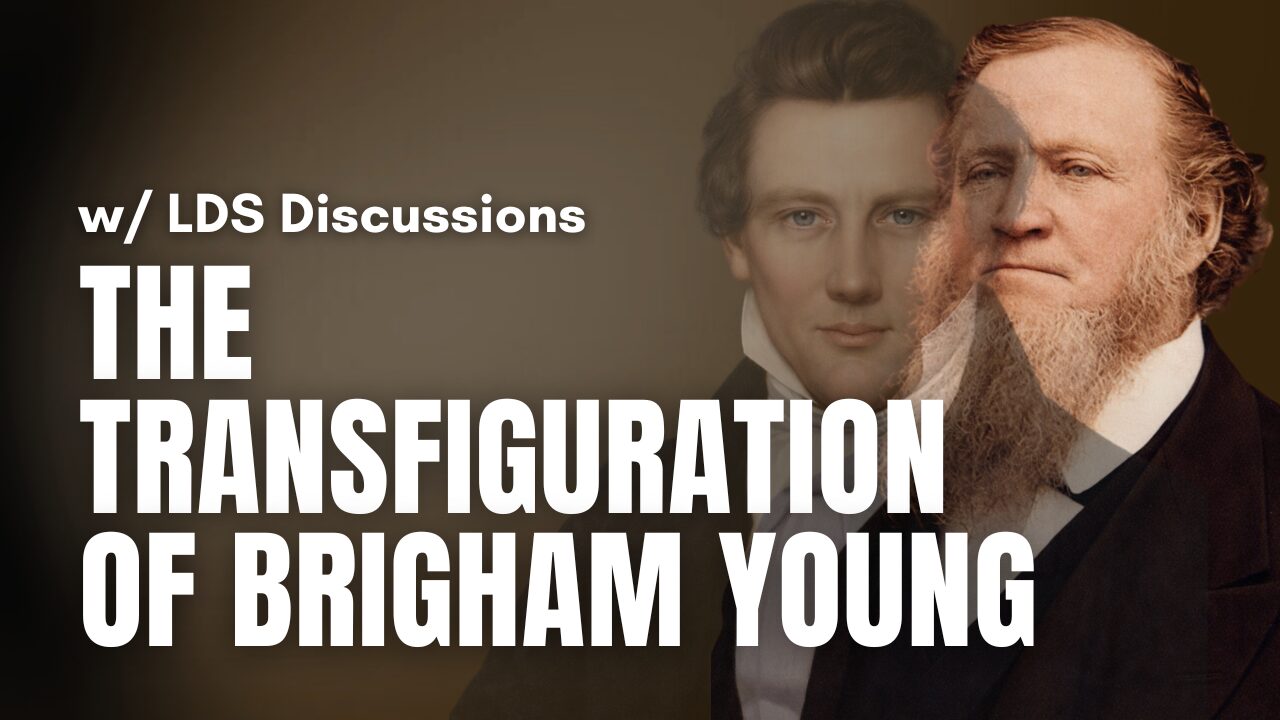
The Transfiguration of Brigham Young w/ LDS Discussions Ep. 42
Listen on Apple Podcasts Spotify YouTube Download MP3
About this episode
Unearth the captivating rise of Brigham Young from the mesmerizing “Transfiguration” that altered Mormonism’s course. Mike, Nemo, and John explore this event through meticulous analysis of historical records, contemporary journals, and a carefully constructed narrative. Unveil the astonishing accounts of miracles, including a highly cited backdated miracle and the use of carefully worded descriptions in “Saints.” Discover why the Transfiguration holds immense significance for Mormonism and how it serves as a guide to the birth of miracle stories.
Overview of the Transfiguration of Brigham Young and Miraculous Stories (ldsdiscussions.com)
LDS Discussions is made possible by generous donors!
Help us continue to deliver quality content by becoming a donor today:
- One-time or recurring donation through Donorbox
- Support us on Patreon
LDS Discussions Platforms:
- LDS Discussions Website
- LDS Discussions on Anchor
- LDS Discussions on Spotify
- LDS Discussions Playlist on YouTube
Contact LDS Discussions:
- Twitter: @ldsdicussions
- Facebook: @ldsdiscussion
- Insta: @ldsdiscussions
- Email: ldsdiscussions@gmail.com
Contact us:
MormonStories@gmail.com
PO Box 171085, Salt Lake City, UT 84117
Social Media:
Show Notes:
Related LDS Discussion Episodes:
Mormon Stories Content:
- 1590: Lost 116 Pages w/ LDS Discussions – 04
- 1688: The Happiness Letter (Joseph Smith’s Proposition to Nancy Rigdon) w/ LDS Discussions – 28
Originally published on mormonstories.org.
Transcript
Machine-generated and lightly edited. Click any timestamp to jump the audio to that moment. The audio is authoritative; please check it before quoting.
Introduction and Episode Overview
Jad Delid Hello everyone, and welcome to another edition of Mormon Stories podcast, LDS Discussions Edition. I am one of your hosts for today, Jad Delid. It is April 26, 2023, and we are here today to discuss, I think, and I think Mike and maybe even Nemo eventually are going to agree that this is actually one of the more, if not one of the most important episodes in this entire LDS discussion series. Today we're going to be talking about the transfiguration of Brigham Young, which is the story that I was told growing up that when there was a succession crisis, Joseph Smith died, that Brigham Young's face transformed into Joseph's as a miracle to let the Saints know that they were to follow Brigham out to Salt Lake. That's the quick preview. We're doing this as part of the LDS discussion series. Let me just remind you all who are joining us for the first time what that is. My friend Mike, which we're about to bring on Adult convert to the Mormon Church, has put together an amazing website@ LDSDiscussions.com where he's written 50 plus essays plus a bunch of other content where once he obtained, let's just say, a truth enlightening regarding the origins of accurate Mormon Church history, he decided to write a bunch of essays where he wanted to process that and share it so that other people would learn the things he was learning that he didn't get taught prior to joining the church or even immediately after joining the church. And so that's what the LDS Discussions website is about. And then of course, we're now this will be 42 episodes into the Mormon Stories podcast series with LDS discussions. You can obviously find this episode integrated into the Mormon Stories podcast feed on all the different platforms, but you can also find this LDS discussion series as its own podcast series on Spotify in both video and audio and on Apple Podcasts and wherever you get your podcasts. And of course we have a YouTube playlist on the Mormon Stories podcast channel dedicated to just these episodes. But this series is definitely one of the most important things Mormon Stories has ever done in its 18 year history. And without any further ado, we bring on Mike and Nemo to join us. Hey, Mike, how's it going?
Mike Good. How are you guys all doing out there?
Jad Delid Good. It's good to have you.
Mike Yeah, it's good to be back. Like, I've been teasing this one for a few episodes. This is one of my favorite ones. Just from the standpoint of kind of putting all of this back together, I think this episode is one that to Me is one of the most important. So hopefully everybody, you know, especially if you've never heard about this stuff before, hopefully this will be a good one for everybody watching.
Jad Delid Yeah. Well, we're excited to jump right in. I'll also just add that this particular story was a major crack in my faith shelf when I learned about it. And I learned about it kind of almost pre Internet from a dialogue article that we're going to be discussing in just a second. But if. If not, if having Mike from LDS discussions weren't enough, we also have the Nemo from the NEMO the Mormon YouTube channel joining us. Hey, Nemo. Hey, how you doing? How are things in the uk?
Nemo I wish I could say good, but, you know,
Jad Delid how's the Nemo family?
Nemo Nemo family is great. We're all fine. So, yeah, we're loving life.
Jad Delid That's almost all that matters. If Nemo and his family are okay.
Nemo Yeah, yeah.
Jad Delid Everything. Everything else can go to fine. Yeah. Everything else. Yeah. All right, man. Thanks for joining us. And Nemo, is it. Is it fair to say that you haven't really dug into this particular topic yet? And so while you may know conceptually what it's about, you'll be kind of offering a fresh reaction to kind of the details. Is that right?
Nemo Yeah. So the overview you offered is essentially all I know about this story. And when I knew we'd be doing an episode on it, I thought, oh, wouldn't it be fun if I actually just don't look into it too much and kind of offer my live reaction to this on air?
Jad Delid Yeah, yeah. And I'll just say, not to build it up too much, but, like, I had been a member for three decades, a lifelong member for three decades, before I heard this story, and it was shocking. This story was shocking to me. And so hopefully we're not building it up too much. But that's why. That's why I agree with Mike. It's super important. All right, Mike, should we jump in or what?
Mike No.
Nemo Yeah.
Mike I mean, all I would point out is we. We've done. What'd you say, 42 episodes. And I would say that, you know, when you look at all these topics, a lot of them are topics that have been covered by other podcasts, other books, whatever. And to me, when I was doing these. These overview topics on the website, the two that really stick out in my head today, that are the two that are the most important topics because of the fact they're not covered that much, is the 116 pages as well as this one. In the 116 pages episode we did, I thought was important because it gave us a real good window into how Joseph Smith was able to create revelation and create the text of the Book of Mormon when he got himself into a jam where he needed to basically find. Find a way out. And we covered all that in that episode. If you have not watched that, I highly recommend it. The transfiguration of Brigham Young does a slightly different approach, but it kind of gives you that same window, which is a window into how do these stories that we hear so much of come together. And a lot of the stories. And we'll go through this as we go, but when you hear about miracle stories in the church, whether it's the priesthood, restoration, the first vision, or if you look into even earlier religious miracle stories, we don't have contemporary accounts to base it against. And that's why this one is so important, because we have the beginning and we have the end. And we can now evaluate all of that and then say, what does this mean to all of these things we've been talking about in the previous 40 episodes? Like I said, I'm, like, totally nerding out about this one because it was, as John said, this one was a massive aha moment for me. And it's such a story that seems very inconsequential, especially when we're so focused on Joseph Smith and the foundations of the church. This story, though, gives us just such a huge spotlight onto a lot of the things we've been pointing out about earlier stories. I feel like this one's going to be kind of like a little bit of a glue that kind of pulls everything back together. So I'm excited. So I'm good.
Jad Delid All right.
Mike To go with that said.
Jad Delid So, Nemo, just to check in with your British sensibilities, have we hyped this enough yet, or do we need to hype it a little bit more?
Nemo I think you need to lessen the hype, please.
Mike Yeah.
Nemo Need to bring the levels down, keep a nice monotony.
Jad Delid All right. Yeah, yeah. Under promise and over deliver. Okay, Absolutely. So here's the slide deck, and there's a preview of some art that. That I pulled off of Google that basically shows Brigham Young at a pulpit, some saints in the audience, and then kind of like light shining down and the image of Joseph Smith appearing. And that's a bit of a preview. So. So let's dig in. Mike, let's go to slide one.
Nemo Yeah.
Mike And so just to point out, you know, kind of what I was saying is you know, we're kind of at that point now where we're wrapping up at least the main part of these episodes. We might try to add some later, because I know there's been a lot of topics people want to hear about, but this is what I would consider one of the biggest miracles in the history of Mormonism that's not directly tied to Joseph Smith, and it's known as the transfiguration of Brigham Young. And one of the most difficult issues for both critics and apologists is that no matter how much evidence we have, we can never know exactly what happened because we were not actually there. And in most cases, we don't have firsthand witnesses that recorded it contemporaneously as well. And so that's why you'll often hear the phrase, we cannot know everything or we'll get the answers in the next life. Because ultimately, when you talk about the early stories like the first vision and the priesthood restoration, there was no one there filming them. There were no reporters. There were no articles in the local newspapers about these things, you know, and as we talked about the first vision, it wasn't even mentioned by Joseph Smith for 12 years. And even then, it was just his own little journal, was not out to the main church. And so because of that, it gave Joseph Smith room to change those stories as he retold them. But it also gives apologists in the church the ability to use that we cannot know everything line to deflect from the fact that with the first vision and the priesthood restoration, we do have a lot of documents that point to the fact that they are clearly being changed, ideas are being retrofitted. Some instances we can tell that the details are being made up out of. Out of nothing. But because there was no contemporaneous writing from someone at the time, apologists will continue to say, well, you weren't there, so you don't know. This story changes that kind of angle of apologetics and really cements this down into something we can evaluate.
Why Miracle Stories Matter to Faith Traditions
Jad Delid Yeah, yeah. And another angle is two things. It's the importance of miracle stories to a faith tradition. If you're Catholic. Well, if you're Christian, if you just think about the. Well, no, let's go back in the Old Testament, it's Moses parting the Red Sea. It's God wiping out all the humans on the planet and animals, you know, with the flood, it's David slaying Goliath. You have to have these miracle stories to. To kind of like, bolster the faith of the membership. And then if you switch to Jesus's time. They there's Jesus curing the lepers. There's Jesus helping the blind see. There's Jesus turning the loaves and fishes into, you know, multiplying the loaves and the fishes to feed the multitudes or turning water into wine. Like, you really don't have a faith tradition without these miraculous stories. Many, many, many followers of a religious tradition based base their faith on these miraculous stories. So that's one. And. And this was. This story was absolutely part of my faith, which is why it was shocking to me when I learned something different. But then secondly, if you want to look, you know, the purpose of the LDS discussion series is to give people information to be able to look at Mormonism as a faith tradition objectively. We're not trying to push anyone in any direction per se, but we are trying to share evidence so that people can have informed consent and make informed decisions. And what I think today would show is an alternative view. If you're open to maybe something not being miraculous, but instead you're open to a secular explanation, both for this story in particular, but also you just want to learn how miracles can develop over time if they're not rooted in reality. Today is like the perfect laboratory for that, I think. All right, Nemo, anything you want to add or you just.
Nemo Yeah, you say. Well, you say that we're not going to one side or another. But let me quote Richard Dawkins for a moment. So he talked about Mormonism in a very interesting way, and it's a thing that kind of comes up to me regularly. Is that what's interesting about Mormonism compared to sort of Catholicism or other faith traditions is that it's relatively new as a faith tradition. And so we have documents from its founding, from its beginning. We have newspaper articles from the time when Joseph Smith was around. So we can undo the sort of apologetic arguments that are used in other faith traditions or the arguments that are used by the defendants of other faith traditions where we say, well, we can't know. We weren't there. Well, we kind of can know because good records were kept from the time when these things happened. That's the only point I'd like to add.
Jad Delid Yeah, yeah, I've heard it said. And I'm going to mask her the quote, something like, woe be unto the person who starts a religion after the invention of the printing press. Because it's one thing to claim a miracle 2,000 years ago when there's no cell phone, and you could even say worse with cell phones, right and with cameras and the Internet. But it's one thing to claim a miracle that happened 2,000 years ago. It's another to claim a set of miracles when you've got documents and evidence to back it up. So, anyway. All right, Mike, should we go to the next slide?
Nemo Yep.
Mike Sorry about the shakiness. Yeah, we can go to the next slide.
The Succession Crisis After Joseph Smith
Jad Delid All right, so let's. Here we are.
Mike Yeah. So this is basically getting into the story of it. And so as John mentioned earlier, after Joseph Smith was killed, there was no. There was no clear plan on who was going to be the next prophet. And so that led to a lot of confusion. And again, that's one of those things where, you know, you would think that there'd be some better way to have this happen. You think it would have been thought of ahead or God would have given a revelation about this. But no. And so there's all this confusion. And both Sidney Rigdon and Brigham Young both felt that they should lead the church moving forward. Sidney Rigdon felt that he should be the prophet. Brigham Young felt that he should lead the church as the leader of the 12. And so this is basically the transfiguration of Brigham Young's story. This is from a website called LDS Answers, and this is how they describe it. Brigham Young, a man fiercely loyal to the prophet Joseph Smith, current president of the 12 and later to become known as the lion of the Lord, takes a stand. Suddenly, the people arise en masse to their feet, astonished. One eyewitness later remembered it appeared that Joseph had returned and was speaking to the people. As Brigham Young commences speaking, hundreds in the audience believe in every possible degree in it is Joseph's voice and his person in look, attitude, dress, and appearance. It is Joseph himself personified. There are even stories where people say that Joseph Smith apparently had, like, a chipped front tooth. And people would say that they even heard Brigham Young started talking with that s sound like when you have a chip tooth and the s kind of. So, I mean, like that this was basically the story that Brigham Young turned transfigured into Joseph Smith in front of hundreds of people. And this is. This is obviously a crucial moment in the history of church because following Joseph Smith's death, the church had split off into many factions, as we all know, with all of the living witnesses following Emma Smith to form the Reorganized Church due to their belief that polygamy was not from God. This moment is used to explain why Brigham Young was the one that was chosen by God to lead this church and why this branch of Mormonism is true and the only living branch of God's church, and that Brigham Young was truly a prophet of God. Like, this is, you know, this sounds crazy to maybe to some people listening, but this is not just the most, one of the most important miracles in Mormonism. This is one of the most important miracles in religion. Like to have this happen in front of hundreds of people, that's a miracle that would live up to a lot of the stuff in the Bible. This is no small thing. And so we accept this now as being the truth. I remember asked somebody, I said, how do we know Brigham Young was the one that was supposedly the church? Because, you know, you have all these, these break offs, you know, and so I'm like, well, why did everyone follow Brigham? And they said, they said, because when Joseph Smith died, Brigham Young spoke and he was being challenged. A lot of people wanted to take over, and everybody saw Brigham Young turn into Joseph Smith in every possible way, and that's how they knew. So, I mean, like, that is exactly why Brigham Young ended up being the prophet. So this story is, is a massively important one, even though a lot of people might kind of gloss over it because we focus so much on Joseph Smith in early church history.
Jad Delid Nemo, I'm, I'm curious to know, were you taught this story growing up as a Mormon? And do you have, do you have memories of it at all?
Nemo Well, see, like I said, I knew the rough overview from my time in seminary, and I knew that there was a succession crisis, and I knew that this was part of what kind of lent legitimacy to Brigham Young's claim. And it's why I refer to the mainstream LDS church or the church that we're talking about as the Brighamite sect of the LDS Church, the Brighamite branch, sometimes, because it is important to remember that the only time this was ever just one church was before Joseph Smith died. And after that, it just went and went and went and it's become, it's become very sprawling, I suppose you could say the family tree of Mormonism has become very sprawling. So I was aware of those other sects, but I always believe that the lds, the Brighamite sect was the right one because of things like this story.
Jad Delid Yeah. So from a faith perspective, from a testimony. Oh, it's crucial belief perspective for you.
Nemo Yeah, yeah, yeah, yeah. Because there is that question in everyone's mind when you, when you learn that there was more than one option, when it wasn't just set in stone that Brigham Young was just going to become the prophet of the church, which I wouldn't be surprised if some people just believe that, that it was just always that going to be that way. And that's how it was. And they don't know about the story to this day. But I did know that there was a succession crisis. And so when you, when you know that there were options where it could have been Joseph Smith's son, where it could have been Sidney Rigden, where it could have been Brigham Young, you need to have a reason to come down on one particular side. There has to be a reason why it was right to follow Brigham over the other options. Right. There has to be a reason for that. And there has to be a reason why I'm not going to Community of Christ or the reorganized LDS church. Instead I'm going to the Brighamite sect because that one has to have more legitimacy, otherwise why wouldn't I go to the other? So it's very important, it was very important to me that that succession crisis went down in a way that meant that God was behind it. And so miracles are a key part of that.
Jad Delid Yeah. And I was just going to say it's almost weird that we don't have an LDS discussions episode on the succession crisis because what I for those who are newer to learning about Mormon Church truth claims, it's just a fact that Joseph Smith promised his son, Joseph Smith iii that he would be his successor. And that's why Emma stayed behind and waited until Joseph Smith III was old enough. And that's why the reorganized church was started, because Joseph Smith Jr. Himself said at one point or another that his son would take over. And then there's Brigham Young. But then there's also Sidney Rigdon who I think Sidney Rigdon was given the impression by Joseph that he would be the successor as well. I'm sure Brigham Young was as well. And there's even other people like James Strang who, who said that Joseph Smith told them they were going to be the successors. And so there's at least four people that I know of who there's good evidence for. Joseph Smith told them they would be the successors. And that's, that's in and of itself an issue. Why would this be left to chance? Why would Joseph Smith be promising it to multiple people? Who, who's right? And I think that's some of the tension that led to the need for some sort of faith promoting story to even come about. Anything you want to add to that, Mike?
Mike Well, I would just point out again, we mentioned this in a few episodes, but we are told in the Mormon Church that God knew Joseph Smith was going to lose the 116 pages of the Book of Mormon. So thousands of years earlier, he had made a second set of plates just for that one little event that he could see that long ago in the future that. And then at the same time, that same God had no idea that it was really important to set up a process for who was going to take over the church in case Joseph Smith died. Like, there are all of these plot holes that you see where you go, yeah, that doesn't make sense, because on one hand, God could see these really specific details, and then on the other hand, God couldn't see anything. And to both of your points, I think that this story is basically, you have all of these people that are under pressure from other sects of Mormonism, obviously, in this case, mostly the ones that stay back with Emma. And so they all go across the country to Utah through horrible conditions, and eventually Brigham Young is going to take over the church with a very authoritative style. Right? Brigham Young was a. You know, I'm not. I'm not a Brigham Young fan for a lot of reasons, but you need to create these stories. One, to justify why you did what you did, you got to justify going across the country to Utah, and you have to justify why you are now in what you consider to be the correct branch of the church. And you need miracles to convince other people why they should join your branch over others. So this serves a lot of different elements that are needed. And we talk. I don't want to skip to the end too much here, but when you talk about miracles and other religions, there's a reason why when the Bible was put together, you have these. These different miracle stories of the Flood and, of course, you know, Adam and Eve and of the Tower of Babel and all that stuff, because you need these origin stories to give justification that you are the chosen people, that you are the people that are supposed to be God's, God's people. And so this is really, to me, a remnant of that. And that's why this is such an important episode, in my opinion, because it gives us a new lens to view those other miracles through.
Nemo Yeah, love it.
Jad Delid All right, so I've already shown it, but I'll show it again. Here is a enlarged photo of one artistic depiction of Brigham Young standing at a. Outdoors at a pulpit with the Scriptures on the pulpit. A bunch of members are listening. And it's sort of this. It's a really powerful and important moment in Mormon history. I believe because it's really this kind of showdown. If there ever were a showdown in Mormon history, it's Sidney Rigdon, who was with Joseph almost from the beginning, who was charismatic, who was much loved, but who also had fallen a little bit out of favor, partly because of a previous episode that we talked about, which is his daughter. You know, if you go to the happiness. Is it the happiness Letter episode that we would want to reference? Letter, yeah. That's why we recommend that people kind of watch these episodes in sequence. Because if you watch the happiness episode, Happiness Letter episode, you'll remember that Joseph Smith propositioned Signe Rigdon's daughter and she becomes one of the heroes of Mormon history because she declines Joseph Smith's super manipulative and I would say predatory advances. Nancy. Nancy Rigdon. And I don't think Joseph loved the fact that Nancy declined his advances. And I don't think Sidney loved that Joseph was propositioning his daughter. And so I'm sure that led to some strain between Joseph Smith and Sidney Rigdon towards the end. And if I understand it, didn't Sidney Rigdon, like, move to Ohio or something for a while in those final years of the church and almost become a little bit estranged from the central leadership of the church? Do either of you remember that?
Mike I think that's a yes and no, because I think he was told, I believe, the revelation to move, but I think the reason was because he was helping Joseph Smith run for president. And I think they also were trying to make sure they had places. I don't know if it's because Nauvoo was kind of under stress and they were thinking they needed to have, like, a secondary location. But I know Sidney Rigdon and Joseph Smith do make amends after the happiness letter incident, and Sidney Rigdon is there through the end helping him run for president. The downside, though, is that Sidney Rigdon was strongly opposed to polygamy. And that's a huge problem, especially when you have someone like Brigham Young who is gung ho on polygamy, because that was. That was one way, as Lindsay Hanson park has so eloquently said, Brigham had no game. And so Brigham Young was rejected by some of the women early on. And I think that's probably not entirely relevant, but Brigham Young was a huge proponent of polygamy, as we know. And so I think really, at the end of the day, that's a huge reason why Sidney Rigdon was so despised by a lot of people in Joseph's inner circle, because he was against polygamy and they were for it. And ultimately that. That certainly played a role. And then Brigham Young also, during this speech at this convention, really focused on the power being with the 12. And so it's not until after, I think three years after maybe, that Brigham Young consolidates the power to himself. At first, it's about the 12 leading the church, and then Brigham really takes over later. So there's a lot of moving parts in here. But I don't think that Sidney Rigdon and Joseph were on bad terms at the end. I think it's just that Sidney Rigdon basically got beat out by Brigham.
Jad Delid Yeah, Nemo, you had something.
Nemo Yeah. If you look at the. The most recent episode I've done, you'll see that we talk about the 1880 General Conference, where John Taylor is made the third president of church. And he references the fact that for three years, the quorum of the 12 were basically in charge of the church while they awaited Brigham Young to become the president. And the other thing that came to mind was that between Joseph Smith and Sidney Rigdon was the issue where, if I remember Jonathan Streeter's presentation at Sunstone about the Happiness Letter was that essentially Joseph lied to Sidney. And then Sydney went, well, hang on, I've still got the letter. And then Joseph had to make something up about, you know, trying to prove his daughter's worthiness and tempt her and that she rejected his advances. He can prove that she's not the sort of harlot that everyone's saying she is. So my point in that is that there's a lot of bad blood around polygamy for Sidney Rigden. So it's understandable that even if he made amends with Joseph, he would still have been opposed to polygamy as a practice because it came very close to him and his family.
Jad Delid Yeah.
Mike And I'd point out to that point, Nemo, that in the Happiness Letter episode, and again, I don't know the exact words because we did it a while ago, but Sidney Rigdon releases a statement after him and Joseph Smith make amends. And in my opinion, the statement throws Nancy under the bus a bit. It tries to be very carefully worded to basically say Joseph never admitted to writing it, which, of course he didn't because he had scribes and all of that. So there is this weird kind of thing where I think they get past it. Sidney Rigdon still hates polygamy. But again, Sidney Rigdon is Joseph Smith's vice presidential candidate. So in all reality, Sidney Rigdon is like the number two guy and probably should have been the person to take over the church. It really just became a battle of winning the hearts of the church. And I think that if I recall correctly, Sidney Rigdon was really sick before going to this convention. So he kind of came off as weak and sick. And Brigham Young had, like, this fiery speech where he wanted to be with the 12th. So, I mean, there is this. This element of. I don't know if Brigham Young had charisma. It sounds to me like he was more of a charisma by power kind of guy. But the point is, at this event, bullish. Yeah.
Nemo Yeah.
Mike So. So Sidney Rigdon was still very. He had a claim probably to be number. A legitimate claim to be the number two in the church. But, you know, at the end of the day, sometimes when. When the leader, you know, the leader dies or is ousted, you know, things take turns that you don't expect.
Nemo Can I just point out real quick that if you've been watching this, you will have seen, we taught. We talk a lot about the Nauvoo House and how God got very, very specific about the size and amounts of shares that could be bought in the Nauvoo House. Very, very specific, minute details. You would have thought he would have put an equal amount of effort into revealing to Joseph Smith the mechanisms by which power should be transferred in the event of Joseph Smith's death, particularly if he's an omnipotent God, he will have known the fact that Joseph Smith was going to be martyred, and you would have thought he would put something in place. It's just my thoughts.
Mike Yeah, that's my. That's just it. Like one of the. One of the themes. And I'll kind of skip off of this, but one of the things we've talked about in these episodes is that Joseph Smith was able to do things when he was in full control. And that's the same for the church as a whole. If you look at the church over the last, even 30 years, when they're not in control of situations, things don't go well, such as the November 15 policy, which they claim was from God. As Nemo said, Joseph Smith was in control of how people were going to give them their money to build the Nauvoo House, which was basically Joseph's mansion. And yet God doesn't feel the need to give directions about how his church would be succeeded by him. And I think that's a big thing that people. Once you get to a point where you start doing the deep dive, you're like, that is Kind of interesting that God had no plan laid out when we have all of these other things that Joseph Smith was able to give revelation on.
Jad Delid Yeah, absolutely. One of the, one other tiny thing I'll just mention is one of the reasons why Brigham Young wasn't the obvious successor was because he was gone all the time. Like, he didn't he spend a lot of those Nauvoo years as a missionary, because at the time, the 12, the quorum of the 12. And I think we should have John Hamer on to talk about this. My. My understanding is one of the main roles of the quorum of the 12 in the early church was to go out and be missionaries, to go out and preach the gospel. And so Brigham Young had spent, as I understand it, way more time away than he had in Kirtland or Nauvoo. And so he wasn't as familiar of a face or as a. As a living, breathing, familiar presence to the people of Nauvoo. And. And that's part of the reason why, in addition to there not being an actual succession plan where he had to fight and struggle for his power. Is that, is that your guys understanding as well?
Nemo Yeah, well, he honed his public speaking skills on his mission in the uk. Like, that's where he will have learned all this, and that's where what will have come into effect here. But it's interesting. If you go to the Scriptures, you go to doctrine and Covenants 107, it talks about how the. The traveling elders of the church are the quorum of the 12. So they're listed in Scripture as a traveling band of high priests of, you know, a traveling quorum, as it were. So, yeah, they're very much according to scripture, designed to be moving around and preaching.
Jad Delid Yeah. Okay, well, let's jump to the next slide.
Examining the Historical Evidence
Mike Yeah. And so this is where the story gets interesting because again, we have this miraculous story of the transfiguration of Brigham Young, but it's going to suffer from the same problems that we talked about with Joseph Smith's first vision, the priesthood restoration, the 1831 polygamy revelation, and what so many of these other stories do, which is nothing was written down about it happening this way at the time. And so with Brigham Young, this is extremely more problematic because we do have many letters and journals from the day the meeting took place, along with newspapers and church records from leaders. Not a single mention of this miraculous event is going to surface until at least seven years later, when the allusions to this event begins to spring up in journals. Such as Emily Hoyt's diary. And so, you know, the most consequential event potentially, and I would say modern religious history happened, and not a single person or publication mentioned it until seven years later. And that is a massive red flag, not just because it wasn't mentioned, but because we have a lot of accounts of the event not mentioning it. So, like, with the first vision, you could go, well, Joseph Smith didn't have a journal in 1820, or in my opinion, 1824, that said, I saw God in Jesus. He just. He didn't do any of that. In this case, we have a lot of writings that talk about the event, and we'll get into it a little bit. In some cases, you know, there's pages of details about what happened. Not a single mention of them seeing it or anyone else reporting it. And that is a really clear indication that this did not happen.
Jad Delid And I'm just going to repeat this. So let's just say thousands of people were at this meeting. It might have been hundreds, but I'm guessing it was thousands of people were at this meeting. Supposedly, like you said, Mike, one of the biggest miracles, a literal miracle, where allegedly the entire crowd sees Brigham Young's face transfigure into Joseph Smith's face and his voice. Right. And not a single person wrote about it in their journal for at least seven years. Not a single person. And I would add that the church was still printing, you know, newspapers or periodicals or whatever, and there's no mention of it there either. Right, right.
Nemo A question then, or a thought, possibly from the believing perspective would be. We know in the Book of Mormon, there were things that were talked about as being too holy to record. You know, the prayer that Jesus offers amongst the Nephites, they say, we can't write the things that he said, for they're too holy. So the question becomes, then, was this a too holy an event to write about? And we thought we should keep it to those that are present. But then why do they start writing about it later? Because of the question.
Mike That's just it. And we'll get into it. And the thing is, to John's point, no one mentions it, but even. Let's just say there were. Let's say that the place they had, it had hundreds of people. And in Nauvoo, there's thousands of members. If this happened, you would have people leaving and going to the people who could not be at that event and be like, brigham Young's the guy to leave the church, dude. Literally, literally transformed transfigured into Joseph Smith. We saw Joseph Smith. That's the dude. Sydney Rigdon is a complete pose or whatever. Whatever they. Whatever they said. Navu Times. The point is, you would have the word of the spreading because people would be telling those who couldn't be at the event, you would not believe what I saw. This is the dude to lead the church. This is God's church. Nothing. Nothing at all.
Jad Delid Yeah.
Nemo Yeah, you think that's. That's a really good point. You think it'd be spread far and wide?
Mike It would be. I mean, it's a missionary. I mean, I realize you're within the church, but it's basically a missionary tool for the people at the event to tell all the people not at the event. Yeah. Brigham Young's a dude. We're follow because he literally turned into Joseph Smith. So you would have other journals who might say, I wasn't here, but sister so and so told me she was there and she saw just nothing. There's not a single journal anywhere. There's not. We have new, as John said, there's newspapers, there's magazines, there's periodicals. Nothing. There's not a single mention. This just did not happen.
Jad Delid Yeah. All right. Well, if there's no record of this happening for seven years, I guess that then begs the question, how did this myth evolve if it wasn't based on reality? So should we jump to the next slide?
Mike Yeah. And so this is the dialogue article that John, I think, referenced earlier. I'm sure there's more than one dialogue article on it, but Richard Van Wagener kind of discusses the evolution of the story in a dialogue for an article for dialogue. He documents that journals from the day surrounding the meeting discuss the event, yet fail to mention the transfiguration on every instance. And so he says the. The legend is now unsurpassed in Mormon lore. Second only that Joseph Smith's own account of angelic ministry ministrations and his first vision. And that when 8th August, 1844 is stripped of emotional overlay, there is not a shred of irrefutable contemporary evidence to suggest that or to support the occurrence of a mythical mystical event either in the morning or afternoon gatherings of that day. And so Van Wagoner, in this article, goes through all these journals and he continues by saying the paramount dilemma with retrospective transfiguration recountings is why so many otherwise honorable pious people recalled experiencing something they probably did not. A rational and likely explanation for this faulty group memory is that a contagious thought can spread through the populace to create a collective mind. And that's a really important point to remember when you read about Joseph Smith and the witnesses of the Book of Mormon who give details that evolve over time and tend to fall in line with the collective mind and the collective account as they got older. And so, in other words, people tend to believe a story the more they tell it, regardless of the accuracy of the story. And you can see that here. We'll get into the details, but a lot of people are talking about being at this event, that some of them weren't even there. And some of them obviously were there but never talked about it until much later.
Nemo Well, contemporaneously, aren't there examples of people remembering things about 9 11, for example, that just didn't happen?
Mike Yeah, there's that too, for sure.
Nemo So this, this happens?
Mike Yeah. Oh yeah, for sure.
Jad Delid Yeah, yeah. So, yeah, exactly. Nemo, like as I, as I understand it, and maybe Nemo, you can Google this. But there's a lot of people who claim that they remember watching the first. Is it the first plane hit the Twin Towers or the second plane.
Mike Yeah, second one.
Jad Delid The second plane hit the Twin Towers live as it was happening. And it turns out it was never aired live.
Mike That the only recording, I think the second one was, was live. But. Yeah, I know what you mean. I think it's the first one.
Jad Delid Yeah, yeah. You guys, I, I wasn't prepared for this, but I definitely remember fact checking it once. There's this whole collective memory of people saying that they watched live one of the planes go into the towers when they've been able to show that there was no live coverage of that particular instance.
Mike Yeah, I think you're right.
Jad Delid That's just one of many examples. I was going to also say that something really worth looking into is kind of social psychology and memory, because memory is just a really, A really, really tricky thing. And whether it's. So there's a series I did on Mormon stories called the Psychology of Religion with Dr. James Nagel. And this is a classic Mormon Stories episode. I'm going to include it in the show. Notes from. From a long, long time ago. But what you learn about memory is that it's completely. And this is kind of a disturbing thought, but you learn that memory is completely malleable, that people can. And we'll show this. Hopefully you're going to mention this in one of the later slides. But if you tell a story enough that people hear and then you add enough time to it, people can remember being at an event that they actually weren't at, but because they, they hear that story enough, they have emotional attachment to the story and then they remember it. They retrieve it, remember it, restore it. And they do that enough times, you give five, 10, or 15 years. And it's been proven that people can remember being at events that they actually weren't at. That's how powerful and how disturbingly unreliable memory memory can be at times. And I'm going to just ask you all to watch the episode with Dr. James Nagle on Mormon stories about the psychology of religion to kind of learn more about what I'm talking about.
Nemo There's a couple, there's a couple of cool articles we can look at. We won't go into them now, but we can put them in the show notes about how people misremember 911 and how how human memory tends to put together after the fact a cohesive series of events. For example, one man remembers hearing the news of 911 while he was on the street. But it turns out in actual fact, at the time that it happened. And he heard the news from actual written, solid records. We know he was in his office, and the theory goes that he was spending time on the street and in the office that day. And as his brain put together a narrative, he settled on one which wasn't necessarily true. So things like that happen.
Jad Delid Love it. And I'll paste those into the show notes. Perfect. Okay, Mike, back to you.
Mike Yeah, we could go to the next slide. I mean, I think we've covered the next slide, so this one's really interesting because this is we taught, we had an episode on backdating revelation, and in a lot of ways, this is a backdated miracle. And so I mentioned earlier the website LDS Answers who had the article on the transfiguration. And they say within a year of the transfiguration, the miracle had been referred to several times, although they surprisingly provide no sources. Again, this was covered in both Nauvoo newspapers along with notes from many leaders of the church. The idea that they missed such a miraculous event is requiring you to literally suspend all common sense. And if they had proof that it was recorded, they would have presented it. So I just want to be upfront that while they say that it happened within within a year, they have no sources. And I've never come across one. And it would be front and center in every lesson that explained why Brigham Young was the chosen successor to Joseph Smith. Wilford Woodruff, who would be a later prophet, wrote something.
Jad Delid Okay, wait, I have to ask, Mike. I'm not Understanding something. Are you saying that the church has claimed that there were newspaper articles about this within a year of it happening?
Mike So this website is. LDS Answers is not. I don't think it's an official church site. It's like kind of like a fair Mormon kind of site. I'm just saying that their article about it makes the. Makes the very clear as they're saying within a year that there began to be for. What's the word? Whatever the. Whatever it says. Referred to. It says it was referred to several times and it's just not. They give no sources. And I've never found one that refers to this event in that.
Jad Delid So I just don't want to confuse our listeners. So, yeah, we don't know of any evidence that this was referred to before those set that seven year window. But there are LDS apologetic LDS websites that appear to be falsely claiming that.
Nemo Yeah, LDS Answers is a project of the Joseph Smith Foundation. I've just had a quick look. So. And the Joseph Smith foundation is connected to the Church.
Jad Delid That's the Hannah. Hannah Stoddard group, Is that right?
Nemo Yeah. Okay, so there you go. There's the connection for you.
Jad Delid Okay, go ahead. Go ahead, Mike, keep going.
Mike Yeah, so I just, you know, just want to point out that you'll. You'll hear some apologetic sources say that, but you weren't. You're not going to find the sources. And so Wilford Woodruff, who is going to be obviously a prophet of the church, wrote seven pages in his journal on this day. Not a single mention of any transfiguration, change in voice, or any other miraculous event. Parley P. Pratt wrote about the day in his autobiography, which was finished in 1856. Not a single mention of anything miraculous happening. There are writings from Brigham Young, Heber C. Kimball, Willard Richards. Not a single mention of any miraculous event. And then there's this diary that's been used by church scholars.
Jad Delid Wait, wait, wait. I just have to note. You would think that if Brigham Young experienced the transfer transfiguration himself, that he would have both noticed it and written about it, Right?
Mike Maybe not though. Maybe. I mean, if you're gonna take it from a faithful perspective, you might be like, well, he's just talking. He doesn't realize what everyone else is seeing. So I suppose that, I mean, I don't think he'd write, I turned into Joseph Smith today. Boom. You know, I don't, I don't think you'd have that. So that one isn't. That's it. But you might have something you might have a writing that says, you know, I spoke against Sidney Rigdon. The crowd said they saw me turn into Joseph Smith. I don't know.
Nemo Dear Diary, today the strangest thing happened.
Mike Yeah.
Jad Delid No, but you would think that if he was transforming into Joseph Smith, he would get the memo, too. It wouldn't. The memo wouldn't be for everyone around him.
Mike Oh, yeah.
Jad Delid But, but, but also you would think that people would immediately come up to him and tell him, and that if he's gonna take the time to write a journal entry that night, he would mention it. Right?
Mike You would think. Yeah. I mean, you would think. And that's just it. All of the. Everything. Everything is pointing to this didn't happen. I mean, it's just. I don't know how more to say it, but this one is really funny because there's one diary that's been used by some church scholars in the past to prove it was mentioned at the time. It's a diary written by George Loeb. But as Van Wagener discovers, this small, tan colored leather diary, which has misled many scholars, has now been determined to be a copy of the original by Lobb himself, with additions. In addition, they have since found the original diary, and it contains no references whatsoever to the transfiguration of Brigham Young. So much like with the retrofitting of the priesthood restoration or the Charles Anthon line of I cannot read a sealed book to Martin Harris, the. This story was literally rewritten into a second version of this journal in an attempt to give the story more credibility.
Altered Records and Eyewitness Accounts
Jad Delid Do we know what year he rewrote his own? Because that's pretty condemning.
Mike I think it was 10 years later, but I'm not positive. I think it was 10.
Jad Delid So 10 years later, which fits. After the seven year window, he rewrites his own diary and inserts the story after that seven year window.
Mike Yeah.
Jad Delid Yeah, that's. That's pretty condemnatory, I think.
Nemo Wow.
Jad Delid Yeah. So, Nemo, I heard a wow from you.
Nemo That's just. Yeah. I have nothing else to say.
Jad Delid Okay.
Nemo Wow.
Jad Delid We got a Nemo Wow. That's. For a Brit, a wow is a significant event. So I'm just gonna note it.
Mike Yeah.
Jad Delid All right. Should we go to the next slide?
Mike Yeah, we can go to the next one. Okay, so this one. This is one of those. This is one of those ones where you hear this now and I'm just like, holy crap. Like. So this is Apostle Orson Hyde speaking at General Conference in 1869. And this is what Orson Hyde says to the church. We went among the congregation and President Young went on the stand. Well, he spoke and his words went through me like electricity. Am I mistaken, said I, or is it really the voice of Joseph Smith? This is my testimony. It was not only the voice of Joseph, but there were the features, the gestures and even the stature of Joseph before us in the person of Brigham. And, and the problem is that Orson Hyde wasn't actually in Nauvoo that day. He arrived five days. He arrived five days later, as confirmed by the journal of Wilford Woodruff. So he wasn't even there. And this account has been used in church lessons before, even though the history has been available for decades, that it could not possibly have happened. And so to John's point, maybe he believed he was there, but he was not there.
Jad Delid I mean, my understanding was he was traveling back from like England or the uk.
Mike Yeah, he was traveling back.
Jad Delid So he was like even passport or, you know, the equivalent of diaries. He was literally like on a boat coming back because he heard that Joseph had died, but he wasn't able to make it to Nauvoo in time.
Mike Yeah, he was a missionary. Yeah, he was a missionary. And I think the diary says he arrived back from wherever he came from. So I mean, like, it, the, the, the, the journal entry that talks about him getting there five days later, I think says he arrived back from wherever he was. So I mean, it's pretty clear that he was not. There was no way he could have been there.
Jad Delid And Nemo, what are you thinking about that?
Nemo I just had a bit of snark to add, to be honest. This is the second time in his life that Orson Hyde's not been in the States when he ought to have been. The first times when married his wife, and then the second time is when he should have been there to witness this miracle, you know? Yeah, he's, he's, he's not great at being where he ought to be. Really. Yeah.
Jad Delid That's dark humor, Nemo.
Nemo Sorry.
Jad Delid Very dark. No, no, this, this story that we just told about Orson Hyde was the lightning bolt for me.
Nemo Yeah, absolutely. Let's not skirt over that.
Jad Delid What?
Nemo I said let's not skirt over that. Carry on.
Jad Delid Yeah, yeah. Like he's an apostle. Decades later, he's standing up in general conference to tell this powerful, faith promoting, miraculous story with his apostolic or whatever authority. And we now know that he wasn't even there. But we don't even need to believe that he was lying or fooling people. We know enough now about social psychology to be able to say it would actually be weird if stuff like this didn't happen, because this is how the human brain works. But it's so condemnatory that we have apostle over the pulpit, completely misleading everybody, saying that he was there, when we have hard evidence that he wasn't even there.
Mike Yeah, and I like, you know, it's one of those things we talk about, the gift of discernment. Our next episode is going to be on Spiritual Witnesses. But imagine all the people watching this general conference and getting that feeling like that. That spiritual feeling when they hear the story about, yeah, Brigham Young is the dude and it's not true. And so all of those feelings that the people in the congregation, the audience, all these spiritual feelings they have, again, are based on a false story. And so it again calls in all that. Like I said, all of these episodes we've done are building to try to make sense of all these things and put this puzzle back together. And this is another area we could talk about in our next episode in Spiritual Witnesses, where you can be fooled, you can be manipulated by other people's stories of things that didn't happen. We obviously have the. With Paul Dunn, the Paul Dunn stories in more modern church history where he was telling fake stories at general Conference. And you get that emotional feeling that's obviously based on a lie, but this is whether or not he was lying intentionally or he really believed it. It's. It's a story that is backdating a miracle that never happened. And you can now see how the church is just going from something mundane to. To one of the most important miracles of all time. And just. They're just rolling with it as if there's no question about it. And I think that's a really important thing. When we look back at these other miracle stories in the church, I think it's just like. Like Nemo said, you can't skirt past this. This is a very crucial window that we have to look at how miracles can be kind of created and then cemented.
Nemo And to be kind to Orson Hyde after I just made quite a mean joke, his expense, it would be fair to say that if he's hitched his wagon to Brigham Young, he's. Which. He's hitched his wagon to the Brigham Young presidency. Brigham was taken out of the church. His legitimacy is as an apostle is tied up in Brigham Young's legitimacy as the rightful successor of Joseph Smith. So he's kind of got to get on the bandwagon of the. Yes, Brigham Young is the right man to have success, to. To be the successor to Joseph Smith. This story proves it's. I'm going to reaffirm this story. I can tell it in the first person because, you know, it'll be faith promoting and I've got a spiritual witness that it happened. So it's like I saw it because we know with the book Mormon witnesses, they saw things with their spirit eyes. So it's, it's not out of the realms of possibility that he said, well, you know, I've had. God's revealed it to me. I've had this spiritual witness that it was. So, so I'm going to say it as though it happened myself and I'm gonna put that story out there because my position here is tied to the legitimacy of this story. In part.
Mike Yeah, it's funny.
Jad Delid Yeah.
Mike Well, what's funny about Orson Haydn and obviously I don't really have all of it ready off top of my head, but Orson Hyde hitch, like you said, he hitches his wagon to Brigham Young. This is in 1869. Six years later, Brigham Young is going to reorder the seniority of the 12, which effectively screws Orson Hyde over of any chance of being profit. So Orson Hyde repays Brigham Young repays Orson Hyde's whatever you want to call lies or a loyalty by basically cutting him at the, cutting him off at the knee so he can't be profit. So, you know, Orson Hyde and Brigham Young did not see eye to eye. And obviously Brigham Young is going to have the last laugh because he's going to completely screw him over six years later.
Jad Delid And I'm just going to echo a point you just made, Mike, which is the epistemological point, because we can all safely assume that when Orson Hyde is telling this story someday in General Conference, you know, powerfully in 1869, that all the people in the audience are feeling what they think is the Holy Ghost they're going to be feeling. How could it not be that they're all, you know, not feeling. That's a double negative. They must have all been feeling completely moved and inspired by Orson Hyde telling the story about the miracle of Joseph Smith and Brigham Young and the transfiguration. And yet now we know he wasn't there. And, and, and it can't be that the Holy Ghost would inspire everyone in a story that was built on a lie. And so that is the epistemological question. If everybody was feeling what they knew was the Holy Ghost. When we know that the Holy Ghost wouldn't testify about a lie, then it begs the question, then what were they feeling it is when, when somebody's listening in general conference or in seminary or in the temple or wherever they are, they're reading the scriptures and they feel these overwhelming emotions. If it's not the Holy Ghost necessarily, then what is it? That, that's the big epistemological question is how do we know things? And are feelings a reliable way to, to end up knowing something? So I just, I just gotta, gotta repeat that. Okay. Should we go to the next slide, Mike?
Mike Yeah, we can go to the next one.
Jad Delid All right, let's do it.
How the Church Has Presented the Story
Mike Yeah. And so, you know, as we talk about the transfiguration of Brigham Young is the central story as to why Brigham Young was chosen to lead after Joseph Smith's death. And referencing this article from LDS Answers, just because it's one of the more thorough articles about kind of the apologetic response. But they say if the Lord miraculously transfigured Brigham Young's appearance, Brigham Young was divinely sanctioned as Joseph Smith's successor. If the transfiguration never took place, the very foundations of our LDS faith and history are weakened. And this is very similar to the Gordon B. Hinckley quoted in the first vision, where they say either it's the most miraculous event that ever took place or this whole thing's a fraud. And I agree, it's true. And this is why I believe that this is one of the most important events to understanding church history, because it gives us an evidence based path to see how myths can grow from the most ordinary events into something just absolutely miraculous. And so in this case, we can look at the tangible, contemporary evidence to see that this event never happened. And yet years years later, it's going to be spoken of as an undeniable fact that gave members that were not even present at the event a spiritual witness that it happened. And I think all of the like, there's so many elements to the story. And that's why at the start of the episode I was saying this, to me, this is one of the most important episodes because it gives you an insight into how miracles happen, into spiritual witnesses, into how church history can be kind of, you know, retrofitted. All of this stuff is coming together in a way that really does show LDS Answers is right. If this didn't happen, it weakens the idea that the Brighamite branch is the true branch of God. It doesn't necessarily mean the Book of Mormon is false, because this is after. But it does tell us that church history has a lot of issues. And in this case, we can show exactly what happened at the day that the speech took place, and seven years later, how this miracle is going to start to grow.
Jad Delid Love it. And I'll just say another example of this sort of apologetic argument, in addition to the Gordon B. Hinckley quote you mentioned, was in the 1960s, I believe, when the information about the stone in the hat and the translation of the Book of Mormon and Joseph Smith's folk magic and treasure digging and the 1826 Bainbridge trial, when all that evidence starts to emerge, Hugh Nibley doubles down and says, man, if all this folk magic, peep stone in a hat stuff is true, it would be the most damning evidence to the church that the church could ever experience. And then it all turned out to be true. And then, of course, apologists just change the narrative and say, man, it doesn't really matter. But there are lots of instances of that sort of stuff happening where the gauntlet gets thrown down and then the apologists are disproven and then they move the goalposts back.
Nemo Yeah, right.
Mike Well, yeah, it's like Joseph Fielding Smith said, if evolution is true, then the church is false. And obviously, I think at this point, you know, that's a statement that the church would love to not have in the records. But, you know, there is. You know, that's why I always laugh because we've talked about this through the episodes, but the church has gone from very specific revelations, very black and white, crystal clear. We know. And now today, they know less and less every day. And it just shows us, because every time they stick their neck out and say, we know this is going to happen, or we know what this means, and then they're proven wrong, which has happened over and over. They look like. They look like fools. And so now they basically say, we don't know who Heavenly Mother is. Please don't ask, because we don't know. And it just shows that this is what happens when you make these statements, when history is not on your side.
Jad Delid Yeah. Nemo, anything you want to.
Nemo Just reading up about the two professors at BYU that are mentioned in the CES letter. One of them is the son of Bruce McConkey, who declare the idea of the rock in the hat being fictitious. And they're like, why else would it be for? And they lay out all these things that just wouldn't make any sense and would make the Church untrue if that were true. So you need to be really careful about those kind of binaries because they don't always work in your favor.
Jad Delid Yeah, yeah, absolutely. I think that's Joseph Fieldy McConkey, if I can. Yeah. Okay, well, let's go to the next slide, Mike.
Mike Yeah, and this one's interesting because, you know, as I'm doing this, the I did the Saints chapter by chapter thing, it was one of the first things I did on the website. It was a very quick every day for Mike.
Jad Delid For those who don't know, tell our viewers and listeners what Saints is, especially for a non member, not never Mormon listeners.
Mike So Saints is a set of books that the church put out. I believe in 2018 they started releasing them. I think there's four volumes and effectively it is what they call the most comprehensive, honest, open history of Mormonism. And it's written in like a narrative prose, almost like it's written for like a young adult audience. So it's written in a kind of a fluffy kind of. There's like they have like dialogue between people and they try to weave history through it. And so when the first one came out, I just launched the website and I was doing. Every day I would do one. Well, not every day, but I would do a chapter in like 15 minutes. I would just do a real quick recap of what I. What I read, what I thought was. Was inaccurate, and I would put links to where I thought people could learn more. It's certainly not. It was never meant to be like a super scholarly adventure. More just my. My kind of stream of stream of consciousness thoughts. But the first book basically leads up to Joseph Smith's death and I think the second one is kind of forming Utah. I'm not sure what the. I haven't really read them after the first one. So it basically is supposed to be a history of the church that is accessible to any member basically from, I would say like middle school on as far as the complexity of language and all that.
Jad Delid Right.
Mike And. Oh yeah. And so within, yeah, within the first book, they do talk about the transfiguration of Brigham Young. And it's interesting because this book, the Saints book, is done by scholars within the church. And you can kind of see in this, in this excerpt how you could tell. The scholars kind of know that the story is actually weak historically. So I want to read how Saints treats the transfiguration of Brigham Young. And so it goes. Seven years later, Emily Hoyt recorded her experience of watching Brigham speak to the Saints, testifying how much he looked and sounded like Joseph on the standard. In the years to come, dozens of saints would add their witness to hers, describing how they saw Joseph's prophetic mantle fall on Brigham that day. And so if you read that paragraph, knowing the history, you could see exactly what the writers of Saints is trying to accomplish here, which is they're presenting the account as proof to members that it happened, but they're putting in that it wasn't written down until years later. So when someone like me points out the absence of any contemporary evidence, they can claim they were being honest in how they framed it. But I would just point out that this, you know, if you read it not knowing the history, you'd be like, oh, my goodness, they all saw it at the time and just didn't write it down. I think it's a really carefully worded paragraph to make it sound like it's a factual event while also trying to be accurate. So, you know, they can fall back and say, we weren't holding anything back from people.
Nemo It's like everything they said there was true, but the key is in what they didn't say.
Mike Yeah.
Nemo And if you look at the church's own standard of honesty, you go to chapter 3:13 of Gospel principles, and it says, you know, to lead someone to believe something that isn't true or to only present them with half of the truth is to be dishonest. So it's, you know, they can't, they can't really get away with. With that.
Mike Yep. 100. That's the thing. It's like it, they're, they're, they're wording it in a way that they're trying to say we're being honest, but they're leaving out all of the context. You know, an honest way. Like seven years. Yeah. Seven years later, Emily Hoyt wrote in her drill, blah, blah, through for the first seven years, no one ever mentioned it happened, but then dozens of people miraculously came out and said it happened. So I just, I think it's a really dishonest framing that's almost lawyerly in the way that they're doing it because they're trying to be very careful to not outright lie, but they're leaving out all the important information for members. And as, as Nemo said that that doesn't pass their own definition of honesty in any way.
Jad Delid Yeah, yeah. It's almost like cigarettes have that warning label, you know, that this stuff could be hazardous to your health. A really, truly ethical organization would say, hey, this is a story that developed later, but seven years is a long time. It's problematic that there was no journal entries or newspaper articles. So, you know, take it with a grain of salt. But this is this is part of our folklore and if you want to believe it, fine, but just know there's some problems with it. That's a, that's probably a standard for a religious organization. That's, that's that, that's ironically the level of honesty, the honesty that they expect from their members while being in excessive expectation for a religious organization.
Nemo It's even, well, it's even in contradiction to the fireside that they did, they did the face to face event with the youth outside the Nauvoo Temple and they had a couple of church historians with them and they said, you know, this book was written by historians. It's, it's, it's narrative in its approach. It reads like a storybook, but it is historically accurate. And they kept just pushing the fact that historians have worked on it, historians have worked on it and they've got the two historians with them. But any historian worth their salt would look at the fact there was a seven year gap between when the events supposedly happened and there being no accounts, and they would start to question then the veracity of the event. Why did no one write about it until seven years later? That's like almost Historian 101 to my mind.
Jad Delid Yeah, but, and if we want to be kind, we can flip it and actually acknowledge that many, many, many, many people have left the Mormon Church, lost their faith in the Mormon Church as a result of the church publishing the Gospel topics essays beginning in 2014, I believe. And many people have left the church after reading the book Saints. So while we're disappointed at the lack of complete honesty and transparency to the church's credit, we have to acknowledge this is an improvement over the past. And it's an improvement that has come at some cost to the church because the Saints book has surely led people out of Mormonism, which means they're doing better, right?
Mike Yeah. I mean, the Saints is a step forward. It is. And it's really one of those things that, where you kind of look at like it's a low bar to jump over to do better than what they had done. But like I said, I just, I feel like when I did the chapter by chapter review, and that was when I first started doing my deep dive and I really was still pretty new at it and I was still able to see all these things like why are you not mentioning that? Or why are you changing your tone towards these, these people who you recently said were awesome, but because he left the church now all of a sudden they're unreliable. It's just all of those, those Kind of, like, weird the way they. It's almost sometimes in. In the saints book, because it is the narrative prose, it almost feels like a cartoonish villain thing. Like, you got, like, people leave the church and early witnesses, William McClellan, all those people. And. And they go from being, like, this righteous, amazing person who joins the church to, like, this evil Disney villain. But. But the point is, it is a step in the right direction. I just. I feel like in the age of the Internet, they're only going in the right direction because they're being dragged there because of people, like, even, like, idiots like me who can put the stuff together in a way that I think is. Is sourced well enough to where people can go, oh, he's not making it up, because it's coming from the church's own history or the church's own publications. So, yeah, I mean, it's a step in the right direction. But when you. When you read that and you kind of know the history, it just feels like they know what they're doing in the way they're framing it, in the way they're wording it. And I feel like that is where I have a hard time giving them too much credit, because it's one thing to say, well, they're moving in the right direction. You can look at. And you're like, well, I could see why they're taking that in this case. You can really see the way they're constructing these sentences to dance around the really obvious problem that this was never mentioned contemporaneously.
Jad Delid All right, let's go to the next slide.
Mike Yep. And so this is something I say a lot. And, you know, follow the footnotes. It's kind of like the Follow the prophet song, but just replace footnotes. And every time you read a church publication, you should kind of follow the footnotes to see what they actually say. And so, you know, this account we just read, what. What Emily Hoy was attributed to insanes, but it's a little bit different than how. It's actually how she actually described it. And so she said, but the God of heaven, who had said it was his business to provide for the saints, sent President Brigham Young home just in time and clothed him not with the mantle of Elijah, but the spirit and power which had rested on Joseph. I was an eye and ear witness. The manner of reasoning, the expression of the countenance, the sound of the voice, thrilled my whole soul. I knew that Joseph was dead. And yet I often startled and involuntarily looked at the stand to see if it was not Joseph. It was not. It was Brigham Young. And it. Anyone. And if anyone doubts the right of Brigham to manage affairs, for all the saints, all I have to say to them is this. Get the spirit of God and know for yourselves. And the point I'm making here is this account does not say that Brigham Young looked and sounded like Joseph. Unless you want to make those assumptions and impose that on her account. What she's saying is that her. His speech compared to Sidney Rigdon gave her a spiritual confirmation that Brigham Young should leave the church because it felt like he was ready to lead it as Joseph Smith did. It was not until after this account that the story grew to Brigham actually becoming transfigured to look and sound like Joseph Smith. Because if you read Emily's account here, she literally says, I have to look up to see if it's Joseph, which means that it didn't look like him. Because she would say, I looked up and it looked like Joseph Smith. And so there's a lot of details here that I think the church is kind of imposing on it to try to make it fit. What's going to be the later accounts of the dozens of people who grow the story from a mundane event to one of the biggest miracles of modern history.
Nemo Because what she's saying is, like, his speech and manner of delivery and everything reminded me of Joseph Smith so much that I had to keep looking up to remind myself and check that it wasn't actually him returned. And it wasn't. It was Brigham. She literally says it was not. It was Brigham Young. But because he spoke in a way that reminded me so much of Joseph Smith, that reaffirmed to me that he had received that prophetic mantle. It's the same as, like, my brother sounds a lot like my dad. And if he was speaking about something the way my dad would speak about it, I'd have to keep looking up to check that isn't my dad talking. And it's not. It's my brother. It's a similar sort of thing.
Mike Yeah. And it would be one thing if her account said I was looking down at the ground and it sounded so much like. Like Joseph Smith, I had to look up. And when I looked up, I saw Joseph Smith's image come over Brigham. That would make more sense, even though it's still seven years later. But this is a really. This is what we talked about, the first vision. You know, the details get larger and larger when they get retold. And this is, yeah, kind of the first working of a miracle. That's going to continue to grow. But what the Saints book wants to do is kind of use this to springboard to what we now are taught today, but it's not in this text. And so, again, if you're watching this as a faithful member, you might say I'm splitting hairs. I'm just saying that the account they're citing here as the reason to say that people thought it. It looked like Joseph and sounded like it's not really there.
Nemo Because this isn't a miracle.
Mike Yeah, it's not. This is someone getting a spiritual confirmation from a speech that this is the person that should lead the church because they feel that this. That Brigham Young is going to lead the church like Joseph Smith did, as opposed to Sidney Rigdon.
Jad Delid Wow, that's really powerful. Yeah. Follow the footnotes. We need to have Weird Alma create a song about following the footnotes. A parody. Yeah, yeah, yeah. All right, let's go to the next slide.
Memory, Testimony, and Constructed Narratives
Mike Yeah. And so, you know, just to kind of put a cap on this, you know, the use of Emily Hoyt's account is a masterwork of bad apologetics. And as we just said, you know, it does not fit with the description from Saints that he looked like Joseph Smith. Because if he did, why did Emily mention that she needed to look up at the stand to make sure it was not Joseph and then not mention that it looked like Joseph? And so Saints is going to claim that Emily testified, and I quote, how much he looked and sounded like Joseph on the stand. Yet when you read that actual accounts, she states that she looked up to make sure he doesn't look like Joseph Smith and never says anything otherwise. And so it's important to seeing, like we said, not how, only how this went from an ordinary speech to one of the most miraculous events, not just in Mormonism, but as religious as a whole, but, you know, just being able to see how it grows. And so, as we talked about earlier in the episode, there's a lot of infighting among the different branches of Mormonism. And so the Brighamite branch was the largest in numbers, and all the branches are fighting for the claim of the authority and the mantle of, you know, the prophet of God. And many of these entries are written with the hindsight that they followed Brigham Young and thus needed to be in the branch that was the one true and living church. And so there's a lot of motivated reasoning here. And that's not to say that they're intentionally fabricating stories. I mean, obviously, some of them are, as we've already noted, but that our memories are largely shaped by the hindsight in order to convince ourselves and others that we made the right choice. And so, as Emily notes in her diary, Sidney Rigdon made a speech and claimed to have authority to leave the church. Others had similar claims. I think I meant lead. None appeared reasonable to me. And so she's saying in her diary that Sidney Rigdon made a speech and it didn't seem reasonable that he should be the leader. And so, you know, Emily, her experience is shaped not just by the event as it happened, but by seven years of members talking about why they followed Brigham Young across to Utah instead of the other breakoffs during the succession crisis. And this also helps to explain how the story began to grow from. From this point to also claim that Brigham looked like Joseph and even talk with the same hissing S. Because they're now trying to convince not just themselves, but other people that they are the true sect of Mormonism that has the authority from God. And so there's a lot of things happening here, but it also kind of shows the motivated reasoning that we all have when we're trying to convince ourselves that we made the right choice.
Jad Delid Yeah. So what's our theory as to how this happens? I know we're kind of speaking to it, speaking around it, but if. If. If this miracle didn't take place, and if the miracle began with. With something seven years later that someone said or wrote in a journal, does anyone want to summarize kind of how collective group memories, how this collective group memory likely formed if it wasn't from the event actually taking place?
Nemo I'll let Mike jump on that.
Mike I just. I think it would be speculation to try to do it. I mean, I think there's. If I remember correctly, Radio Free Mormon did a podcast about some of this stuff, and I think there's actually a second miracle story about Brigham Young. Like, they're in a house and they're talking about how the 12 is going to lead, and there's like, some lightning bolt that comes at the right moment that everyone knows means Brigham is. Is to be the one. And. And someone said that's kind of a later, later recollection, too, but I'm not real. That's something I'd have to look into because it's been a long time since I heard it. But I honestly, I feel like it's one of those things where you have seven years of all this infighting between all these sex and Mormonism, and they're trying to find any way they can to justify why they are the one true and living branch of Mormonism. And so I think that maybe it was something where people are just talking and someone mentions a detail and someone's like, oh, yeah, I remember that too. And then. Then someone else kind of ups it a little bit, and it's kind of like, you know, again, we'll talk about this a little bit as we go.
Nemo Whispers Right.
Mike Yeah. It's a telephone change. Except in this. In this game, you're, remember, you're trying not only to convince yourselves that you join the right sect of Mormonism, but you're trying to convince other people that they should join your sect of Mormonism. So, of course, you need grander and grander stories so that when you're trying to do missionary efforts, especially if you're doing missionary efforts where they're hearing from other branches of Mormonism, you're like, no, no, no. This is why we are the one. And so I feel like whether or not I don't think that, like, the. The 12 are sitting in a room, you know, twisting their mustache, going, oh, my goodness, how are we going to trick these people? I think it's something where people are trying to convince themselves as well as convince others that they made the right choice to join this church, go all the way across the country, have family and friends that died along the way, and now they need to convince themselves not only that they made the right choice, but that this guy who's leading this church, who I would argue is kind of a monster, is actually the right person from God. And I think that that is something we all. I mean, we've seen it over and over in, in our lives where, you know, people who are in bad situations who convince themselves that they're in the right situation, even though from the outside we're all like, dude, this is not a good, good place for you. So I just, I feel like it's kind of like a human emotion to need to find ways to justify what you did and to try to find, like, a direct foundation as to why they did it. I think that would be kind of real speculative.
Jad Delid Yeah. And then just to kind of repeat what I referenced a tiny bit earlier, the way memory works is, you know, something happens or something doesn't happen, but if. If. If something does happens, it. It is something that gets stored. And. But let's say in this case, it didn't happen. But then this woman bears her testimony one time, or a leader gets up and recounts a story and he tells it, and then everybody listens, and then they Store it. But then every time you discuss or remember the memory, what you do, just like in a computer situation, you retrieve the memory. It's an active memory, and then you later restore it. But if you restore the memory and then you just happen to add a thing or two to it, kind of like a fish story where it gets embellished over time and it grows and it grows and it grows. Or like the first vision story where it's told one way, but then with changing doctrine, changing theology, it goes from, you know, the Lord to God and Jesus. It's sort of like you retrieve the memory, but then you have to reconcile it with your new theology. So you put Heavenly Father in there along with the Savior, and then you store it again. This whole process of storing the memory, retrieving it, adding some things to it, and then revolution, storing the memory and then retrieving it again over time, not just allows the. The story to change over time, it allows other people to eventually insert themselves into the story, because that's just how memory works.
Mike Yeah, And I would add also that when you listen to. And I think we've all experienced this at some point, and I've heard a lot of people talk about this too, with. With church, but it's not just church, but when you have someone who's leading a group and they need you to believe and to be faithful and to be energetic and enthusiastic, sometimes they may hear details of a story and then they go, you know what? I can use that to get people to feel the spirit in this case. So, I mean, it could be something that there were leaders who heard these little, you know, kind of Emily Hoyt's thing, which is real generic. And they may have said, you know, what did you guys know when Brigham Young spoke that people saw. Started to see Joseph Smith? And then all of a sudden, the people that are being told this story and they start repeating it, and then they start, you know, like you said, it's kind of like a. The fish story, the telephone game, whatever you want to call it. And so I don't necessarily know that it started as some nefarious thing. I'm just saying that we know it didn't happen. And then we know that within seven to 10 years, it went from nothing happening to kind of. Well, there was a little bit where we got a spiritual confirmation to. Not only do we get spiritual confirmation, we got a visual one. We got Joseph Smith on the stand. And I just feel like you could see that with church today. I mean, I think free Mormon actually recently Might have done a podcast where he talked about how he heard these stories from his, I think, mission president. And then later on, he found out that the missionary person had taken him from, like, a movie or something. And so you just, you know, people do stuff with that, with stories because they. Not that they feel like I'm gonna go dupe these group people, but it's like I know a story that's gonna get them to really feel the spirit and to really feel like they're in the right place, even though they know it's not technically true. And I just feel like those things lead to cementing it as a real event.
Nemo I wonder whether you could look at it in terms of how people are driven by the outcome of a system situation. They want social situations. People come into them wanting to achieve a certain outcome. The outcome that people telling this story want to achieve is that their position as following Brigham Young is validated as the right decision, both to themselves and these other people. And so that is the thing that must remain fixed. And other things can be fluid, depending on what the desired outcome is. So they can. They can be more fluid about the story. It can be embellished. And they don't feel like they're lying, because they're all ultimate good is. Well, people need to feel the spirit. And if telling the story this way gets them to feel the spirit and makes me right and makes them believe that I'm right, so they'll join me. That's more important.
Mike So, yeah, I think that's a big element of it, for sure.
Jad Delid Yeah. All right, well, let's go to the next slide.
Broader Implications for LDS History
Mike Yeah. And so, you know, I said at the beginning of the episode what a big aha moment the story was. And this is part of the reason why, because, you know, this is not an uncommon experience throughout history. And so you take the evolution of this story, of the transfiguration of Brigham Young, you look at the other important stories in church history that we have covered already in these overviews. And so the first. First vision was written about 1832, 12 years after it was claimed to have happened. And even setting aside that Joseph Smith never mentioned the first vision to his family or friends during those 12 years. In the next six years, the story would evolve from one personage to two, as we talked about. And it was using a common experience that was written in Joseph Smith's milieu. There were, I think, three dozen that Richard Bushman had found. And so all of a sudden, these stories evolve in. In a way that matches Joseph Smith's. Theology. And then the priesthood restoration was retrofitted and evolved in much of the same way. And so we covered this in our episode on the priesthood restoration. But the original 1829 revelation does not mention the multiple, multiple priesthoods, nor does it contain any mention of Peter, James, and John. There's no development of the Melchizedek priesthood until years later. And Joseph Smith does not even introduce a high priesthood until 1831. Five years later, Joseph changes the original 1829 revelation to include the miraculous event of Peter, James, and John, bestowing the Melchizedek priesthood to Joseph Smith and Oliver Cowdery. So in just five years, the story went from a revelation that was effectively about the authority to baptize to a miraculous event with Peter, James, and John conferring a higher priesthood to Joseph Smith, which elevated his status in the church above all others at a time when he was having his authority question. So we have two stories here that are genuine miracles that we have at least some earlier reminiscence of to know that they're being embellished, ingrandized, and in some cases, completely fabricated in order to serve a purpose. Kind of like Nemo said, where Joseph Smith may have been saying, hey, you know what? The first vision didn't happen, but I need them to believe it happened in order to feel the spirit and join the church. I'm not saying, you know, we can't say whether or not Joseph Smith sat in a room and said, oh, my goodness, I'm going to pull the wool over their eyes. I'm just saying we do know that he's embellishing and changing the story. Once you see the transfiguration of Brigham Young and you could see how easily a story can go from hundreds of people witnessing nothing to being with one of the biggest miracles of all time, all of these other stories start to make a whole lot more sense as to how not only they were able to be created, when all these people around Joseph Smith are like, I never heard of these things, but to be accepted as truth just within a few years.
Jad Delid And I'll just add, we, you know, we'll put in the show notes links to the LDS discussions episodes on the first vision and on the priesthood restoration, because those are. Those are classics and they're really, really important. And that's, again, why we say this series builds on itself, and it's best to watch this all in succession. Nemo, anything before we jump to the next slide?
Nemo No, I think that's really well put.
Jad Delid Yeah. And, Mike, if that weren't enough? You're going to tell us now that the Bible has similar challenges?
Mike Yeah, I mean, and this is one of those things, too. We, you know, we've done episodes on biblical scholarship in Mormonism, and I think that this is another way to look at it, which is when we look at the New Testament, they were all written between 30 and 80 years after the death of Jesus, and they're being told by different communities through oral tradition before being written down by the anonymous Gospel writers. And so when you look at how stories change in early church Mormon history, it becomes easier to understand why biblical scholars have identified many contradictions in the Gospels and how some stories were even added in later by scholars. Sorry, they were added in later by scribes such as the woman taken in adultery in the Gospel of John or the long ending of Mark, which, as we talked about, the long ending of Mark appears in the Book of Mormon even though it was not original to the text. And that also tells you, when you look at the fact that Brigham Young's story went from absolutely nothing miraculous happening to an absolute miracle in seven years, the Gospels were all written down 30 to 80 years after the death of Jesus. And so you have to then think about that's 23 to 73 years longer than Brigham Young. And these are all being told orally. There's no contemporariously contemporaneous written journals from the death of Jesus. So everything is being told orally for all of that time. And now you look at it with the same lens as Brigham Young, you're like, okay, now I can see how these miracles grow and grow and grow until they're written down. And we talked a lot about the, you know, the first five books of the Old Testament in our earlier episodes as well. They were written hundreds and thousands of years after the events are supposed to have taken place. And so, as we covered in the Adam and Eve overview, the story was not even known to the earliest prophets of the Old Testament because the story was not written, kind of written in the. In the current form until about 600 BCE when those first five books were compiled. And, you know, as we said this, this is made clear by noticing there are zero references to Adam and Eve in the early books of the Old Testament. When you think of how long these stories were told orally and how they used a surrounding mythical stories, and then they're passed down from generation to generation, it's really easy to see why the global flood myth resembles the earlier flood myth of the Epic of Gilgamesh. And The Tower of Babel story resembles both earlier Sumerian and Assyrian myths. And as we talked about in those episodes, you know, these stories from the Bible need to have happened in a literal way for the Book of Mormon's, you know, truth claims as being historical and from God to be true. And so now you start to look at this and you go, okay, well, now in this case, you know, in seven years, Brigham Young's story went from nothing to miracle the Old Testament. You've got hundreds and thousands of years being told without any document trail. And so of course, you're going to have stories that are not even meant to be historical, that are being passed down and now in Mormonism, are being cemented as historical.
Jad Delid Love it. All right. And. And I'll just throw in a reference to an amazing Tick tock channel and YouTube channel that have both emerged over the past year or so. There's an amazing believing Mormon scholar named Dan McClellan who has been tick tocking about biblical historical criticism now for. For over a year. And he's just launched a podcast in a YouTube channel. I think it's called Data Over Dogma.
Nemo Yep.
Jad Delid But I can't recognize. I can't recommend Dan McClellan's stuff enough. If you want to hear a believing, faithful Mormon scholar who knows more than all of us combined about the Bible, talking, validating, everything you just said, Mike, about the Bible, you can check out Dan McClellan's stuff, and we'll be sharing that in the show. Notes Nemo. Anything you wanted to add?
Nemo I mean, I'm not one to shy away from my own weaknesses. I have to say that biblical scholarship is an area that I'm. I'm particularly. I don't know a terrible amount about, be honest, but I can see what you've laid out there, Mike, and how we start to see that. I guess what I take away from it is we start to see this is not a unique position. It's not a unique thing to be happening within the LDS Church. Happens in the Bible as well. It happens in religious traditions. Human beings are ultimately storytelling people, creatures. We. One of the ways that we managed to get better was we invented systems of writing, and then we were able to record things more accurately because the brain isn't like a computer where you can just reach in and retrieve data perfectly every time. So, yeah, when we're doing oral storytelling traditions, things will change.
Mike Yeah. And we talked earlier in this episode about how everyone who's telling these stories has a specific need. And so if you're in the Brighamite sect of Mormonism, and you're going out and you're doing missionary work, it's really valuable to be able to say, we know where the true break off of Mormonism, because God made Brigham Young look like Joseph Smith. And, you know, when we talk about the gospels of the New Testament, you know, in the early church, you've got people going out and preaching about Jesus. And if you're going to people who are not familiar with Jesus, you need stories that are going to resonate with people to make them feel, you know, the spirit and to make them feel like they want to join that church. And I'm not saying that the New Testament is completely made up. I'm saying that within decades, there is a lot of room for these stories to be created and told. And the best example is the story which I realize is not like a true miracle, but the woman taken in adultery in John. They know from looking at early manuscripts is completely a late, late edition, which doesn't take the value of it away. I'm just saying that there's a lot of time for these stories to be kind of changed based on what the people telling these stories need for their communities, whether it's to get them to feel the spirit, whether it's to get them other people to join the church. And that's why it's really important to try to understand why these miracle stories might be created and to be able to look at what we do know from a historical basis to make a better evaluation as to what you want to do about them. Because every religion obviously has miracle stories that predate Mormonism that are a lot harder to evaluate because they don't have the contemporary evidence.
Jad Delid All right, so should we jump to the next slide?
Mike Yeah. And, you know, we talked about why the story is so important to Mormonism. You know, the point of detailing, you know, these events is that you can see throughout history how miracles often develop long after the events happened. And as we just mentioned, with most of these examples, there are no contemporary writings to compare to. But with the transfiguration of Brigham Young, not only can you see that the event became miraculous without ever being spoken of at the time, but that some members of the church claimed to witness it when they were not even present. And so, just to be perfectly clear here, there is not a single contemporary account that talks about the transfiguration of Brigham Young ever happening. And there are many accounts that describe the event without a single mention of it happening, just not from the writer's perspective, but of anyone else. There as well. And so, you know, as we said, that there's hundreds of people there. So not only, you know, if I was there and I didn't see it, not only did I not see it, but I'm not even mentioning that other people were talking about it. So do you really believe that something that miraculous could possibly go unmentioned by everyone in attendance on something of such incredible importance as to who to lead the church after Joseph Smith and the transfiguration, because of that, is a pivotal event, not just, you know, in church history, because it's not backed up by a single event in any contemporary contemporaneous account around the event, whether it's a journal or a publication or a newspaper. And as we mentioned earlier, we have Orson Hyde lying. And again, maybe it's not intentionally lying, but he's certainly misleading about being there in a General Conference talk when he wasn't even there yet. And that again should cast further doubt or at least skepticism on other miracle stories from the early days of the church. And so Van Wagoner, in his Dialogue article sums this up in his article, he says, since these things are myth and our church has permitted them to be perpetuated, might not the other fundamentals to the actual story of the church, the things in which it had its origin, might they not all be lies and nothing but lies? And I think that might be a little bit blunt and straightforward, but the point is, once you realize that the transfiguration of Brigham Young is made up and perpetuated by the church, even though they know, just as we do, that there's no contemporary accounts whatsoever, how then are we supposed to continue to believe all these other miracle stories, which have the same problems, are not going to suffer the same fate as just being a completely made up event?
Jad Delid It's fair.
Nemo Yeah. I mean, what I take from that is I don't think it's ever fair to, to look at something like that and say, right, so because this one incident seems to be made up or seems to have been elaborated or blown out of proportion, therefore all the others are wrong too. I don't think that's an intellectually healthy way to approach it. I think what we need to do is when you realize something like that isn't true, you go, okay, so I'm now going to look at the other things like it, other miraculous stories from early Mormonism, and I'm going to analyze those as well, with the view now that they may not be true, not just looking at them to try and prove them right. But looking at them as though they may not be true because you've noticed that one thing like that was able to not be true. So it's about creating a possibility in your mind that something could be untrue rather than using that to then label all the other things as untrue as well. You have to go through and look at each of them. That's why we have a series that's this long.
Jad Delid And Mike, I was at a roller skating event for post Mormons here in Salt Lake City just last night put on by the Faith Journey Meetups Group, which is a Facebook group for like 10,000 post Mormon women. It's an amazing group. Chelsea Homer leads it with her board. They have an organization called the Lost and Found Club, which you can find at LostAndFound club, where they hold regular events for postmortems along the Wasatch front. And during this roller skating event, I met a couple last night that is just in love with this series. And the point that they made is the point that you mention a lot. Which is it? You know, what apologists try and do, Mormon apologists is they try and attack each individual issue in isolation and try to either create plausible deniability or explain why the problems with the particular issue in and of itself aren't necessarily a problem. And I think what we're all trying to say here is don't base anything off of one data point. But what you do need to do and what we're doing over this series is we're covering 50 data points and or 100 data points or 500 data points. And what you need to do is look at each data point and then pull them all together, aggregate the story based on all the data points, and then make an informed decision. And I think that's what LDS discussions really does a good job.
Nemo And you need to decide which. Which ones of those are important to you. And you need to also decide how many is enough. You know, like how you will. You will get a feeling with yourself and it'll be different for everyone. How many of these things is enough to make me go, okay, I'm not sure I need to look at any more now, because I've looked at the ones that are important to me and I've looked at enough of them. And that's different for everyone? I think.
Mike Yeah, it really is. The. I always think of it. I'm not the first one to say it by any stretch, but it's like the. Do you. Do you look at the church history as like, smoking Guns, like, do. Some people will look at the book Abraham, like, he got everything wrong. I'm out. But then some people, like, no, no, we can make that work. And then he gets a. DNA, gets plugged in. So it's like smoking guns or death by a thousand cuts. And really, it's like, which one? And everyone's different. And some people, it really does. Like, I've talked to people, and I know both of you probably have, where they're like, yeah, I hung on for years because I knew these problems, but then all of a sudden, every time I got a little bit deeper, I found two more problems and then two more problems. And the one thing about the series that I tried to do with the overview project on the site is you can find answers from apologists on every one of these. But the question is, when you get. When you apply those answers across the board, are you creating more problems elsewhere? And usually the case is yes. And that really shows that your. Your argument is pretty weak if it's going to create problems elsewhere. It's like, you know, it's like, you know, you need a car repair, and you're like, well, I can fix this car by putting this part in, but it's going to blow out the back end of your car. And you're like, well, that's not very helpful, but you're still going to fix that one part. And I think that's really where Apologetics doesn't even care to go, because they. They know in their head I can't apply the same answer to this other issue, but they don't care because you're asking about that one issue. And so it really is about, like Nemo said. You look at it and you say, what's enough? What's not enough? And, you know, one problem does not make everything false, but it does give you the tools to then look at the other problems with a new perspective and say, okay, now I can look at the first vision using some of the stuff we learned from the transfiguration of Brigham Young and apply it there. And does it fit? Does it help? Does it hurt? And obviously everyone's going to make their own decisions, but I do feel like that is the part of this series and the part of doing this on the website that I thought was helpful to me, which was to try to layer it so that as you get further along, you can go, oh, that makes the 116 pages even more problematic. Or the 116 pages makes the composition of the Book of Mormon more understandable. And obviously everyone's going to do with that what they want. But, yeah, I agree with the people you spoke to. That, I think, is the biggest problem that most people in the church who do come across these problems don't understand is that when you read the apologetics, it doesn't work once you start to pull back and look at the bigger picture and to see if they can be applied to everything uniformly, because usually they cannot.
Closing Thoughts and Future Episodes
Jad Delid Yeah. So that takes us to the last slide.
Mike Yeah. And, you know, we've kind of gone through this, but, you know, we talked in our episodes on biblical scholarship a lot about how Adam and Eve, the Global Flood, the Tower of Babel are kind of considered ideological myths, which is a way to kind of give, like, an origin story for a group of people. And so, in a lot of ways, the transfiguration of Brigham Young is the ideological myth for the Brighamite branch of Mormonism, which is the way to say, why are we here? Why are we in this branch of Mormonism after Joseph Smith died? And the transfiguration is the reason? And so, just as these ideological myths in the Bible, this is the myth that people rallied around in Utah to feel more assured that they made the correct decision. And now they have a miracle story that they can rally around, even if it was invented long after the fact. And so the implications of the story are going to make any believer a bit uncomfortable, especially if you're in the Brighamite branch. But they really do help to make these other issues make more sense. And so, as we keep saying and kind of just referred to a minute ago, when you take these problems in totality, the puzzle pieces are going to begin to fit together, and we no longer have to kind of smash them together with, like, the Hammer of apologetics. And, you know, again, is that website that we kind of referenced, LDS Answers, said, if this transfiguration never took place, the very foundations of our LDS faith in history are weakened. And they're right. And it's because once you realize this event never happened, you begin to understand just how weak Brigham Young's place is the next prophet of God is. And it begins to show you how all of these miraculous stories could be created after the fact to bolster authority and charismatic leaders, just as we saw with Joseph Smith. You know, whether it's the first vision, the priesthood restoration, and all of the different kind of claimed visitations from God, Jesus, angels, Elias, Elijah, and all that stuff. And then once you start to peel that layer back, it just really shows you how easily people can believe in Stories that aren't true feel the spirit about stories that aren't true. And that leads just to, I think, an uncomfortable feeling in all of us. But in a weird way, like I said at the beginning, it. From a. From like a dorky, nerdy perspective. This story was one of my biggest Aha. Aha moments because it really helped me to understand, even though this story might not feel like a big deal in Mormonism, but it allowed me to see all of these things in a much more, I guess, a better perspective, because you could see how it happened. You could see how these people, they weren't gullible idiots. They just were people that felt something and just went all in on it, and, you know, they just didn't know any better. And I think we can know better. And so now it's about applying this stuff however you want to do it. But I think this is a really important story, not just for Mormonism, but for religious, modern religion as a whole.
Jad Delid Yeah, absolutely. All right, well, that's the episode for today. Hope you all enjoyed it. I hope you aren't disappointed that it. That it wasn't as significant as maybe we built it up to be. Mike, anything you want to talk about up the upcoming. You know, we only have like five episodes formally left on our LDS discussion series, but we also have at least a list of 10 other possible additions to incorporate. I know that you usually take the summers off, so we're probably only going to get another five out of you before we at least take a break from. For the summer. Anything you want to say about the, you know, what's coming up?
Mike Well, we've got some episodes that are going to kind of start to wind up everything on Spiritual Witnesses, which I think will tie a little bit into this, how the church kind of handles doubt with members. I think we have one about apologetics. There's another episode which I think is actually kind of a really cool way to look at this, which is if Joseph Smith got it right, who got it wrong? And I think that's a really good episode in terms of trying to kind of flip all of this upside down and say, okay, let's just say you got it right, then what? Who's getting it wrong on these other big issues? And that's an important one. We have one on apologetics, and I think we have one that kind of wraps up, so we've got some good stuff left. And then I think while we're on a little bit of a break, we can have anyone submit some topics they would like to hear about. We're gonna try to pick some. And because there are topics I wanted to get to that I just never got to on the website. And I know John had some and some people have sent some. So we've got a list that we're working off of, but we'll definitely try to get to some of those more either specific topics or, you know, there's some more broader topics we never really did episodes on. So there's a lot to come. And at least we've got five more, which I think will be really useful because as we've talked about, like the first, like 38 episodes are all early early church. And these last ones are going to be more about modern church, more about our beliefs, apologetics and stuff. I think it'll be a little bit more of a light hearted. Well, maybe not light hearted, but it'll be maybe a nice change of pace, I guess, from the early one. So we got some good stuff left. And then like I said, people can send in suggestions and we can kind of regroup at some point and try to figure out which ones we want to do.
Jad Delid All right. And Mike, do you want to talk really briefly about your vision for a PDF or a book, just in case there's people out there that might have ideas on how to help you get that going?
Mike Yeah. So one thing I've been working on on the side, and I haven't gotten terribly far just because of time and all of that, is to take the overview project on LDSDiscussions.com and condense it down as much as we can into a PDF file that can be downloaded. It wouldn't be meant to be a replacement for the CES letter because that's its own thing, but it would be meant to be effectively a very, very, very shortened PDF file that covers all the topics we've been doing in the series and have a lot of links back to the longer topics on the website. So we're just trying to think of ways that would make that helpful to people because obviously I don't want to. There's no point in doing it if people don't want to read that. But it might be a way that you could read it, download it, read it when you have time. Maybe it's something you want to share with people who are more open to it. So basically it's more of a question of do people actually want that? And if you do, you know, you can let John know. You can email me at LDS discussion no smail.com just let me know and then we'll try to find the best way to make it as short as possible while not leaving out too much info. That's been my struggle, is trying to condense it to where it's still kind of hitting all the points without being too long. But that's something I've been trying to work on in my head for, like, the last year or so, to kind of cap off this project to make it accessible to people, especially if they don't want to go through 39 long topics. This would be more like, you could read like a two page, say, two page, three pages on the first vision. And then at the end it would say, click here if you want to read the full article. And then you could say, oh, I want to read that, but I don't really want to read the long one on, you know, DNA or something. So hopefully that would help people that are trying to dip their toes in as opposed to diving all in.
Jad Delid And so if somebody wants to help with that, they email LDS discussion. No. S gmail.com. is that right?
Mike Yeah. Yeah. Someone got LDS discussions at Gmail? Yeah. Yeah. Or you could, you know, you can. You can message me, like, on Twitter LDS discussions. You send me a direct message or whatever, and just let me know if that's something you'd want to see and if anyone has any thoughts on, like, what would be effective as far as length and all that stuff too. Because, like I said, it's hard because I don't want it to be four times as long as the CS letter, because I realize a lot of people have said the CS letters too long, and I don't think that's the case. But I just. I want it to be as helpful as possible. But also, I don't want to have it be so short that from an, like, from an apologetic standpoint, you're like, oh, he's leaving this out. And it's like, I'm not leaving it out. I'm just not putting in the PDF. So I'm trying to find a way to kind of, you know, cross all the T's without making it unbearably long. So that's the. That's the challenge.
Jad Delid All right, that sounds great, Mike. Nemo, any final words?
Nemo No, I just want to bemoan the fact that American summer holidays, or vacations, as you call them, are so long. Who needs 12 weeks off summer school? What's that about?
Mike Yeah, you know, I mean, it's. It's a nice time to. To have time off and, you know, that's why we won the war.
Nemo Is it now? Right. Okay, I'll bear that in.
Mike Haven't you read your that is why the American Revolutionary War happened. Don't you remember? It wasn't about taxes without representation. It was about summer break. I don't know how you miss that over there.
Nemo Yeah, well, we'll know better next time.
Mike I apologize to everybody for that horrible
Jad Delid joke and I'll just say Please subscribe to the Mormon Stories Podcast YouTube channel. Please like this episode. Please share it. Please follow us on Facebook, but also check out Nemo the Mormon YouTube channel. Check out his donor box link. I'm trying to remember if you have a Patreon or not.
Nemo Nemo I do. I don't 10 I don't upload any extras to it. It's just another way by which people can donate if they like.
Jad Delid Yeah, but check out the good work of Nemo the Mormon. And of all the Brit vengers. There's so much good work going on within Mormonism and post Mormonism in the uk.
Nemo Yeah.
Jad Delid So do your best to support all the good channels.
Nemo Yeah, we're smashing it out here in Europe. We're about to look at a French documentary so you know, we're getting cultured, which John featured in.
Jad Delid Yeah, that was fun. Some British, some French journalists came to Mormon Story Studios last, I guess late fall, early winter, interviewed me and I didn't know if it would see the light of day, but apparently it has. So if you speak French, you can check that out.
Nemo Yeah.
Jad Delid All right. Thanks Nemo. It's so great to have you on. And again, thanks Mike. You're the best.
Mike Thanks everybody.
Jad Delid And again, check out the website LDS discovery discussions.com for these essays. Check out this podcast either on Spotify under LDS Discussions or on the Apple Podcast app, or on integrated in the Mormon Stories Podcast feed. Or you can check out our playlist on YouTube named LDS Discussions because this series is amazing and it changes lives. Thanks again for joining us today on the live stream. Please be good to each other, be kind to each other, and we'll see you all again soon on another episode of Mormon Stories Podcast. Take care.
Transcript © 2026 John P. Dehlin. All rights reserved. Brief quotations are welcome with attribution and a link to mormonstories.org; all other use requires written permission.